1994 CADILLAC ELDORADO fuel
[x] Cancel search: fuelPage 157 of 398

Downloaded from www.Manualslib.com manuals search engine n
r
Ir
r
b”
n I t-
compressor,.is ,automatically $Urned.o€L =tlaat.;hap.pgns, air
conditioned air is not delivered.
If the coolant temperature returns to
normal, you must select “AUTO”, “DEFOG” or Defrost to return to a
normal A/C compressor operation.
FUEL LEVEL VERY LOW - 11
This message serves as a warning that the fuel level in your tank is
critically low. It means you should stop for fuel immediately. I
CHECK WASHER FLUID - 25
This message shows that the washer fluid reservoir is nearly empty.
SERVICE A/C SYSTEM A/C COMPRESSOR OFT - 14 I
This message appears when the electronic sensors that control the A/C
and heating system are no longer working. You may notice a drop in
heating and
A/C efficiency when this message appears. Have your
Climate Control system serviced
if this message appears.
STARTING DISABLED DUE TO THEFT SYSTEM REMOVE
IGNITION KEY - 33
This message will a ear when the Personalized Automotive Security
System (PASS Key
gp 11) senses that an improper ignition key is being used
to try to start the vehicle. Check the ignition key for damage.
If it is
damaged, it may need to be replaced.
If you see no damage, clean the Ii
pellet contacts with a soft cloth or napkin. Remove the ignition key and
wait for the Driver Information Center to display “WAIT
3 MINUTES”.
The Instrument Panel Cluster
will then run a timer and change the
messages to “WAIT
2 MINUTES ”, “WMT 1 MINUTE”, and then
“START CAR”. When the “START
CAR” message is displayed, try again
to start the engine.
SERVICE NOW - REFER TO OWNERS MANUAL - 02
This message appears if you have a problem with the Powertrain Control
Module
(PCM). To correct this problem have your vehicle serviced at
your Cadillac dealership.
SERVICE RIDE CONTROL - 84
This message is displayed to indicate that the Suspension System is not
operating properly. To correct this problem have your vehicle serviced at
your Cadillac dealership at your earliest convenience.
145.
Page 164 of 398
Downloaded from www.Manualslib.com manuals search engine Temperature
I
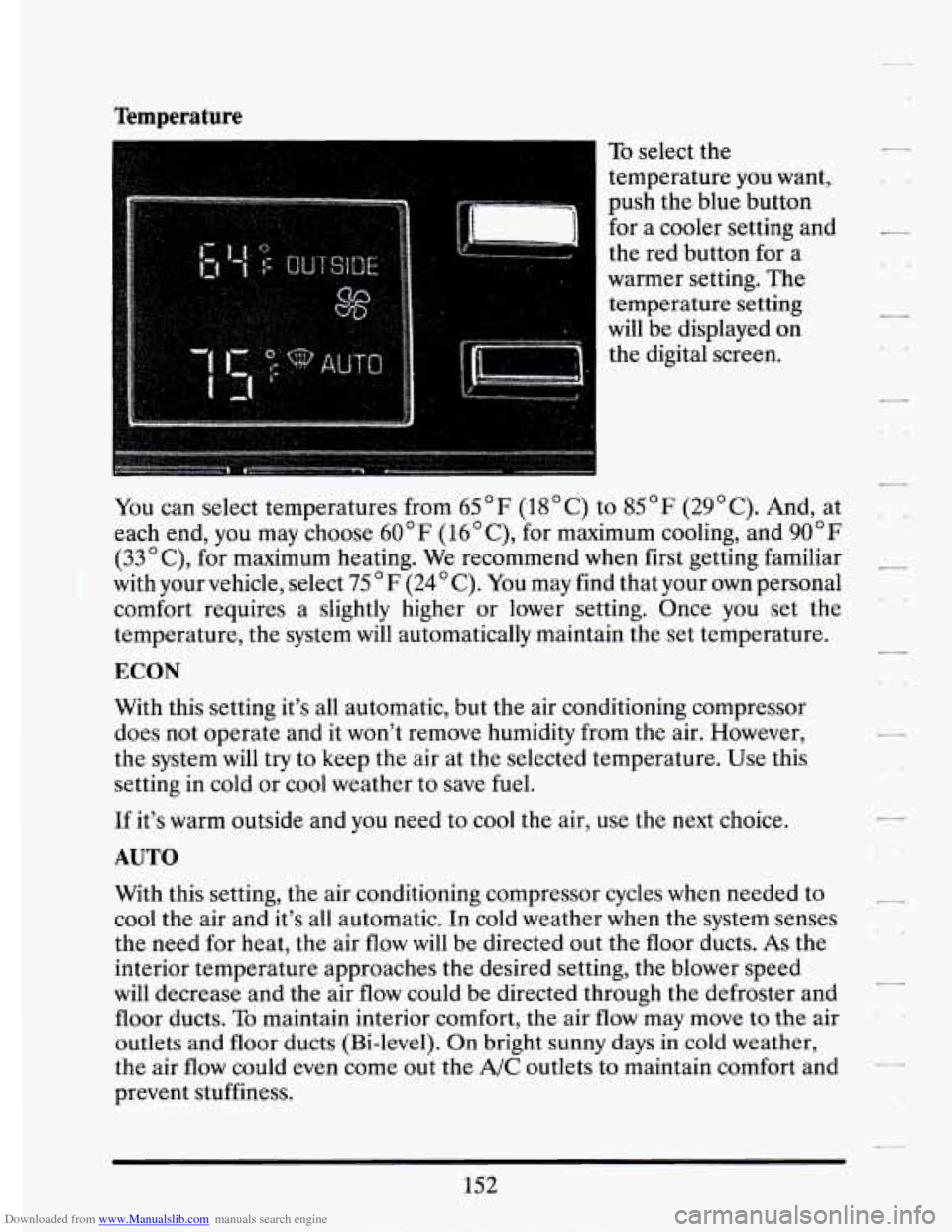
To select the
temperature you want,
push the blue button
for a cooler setting and
the red button for a
warmer setting. The
temperature setting
will be displayed on
the digital screen. -
c.
7
You can select temperatures from 65 "F (18°C) to 85°F (29°C). And, at
each end, you may choose
60 " F (16 " C), for maximum cooling, and 90" F
(33 " C), for maximum heating. We recommend when first getting familiar
with your vehicle, select
75 " F (24 " C). You may find that your own personal
comfort requires a slightly higher or lower setting. Once you set the
temperature, the system will automatically maintain the set temperature.
-
,.
ECON
With this setting it's all automatic, but the air conditioning compressor
does not operate and it won't remove humidity from the air. However,
the system will try to keep the air at the selected temperature. Use this
setting in cold or cool weather to save fuel.
If it's warm outside and you need to cool the air, use the next choice.
AUTO
With this setting, the air conditioning compressor cycles when needed to -_
cool the air and it's all automatic. In cold weather when the system senses
the need for heat,
the air flow will be directed out the floor ducts. As the
interior temperature approaches the desired setting, the blower speed
will decrease and the air
flow could be directed through the defroster and
floor ducts.
To maintain interior comfort, the air flow may move to the air
outlets and floor ducts (Bi-level). On bright sunny days in cold weather,
the air
flow could even come out the A/C outlets to maintain comfort and --
prevent stuffiness.
-
152
Page 191 of 398
Downloaded from www.Manualslib.com manuals search engine I
r
i .’
r
r
L
r
i
r I
Your vehicle has traction control system that limits wheel spin. This is
especially useful in slippery road conditions. The system operates only
if
it senses that one or both of the front wheels are spinning or- beginning to
lose traction. When .this happens, the system works the front brakes and
reduces engine power (by shutting
off fuel injectors) to limit wheel spin.
The “TRACTION ACTIVE” message will display on the Driver
Information Center when the traction control system is limiting wheel
spin. See “Driver Information Center Messages” in the Index. You may
feel the system working, or you may notice some noise, but this
is nomal.
If your vehicle is in cruise control when the traction control system begins
to limit wheel spin, the cruise control will automatically disengage. When
road conditions allow you to safely use it again, you may
turn the cruise
control back on. (See “Cruise Control” in the Index.)
The “TRACTION DISABLED” message
will display on the Driver
Information Center
if there’s a problem with your traction control system.
See “D,river Information Center Messages” in the Index. When. this
message is displayed, the system will not limit wheel spin. Adjust your
driving accordingly.
Braking in Emergencies
Use your anti-lock braking system when you need to. With anti-lock, you
can steer and brake at the same time. In many emergencies, steering can
help you more than even the very best braking.
179
Page 204 of 398
Downloaded from www.Manualslib.com manuals search engine Before changing lanes, check your mirrors. Then use your turn signal.
Just before you leave the lane, glance quickly over your shoulder to make
sure there isn’t another vehicle
in your “blind” spot.
Once you are moving
on the freeway, make certain you allow .a
reasonable following distance. Expect to move slightly slower at night.
When you want to leave the freeway, move to the proper lane well
in
advance. If you miss your exit do not, under any circumstances, stop and
back up. Drive
on to the next exit.
The exit ramp can be-curved, sometimes quite sharply.
The exit speed is usually posted.
Reduce your speed according to your speedometer, not
to your sense of
motion. After driving for any distance at higher speeds, you may tend to
think you are going slower than you actually are.
BEFORE LEAVTNG ONA LONG THP
Make sure you’re ready. Try to be well rested. If you must start when
you’re not fresh
-- such as after a day’s work -- don’t plan to make too
many miles that first part of the journey. Wear comfortable clothing and
shoes you can easily drive in.
Is your vehicle ready for a long trip? If you keep it serviced and
maintained, it’s ready to go. If it needs service, have it done before
-
starting out. Of course, you’ll find experienced and able service experts in
Cadillac dealerships all across North America. They’ll be ready and
willing to help
if you need it.
Here are some things
you can check before a trip:
Windshield Washer Fluid: Is the reservoir full? Are all windows clean
inside and outside?
Wiper Blades: Are they in good,shape?
Fuel, Engine Oil. Other Fluids: Have you checked all levels?
-.
192
Page 212 of 398

Downloaded from www.Manualslib.com manuals search engine Run your engine only as long as you must. This saves fuel. W\
hen you run
the engine, make it go a little faster than just idle. That is, push the
accelerator slightly. This uses less
fuel for the heat that you get and it
keeps the battery charged.
You will need a well-charged battery to restart
the vehicle, and possibly for signaling later
on with your headlights. Let
the heater run for awhile.
Then, shut the engine off and close the window almost all the way to
preserve the heat. Start the engine again and repeat this only when you
feel really uncomfortable from the cold. But do it as little as possible.
Preserve the fuel as long as you can. To help
keep warm, you can get out
of the vehicle and do some fairly vigorous exercises every half hour or
so
until help comes.
200
Page 213 of 398
Downloaded from www.Manualslib.com manuals search engine r
r
r
P
r
!
r I
r
r-
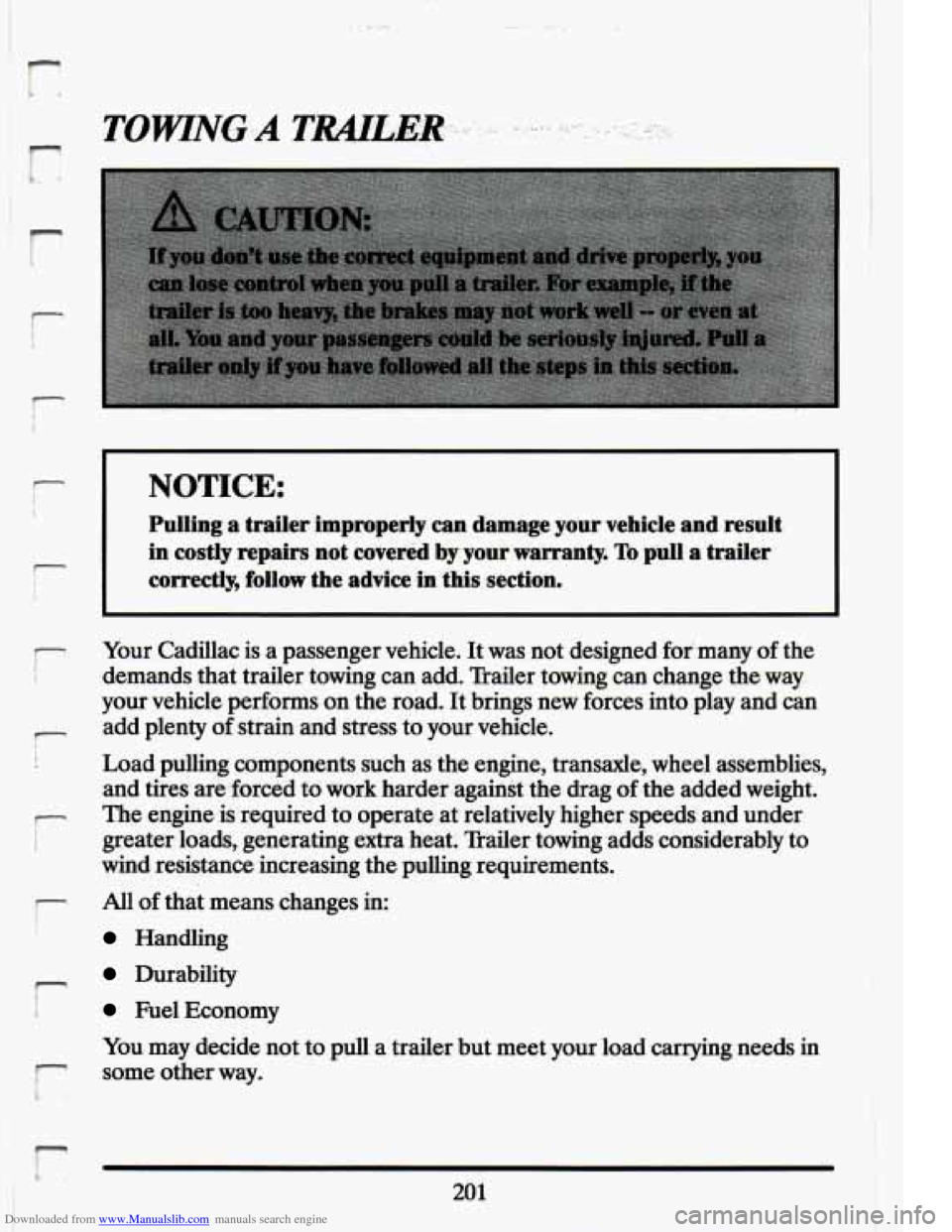
NOTICE:
Pulling a trailer improperly can damage your vehicle and result
in costly repairs not covered by your warranty. To pull a trailer
correctly, follow the advice
in this section.
Your Cadillac is a passenger vehicle. It was not designed for many of the
demands that trailer towing can add.. Trailer towing can change the way
your vehicle performs on the road. It brings new forces into play and can
add plenty
of strain and stress to your vehicle.
Load pulling components such as the engine, transaxle, wheel assemblies,
and tires are forced to work harder against the drag
of the added weight.
The engine is required to operate at relatively higher speeds and under
greater loads, generating extra heat. Trailer towing adds considerably to
wind resistance increasing the pulling requirements.
All
of that means changes in:
Handling
Durability
Fuel Economy
You may decide not to pull a trailer but meet your load carrying needs in
some other way.
201 I
I
Page 253 of 398
Downloaded from www.Manualslib.com manuals search engine r:
r
r
r
r r
r:
I SECTION 6
SERVICE AND APPEARANCE CARE
Here you will find information about the care of)your Cadillac. This
section begins with service and fuel information, and then it shows how to
check important fluid and lubricant levels. There is also technical
information about your vehicle, and a section devoted to its appearance
care.
SERWCE
Your Cadillac dealer knows your vehicle best and wants you to be happy
with it. We hope you’ll go to your dealer for all your service needs. You’ll
get genuine GM parts and GM-trained and supported service people.
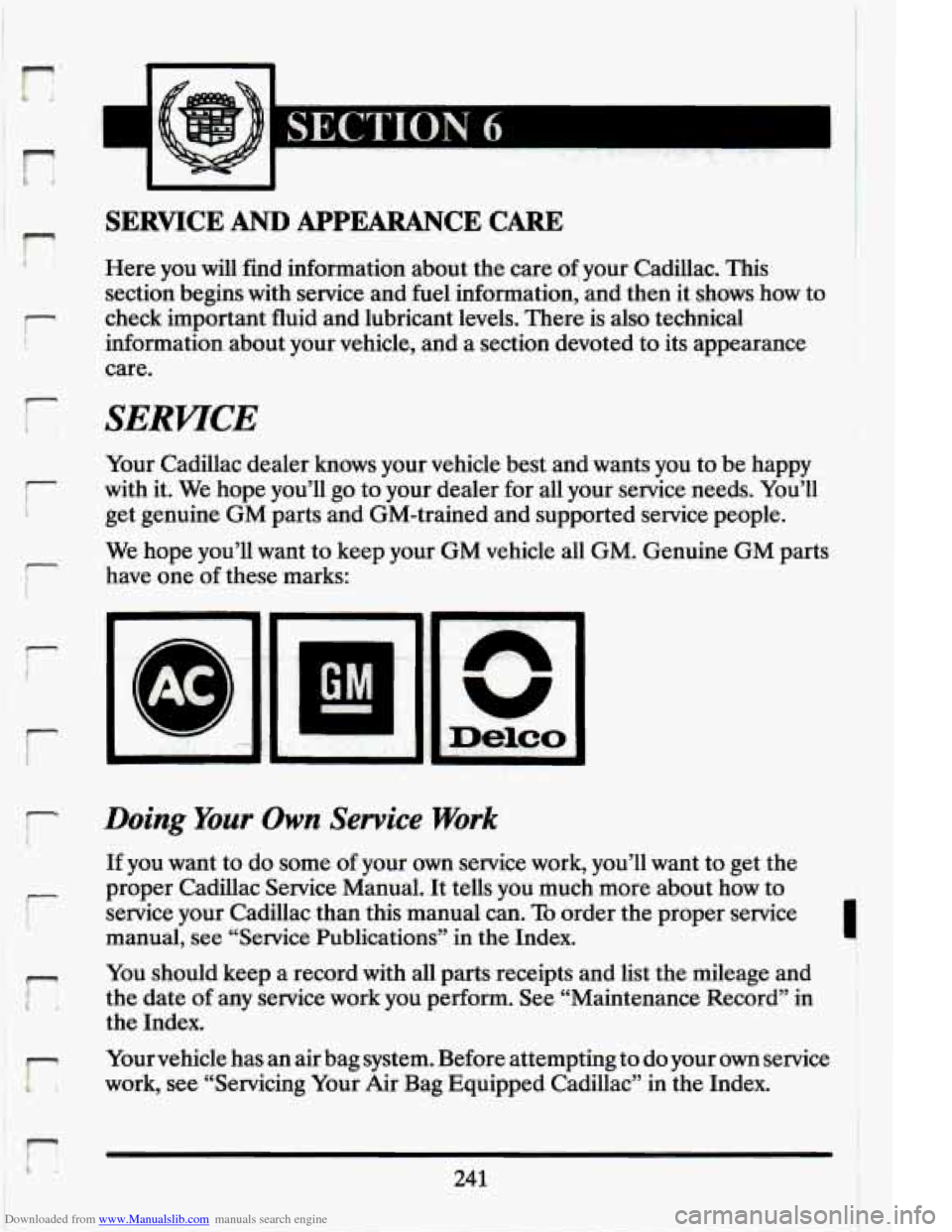
We hope you’ll want to keep your GM vehicle all GM. Genuine GM parts
have one of these marks:
GM
Doing Your Own Service Work
If you want to do some of your own service work, you’ll want to get the
proper Cadillac Service Manual. It tells you much more about how to
service your Cadillac than this manual can. To order the proper service
manual, see “Service Publications’’ in the Index.
You should keep a record with all parts receipts and list the mileage and
the date of any service work you perform. See “Maintenance Record” in
the Index.
Your vehicle has an air bag system. Before attempting to do your own service
work, see “Servicing Your Air Bag Equipped Cadillac” in the Index.
241
Page 254 of 398
Downloaded from www.Manualslib.com manuals search engine NOTICE:
If you try to do your own service work without knowing enough
about it,
your vehicle could be damaged.
FUEL
Use premium unleaded gasoline rated at 91 octane or higher. It should
meet specifications
ASTM D4814 in the U.S. and CGSB 3.5-92 in
Canada. These fuels should have the proper additives,
so you should not
have to add anything
to the fuel.
In the U.S. and Canada, it’s easy to be sure you get the right kind
of
gasoline (unleaded). You’ll see “UNLEADED” right on the pump. And
only unleaded nozzles will fit into your vehicle’s filler neck.
Be sure the posted octane is at least 91. If the octane is less than 91, you
may get a heavy knocking noise when
you drive. (In an emergency, you
may be able to use lower octane
-- as low as 87 -- if heavy knocking does
not occur.)
If you’re using 91 or higher octane unleaded gas and you still
get heavy knocking, your engine needs service.
242
-
L