Page 207 of 308
I NOTICE:
Compact Spare Tire
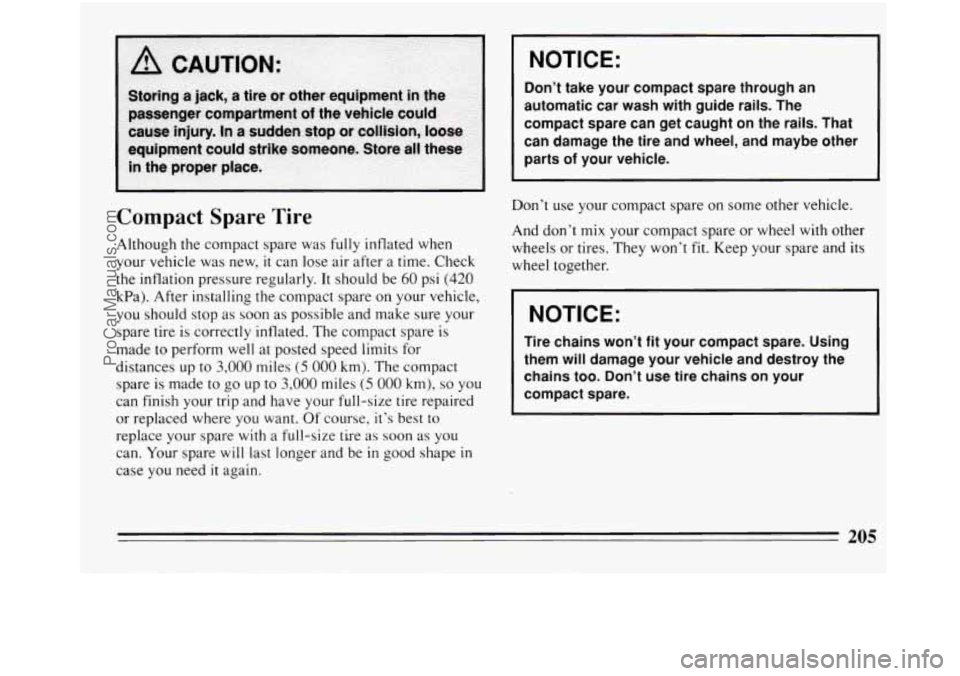
Although the compact spare was fully inflated when
your vehicle was new,
it can lose air after a time. Check
the inflation pressure regularly. It should be
60 psi (420
kPa). After installing the compact spare on your vehicle,
you should stop as soon as possible and make sure your
spare tire is correctly inflated. The compact spare
is
made to perform well at posted speed limits for
distances
up to 3,000 miles (5 000 km). The compact
spare is made to
go up to 3,000 miles (5 000 km), so you
can finish your trip and have
your full-size tire repaired
or replaced where you want. Of course, it’s best to
replace your spare with a full-size tire
as soon as you
can. Your spare will last longer and be
in good shape in
case you need it again.
Don’t take your compact spare through an
automatic car wash with guide rails. The
compact spare can get caught on the rails. That
can damage the tire and wheel, and maybe other
parts
of your vehicle.
Don’t use your compact spare on some other vehicle.
And don’t mix your compact spare or wheel with other
wheels or tires. They won’t fit. Keep your spare and its
wheel together.
NOTICE:
Tire chains won’t fit your compact spare. Using
them will damage your vehicle and destroy the
chains too. Don’t use tire chains on your
compact spare.
205
ProCarManuals.com
Page 208 of 308
If You’re Stuck: In Sand, Mud, Ice or
Snow
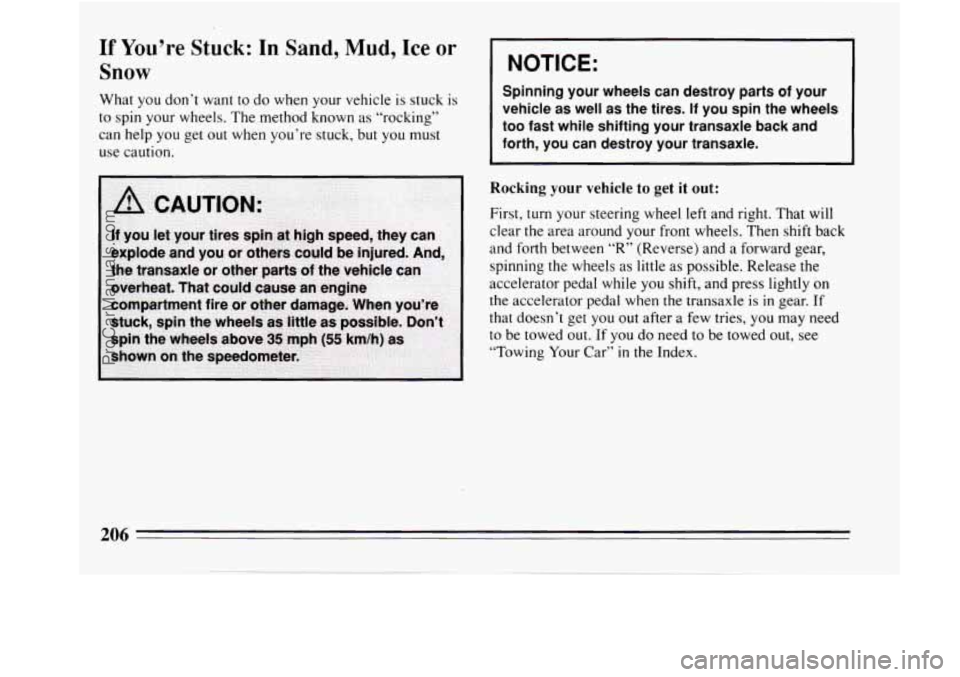
What you don’t want to do when your vehicle is stuck is
to spin your wheels. The method known as “rocking”
can help you get out
when you’re stuck, but you must
use caution.
I I
I NOTICE:
Spinning your wheels can destroy parts of your
vehicle as well
as the tires. If you spin the wheels
too fast while shifting your transaxle back and
forth, you can destroy your transaxle.
Rocking your vehicle to get it out:
~ First, turn your steering wheel left and right. That will
clear the area around your front wheels. Then shift back
and forth between
“R” (Reverse) and a forward gear,
spinning the wheels as little as possible. Release the
accelerator pedal while you shift, and press lightly on
the accelerator pedal when the transaxle
is in gear. If
that doesn’t get you out after a few tries, you may need
to be towed out. If you do need to be towed out, see
“Towing Your Car”
in the Index.
206
ProCarManuals.com
Page 231 of 308
What to Add
When you do need brake fluid, use only DOT-3 brake
fluid
-- such as Delco Supreme 11 @ (GM Part
No. 1052535). Use new brake fluid from a sealed
container only, and always clean the brake fluid
reservoir cap before removing
it.
I NOTICE:
Don’t let someone put in the wrong kind of
fluid. For example, just
a few drops of
mineral-based oil, such as engine oil, in
your brake system can damage brake
system parts
so badly that they’ll have to
be replaced.
@ Brake fluid can damage paint, so be careful
not to spill brake fluid on your vehicle.
If
you do, wash it off immediately. See
“Appearance Care’’
in the Index.
Brake Wear
Your Buick has four-wheel disc brakes.
Disc brake pads have built-in wear indicators that make
a high-pitched warning sound when the brake pads are
worn and new pads are needed. The sound may come
and go
or be heard all the time your vehicle is moving
(except when you are pushing on the brake pedal
firmly).
I NOTICE:
Continuing to drive with worn-out brake pads
could result
in costly brake repair.
229
ProCarManuals.com
Page 240 of 308
Tire Inspection and Rotation
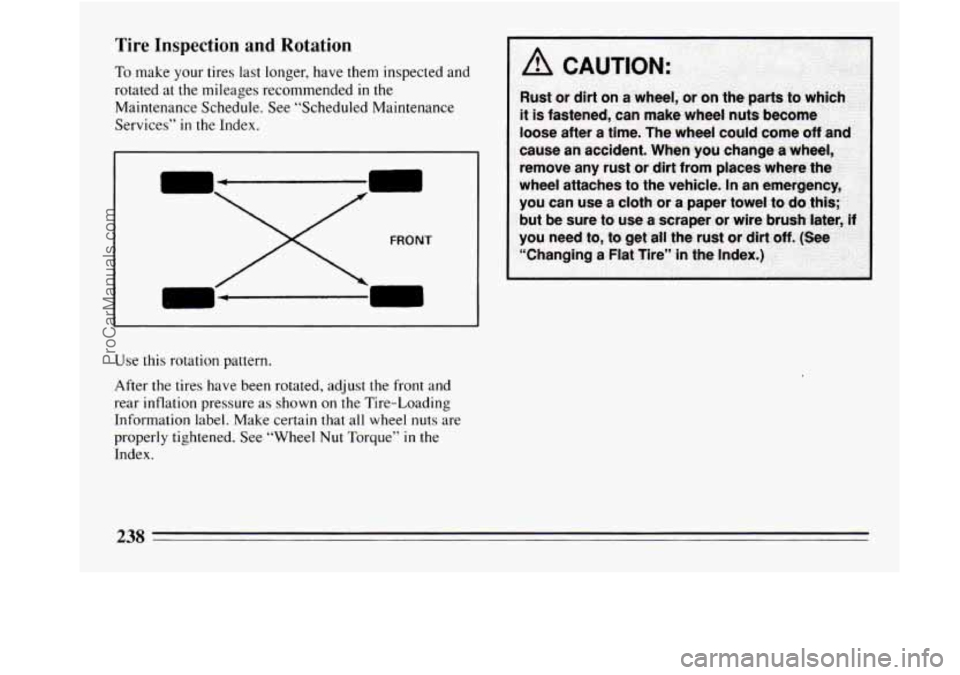
To make your tires last longer, have them inspected and
rotated at the mileages recommended
in the
Maintenance Schedule. See “Scheduled Maintenance
Services”
in the Index.
FRONT
Use this rotation pattern.
After the tires have been rotated, adjust the front and
rear inflation pressure as shown
on the Tire-Loading
Information label. Make certain that all wheel nuts are
properly tightened. See “Wheel Nut Torque”
in the
Index.
238
ProCarManuals.com
Page 243 of 308
Temperature - A, B, C
The temperature grades are A (the highest), B, and C,
representing the tire’s resistance to the generation of
heat and its ability
to dissipate heat when tested under
controlled conditions on a specified indoor laboratory
test wheel. Sustained high temperature can cause the
material of the tire
to degenerate and reduce tire life, and
excessive temperature can lead to sudden tire failure.
The grade
C corresponds to a level of performance
which all passenger car tires must meet under the
Federal Motor Vehicle Safety Standard
No. 109. Grades
B and A represent higher levels of performance on the
laboratory test
wheel than the minimum required by law.
Warning: The temperature grade for this tire is
established for a tire that is properly inflated and not
overloaded. Excessive speed, underinflation, or
excessive loading, either separately or
in combination,
can cause heat buildup and possible tire failure.
These grades are molded on
the sidewalls of passenger
car tires. While the tires
available as standard or optional
equipment
on General Motors vehicles may vary with
respect to these grades, all such tires meet General
Motors performance standards and have been approved
for use on General Motors vehicles. All passenger type
(P Metric) tires must conform to Federal safety
requirements
in addition to these grades.
Wheel Alignment and Tire Balance
The wheels on your vehicle were aligned and balanced
carefully at the factory to give you the longest tire life
and best overall performance.
In most cases, you will not need to have your wheels
aligned again. However,
if you notice unusual tire wear
or your vehicle pulling one way or the other, the
alignment may need to be reset. If you notice your
vehicle vibrating when driving on a smooth road, your
wheels may need to be rebalanced.
241
ProCarManuals.com
Page 244 of 308
Wheel Replacement
Replace any wheel that is bent, cracked or badly rusted.
If wheel nuts keep coming loose, the wheel, wheel bolts,
and wheel nuts should be replaced. If the wheel leaks
air, replace
it (except some aluminum wheels, which can
sometimes be repaired). See your Buick dealer
if any of
these conditions exist.
Your dealer will know the kind of wheel you need.
Each new wheel should have the same load carrying
capacity, diameter, width, offset, and be mounted the
same way as the one it replaces.
If you need to replace any of your wheels, wheel bolts,
or wheel nuts, replace them only with new
GM original
equipment parts. This way, you will be sure
to have the
right wheel, wheel bolts, and wheel nuts for your Buick
model. NOTICE:
The wrong wheel can also cause problems with
bearing life, brake cooling,
speedometer/odometer calibration, headlight
aim, bumper height, vehicle ground clearance,
and tire or tire chain clearance to the body and
chassis.
242
ProCarManuals.com
Page 245 of 308
Used Replacement Wheels Tire Chains
NOTICE:
If your Buick has P215/60R16 or P225/60R16 size
tires, don’t use tire chains; they can damage
your vehicle.
If you have other tires, use tire chains only where
legal and only when you must.
Use only SAE
Class “S” type chains that are the proper size for
your tires. Install them on the front tires and
tighten them as tightly as possible with the ends
securely fastened. Drive slowly and follow the
chain manufacturer’s instructions.
If you can
hear the chains contacting your vehicle, stop and
retighten them. If the contact continues, slow
down until
it stops. Driving too fast with chains
on will damage your vehicle.
243
ProCarManuals.com
Page 251 of 308
I NOTICE:
Machine compounding or aggressive polishing
on a basecoat/clearcoat paint finish may dull the
finish or leave swirl marks.
Aluminum Wheels (If So Equipped)
Your aluminum wheels have a protective coating similar
to
the painted surface of your car. Don’t use strong
soaps, chemicals, chrome polish, abrasive cleaners or
abrasive cleaning brushes
on them because you could
damage this coating. After rinsing thoroughly, a wax
may be applied.
If you have aluminum wheels, don’t use an
automatic vehicle wash that has hard silicon
carbide cleaning brushes. These brushes can
take off the protective coating.
White Sidewall Tires
Your Buick dealer has a GM White Sidewall Tire
Cleaner. You can use a stiff brush
with the cleaner.
Weatherstrips
Silicone grease on weatherstrips will make them last
longer, seal better, and not stick or squeak. Apply
silicone grease with a clean cloth at least every six
months. During very cold, damp weather more frequent
application may be required. (See “Recommended
Fluids
& Lubricants” in the Index.)
Sheet Metal Damage
If your vehicle is damaged and requires sheet metal
repair or replacement, make sure the body repair shop
applies anti-corrosion material to the parts repaired or
replaced to restore corrosion protection.
249
ProCarManuals.com