1994 BUICK REGAL light
[x] Cancel search: lightPage 131 of 308
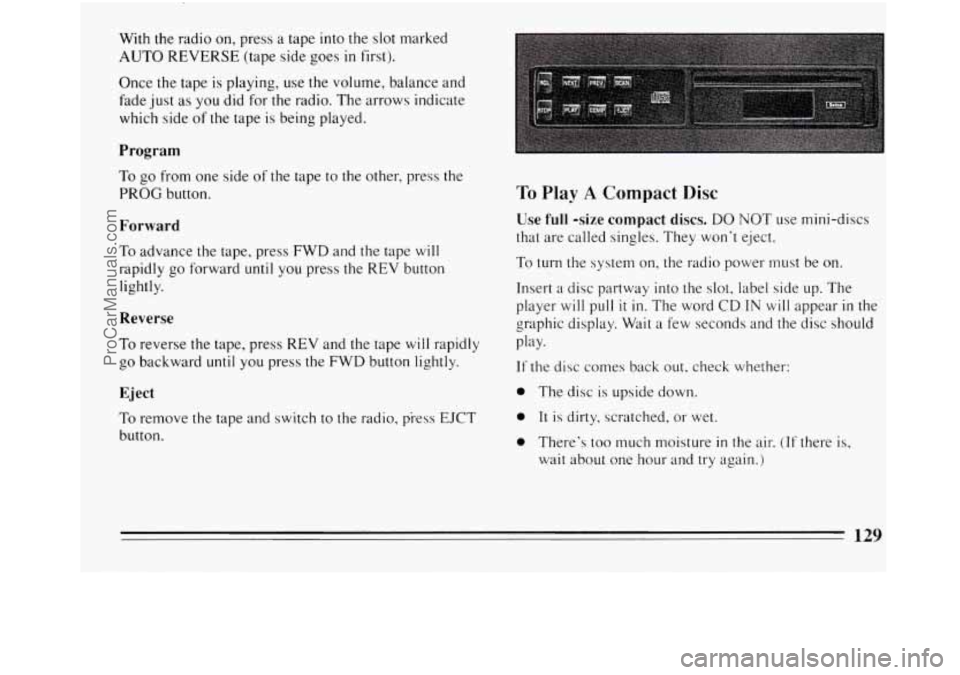
With the radio on, press a tape into the slot marked
AUTO REVERSE (tape side goes in first).
Once the tape is playing, use the volume, balance and
fade just
as you did for the radio. The arrows indicate
which side
of the tape is being played.
Program
To go from one side of the tape to the other, press the
PROG button.
Forward
To advance the tape, press FWD and the tape will
rapidly go forward until you press the REV button
lightly.
Reverse
To reverse the tape, press REV and the tape will rapidly
go backward until you press the FWD button lightly.
Eject
To remove the tape and switch to the radio, press EJCT
button.
To Play A Compact Disc
Use full -size compact discs. DO NOT use mini-discs
that are called singles. They won’t eject.
To turn the system on, the radio power must be on.
Insert a disc partway into the slot, label side up. The
player will pull
it in. The word CD IN will appear in the
graphic display. Wait a few seconds and the disc should
Play-
If the disc comes back out. check whether:
0 The disc is upside down.
0 It is dirty, scratched, or wet.
0 There’s too much moisture in the air. (If there is,
wait about one hour and try again.)
129
ProCarManuals.com
Page 133 of 308
Tune
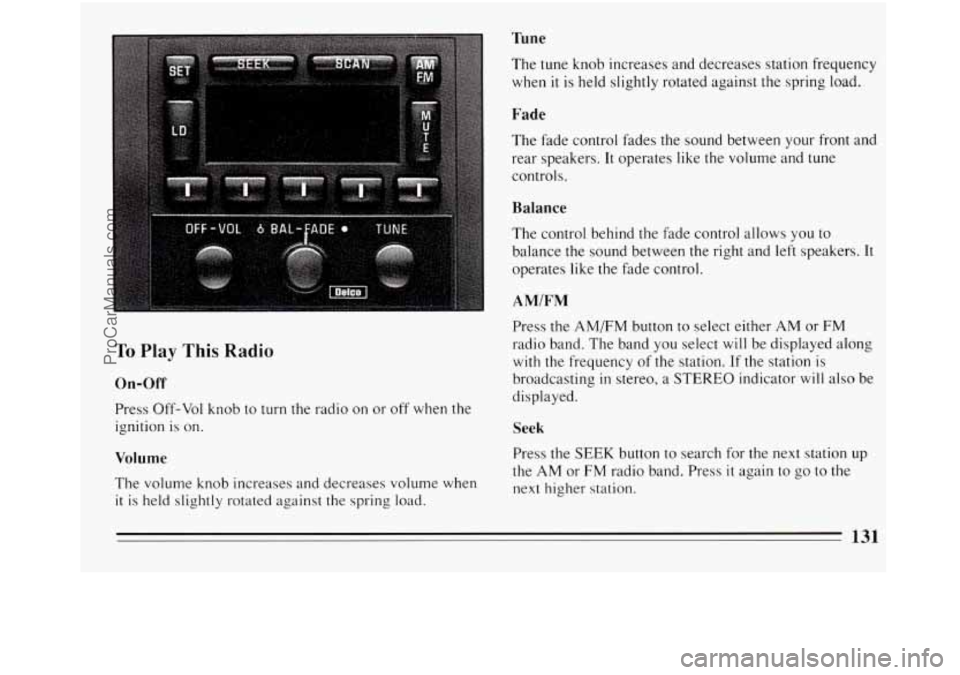
To Play This Radio
On-Off
Press Off-Vol knob to turn the radio on or off when the
ignition is on.
Volume
The volume knob increases and decreases volume when
it is held slightly rotated against the spring load. The tune knob increases
and decreases station frequency
when it is held slightly rotated against the spring load.
Fade
The fade control fades the sound between your front and
rear speakers.
It operates like the volume and tune
controls.
Balance
The control behind the fade control allows you to
balance the sound between the right and left speakers. It
operates like the fade control.
AMIFM
Press the AMEM button to select either AM or FM
radio band. The band you select will be displayed along
with the frequency of the station. If the station is
broadcasting
in stereo, a STEREO indicator will also be
displayed.
Seek
Press the SEEK button to search for the next station up
the AM or FM radio band. Press
it again to go to the
next higher station.
131
ProCarManuals.com
Page 137 of 308
Care of Your Cassette Tape Player
A tape player that is not cleaned regularly can cause
reduced sound quality, ruined cassettes, or a damaged
mechanism. Cassette tapes should be stored in their
cases away from contaminants, direct sunlight, and
extreme heat. If
they aren't, they may not operate
properly or cause failure of the tape player.
Your tape player should be cleaned regularly each
month or after every
15 hours of use. If you notice a
reduction in sound quality, try
a known good cassette to
see if the tape or the tape player is at fault. If this other
cassette has no improvement in sound quality, clean the
tape player.
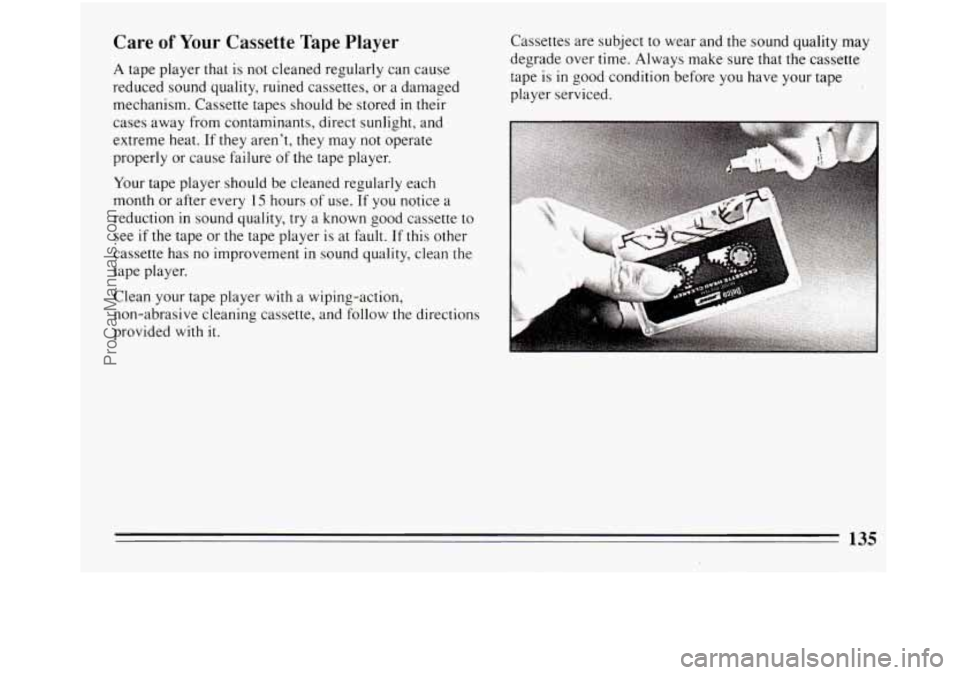
Clean your tape player
with a wiping-action,
non-abrasive cleaning cassette, and follow the directions
provided with
it.
Cassettes are subject to wear and the sound quality may
degrade over time. Always make sure that the cassette
tape is
in good condition before you have your tape
player serviced.
135
ProCarManuals.com
Page 138 of 308
Care of Your Compact Discs
Handle discs carefully. Store them in their original cases
or other protective cases and away from direct sunlight
and dust. If the surface of a disc
is soiled, dampen a
clean, soft cloth
in a mild, neutral detergent solution and
clean
it, wiping from the center to the edge.
Be sure never to touch the signal surface when handling
discs. Pick up discs by grasping the outer edges or the
edge of the hole and the outer edge.
Fixed Mast Antenna
The fixed mast antenna can withstand most car washes
without being damaged. If the mast should ever become
slightly bent, you can straighten
it out by hand. If the
mast
is badly bent, as it might be by vandals, you should
replace
it.
Check every once in a while to be sure the mast is still
tightened to the fender.
If necessary, tighten the antenna
with your hand until
snug and then use a wrench to tighten it another 1/4 of a
turn.
Power Antenna Mast Care
Your power antenna will look its best and work well if
it’s cleaned from time
to time.
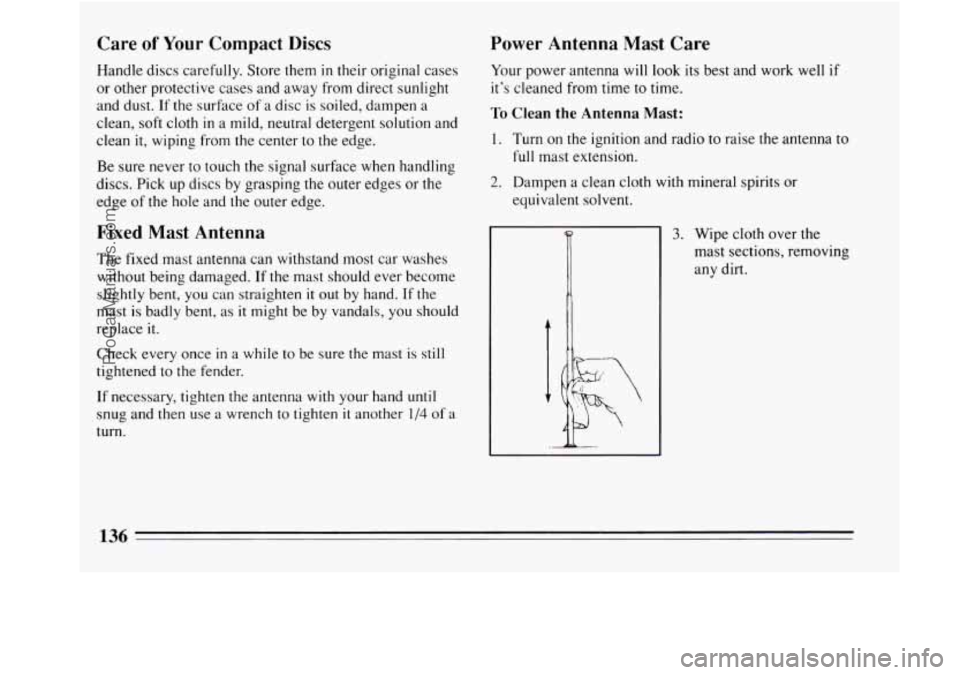
To Clean the Antenna Mast:
1. Turn on the ignition and radio to raise the antenna to
full mast extension.
2. Dampen a clean cloth with mineral spirits or
equivalent solvent.
3. Wipe cloth over the
mast sections, removing
any dirt.
136
ProCarManuals.com
Page 144 of 308
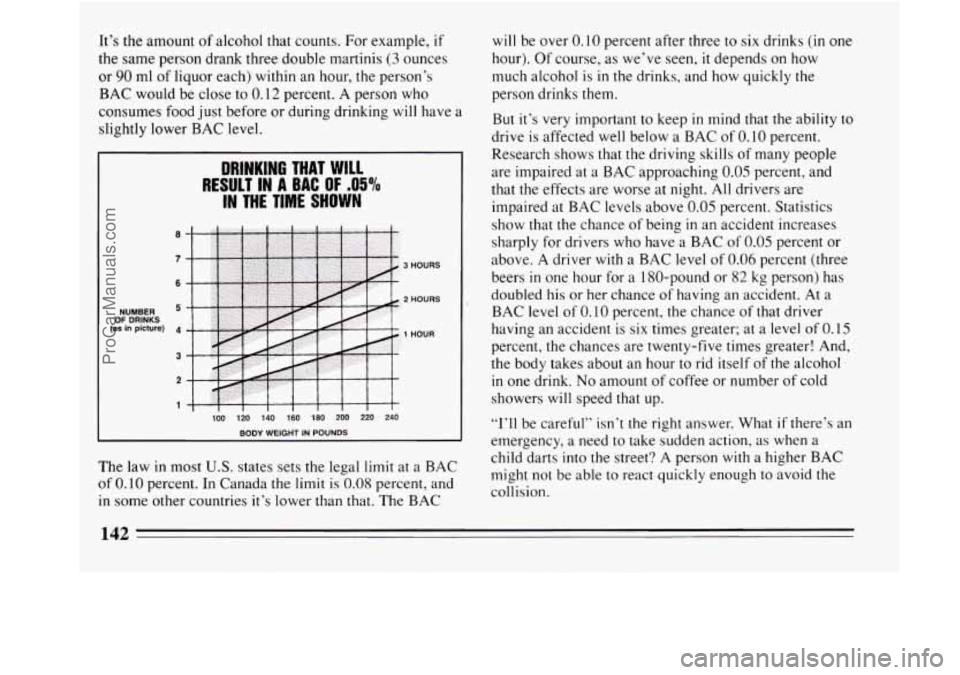
It’s the amount of alcohol that counts. For example, if
the same person drank three double martinis (3 ounces
or
90 ml of liquor each) within an hour, the person’s
BAC would be close to 0.12 percent. A person who
consumes food just before or during drinking will have a
slightly lower BAC level.
OF DRINKS
NUMBER (as in picture)
100 120 140 160 180 200 220 240
BODY WEIGHT IN
POUNDS
DRINKING THAT WILL
RESULT IN A BAG OF .05%
IN THE TIME SHOWN
HOURS
HOURS
HOUR
The law in most U.S. states sets the legal limit at a BAC
of
0.10 percent. In Canada the limit is 0.08 percent, and
in some other countries it’s lower than that. The BAC will be
over 0.10 percent after three to six drinks (in one
hour). Of course, as we’ve seen,
it depends on how
much alcohol is
in the drinks, and how quickly the
person drinks them.
But it’s very important to keep
in mind that the ability to
drive is affected well below a BAC of 0.10 percent.
Research shows that the driving skills of many people
are impaired at a BAC approaching
0.05 percent, and
that the effects are worse at night. All drivers are
impaired at BAC levels above
0.05 percent. Statistics
show that the chance of being
in an accident increases
sharply for drivers who have a BAC of
0.05 percent or
above. A driver with a BAC level of
0.06 percent (three
beers
in one hour for a 180-pound or 82 kg person) has
doubled his or her chance
of having an accident. At a
BAC level of 0.10 percent, the chance of that driver
having an accident is six times greater; at a level of
0.15
percent, the chances are twenty-five times greater! And,
the body takes about an hour to rid itself of the alcohol
in one drink. No amount of coffee or number of cold
showers
will speed that up.
“I’ll be careful” isn’t the right answer. What
if there’s an
emergency,
a need to take sudden action, as when a
child darts into the street? A person
with a higher BAC
might not be able to react quickly enough to avoid the
collision.
142
ProCarManuals.com
Page 147 of 308
Anti-Lock Brakes (ABS)
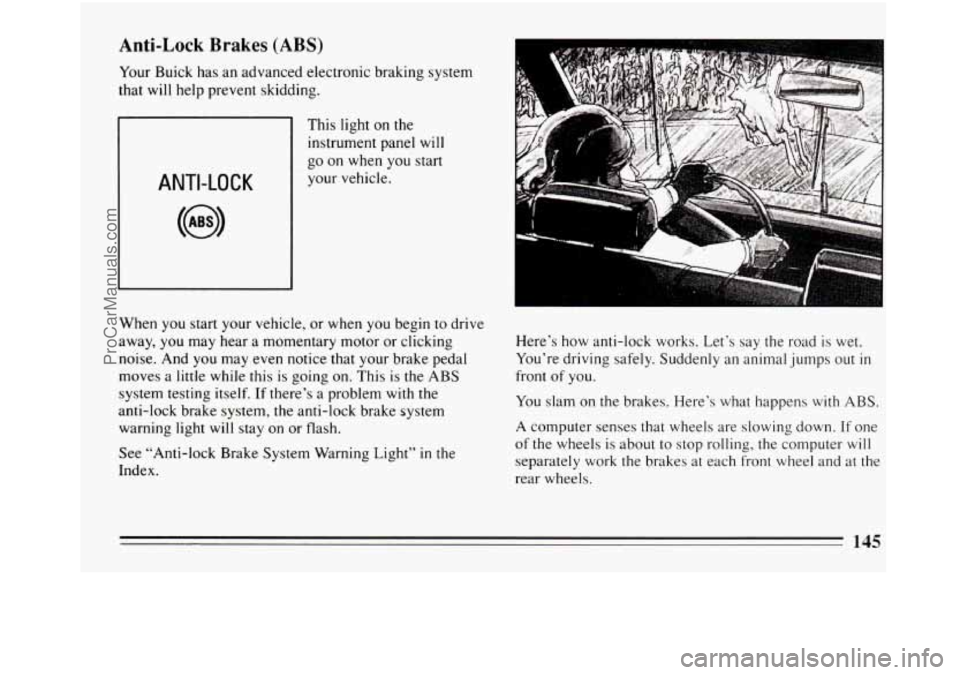
Your Buick has an advanced electronic braking system
that will help prevent skidding.
ANTI-LOCK
This light on the
instrument panel will
go on when you start
your vehicle.
When you start your vehicle, or when you begin to drive
away, you may hear a momentary motor or clicking
noise. And
you may even notice that your brake pedal
moves a little while this is going on. This is the
ABS
system testing itself. If there’s a problem with the
anti-lock brake system, the anti-lock brake system
warning light
will stay on or flash.
See “Anti-lock Brake System Warning Light”
in the
Index. Here’s how
anti-lock works. Let’s say the road is wet.
You’re driving safely. Suddenly an animal jumps out
in
front of you.
You slam on the brakes. Here’s what happens
with ABS.
A computer senses that wheels are slowing down. If one
of the wheels
is about to stop rolling, the computer will
separately work the brakes at each front wheel and at the
rear wheels.
145
ProCarManuals.com
Page 151 of 308
Off-Road Recovery
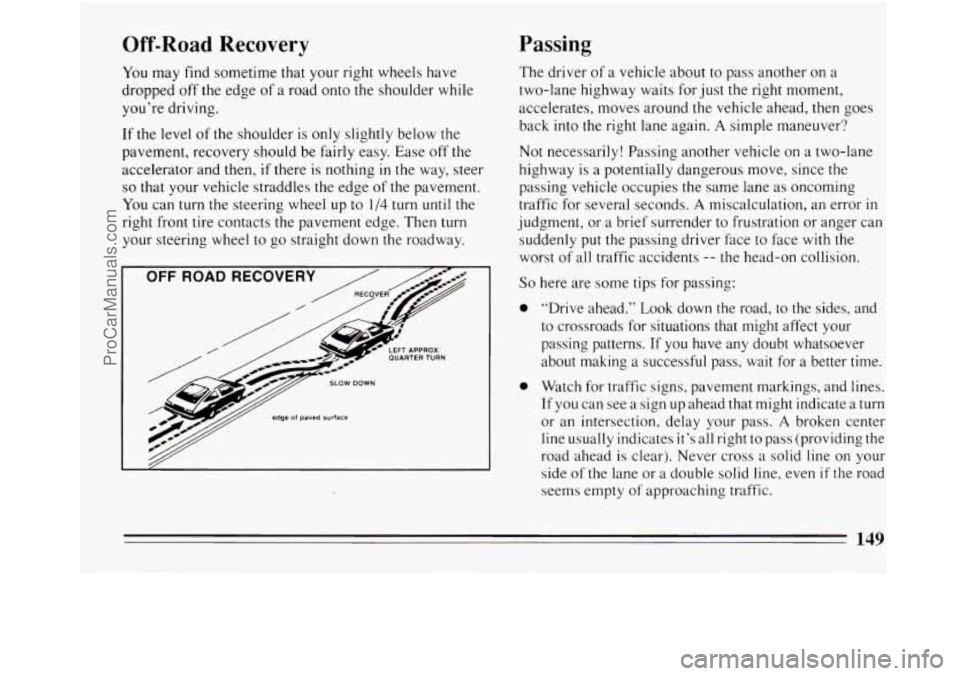
You may find sometime that your right wheels have
dropped off the edge
of a road onto the shoulder while
you’re driving.
If the level of the shoulder is only slightly below the
pavement, recovery should be fairly easy. Ease off the
accelerator and then,
if there is nothing in the way, steer
so that your vehicle straddles the edge of the pavement.
You can turn
the steering wheel up to 1/4 turn until the
right front tire contacts the pavement edge. Then turn
your steering wheel to
go straight down the roadway.
I I / ,.e-
l
Passing
The driver of a vehicle about to pass another on a
two-lane highway waits for just the right moment,
accelerates, moves around the vehicle ahead, then goes
back into the right lane again.
A simple maneuver?
Not necessarily! Passing another vehicle on a two-lane
highway is a potentially dangerous move, since the
passing vehicle occupies the same lane as oncoming
traffic for several seconds.
A miscalculation, an error in
judgment, or a brief surrender to frustration or anger can
suddenly put the passing driver face to face with the
worst of all traffic accidents
-- the head-on collision.
So here are some tips for passing:
0 “Drive ahead.” Look down the road, to the sides, and
to crossroads for situations that might affect your
passing patterns. If you have any doubt whatsoever
about making a successful pass, wait for a better time.
0 Watch for traffic signs, pavement markings, and lines.
If you can see a sign up ahead that might indicate a turn
or an intersection, delay your pass.
A broken center
line usually indicates it’s all right to pass (providing the
road ahead is clear). Never cross
a solid line on your
side of the lane or a double solid line, even
if the road
seems empty of approaching traffic.
149
ProCarManuals.com
Page 152 of 308
Do not get too close to the vehicle you want to pass
while you’re awaiting an opportunity. For one thing,
following too closely reduces your area of vision,
especially if you’re following a larger vehicle. Also,
you won’t have adequate space if the vehicle ahead
suddenly slows or stops. Keep back a reasonable
distance.
0 When it looks like a chance to pass is coming up,
start
to accelerate but stay in the right lane and don’t
get too close. Time.your move
so you will be
increasing speed as the time comes to move into the
other lane. If the way is clear
to pass, you will have a
“running start” that more than makes up for
the
distance you would lose by dropping back. And if
something happens to cause
you to cancel your pass,
you need only slow down and drop back again and
wait for another opportunity.
0 If other cars are lined up to pass a slow vehicle, wait
your turn. But take care that someone isn’t trying to
pass you as
you pull out to pass the slow vehicle.
Remember to glance over your shoulder and check
the blind spot.
Check your mirrors, glance over your shoulder, and
start your left lane change signal before moving out
of the right lane to pass. When you are far enough
ahead of the passed vehicle to see its front in you:
inside mirror, activate your right lane change signal
and move back into the right lane. (Remember that
your right outside mirror is convex. The vehicle you
just passed may seem to be farther away from
you
than it really is.)
Try not to pass more than one vehicle at a time on
two-lane roads. Reconsider before passing the next
vehicle.
0 Don’t overtake a slowly moving vehicle too rapidly.
Even though the brake lights are not flashing,
it may
be slowing down or starting to turn.
If you’re being passed, make it easy for the
following driver to get ahead of you. Perhaps you
can ease a little
to the right.
ProCarManuals.com