Page 223 of 308
Wait at least 30 minutes before checking the transaxle
fluid level if you have been driving:
0 When outside temperatures are above 90°F (32°C).
0 At high speed for quite a while.
In heavy traffic -- especially in hot weather.
0 While pulling a trailer.
To get the right reading, the fluid should be at normal
operating temperature, which is
180°F to 200°F (82°C
to 93°C).
Get the vehicle warmed up by driving about 15 miles
(24 km) when outside temperatures are above 50°F
(10°C).
If it’s colder than 50°F (lO”C), you may have
to drive longer.
To check the fluid level
Park your vehicle on a level place.
0 With the parking brake applied, place the shift lever
0 With your foot on the brake pedal, move the shift
in “P” (Park).
lever through each gear range, pausing for about three seconds
in each range. Then, position the shift
lever
in “P” (Park).
0 Let the engine run at idle for three to five minutes.
Then, without shutting off the engine. follow these
steps:
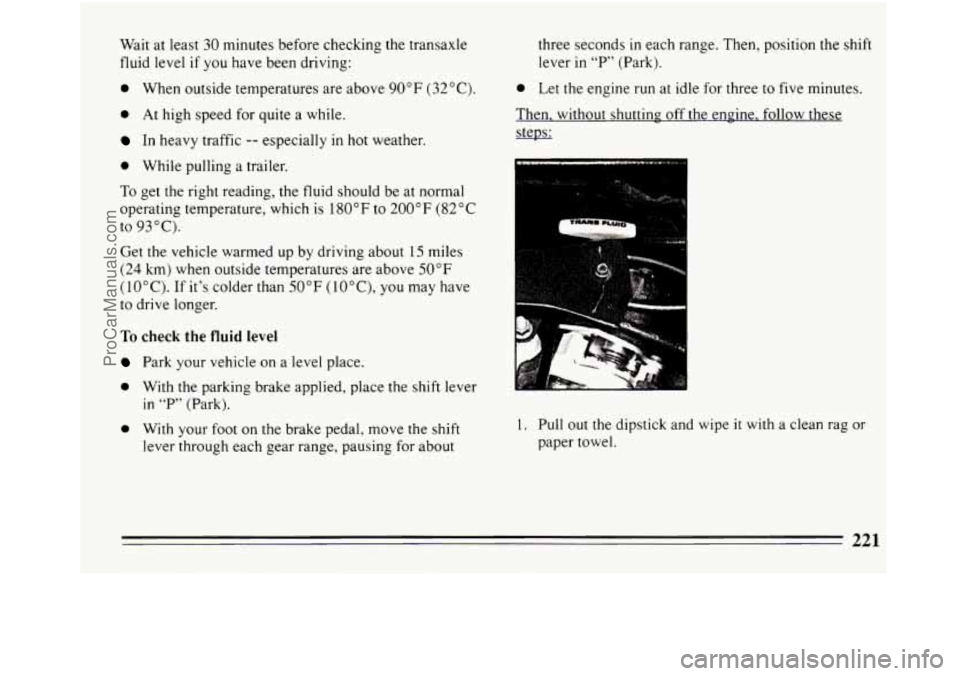
1. Pull out the dipstick and wipe it with a clean rag or
paper towel.
ProCarManuals.com
Page 230 of 308
Brakes
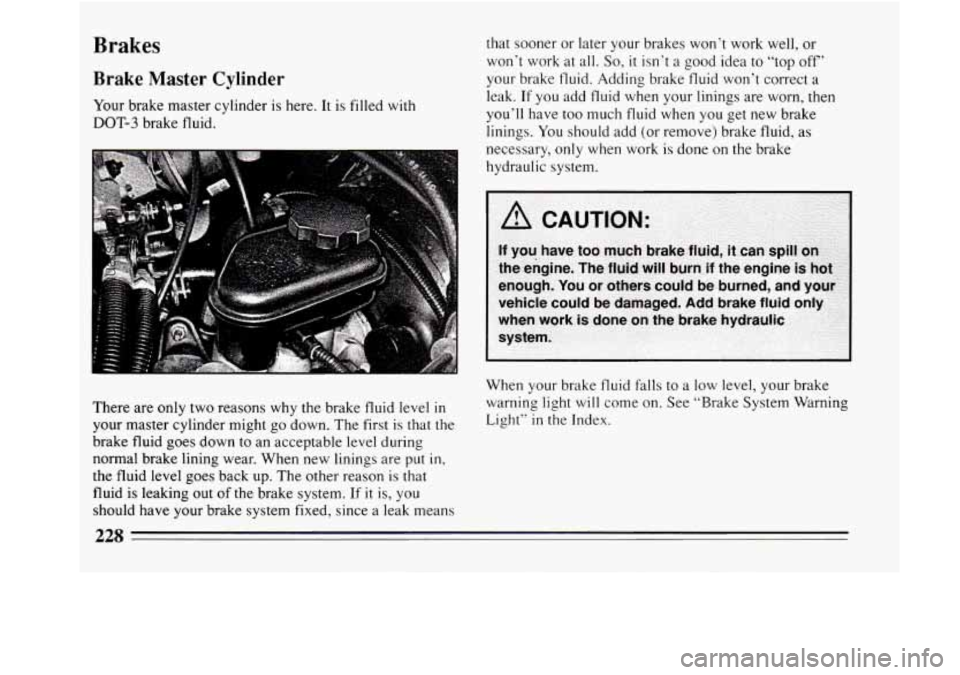
Brake Master Cylinder
Your brake master cylinder is here. It is filled with
DOT-3 brake fluid. that
sooner or later your brakes won’t work well, or
won’t work at all.
So, it isn’t a good idea to “top off’
your brake fluid. Adding brake fluid won’t correct a
leak. If you add fluid when your linings are worn, then
you’ll have too much fluid when you get new brake
linings. You should add (or remove) brake fluid, as
necessary, only when work is done on the brake
hydraulic system.
When your brake fluid falls to a low level, your brake
There are only two reasons why
the brake fluid level in warning light will come on. See “Brake System Warning
your master cylinder might
go down. The first is that the Light” in the Index.
brake fluid goes down to an acceptable level during
normal brake lining wear. When new linings are
put in,
the fluid level goes back up. The other reason is that
fluid is leaking out
of the brake system. If it is, you
should have your brake system fixed, since a leak means
228
ProCarManuals.com
Page 231 of 308
What to Add
When you do need brake fluid, use only DOT-3 brake
fluid
-- such as Delco Supreme 11 @ (GM Part
No. 1052535). Use new brake fluid from a sealed
container only, and always clean the brake fluid
reservoir cap before removing
it.
I NOTICE:
Don’t let someone put in the wrong kind of
fluid. For example, just
a few drops of
mineral-based oil, such as engine oil, in
your brake system can damage brake
system parts
so badly that they’ll have to
be replaced.
@ Brake fluid can damage paint, so be careful
not to spill brake fluid on your vehicle.
If
you do, wash it off immediately. See
“Appearance Care’’
in the Index.
Brake Wear
Your Buick has four-wheel disc brakes.
Disc brake pads have built-in wear indicators that make
a high-pitched warning sound when the brake pads are
worn and new pads are needed. The sound may come
and go
or be heard all the time your vehicle is moving
(except when you are pushing on the brake pedal
firmly).
I NOTICE:
Continuing to drive with worn-out brake pads
could result
in costly brake repair.
229
ProCarManuals.com
Page 232 of 308
Some driving conditions or climates may cause a brake
squeal when the brakes are first applied or
lightly
applied. This does not mean something is wrong with
your brakes.
Brake linings should always be replaced as complete
axle sets.
Brake Pedal Travel
See your dealer if the brake pedal does not return to
normal height, or if there is a rapid increase in pedal
travel. This could
be a sign of brake trouble.
Brake Adjustment
Every time you make a moderate brake stop, your disc
brakes adjust for wear. If you rarely make a moderate .or
heavier siop, then your brakes might not adjust
correctly. If you drive
in that way, then -- very carefully
-- make a few moderate brake stops about every 1000
miles (1600 km), so your brakes will adjust properly.
Keplacing Brake System Parts
The braking system on a modern vehicle is complex. Its
many parts have to be
of top quality and work well
together
if the vehicle is to have really good braking. Vehicles we
design and test have top-quality
GM brake
parts
in them, as your Buick does when it is new. When
you replace parts of your braking system
-- for example,
when your brake linings wear down and you have
to
have new ones put in -- be sure you get new genuine
GM replacement parts. If you don’t, your brakes may no
longer work properly. For example,
if someone puts in
brake linings that are wrong for your vehicle, the
balance between your front and rear brakes can change,
for the worse. The braking performance you’ve come
to
expect can change in many other ways if someone puts
in the wrong replacement brake parts.
Battery
Every new Buick has a Delco Freedom@ battery. You
never have to add water to one of these. When it’s time
for a new battery, we recommend a Delco Freedom@
battery. Get one that has the catalog number shown on
the original battery’s label.
Vehicle Storage
If you’re not going to drive your vehicle for 25 days or
more, take off the black, negative
(-) cable from the
battery. This
will help keep your battery from running
down.
230
ProCarManuals.com
Page 244 of 308
Wheel Replacement
Replace any wheel that is bent, cracked or badly rusted.
If wheel nuts keep coming loose, the wheel, wheel bolts,
and wheel nuts should be replaced. If the wheel leaks
air, replace
it (except some aluminum wheels, which can
sometimes be repaired). See your Buick dealer
if any of
these conditions exist.
Your dealer will know the kind of wheel you need.
Each new wheel should have the same load carrying
capacity, diameter, width, offset, and be mounted the
same way as the one it replaces.
If you need to replace any of your wheels, wheel bolts,
or wheel nuts, replace them only with new
GM original
equipment parts. This way, you will be sure
to have the
right wheel, wheel bolts, and wheel nuts for your Buick
model. NOTICE:
The wrong wheel can also cause problems with
bearing life, brake cooling,
speedometer/odometer calibration, headlight
aim, bumper height, vehicle ground clearance,
and tire or tire chain clearance to the body and
chassis.
242
ProCarManuals.com
Page 257 of 308

Fuse Block
Amp Description
1.
2.
10
10
3. 20
4.
2s
5. IO
6. 15
7. 15
8. 1s
9. 20
10.
1s
11. 5
12. 1s
13. 15 Radio
& Clock, Steering
Wheel Radio Switches.
Headlight Switch, Air Bag Diagnostic Module, ABS
Lamp Driver Module, Daytime Running Lamps
Module (w/DRL), TCC/Brake Switch, Cruise
Control Cut-Out Switch, Instrument Cluster, Chime
Module, Rear Defogger Timer Relay
A/C HI Blower Relay
Wipermasher Switch
Turn Signal Flasher
TCC/Brake Switch, Hazard Flasher
Vanity Mirror, Lights, I/P Compartment Light,
Courtesy Lights, Trunk Courtesy Light,
Dome/Reading Lights, Cigar Lighter.
Air Bag Diagnostic Module
Power Door Locks, Remote Keyless Entry System
Cigar Lighter
Theft Deterrent Decoder Module
Heater, Vent A/C Solenoid Box, A/C LO Blower
Relay
Chime Module, Electronic Brake Control Module.
Theft Deterrent Decoder Module, Radio, Passive
Restraint Timer Relay, Low Oil Level Module
1s.
Amp Description
14. 15 Air Temperature Valve Motors, Instrument Cluster,
Daytime Running Lights Module (w/DRL), HVAC
Control Assembly, Multi-Function Lever, Heated
Oxygen Sensor
#2, Passenger Temperature Control
Electrical Center
#2, ABS Relay
16. 10 Antenna Relay, Outside Mirror Control, Front
Window/Door Lock Switches, Front Door Handle
Switches
17.
Not Used
18. 5 Air Bag Diagnostic Module
5 Electronic Brake Control Module, Underhood
n
CTSY ARBGl DRLKS
@m@
ClLTR VATS HVAC
This fuse panel is inside the
glove
box. Pull the cover
down to access the
fuses.
Some spare fuses and a fuse
puller are included.
255
ProCarManuals.com
Page 258 of 308
30
30
30
20
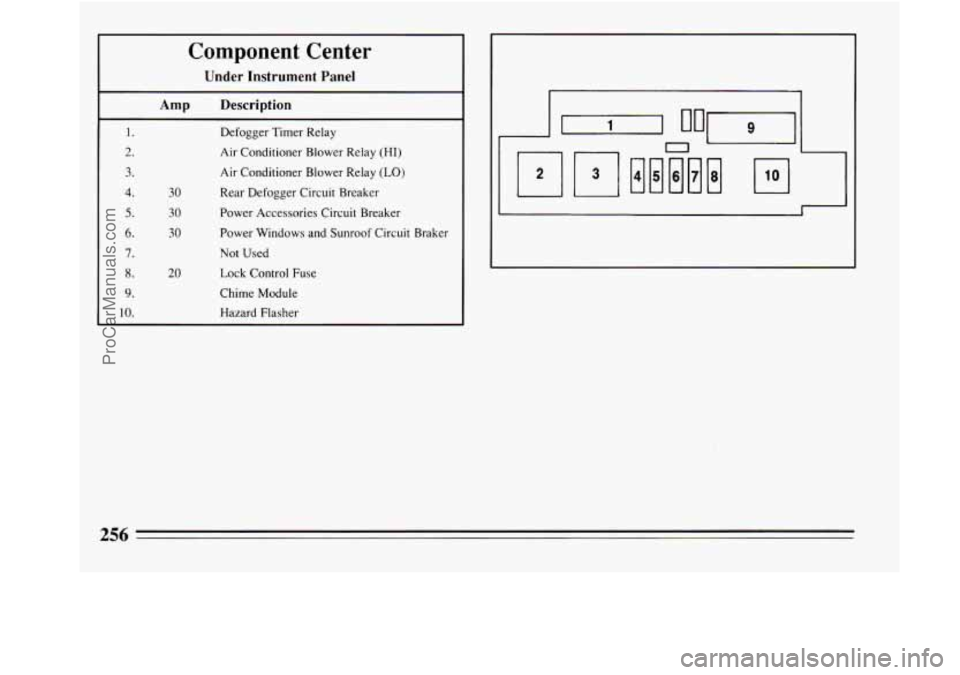
Component Center
Under Instrument Panel
Amp Description
1. Defogger Timer Relay
2. Air Conditioner Blower Relay (HI)
3. Air Conditioner Blower Relay (LO)
4. Rear Defogger Circuit Breaker
5. Power Accessories Circuit Breaker
6. Power Windows and Sunroof Circuit Braker
7. Not Used
8. Lock Control Fuse
9. Chime Module
10. Hazard Flasher
.r
I I
256
ProCarManuals.com
Page 260 of 308
10
25
1s
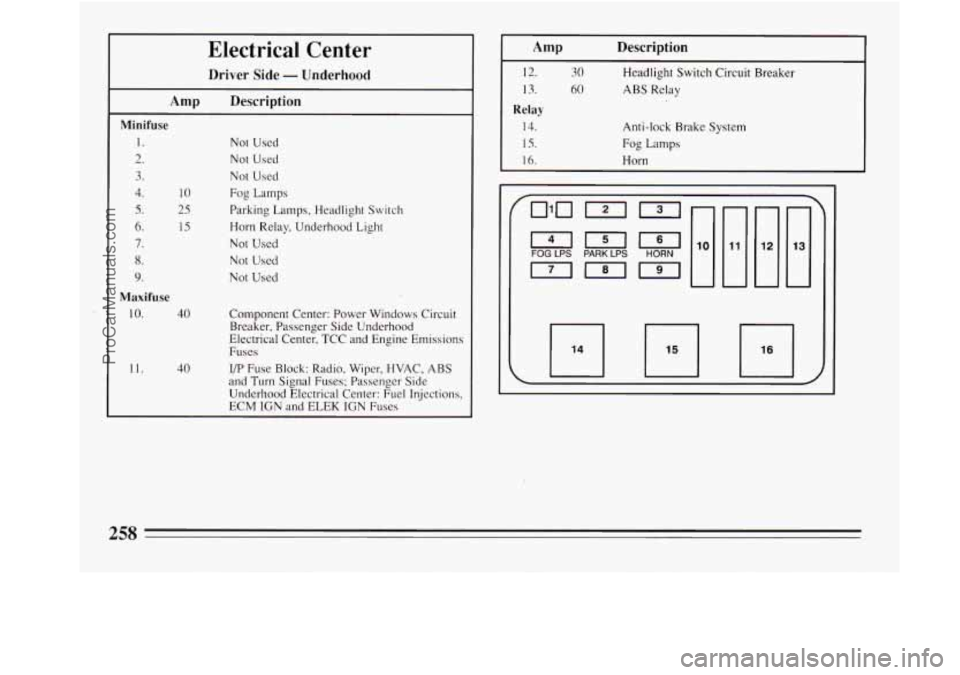
Electrical Center
Driver Side - Underhood
Amp Description
Minifuse
1. Not Used
2. Not Used
3. Not Used
4. Fog Lamps
5. Parking Lamps, Headlight Switch
6. Horn Relay, Underhood Light
7. Not Used
8. Not Used
9. Not Used
Maxifuse
10. 40
11 40
Component Center: Power Windows Circuit
Breaker, Passenger Side Underhood
Electrical Center, TCC and Engine Emissions
Fuses
I/P Fuse Block: Radio, Wiper, HVAC, ABS
and Turn Signal Fuses; Passenger Side
Underhood Electrical Center:
Fuel Injections,
ECM IGN and
ELEK IGN Fuses
Amp Description
12. 30 Headlight Switch Circuit Breaker
13. 60 ABS Relay
Relay
14. Anti-lock Brake System
1s. Fog Lamps
16. Horn
258
ProCarManuals.com