Page 102 of 308
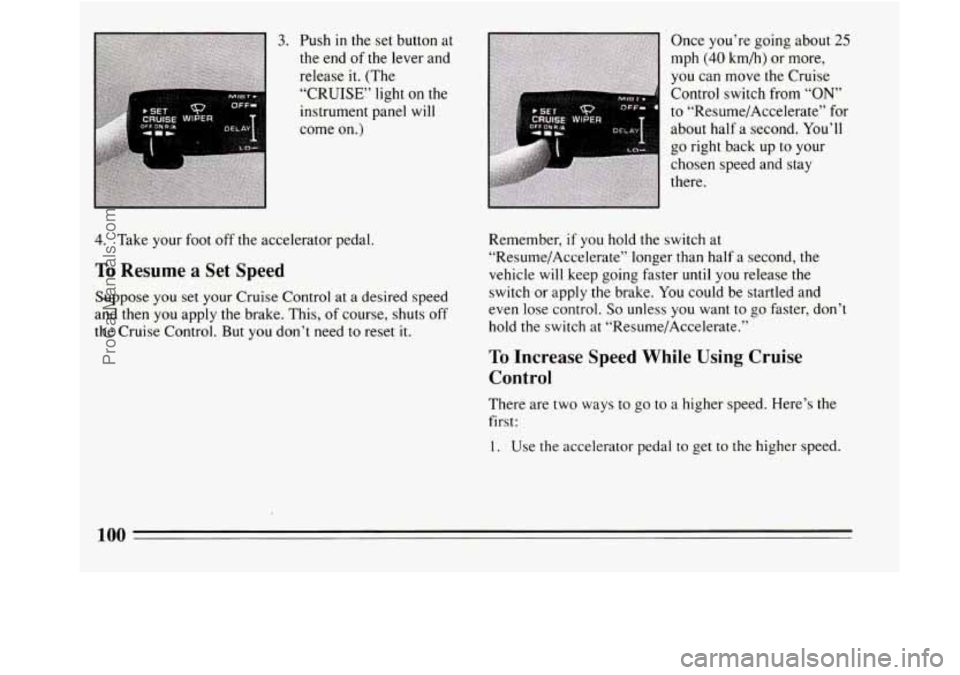
3. Push in the set button at
the end of the lever and
release it. (The
“CRUISE” light
on the
instrument panel will
come
on.)
4. Take your foot off the accelerator pedal.
To Resume a Set Speed
Suppose you set your Cruise Control at a desired speed
and then
you apply the brake. This, of course, shuts off
the Cruise Control. But
you don’t need to reset it. Once
you’re
going about 25
mph (40 km/h) or more,
you can move the Cruise
Control switch from
“ON’
to “Resume/Accelerate” for
about half a second. You’ll
go right back up to your
chosen speed and stay
there.
Remember,
if you hold the switch at
“Resume/Accelerate” longer than half a second, the
vehicle
will keep going faster until you release the
switch or apply the brake.
You could be startled and
even lose control.
So unless you want to go faster, don’t
hold
the switch at “Resume/Accelerate.”
To Increase Speed While Using Cruise
Control
There are two ways to go to a higher speed. Here’s the
first:
1. Use the accelerator pedal to get to the higher speed.
100
ProCarManuals.com
Page 104 of 308
Passing Another Vehicle While Using
Cruise Control
Use the accelerator pedal to increase your speed. When
you take your foot off the pedal, your vehicle
will slow
down
to the Cruise Control speed you set earlier.
Using Cruise Control on Hills
To Get Out of Cruise Control
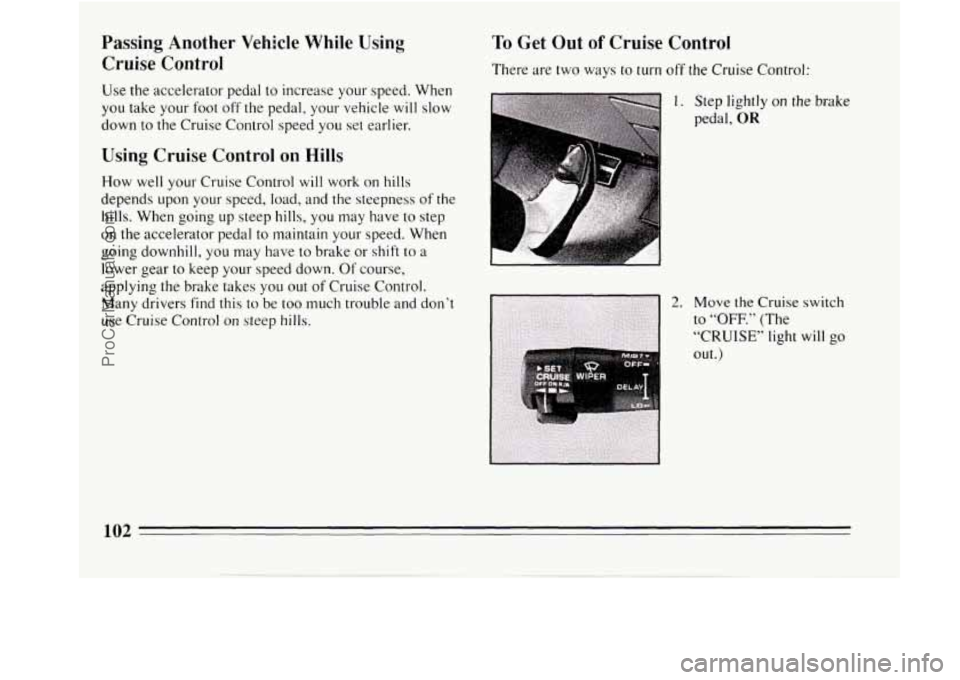
There are two ways to turn off the Cruise Control:
1. Step lightly on the brake
pedal,
OR
102 -
ProCarManuals.com
Page 106 of 308
Your DRL work with a light sensor on top of the
instrument panel. Don’t cover it up.
The low beam headlights will come on at reduced
brightness in daylight
when:
0 The ignition is on,
0 The headlight switch is off, and
0 The parking brake is released.
At dusk, the exterior lights will come on automatically
and the low beams will change
to full brightness. At
dawn, the exterior lights will
go out and the low beams
will change to
the reduced brightness of DRL (if the
headlight switch is off).
Of course, you may still turp on the headlights any time
you need to.
To idle your vehicle with
the DRL off, set the parking
brake while the ignition
is in the “Off” or “Lock”
position. Then start the vehicle. The DRL will stay off
until
you release the parking brake.
Front Seat Reading Lights (Option)
The front seat reading lights are turned on by pressing
the switches.
104
ProCarManuals.com
Page 116 of 308
* LOW
FUEL
L
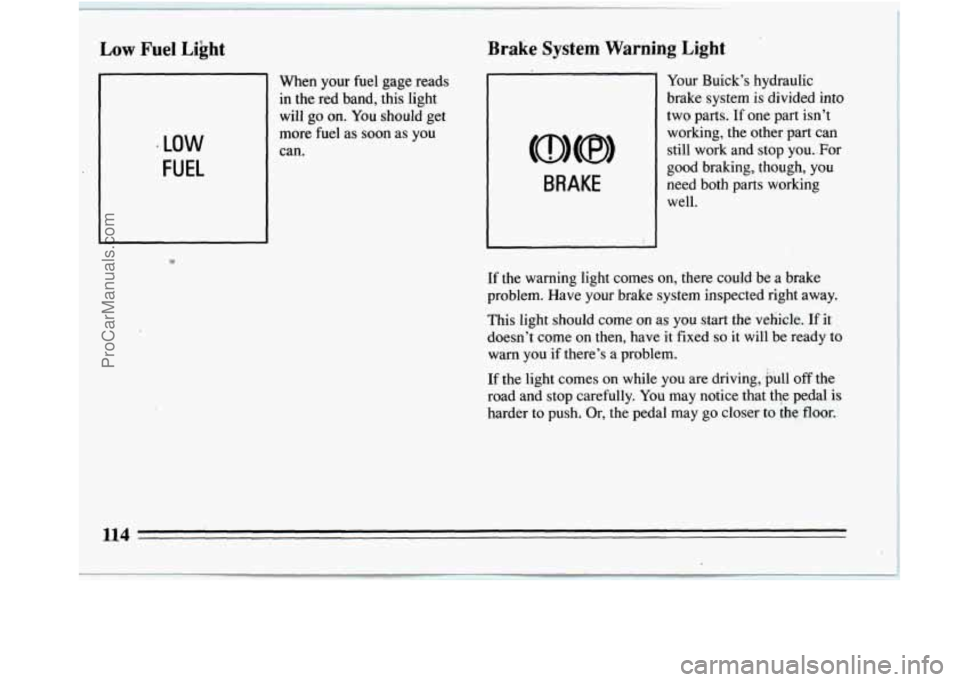
When your fuel gage reads in the red band, this light will
go on. You should get
more fuel
as soon as you
can.
Brake System Warning Light
BRAKE
Your Buick’s hydraulic
brake system is divided into
two parts. If one part isn’t
working, the other
part can
still work and stop you..For
good braking, though, you
need both parts working
well.
If the warning light comes on, there could be
a brake
problem. Have your brake system inspected right away.
This light should come on as you start the vehicle.
If it
doesn’t come on then, have it fixed
so it will be ready to
warn you if there’s a problem.
If the light comes
on while you are driving, pull off the
road and stop carefully. You may notice that the pedal is
harder to push. Or, the pedal may
go closer to the floor.
114
ProCarManuals.com
Page 117 of 308
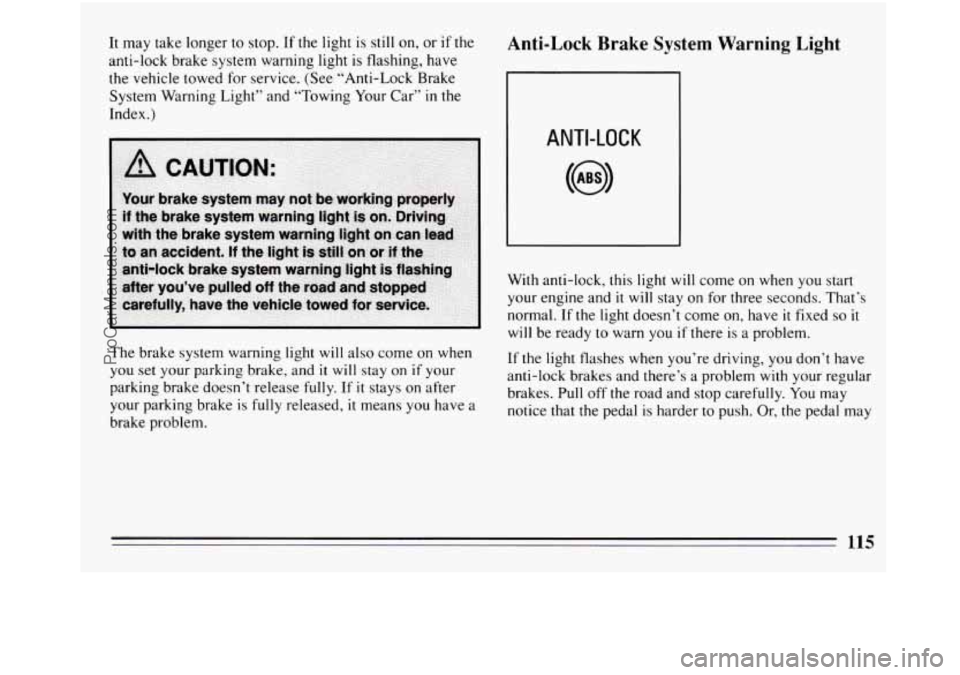
It may take longer to stop. If the light is still on, or if the
anti-lock brake system warning light is flashing, have
the vehicle towed for service. (See “Anti-Lock Brake
System Warning Light” and “Towing Your Car” in the
Index.)
The brake system warning light will also come on when
you
set your parking brake, and it will stay on if your
parking brake doesn’t release
fully. If it stays on after
your parking brake is
fully released, it means you have a
brake problem.
Anti-Lock Brake System Warning Light
ANTI-LOCK
With anti-lock, this light will come on when you start
your engine and
it will stay on for three seconds. That’s
normal. If the light doesn’t come on, have
it fixed so it
will be ready to warn you if there is a problem.
If the light flashes when you’re driving, you don’t have
anti-lock brakes and there’s a problem with your regular
brakes. Pull
off the road and stop carefully. You may
notice that the pedal is harder to push. Or, the pedal may
115
ProCarManuals.com
Page 118 of 308
go closer to the floor. It may take longer to stop. Have
the vehicle towed for service. (See “Towing Your Car”
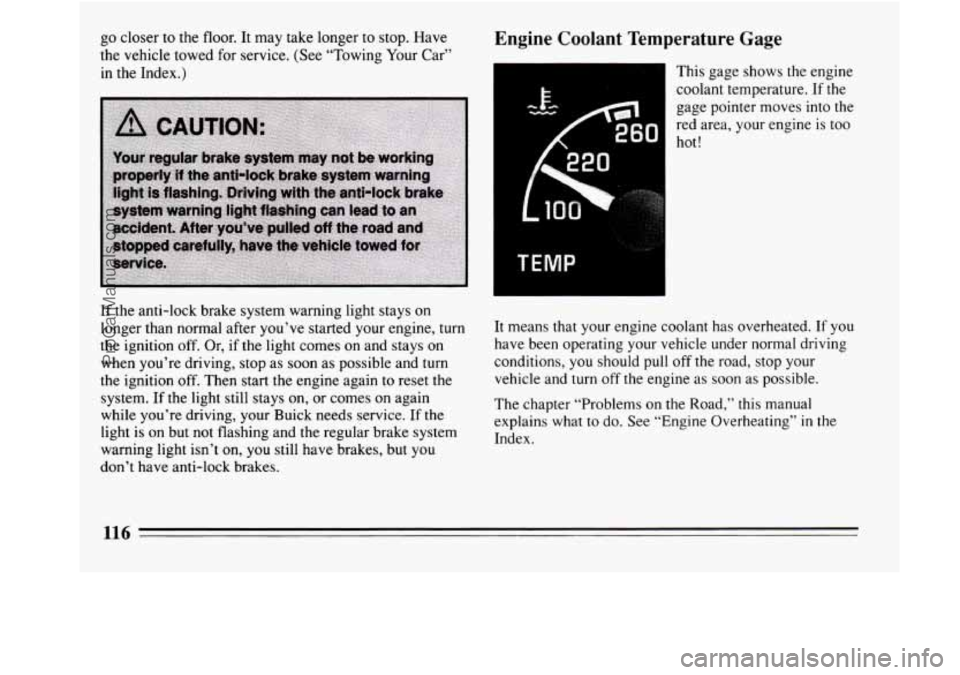
in the Index.) Engine Coolant Temperature Gage
This gage shows the engine
coolant temperature. If the
gage pointer moves into the
red area, your engine
is too
hot!
If the anti-lock brake system warning light stays on
longer than normal after you’ve started your engine, turn
the ignition off. Or,
if the light comes on and stays on
when you’re driving, stop as soon as possible and turn
the ignition off. Then start the engine again to reset the
system. If the light still stays on, or comes on again
while you’re driving, your Buick needs service. If the
light is on but not flashing and the regular brake system
warning light isn’t on,
you still have brakes, but you
don’t have anti-lock brakes. It means
that your engine coolant has overheated. If you
have been operating your vehicle under normal driving
conditions,
you should pull off the road, stop your
vehicle and turn off the engine as soon as possible.
The chapter “Problems on the Road,” this manual
explains what to do. See “Engine Overheating”
in the
Index.
116
ProCarManuals.com
Page 142 of 308
F
Defensive Driving
The best advice anyone can give about driving is: Drive
defensively.
Please start with a very important safety device in your
Buick: Buckle
up. (See “Safety Belts” in the Index.)
Defensive driving really means “be ready for anything.”
On city streets, rural roads, or freeways, it means
“always expect the unexpected.” Assume that
pedestrians or other drivers are going to
be,
careless and make mistakes. Anticipate what they might
do. Be ready for their mistakes.
Rear-end collisions
are about the most preventable of
accidents. Yet they are common. Allow enough
following distance. It’s the best defensive driving
maneuver, in both city and rural driving. You never
know when the vehicle in front of you is going to brake
or turn suddenly.
Drunken Driving
Death and injury associated with drinking and driving is
a national tragedy. It’s the number one contributor to the
highway death toll, claiming thousands
of victims every
year. Alcohol takes away three things that anyone needs
to drive a vehicle:
0 Judgment
0 Muscular Coordination
0 Vision
Police records show that almost half of all motor
vehicle-related deaths involve alcohol
- a driver, a
passenger or someone else, such as
a pedestrian, had
been drinking. In most cases, these deaths are the result
of someone who was drinking and driving. About
140
ProCarManuals.com
Page 145 of 308
There’s something else about drinking and driving that
many people don’t know. Medical research shows that
alcohol
in a person’s system can make crash injuries
worse. That’s especially true for brain, spinal cord and
heart injuries. That means that if anyone who has been
drinking
-- driver or passenger -- is in a crash, the
chance of being killed or permanently disabled
is higher
than if that person had not been drinking. And we’ve
already seen that the chance of
a crash itself is higher for
drinking drivers.
Control of a Vehicle
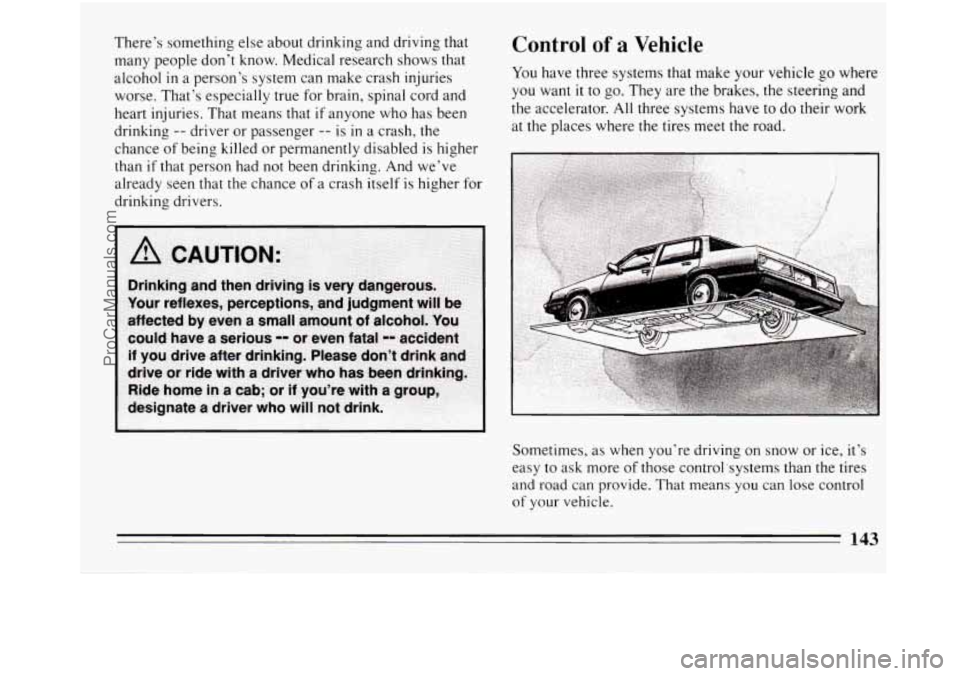
You have three systems that make your vehicle go where
you want it to go. They are the brakes, the steering and
the accelerator. All three systems have to do their work
at the places where the tires meet the road.
.... . . ...
Sometimes, as when you’re driving on snow or ice, it’s
easy
to ask more of those control’systems than the tires
and road can provide. That means
you can lose control
of your vehicle.
ProCarManuals.com