Page 244 of 324
Engine Oil Additives
Don’t add anything to your oil. Your Buick dealer is
ready to advise if you think something should be added.
When to Change Engine Oil
See if any one of these is true for you:
Most trips are less than 4 miles (6 km).
It’s below freezing outside and most trips are less
than
10 miles (16 km).
The engine is at low speed most of the time (as in
door-to-door delivery, or in stop-and-go traffic).
0 You tow a trailer often.
Most trips are through dusty places.
If any one of these is true for your vehicle, then you
need to change your oil and filter every
3,000 miles
(5 000 km) or 3 months -- whichever comes first. (See
“Change Oil Soon” in the Index.) If
none of
them is true, change the oil every 7,500 miles
(12 500 km) or 12 months -- whichever comes first.
Change the filter at the first oil change and at every
other oil change after that.
If the optional “Change Oil Soon” light comes on you
will need to change your oil sooner than either mileage
specified. Depending upon driving habits, the “Change
Oil Soon’’ light may come on
as early as 2,000 miles or
less from the last time the oil life monitor was reset (See
“Oil Life Monitor” in the Index.)
Always reset the oil
life monitor after every oil change.
Engine Coolant Heater (Engine Block
Heater)
An engine coolant heater can be a big help if you have
to park outside in very cold weather,
0°F (- 18 “C) or
colder. If your vehicle has this option, see “Engine
Coolant Heater” in the Index.
242
ProCarManuals.com
Page 245 of 324
What to Do with Used Oil
Did you know that used engine oil contains certain
elements
that may be unhealthy for your skin and could
even cause cancer? Don’t let used oil stay on your skin
for very long. Clean your skin and nails with soap and
water, or a good hand cleaner. Wash or properly throw
away clothing or rags containing used engine oil. (See
the manufacturer’s warnings about the use and disposal
of oil products.)
Used oil can be a real threat to the environment. If you
change your own
oil, be sure to drain all free-flowing
oil from the filter before disposal. Don’t ever dispose of
oil by putting it in the trash, pouring
it on the ground,
into sewers, or into streams or bodies of water. Instead,
recycle it by taking
it to a place that collects used oil. If
you have a problem properly disposing of your used oil,
ask your dealer, a service station or a local recycling
center for help.
Air Cleaner
1
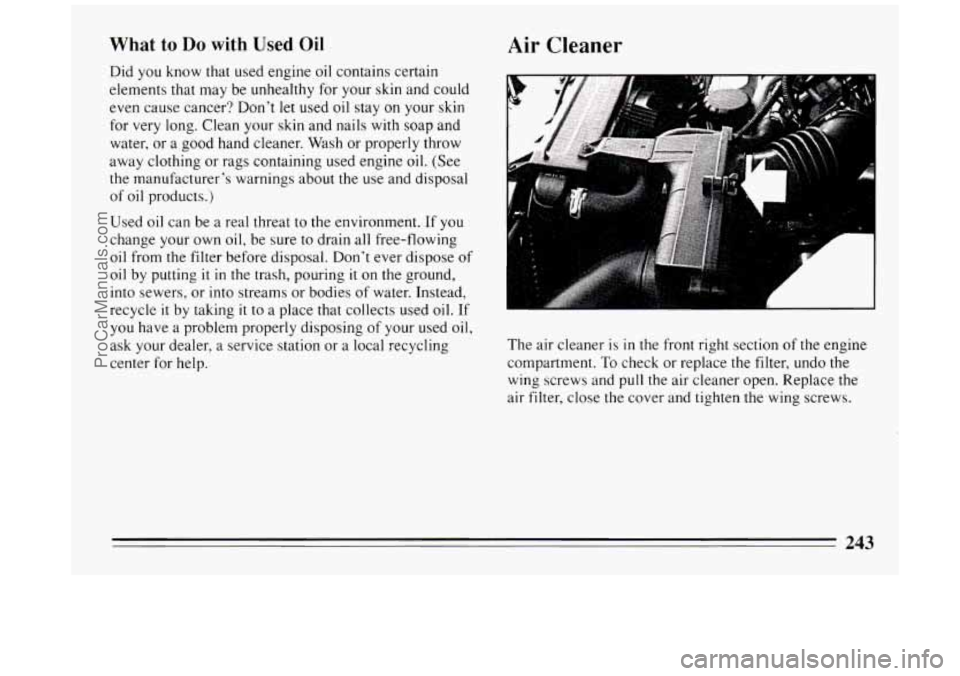
The air cleaner is in the front right section of the engine
compartment.
To check or replace the filter, undo the
wing screws and pull the air cleaner open. Replace the
air filter, close
the cover and tighten the wing screws.
243
ProCarManuals.com
Page 246 of 324
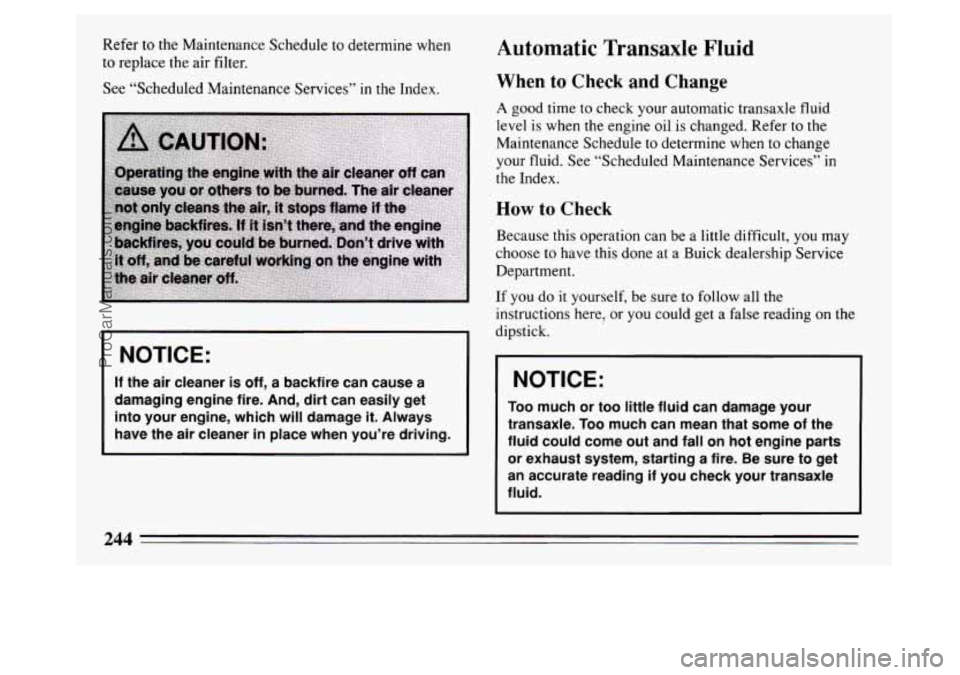
Refer to the Maintenance Schedule to determine when
to replace the air filter.
See “Scheduled Maintenance Services”
in the Index.
NOTICE:
If the air cleaner is off, a backfire can cause a
damaging engine fire. And, dirt can easily get
into your engine, which will damage
it. Always
have the air cleaner
in place when you’re driving.
Automatic Transaxle Fluid
When to- Check and Change
A good time to check your automatic transaxle fluid
level is when the engine oil is changed. Refer
to the
Maintenance Schedule to determine when to change
your fluid. See “Scheduled Maintenance Services’’ in
the Index.
How to Check
Because this operation can be a little difficult, you may
choose
to have this done at a Buick dealership Service
Department.
If you do it yourself, be sure to follow all the
instructions here, or you could get a false reading
on the
dipstick.
NOTICE:
Too much or too little fluid can damage your
transaxle.
Too much can mean that some of the
fluid could come out and fall on hot engine parts
or exhaust system, starting a fire. Be sure
to get
an accurate reading if you check your transaxle
fluid.
244
ProCarManuals.com
Page 247 of 324
Wait at least 30 minutes before checking the transaxle
fluid level
if you have been driving:
0 When outside temperatures are above 90°F (32°C).
0 At high speed for quite a while.
0 In heavy traffic -- especially in hot weather.
0 While pulling a trailer.
To get the right reading, the fluid should be at normal
operating temperature, which is 180°F to 200°F (82°C
to 93°C).
Get the vehicle warmed up by driving about 15 miles
(24 km) when outside temperatures are above 50°F
(10°C). If it's colder than 50°F (lO"C), you may have
to drive longer.
To check the fluid level
Park your vehicle on a level place. Keep the engine
running.
0 With the parking brake applied, place the shift lever
in "P" (Park).
With your foot on the brake pedal, move the shift
lever through each gear range, pausing for about
three seconds
in each range. Then, position the shift
lever in "P" (Park).
0 Let the engine run at idle for three to five minutes.
Then, without shutting
off the engine. follow these
steps:
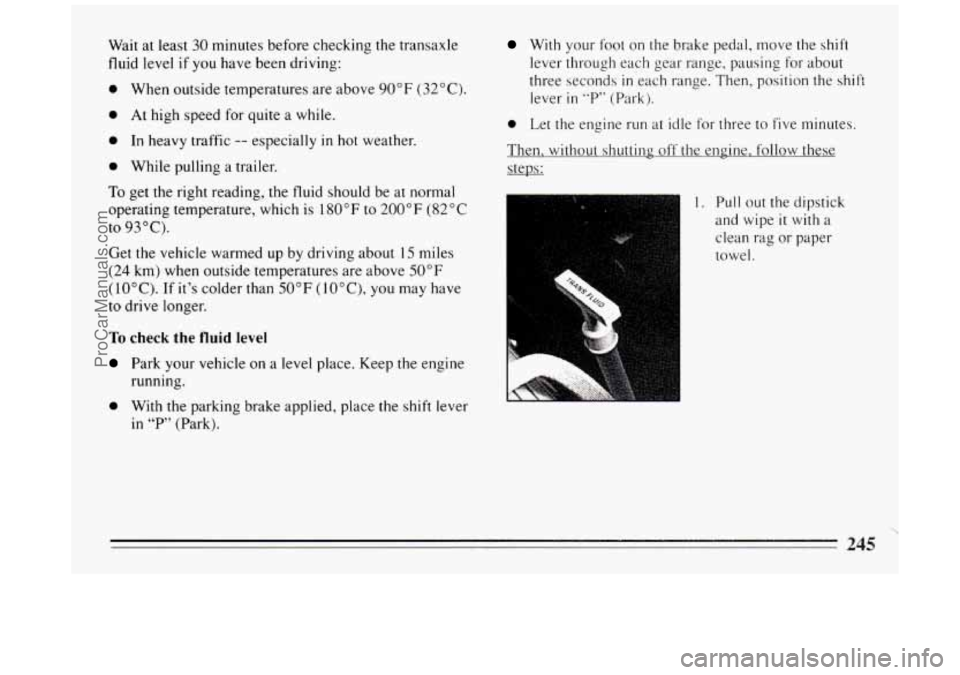
I. Pull out the dipstick
and wipe
it with a
clean rag or paper
towel.
ProCarManuals.com
Page 249 of 324
Engine Coolant
The following explains your cooling system and how to
add coolant when
it is low. If you have a problem with
engine overheating, see “Engine Overheating” in the
Index.
The proper coolant for your Buick will:
0 Give freezing protection down to -34°F (-37 “C).
0 Give boiling protection up to 262°F (128 “C).
0 Protect against rust and corrosion.
0 Help keep the proper engine temperature,
Let the warning lights work as they should.
What to Use
Use a mixture of one-half clean water (preferably
distilled) and one-half antifreeze that meets “GM
Specification 1825-M,” which won’t damage aluminum
parts.
You can also use a recycled coolant conforming to
GM Specification 1825-M with a complete coolant flush
and refill. If you use this mixture,
you don’t need to add
anything else.
I NOTICE:
If you use an improper coolant mix, your engine
could overheat and be badly damaged. The
repair cost wouldn’t be covered by your
warranty. Too much water in the mix can freeze
and crack the engine, radiator, heater core and
other parts.
247
ProCarManuals.com
Page 250 of 324
Adding Coolant
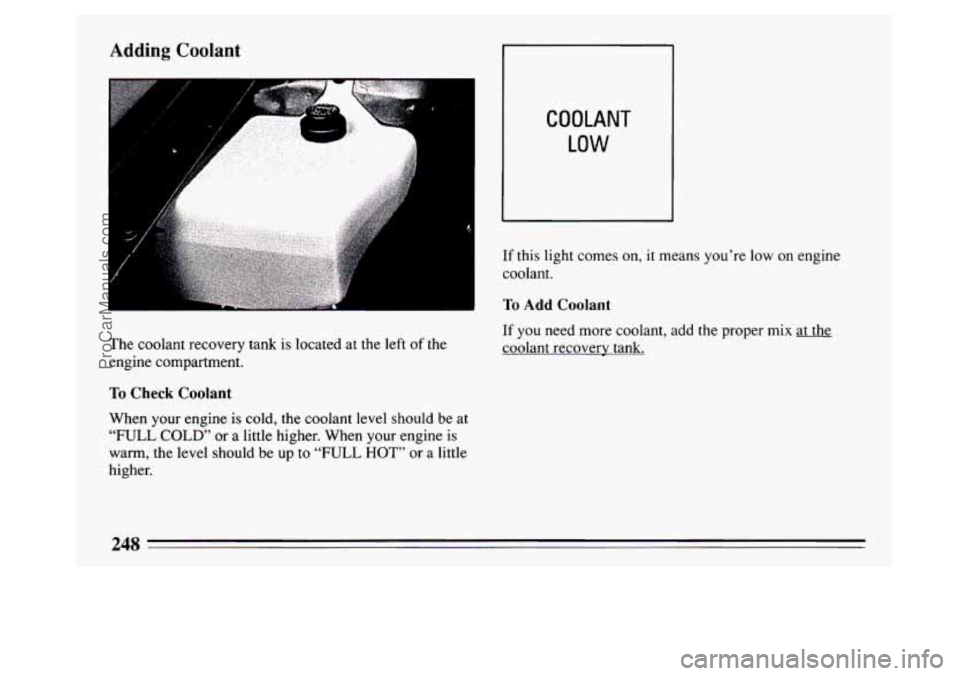
The coolant recovery tank is located at the left of the
engine compartment.
To Check Coolant
When your engine is cold, the coolant level should be at
“FULL COLD’ or a little higher. When your engine is
warm, the level should be up to
“FULL HOT” or a little
higher.
COOLANT
LOW
If this light comes on, it means you’re low on engine
coolant.
To Add Coolant
If you need more coolant, add the proper mix at the
coolant recovery tank.
248
ProCarManuals.com
Page 251 of 324
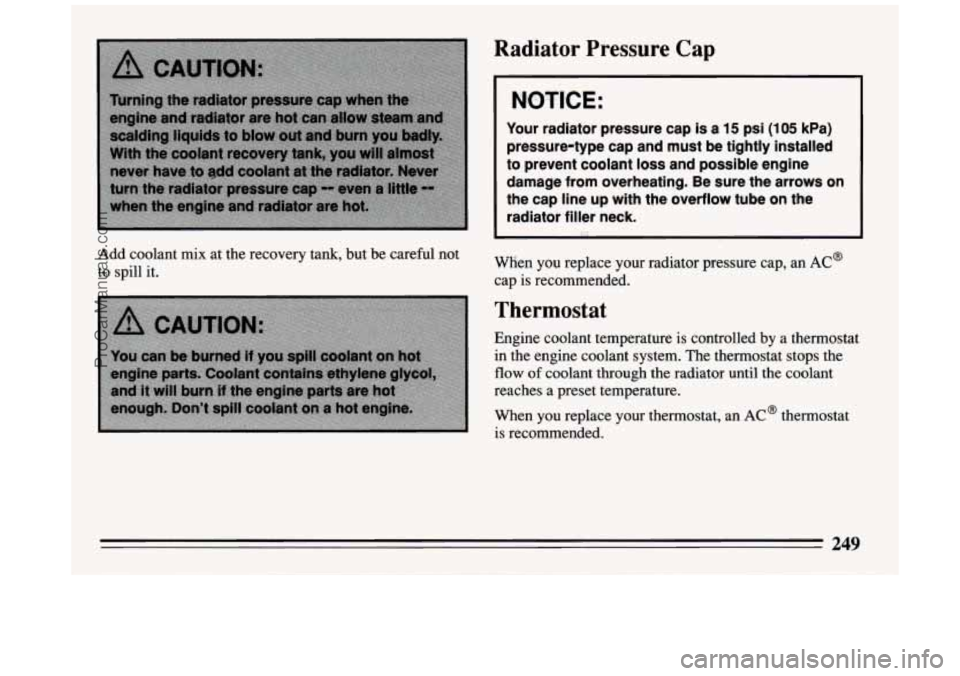
Add coolant mix at the recovery tank, but be careful not
to spill
it.
Radiator Pressure Cap
Your radiator pressure cap is a 15 psi (1 05 kPa)
pressure-type cap and must be tightly installed
to prevent coolant
loss and possible engine
damage from overheating. Be sure the arrows on
the cap line up with the overflow tube on the
radiator filler neck.
Wlien you replace your radiator pressure cap, ap AC@
cap is recommended.
Thermostat
Engine coolant temperature is controlled by a thermostat
in the engine coolant system. The thermostat stops the
flow of coolant through the radiator until the coolant
reaches a preset temperature.
When you replace your thermostat, an
AC@ thermostat
is recommended.
249
ProCarManuals.com
Page 252 of 324
Power Steering Fluid
How To Check Power Steering Fluid
Unscrew the cap and wipe the dipstick with a clean rag.
Replace the cap and completely tighten it. Then remove
the cap again and look at the fluid level
on the dimtick.
When the engine compartment is hot, the level
should be at the
“HOT” mark.
0 When the engine compartment is cool, the level
should be at the
“FULL COLD” mark.
What to Add
Refer to the Maintenance Schedule to determine what
kind
of fluid to use. See “Recommended Fluids and
Lubricants” in the Index.
NOTICE:
When adding power steering fluid or making a
complete fluid change, always use the proper
fluid. Failure to use the proper fluid can cause
leaks and damage hoses and seals.
250
ProCarManuals.com