Page 188 of 324
Your anti-lock brakes improve your ability to make a
hard stop on a slippery road. Even though you have the
anti-lock braking system, you’ll want
to begin stopping
sooner than you would on dry pavement. See
“Anti-lock”
in the Index.
Allow greater following distance on any slippery
road.
Watch for slippery spots. The road might be fine
until you hit a spot that’s covered with
ice. On an
otherwise clear road, ice patches may appear in
shaded areas where the sun can’t reach: around
clumps
of trees, behind buildings, or under bridges.
Sometimes
the surface of a curve or an overpass may
remain icy when the surrounding roads are clear. If
you see a patch of ice ahead of you, brake before you
are on it. Try not to brake while you’re actually on
the ice, and avoid sudden steering maneuvers.
If You’re Caught in a Blizzard
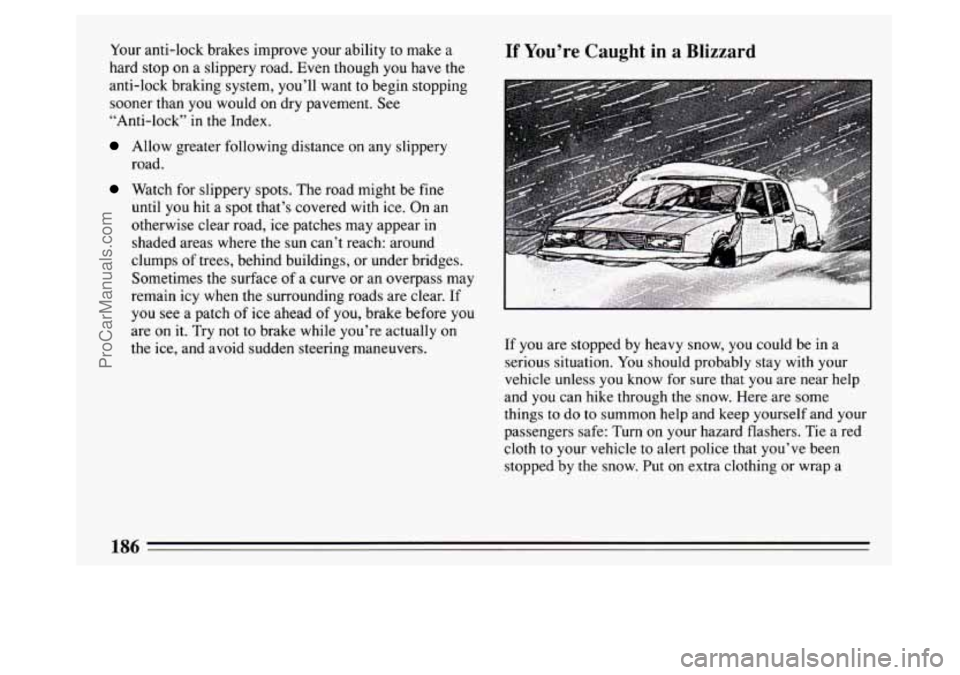
If you are stopped by heavy snow, you could be in a
serious situation. You should probably stay with your
vehicle unless you know
for sure that you are near help
and
you can hike through the snow. Here are some
things to do to summon help and keep yourself and your
passengers safe: Turn on your hazard flashers. Tie a red
cloth
to your vehicle to alert police that you’ve been
stopped by
the snow. Put on extra clothing or wrap a
186
ProCarManuals.com
Page 194 of 324
the trailer brakes so you’ll be able to install, adjust and
maintain them properly. Because you have anti-lock
brakes, do not try
to tap into you vehicle’s brake system.
If
you do, both brake systems won’t work well, or at all.
Driving with a Trailer
Towing a trailer requires a certain amount of experience.
Before setting out for the open road, you’ll want to get
to know your rig. Acquaint yourself with the feel of
handling and braking with the added weight of the
trailer. And always keep in mind that the vehicle you are
driving is now a good deal longer and not nearly
so
responsive as your vehicle is by itself.
Before you start, check the trailer hitch and platform,
safety chains, electrical connector, lights, tires and
mirror adjustment. If the trailer has electric brakes, start
your vehicle and trailer moving and then apply the
trailer brake controller by hand to be sure the brakes are
working. This lets you check your electrical connection
at the same time.
During your trip, check occasionally to be sure that the
load is secure, and that the lights and any trailer brakes
are still working.
Following Distance
Stay at least twice as far behind the vehicle ahead as you
would when driving your vehicle without a trailer. This
can help you avoid situations that require heavy braking
and sudden turns.
Passing
You’ll need more passing distance up ahead when
you’re towing a trailer. And, because you’re a good deal
longer, you’ll need
to go much farther beyond the
passed vehicle before you can return to your lane.
Backing Up
Hold the bottom of the steering wheel with one hand.
Then, to move the trailer to the
left, just move that hand
to the left.
To move the trailer to the right, move your
hand to the right. Always back up slowly and,
if
possible, have someone guide you.
Making Turns
When you’re turning with a trailer, make wider turns
than normal.
Do this so your trailer won’t strike soft
shoulders, curbs, road signs, trees, or other objects.
Avoid jerky or sudden maneuvers. Signal well in
advance.
192
ProCarManuals.com
Page 206 of 324
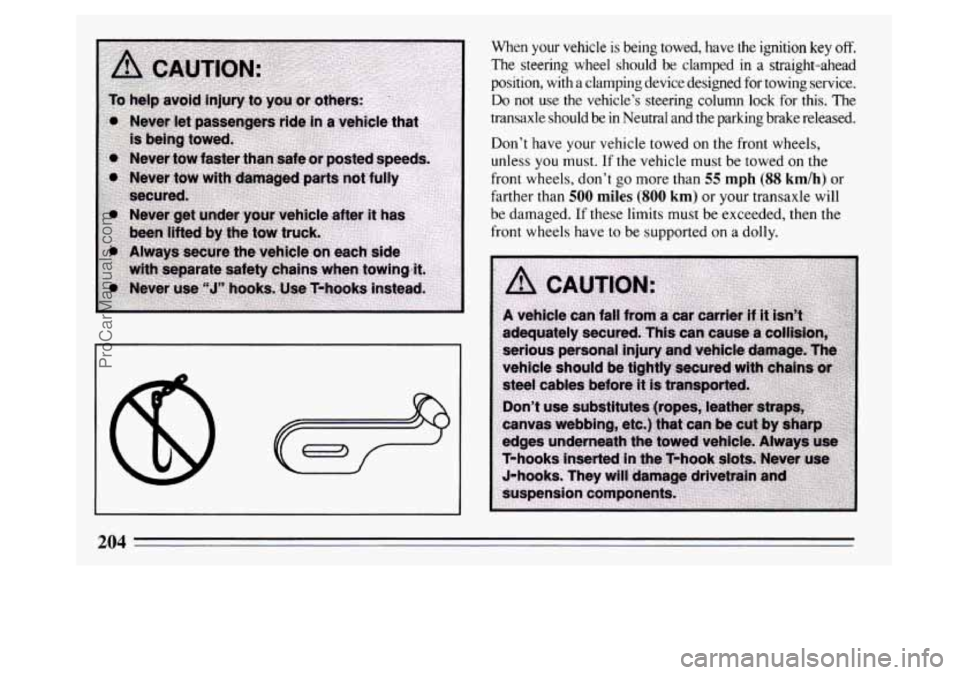
When your vehicle is being towed, have the ignition key off.
The steering wheel should be clamped in a straight-ahead
position, with
a clamping device designed for towing service.
Do not use the vehicle’s steering column lock for this. The
transaxle should be
in Neutral and the parking brake released.
Don’t have your vehicle towed on the front wheels,
unless you must.
If the vehicle must be towed on the
front wheels, don’t go more than
55 mph (88 km/h) or
farther than
500 miles (800 km) or your transaxle will
be damaged. If these limits must be exceeded, then the
front wheels have
to be supported on a dolly.
ProCarManuals.com
Page 219 of 324
The jack has a bolt at
the end. Attach the
wheel wrench to the
jack bolt.
Rotate the wheel wrench clockwise
(to the right). That
will raise
the lift head a little.
If your Buick has a wheel cover, you must take it off to
reach the wheel nuts.
'A
A
If your vehicle has an aluminum wheel with a center
cover, remove
it using the flat end of the wheel wrench.
217
ProCarManuals.com
Page 221 of 324
Remove the theft deterrent wheel
nut, by placing the
key end of the wire wheel
key wrench over the
nut
and turning it to the left.
Pull
off the wire wheel
cover. Note: When
reppacing the wheel cover,
carefully line up the tire
.,’ valve stem and the notch in
the wheel cover.
54
Using the wheel wrench, loosen all the wheel nuts.
Don’t remove them yet. Next, attach the wheel wrench
to the bolt on the end of the jack. Raise the jack a little
by rotating the wheel wrench clockwise (to the right). The jack
handle has markings at 8” for the rear and 10”
for the front, which will help you to locate the jacking
notches in the frame.
219
ProCarManuals.com
Page 222 of 324
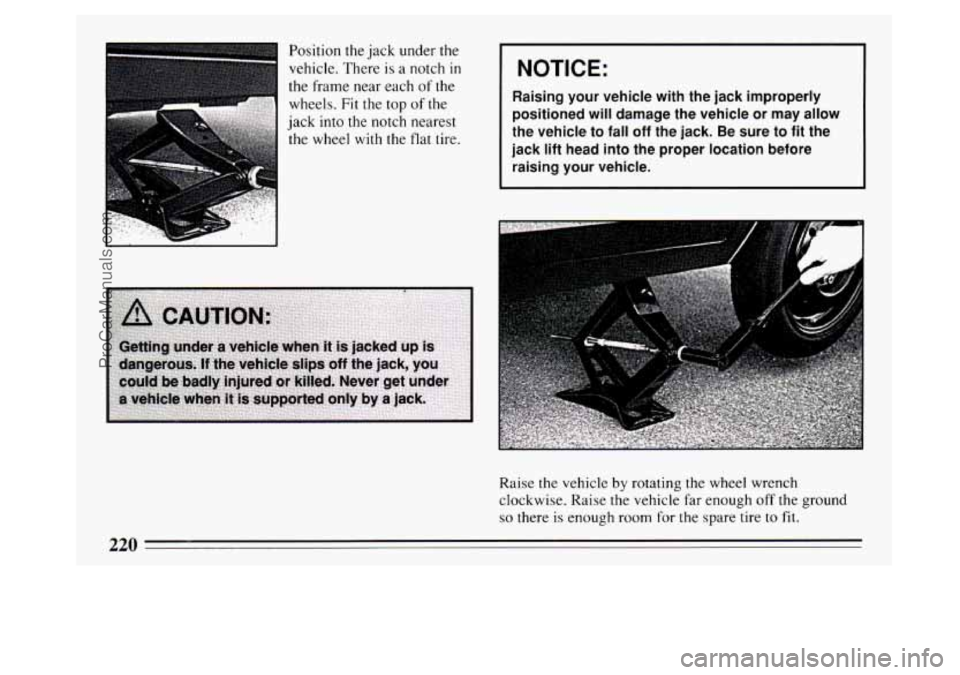
Position the jack under the
vehicle. There is a notch
in
the frame near each of the
wheels. Fit the top
of the
jack into the notch nearest
the wheel
with the flat tire.
I NOTICE:
Raising your vehicle with the jack improperly
positioned will damage the vehicle
or may allow
the vehicle to fall off the jack. Be sure to
fit the
jack lift head into the proper location before raising your vehicle.
t I
Raise the vehicle by rotating the wheel wrench
clockwise. Raise the vehicle far enough
off the ground
so there is enough room for the spare tire to fit.
220
ProCarManuals.com
Page 224 of 324
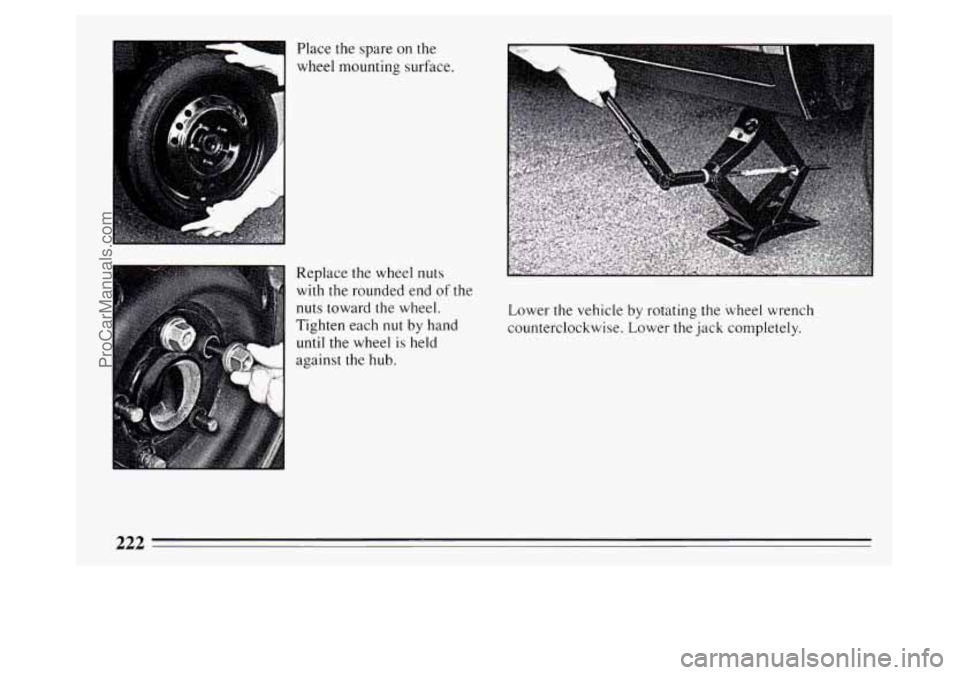
Place the spare on the
wheel mounting surface.
Replace the wheel nuts
with the rounded end
of the
nuts toward the wheel.
Tighten each
nut by hand
until the wheel is held
against the hub. Lower
the vehicle by rotating the wheel wrench
counterclockwise. Lower the jack completely.
222
ProCarManuals.com
Page 234 of 324
Fuels in Foreign Countries
If you plan on driving in another country outside the
U.S. or Canada, unleaded fuel may be hard to find. Do
not use leaded gasoline.
If you use even one tankful,
your emission controls won’t work well or at all. With
continuous use, spark plugs can get fouled, the exhaust
system can corrode, and your engine oil can deteriorate
quickly. Your vehicle’s oxygen sensor will be damaged.
All of that means costly repairs that wouldn’t be covered
by your warranty.
To check on fuel availability, ask an auto club, or
contact a major oil company that does business
in the
country where you’ll be driving.
You can also write us at the following address for
advice. Just
tell us where you’re going and give your
Vehicle Identification Number (VIN).
General Motors Overseas Distribution Corporation, North American Export Sales (NAES)
1908 Colonel Sam Drive
Oshawa, Ontario
L 1 H 8P7
Filling Your Tank
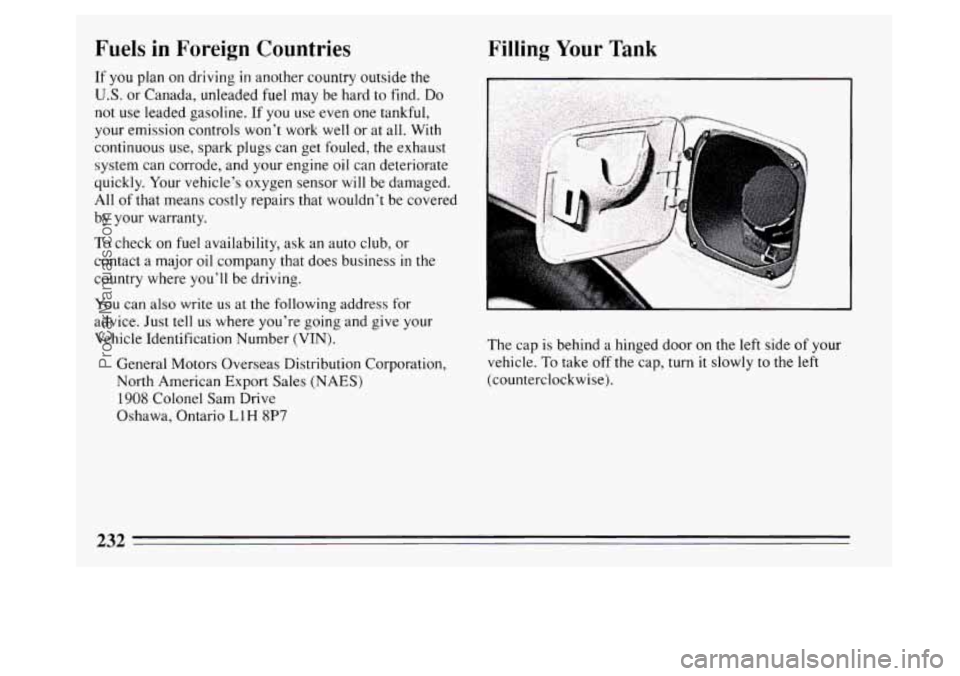
The cap is behind a hinged door on the left side of your
vehicle.
To take off the cap, turn it slowly to the left
(counterclockwise).
232
ProCarManuals.com