Page 197 of 324
Part 5 Problems on the Road
Here you’ll find what to do about some problems that can occur on the road .
Part 5 includes:
Hazard Warning Flashers .................................................. ....
Other Wa-ning Devices ........................................ ...............
“Jump”Starting ...................................................................
TowingYourBuick ................................................................
Engineoverheating ................................................................
IfaTireGoesFlat .................................................................
ChangingaFlatTire ................................................................
Compact Spare Tire .................................................................
If You’re Stuck in Sand, Mud, Ice or Snow ..............................................
196
197
198
203
207
214
215
224
225
195
ProCarManuals.com
Page 222 of 324
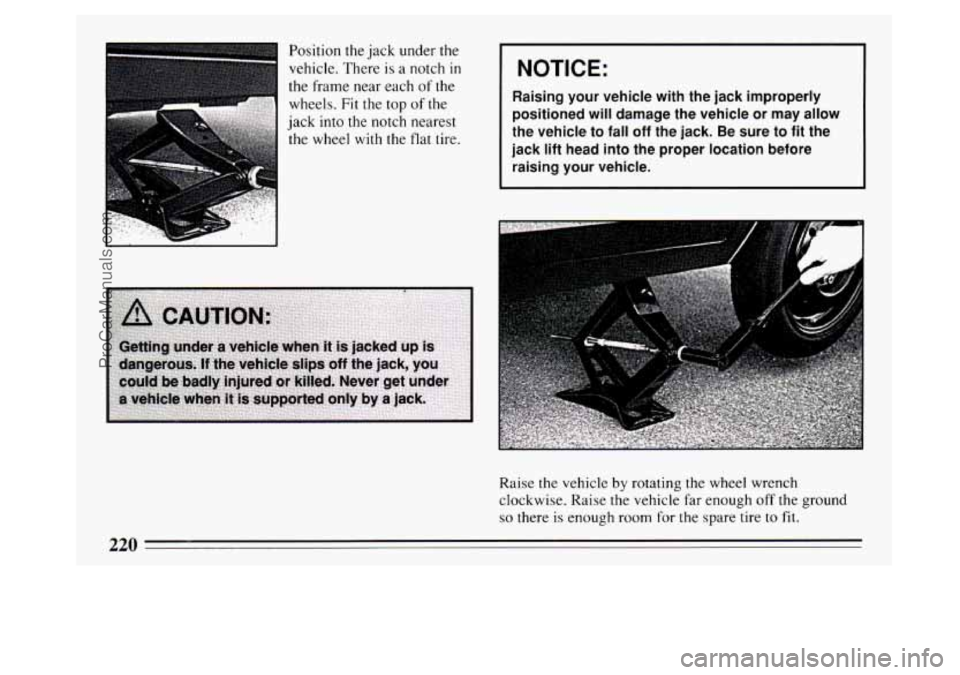
Position the jack under the
vehicle. There is a notch
in
the frame near each of the
wheels. Fit the top
of the
jack into the notch nearest
the wheel
with the flat tire.
I NOTICE:
Raising your vehicle with the jack improperly
positioned will damage the vehicle
or may allow
the vehicle to fall off the jack. Be sure to
fit the
jack lift head into the proper location before raising your vehicle.
t I
Raise the vehicle by rotating the wheel wrench
clockwise. Raise the vehicle far enough
off the ground
so there is enough room for the spare tire to fit.
220
ProCarManuals.com
Page 223 of 324
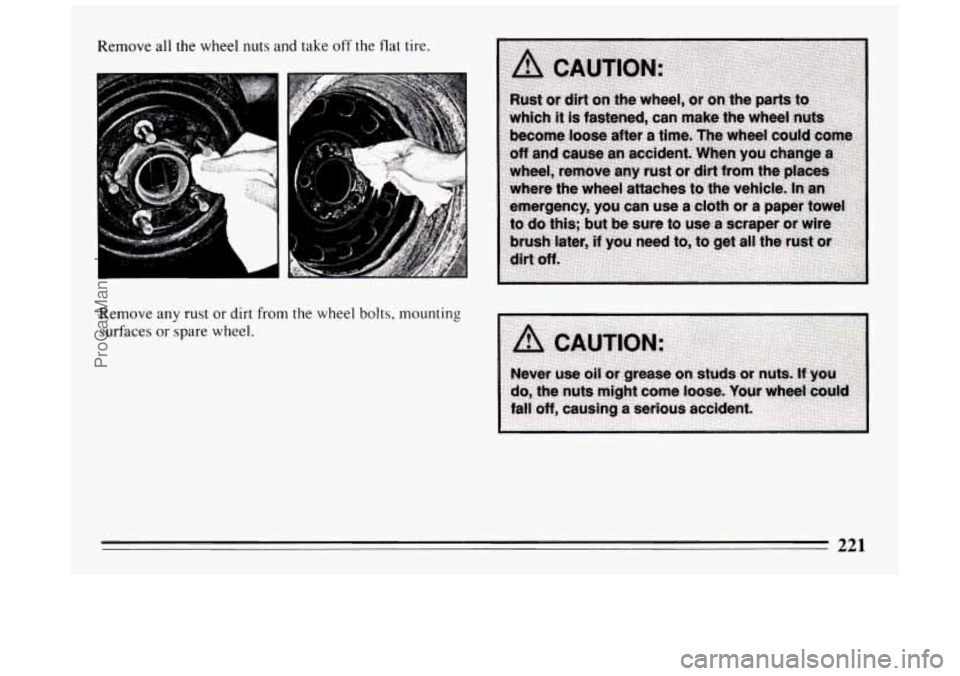
Remove all the wheel nuts and take off the flat tire.
Remove any rust or dirt from the wheel
bolts, mounting
surfaces or spare wheel.
221
ProCarManuals.com
Page 225 of 324
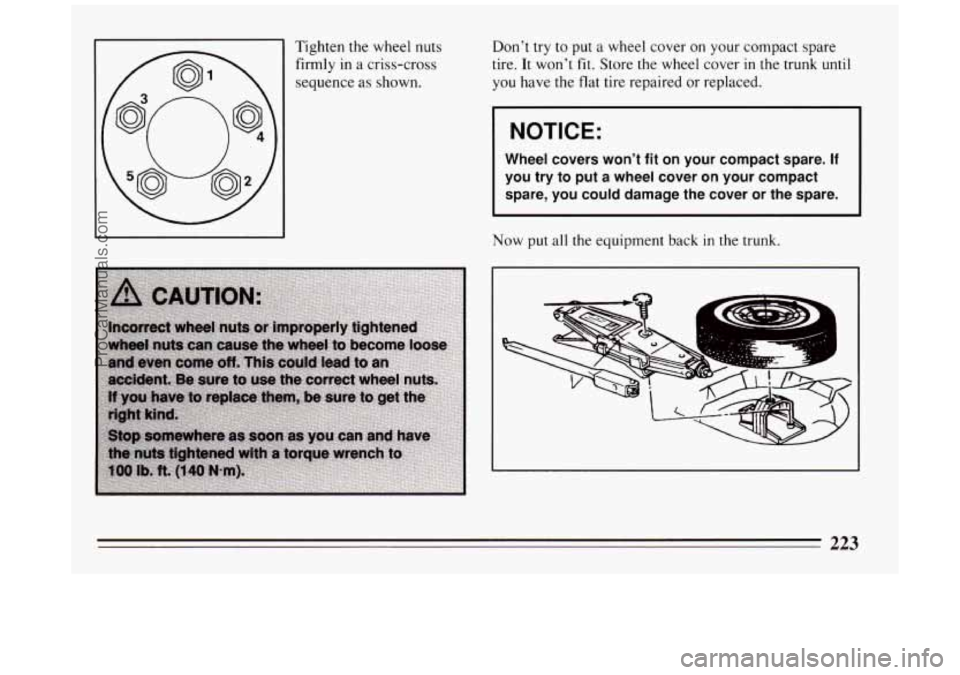
Tighten the wheel nuts firmly
in a criss-cross
sequence as shown. Don’t
try to put a wheel cover on your compact spare
tire. It won’t fit. Store the wheel cover in the trunk until
you have the flat tire repaired or replaced.
Wheel covers won’t fit on your compact spare. If
you try to put a wheel cover on your compact
spare, you could damage the cover or the spare.
Now put all the equipment back in the trunk.
223
ProCarManuals.com
Page 226 of 324
Compact Spare Tire
Although the compact spare was fully inflated when
your vehicle was new,
it can lose air after a time. Check
the inflation pressure regularly. It should be
60 psi (420
kPa). After installing the compact spare on your vehicle,
you should stop as
soon as possible and make sure your
spare tire
is correctly inflated. The compact spare is
made to perform well at posted speed limits for
distances up to
3,000 miles (5 000 km). The compact
spare
is made to go up to 3,000 miles (5 000 km), so you
can finish your trip and have your full-size tire repaired
or replaced where you want.
Of course, it’s best to
replace your spare with a full-size tire as soon as you
can. Your spare
will last longer and be in good shape in
case you need it again.
224
ProCarManuals.com
Page 227 of 324
NOTICE:
If You’re Stuck: In Sand, Mud, Ice or
Snow
Don’t take your compact spare through an
automatic car wash with guide rails. The
compact spare can get caught
on the rails. That
can damage the tire and wheel, and maybe other
parts
of your vehicle.
What you don’t want to do when your vehicle is stuck is
to spin your wheels. The method known as “rocking”
can help you get out when you’re stuck, but you must
use caution.
Don’t use your compact spare on some other vehicle.
And don’t mix your compact spare
or wheel with other
wheels or tires. They won’t
fit. Keep your spare and its
wheel together.
I NOTICE:
Tire chains won’t fit your compact spare. Using
them will damage your vehicle and destroy the
chains too. Don’t use tire chains
on your
compact spare.
225
ProCarManuals.com
Page 262 of 324
Tires
We don't make tires. Your new vehicle comes with high
quality tires made by a leading tire manufacturer. These
tires are warranted by the tire manufacturers and their
warranties are delivered with every
new Buick. If your
spare tire is a different brand than your road tires,
you
will have a tire warranty folder from each of these
manufacturers.
ProCarManuals.com
Page 264 of 324
When to Check
Check your tires once a month or more.
Don’t forget your compact spare tire. It should be at
60
psi (420 Wa).
How to Check
Use a good quality pocket-type gage to check tire
pressure. Simply looking at the tires will not tell you the
pressure, especially
if you have radial tires -- which
may look properly inflated even if they’re underinflated.
If your tires have valve caps, be sure to put them back
on. They help prevent leaks by keeping out dirt and
moisture.
Tire Inspection and Rotation
To make your tires last longer, have them inspected and
rotated at the mileages recommended
in the
Maintenance Schedule. See “Scheduled Maintenance
Services”
in the Index.
FRONT
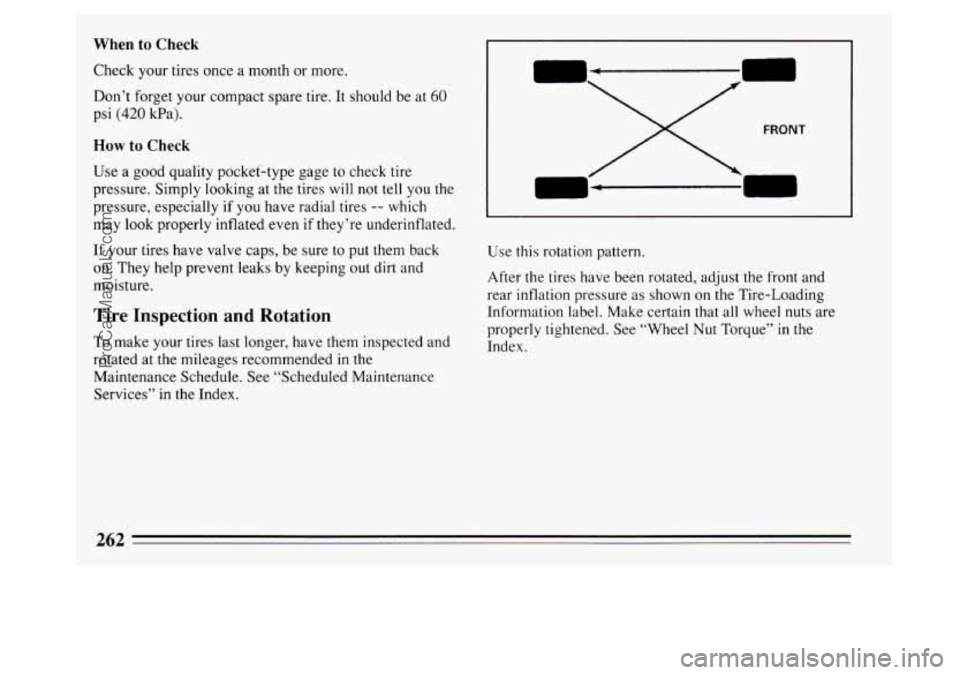
Use this rotation pattern.
After the tires have been rotated, adjust the front and
rear inflation pressure
as shown on the Tire-Loading
Information label. Make certain that all wheel nuts are
properly tightened. See “Wheel Nut Torque” in the
Index.
262
ProCarManuals.com