Page 20 of 324
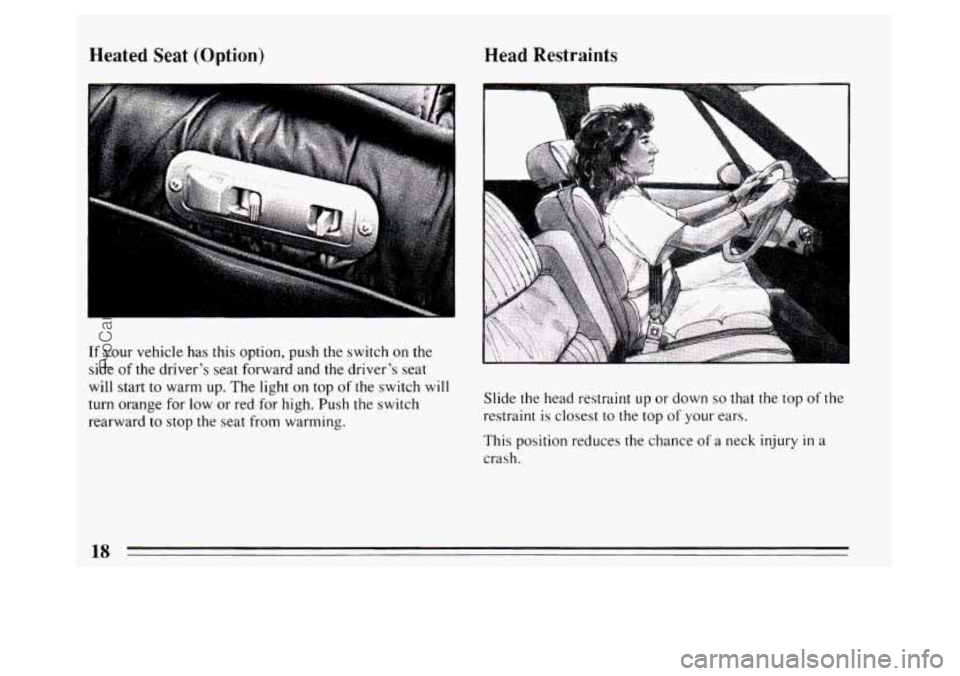
Heated Seat (Option)
If your vehicle has this option, push the switch on the
side of the driver’s seat forward and the driver’s seat
will start
to warm up. The light on top of the switch will
turn orange for low or red for high. Push the switch
rearward
to stop the seat from warming.
Head Restraints
Slide the head restraint up or down so that the top of the
restraint is closest
to the top of your ears.
This position reduces the chance
of a neck injury in a
crash.
18
ProCarManuals.com
Page 81 of 324
New Vehicle “Break-In”
NOTICE:
Your modern Buick doesn’t need an elaborate
“break-in.” But
it will perform better in the long
run if you follow these guidelines:
1. Don’t drive at any one speed -- fast or slow
-- for the first 500 miles (804 km). Don’t
make full-throttle starts.
2. Avoid making hard stops for the first 200
miles (322 km) or so. During this time your
new brake linings aren’t yet broken
in. Hard
stops with new linings can mean premature
wear and earlier replacement. Follow this
“breaking-in” guideline every time you get
new brake linings.
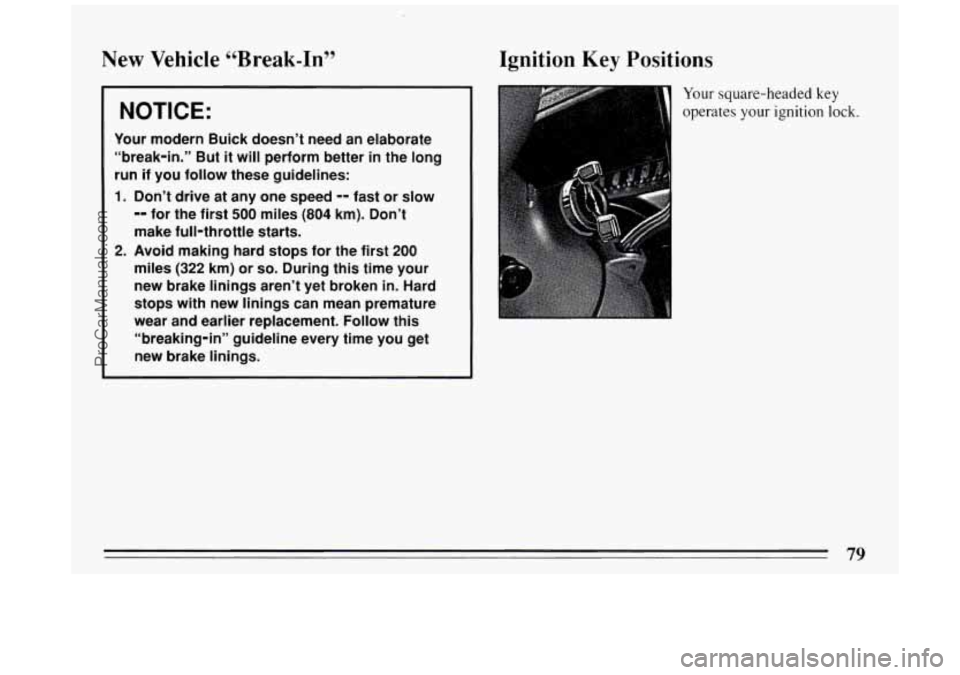
Ignition Key Positions
Your square-headed key
operates your
ignition lock.
79
ProCarManuals.com
Page 83 of 324

Retained Accessory Power (Option)
After the ignition is turned off, and before any door is
opened, the following systems will work for
ten
minutes:
0 Power Windows
0 Radio
Optional Astroroof
Starting Your Engine
Move your shift lever to “P” (Park) or “N” (Neutral).
Your engine won’t start
in any other position -- that’s a
safety feature.
To restart when you’re already moving,
use “N” (Neutral) only.
NOTICE:
Don’t try to shift to “P” (Park) if your Buick is
moving. If you do, you could damage the
transaxle. Shift to
“P” (Park) only when your
vehicle
is stopped.
1. Without pushing the accelerator pedal, turn your
ignition key to “Start.” When the engine starts, let go
of the key. The idle speed will go down as your
engine gets warm.
I NOTICE:
Holding your key in “Start” for longer than 15
seconds at a time will cause your battery to be
drained much sooner.
And the excessive heat
can damage your starter motor.
2. If it doesn’t start right away, hold your key in “Start”
for about three to five seconds at a time
until your
engine starts.
Wait about 15 seconds between each
try to help avoid draining your battery.
ProCarManuals.com
Page 84 of 324
3. If your engine still won’t start (or starts but then
stops),
it could be flooded with too much gasoline.
Try pushing your accelerator pedal all the way to the
floor and holding
it there as you hold the key in
“Start” for about three seconds. If the car starts
briefly but then stops again, do the same thing, but
this time keep the pedal down for five or
six seconds.
This clears the extra gasoline from the engine. After
waiting about
15 seconds, repeat the normal starting
procedure.
NOTICE:
Your engine is designed to work with the
electronics in your vehicle.
If you add electrical
parts or accessories, you could change the way
the fuel injection system operates. Before adding
electrical equipment, check with your dealer.
If
you don’t, your engine might not perform
properly.
If you ever have to have your vehicle towed, see
the part of this manual that tells how to
do it
without damaging your vehicle. See “Towing
Your Car”
in the Index.
Driving Through Deep Standing
Water
I NOTICE:
If you drive too quickly through deep puddles or
standing water, water can come
in through your
engine’s air intake and badly damage your
engine.
If you can’t avoid deep puddles or
standing water, drive through them very slowly.
Engine Coolant Heater (Engine Block
Heater) (Canada Only)
In very cold weather, 0°F (- 18 “C) or colder, the engine
coolant heater can help. You’ll get easier starting and
better fuel economy during engine warm-up. Usually,
the coolant heater should be plugged
in a minimum of
four hours prior to starting your vehicle.
To use the coolant heater:
1. Turn off the engine.
2. Open the hood and unwrap the electrical cord.
3. Plug it into a normal, grounded 1 10-volt outlet.
82
ProCarManuals.com
Page 86 of 324
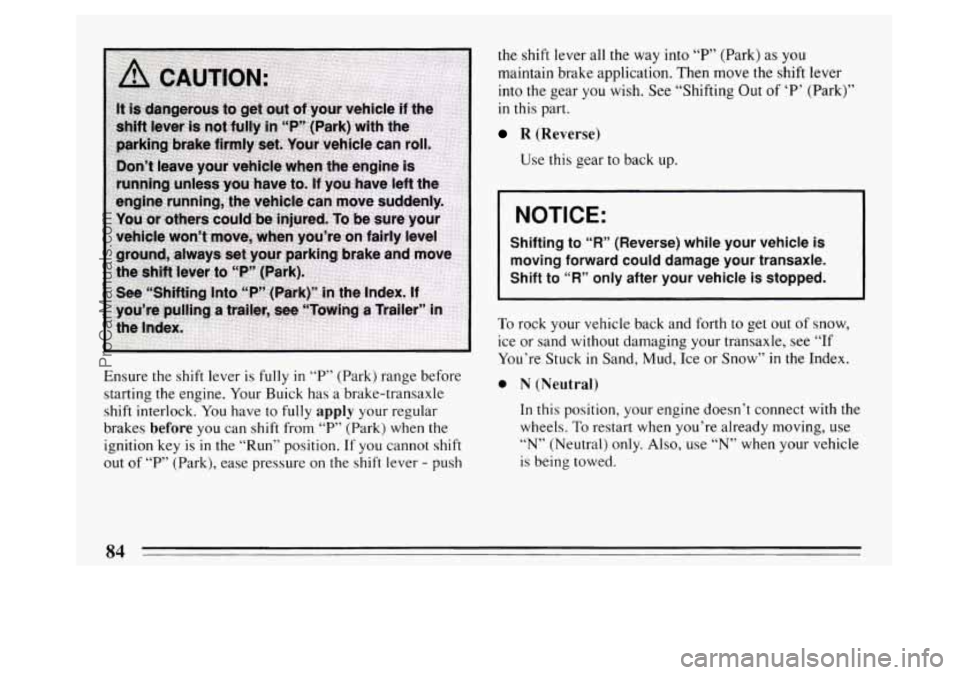
Ensure the shift lever is fully in T’ (Park) range before
starting the engine. Your Buick has a brake-transaxle
shift interlock. You have
to fully apply your regular
brakes
before you can shift from “P” (Park) when the
ignition key
is in the “Run” position. If you cannot shift
out of “P’ (Park), ease pressure on the shift lever - push the
shift lever all the way into
“P’ (Park) as you
maintain brake application. Then move the shift lever
into the gear
you wish. See “Shifting Out of ‘P’ (Park)”
in this part.
R (Reverse)
Use this gear to back up.
NOTICE:
Shifting to “R” (Reverse) while your vehicle is
moving forward could damage your transaxle.
Shift to “R” only after your vehicle is stopped.
I
To rock your vehicle back and forth to get out of snow,
ice or sand without damaging your transaxle, see
“If
You’re Stuck in Sand, Mud, Ice or Snow” in the Index.
0 N (Neutral)
In this position, your engine doesn t connect with the
wheels.
To restart when you’re already moving, use
“N” (Neutral) only. Also, use “N” when your vehicle
is being towed.
84
ProCarManuals.com
Page 98 of 324
Headlight High-Low Beam
BRIGHT
Windshield Wipers
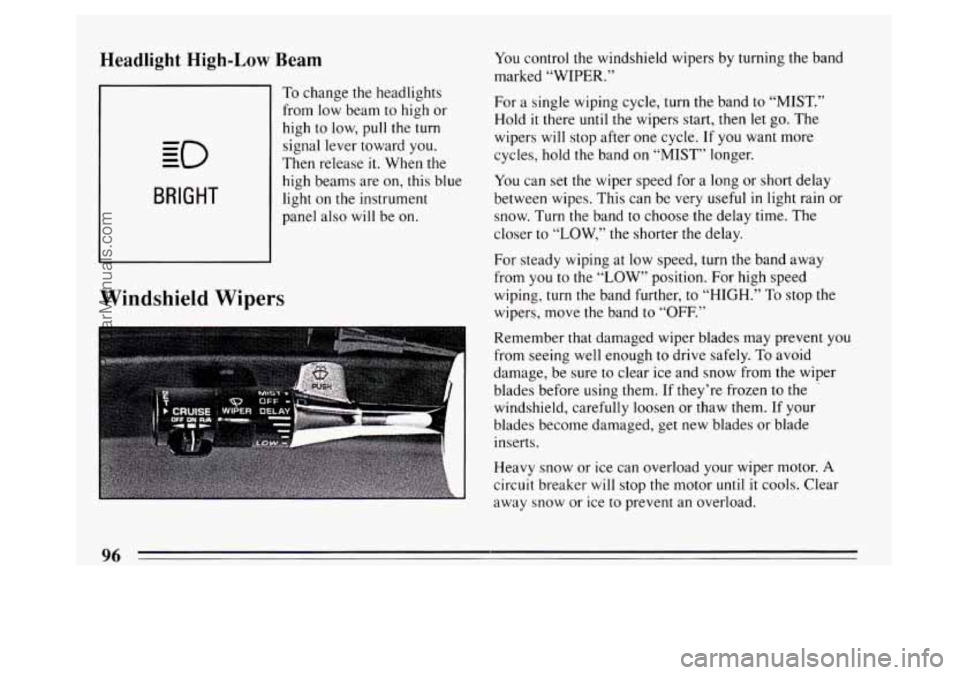
To change the headlights
from low beam to high or
high to low,
pull the turn
signal lever toward you.
Then release
it. When the
high beams are on, this blue
light on the instrument
panel also will be on. You
control the windshield wipers by turning the band
marked
“WIPER.”
For a single wiping cycle, turn the band to “MIST.”
Hold
it there until the wipers start, then let go. The
wipers will stop after one cycle. If you want more
cycles, hold the band on “MIST” longer.
You can set the wiper speed for a long or short delay
between wipes. This can be very useful
in light rain or
snow. Turn the band to choose the delay time. The
closer to
“LOW,” the shorter the delay.
For steady wiping at low speed, turn the band away
from you to the
“LOW” position. For high speed
wiping, turn the band further,
to “HIGH.” To stop the
wipers, move the band to “OFF.”
Remember that damaged wiper blades may prevent you
from seeing well enough to drive safely.
To avoid
damage, be sure to clear ice and snow from the wiper
blades before using them. If they’re frozen to
the .
windshield, carefully loosen or thaw them. If your
blades become damaged, get new blades or blade
inserts.
Heavy snow or ice can overload your wiper motor.
A
circuit breaker will stop the motor until it cools. Clear
away snow or ice to prevent an overload.
96
ProCarManuals.com
Page 109 of 324

Lamp Monitors (Option)
This system will let you know when certain exterior
light bulbs fail. When you start your car all eight lights
come on briefly to show that the system is working.
When a bulb Fails an indicator
will flash for several
seconds and then stay on
until the failed bulb is replaced
and
lit. For example, if a burned out back-up light bulb
is replaced, the indicator for back-up lamps will stay on
until the transaxle is put in reverse with the ignition on.
The bulbs are monitored only while they are being used.
If you have recently had a low battery condition or the
battery has been disconnected and reconnected, the
indicators will flash when
you turn the ignition switch to
RUN. Turning on the parking lamps will return the lamp
monitor system
to normal operation.
Bulbs Monitored
Indicator
High Beam
Low Beam Left Turn
Right Turn
Tail
Parking stop
Backup
Bulbs Monitored
Both Headlight
High Beams
Both Headlight
Low Beams
1 Front Left Turn/Park
2 Rear Left Turn/Stop
1 Front Right Turnpark
2 Rear Right Turn/Stop
2 Tail Only
4 Tail/Turn
Right and Left Rear
Side Marker
2 License
2 Park/Turn
2 Front Park
Right and Left Front Side Marker
4 Rear Stop/Turn
1 Center High Mounted
2 Back up
107
ProCarManuals.com
Page 113 of 324
Heated Outside Rearview Mirror (Option)
If you have this option, the left outside mirror is heated
when you activate the rear window defogger.
Convex Outside Mirror
Your right side mirror is convex.
A convex mirror’s surface is curved so you can see more
from
the driver’s seat.
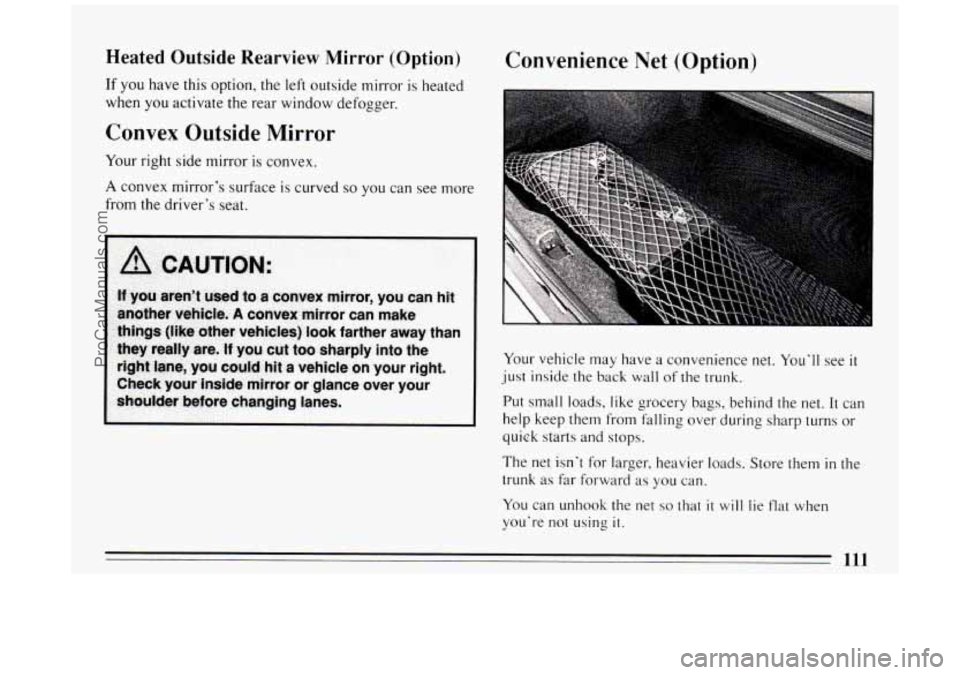
Convenience Net (Option)
Your vehicle may have a convenience net. You’ll see it
just inside the back wall of the trunk.
Put small loads, like grocery bags, behind the net.
It can
help keep them from falling over during sharp turns or
quick starts and stops.
The net isn’t for larger, heavier loads. Store them
in the
trunk as far forward as you can.
You can unhook the net
so that it will lie flat when
you‘re not using
it.
111
ProCarManuals.com