Page 244 of 324
Engine Oil Additives
Don’t add anything to your oil. Your Buick dealer is
ready to advise if you think something should be added.
When to Change Engine Oil
See if any one of these is true for you:
Most trips are less than 4 miles (6 km).
It’s below freezing outside and most trips are less
than
10 miles (16 km).
The engine is at low speed most of the time (as in
door-to-door delivery, or in stop-and-go traffic).
0 You tow a trailer often.
Most trips are through dusty places.
If any one of these is true for your vehicle, then you
need to change your oil and filter every
3,000 miles
(5 000 km) or 3 months -- whichever comes first. (See
“Change Oil Soon” in the Index.) If
none of
them is true, change the oil every 7,500 miles
(12 500 km) or 12 months -- whichever comes first.
Change the filter at the first oil change and at every
other oil change after that.
If the optional “Change Oil Soon” light comes on you
will need to change your oil sooner than either mileage
specified. Depending upon driving habits, the “Change
Oil Soon’’ light may come on
as early as 2,000 miles or
less from the last time the oil life monitor was reset (See
“Oil Life Monitor” in the Index.)
Always reset the oil
life monitor after every oil change.
Engine Coolant Heater (Engine Block
Heater)
An engine coolant heater can be a big help if you have
to park outside in very cold weather,
0°F (- 18 “C) or
colder. If your vehicle has this option, see “Engine
Coolant Heater” in the Index.
242
ProCarManuals.com
Page 258 of 324
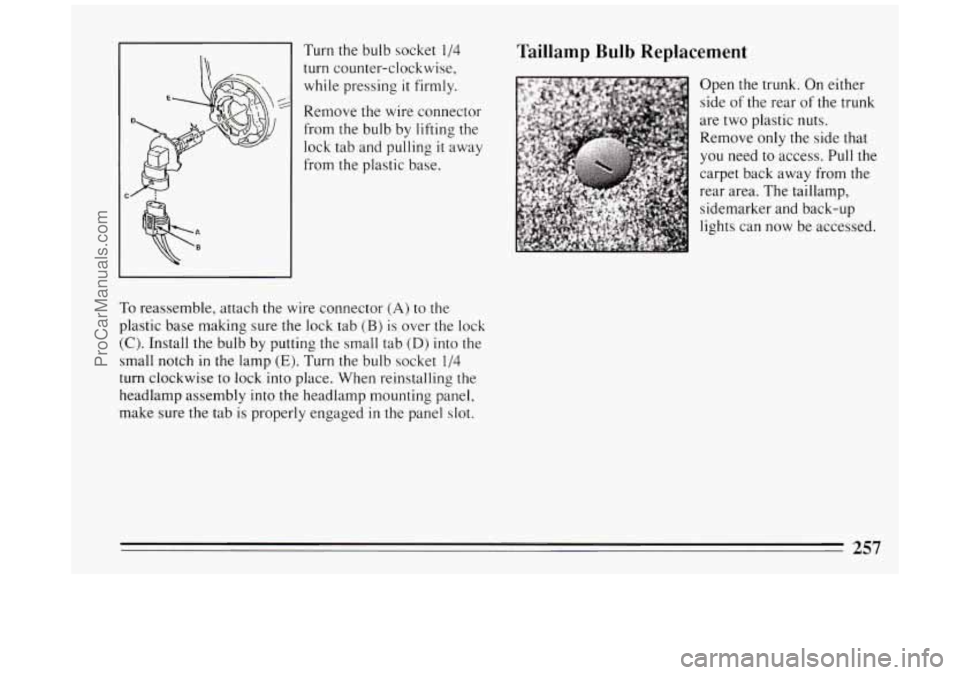
Headlamp Bulb Replacement Remove the retainers by turning in a counter-clockwise
direction.
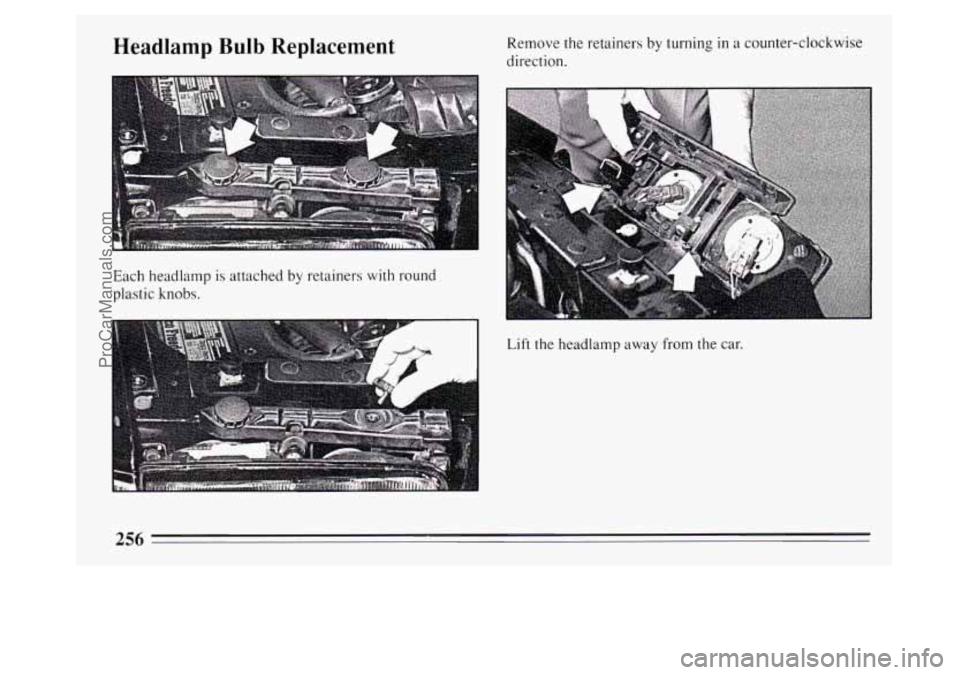
Each headlamp
is attached by retainers with round
plastic knobs.
Lift the headlamp away from the car.
256
ProCarManuals.com
Page 259 of 324
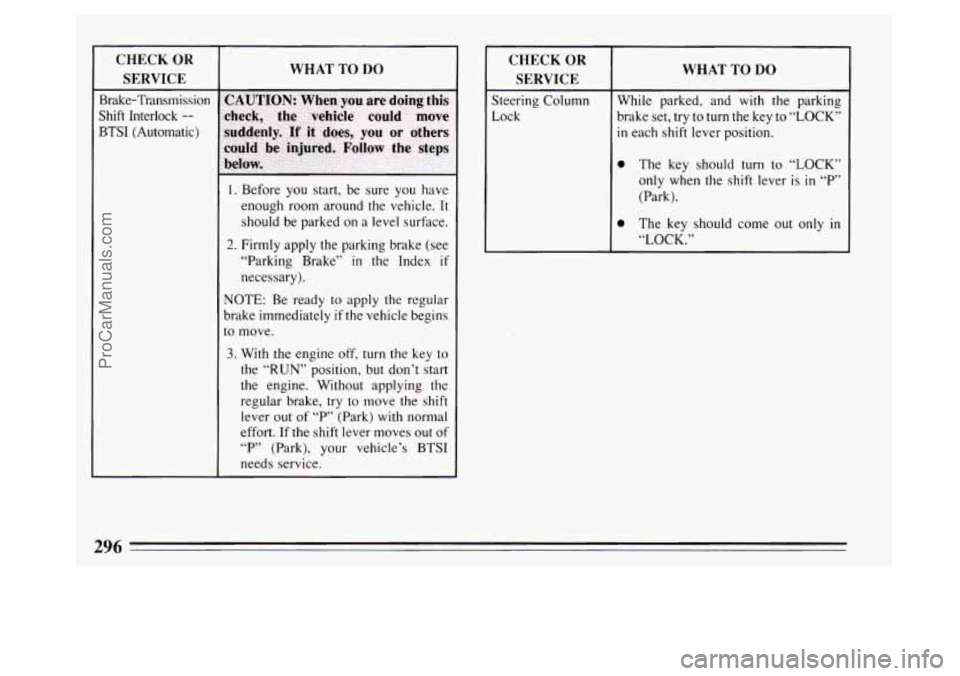
Turn the bulb socket 1/4
turn counter-clockwise,
while pressing
it firmly.
Remove
the wire connector
from the bulb by lifting
the
lock tab and pulling it away
from the plastic base.
To reassemble, attach the wire connector (A) to the
plastic base making sure the lock tab
(B) is over the lock
(C). Install the bulb by putting the small tab (D) into the
small notch
in the lamp (E). Turn the bulb socket 1/4
turn clockwise to lock into place. When reinstalling the
headlamp assembly
into the headlamp mounting panel,
make sure
the tab is properly engaged in the panel slot.
Taillamp Bulb Replacement
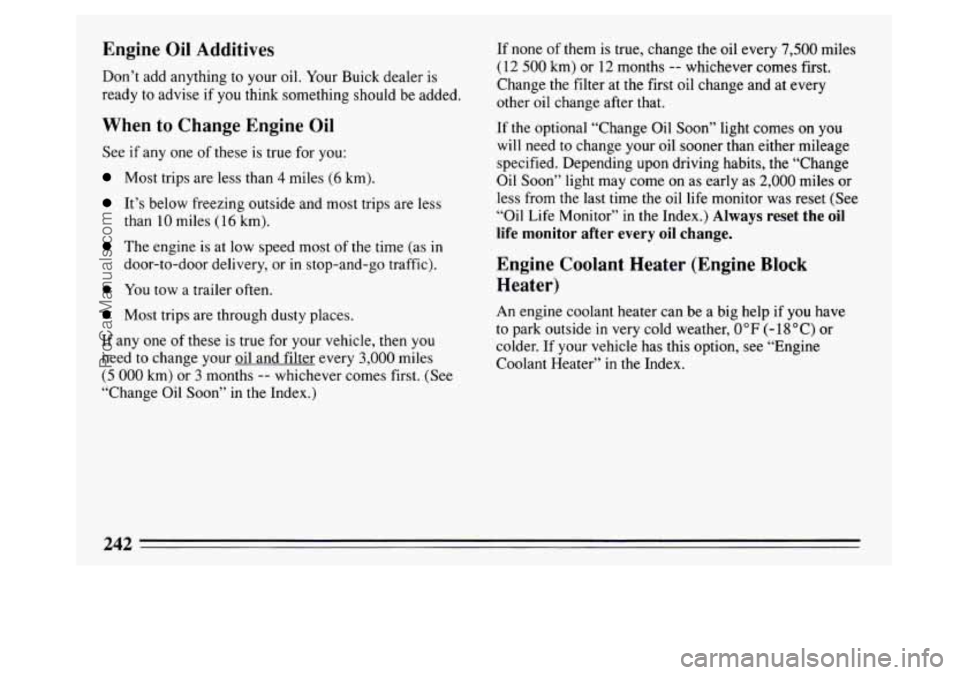
Open the trunk. On either
side
of the rear of the trunk
are two plastic nuts.
Remove only the side that
you need
to access. Pull the
carpet back away from the
rear area. The taillamp,
sidemarker and back-up
lights can now be accessed.
257
ProCarManuals.com
Page 260 of 324
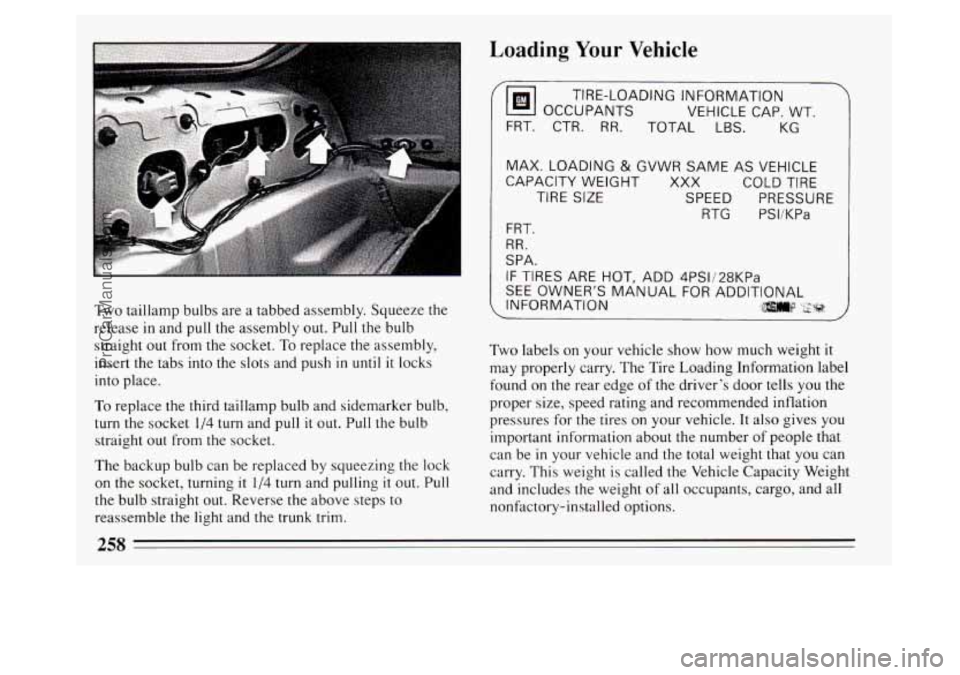
Two taillamp bulbs are a tabbed assembly. Squeeze the
release
in and pull the assembly out. Pull the bulb
straight out from the socket. To replace the assembly,
insert the tabs into the slots and push
in until it locks
into place.
To replace the third taillamp bulb and sidemarker bulb,
turn the socket 1/4 turn and pull it out. Pull the bulb
straight out from the socket.
The backup bulb can be replaced by squeezing the lock
on the socket, turning it
1/4 turn and pulling it out. Pull
the bulb straight out. Reverse the above steps to
reassemble the light and the trunk trim.
Loading Your Vehicle
%I OCCUPANTS
VEHICLE CAP. WT.
TIRE-LOADING INFORMATION
FRT. CTR.
RR. TOTAL LBS. KG
MAX. LOADING
& GVWR SAME AS VEHICLE
CAPACITY WEIGHT XXX
COLD TIRE
TIRE
SIZE SPEED PRESSURE
RTG PSliKPa
FRT.
RR.
SPA.
IF TIRES ARE HOT, ADD 4PS1/28KPa
SEE OWNER'S MANUAL FOR ADDITIONAL
( INFORMATION \]]!mlp ,j;;f&ip
Two labels on your vehicle show how much weight it
may properly carry. The Tire Loading Information label
found on the rear edge of the driver's door tells
you the
proper size, speed rating and recommended inflation
pressures for the tires on your vehicle.
It also gives you
important information about the number of people that
can be
in your vehicle and the total weight that you can
carry. This weight is called the Vehicle Capacity Weight
and includes the weight
of all occupants, cargo, and all
nonfactory-installed options.
ProCarManuals.com
Page 280 of 324
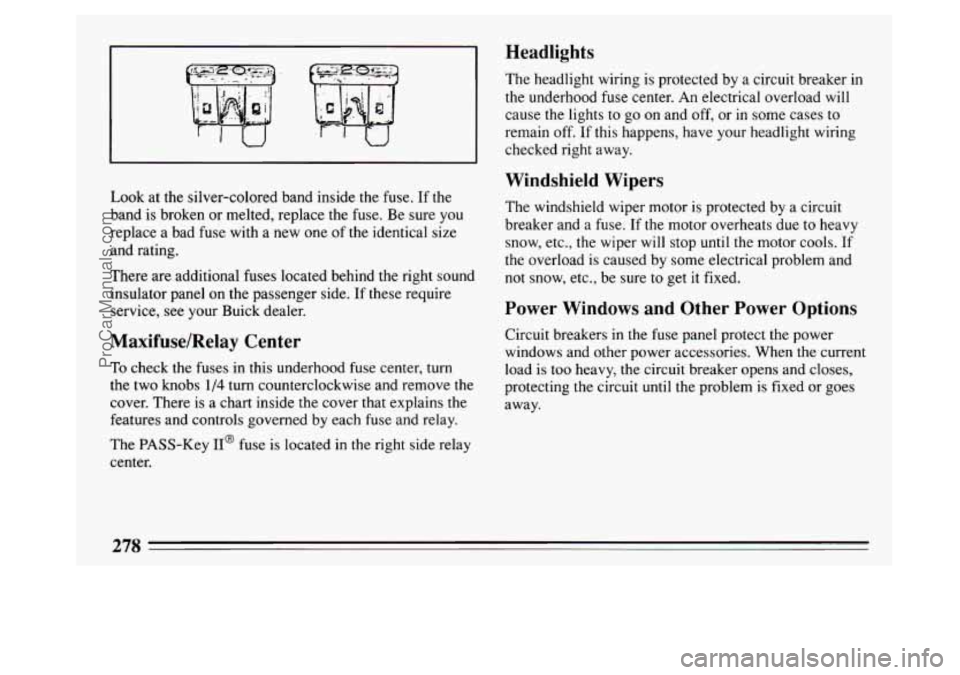
Look at the silver-colored band inside the fuse. If the
band is broken or melted, replace the fuse. Be sure
you
replace a bad fuse with a new one of the identical size
and rating.
There are additional fuses located behind the right sound
insulator panel on the passenger side. If these require
service, see your Buick dealer.
Maxifuse/Relay Center
To check the fuses in this underhood fuse center, turn
the two knobs
1/4 turn counterclockwise and remove the
cover. There is a chart inside the cover that explains the
features and controls governed by each fuse and relay.
The PASS-Key
II@ fuse is located in the right side relay
center.
Headlights
The headlight wiring is protected by a circuit breaker in
the underhood fuse center. An electrical overload will
cause the lights to go on and off, or in some cases to
remain off. If this happens, have your headlight wiring
checked right away.
Windshield Wipers
The windshield wiper motor is protected by a circuit
breaker and a fuse. If
the motor overheats due to heavy
snow, etc., the wiper will
stop until the motor cools. If
the overload is caused by some electrical problem and
not snow, etc., be sure to get it fixed.
Power Windows and Other Power Options
Circuit breakers in the fuse panel protect the power
windows and other power accessories. When the current
load is too heavy, the circuit breaker opens and closes,
protecting the circuit until the problem
is fixed or goes
away.
278
ProCarManuals.com
Page 297 of 324
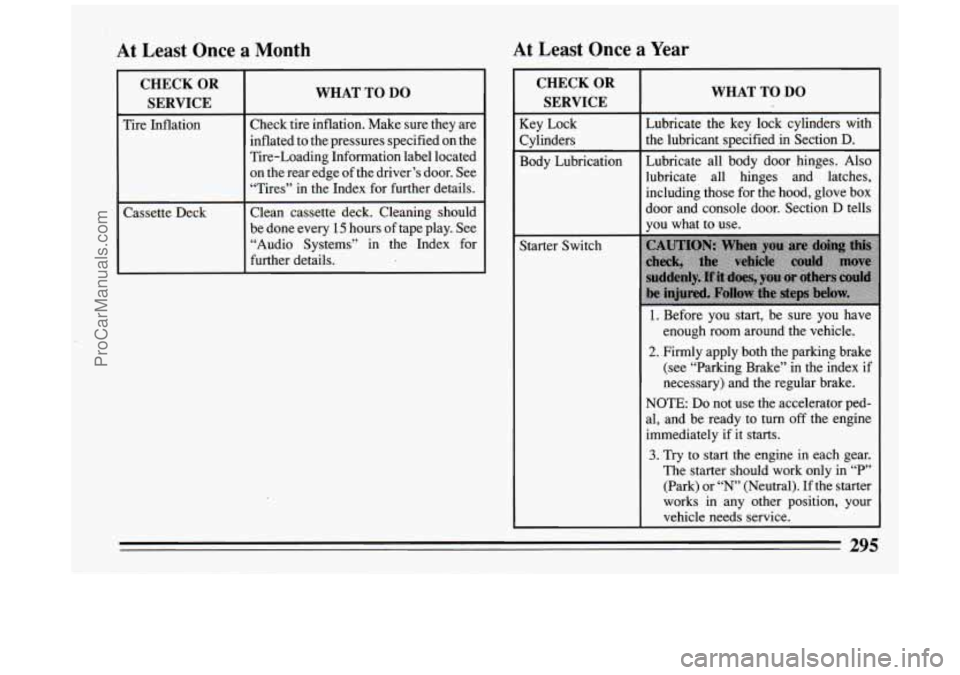
At Least Once a Month At Least Once a Year
CHECKOR SERVICE I
WHAT TO DO
Tire Inflation
Tire-Loading Information label located
inflated to the pressures specified on the Check
tire inflation. Make sure they are
on the rear edge of the driver’s door. See
“Tires” in the Index for further details.
Cassette Deck Clean cassette deck. Cleaning should
be done every
15 hours of tape play. See
“Audio Systems”
in the Index for
further details.
CHECK OR
SERVICE
Key Lock
Cylinders
Body Lubrication
Starter Switch
WHAT TO DO
Lubricate the key lock cylinders with
the lubricant specified in Section
D.
Lubricate all body door hinges. Also
lubricate all hinges and latches,
including those for the hood, glove box
joor and console door. Section
D tells
you what to use.
1. Before you start, be sure you have
enough room around
the vehicle.
2. Firmly apply both the parking brake
(see “Parking Brake” in the index
if
necessary) and the regular brake.
NOTE:
Do not use the accelerator ped-
al, and
be ready to turn off the engine
immediately if it starts.
3. Try to start the engine in each gear.
The starter should work only in
“P’
(Park) or “N’ (Neutral). If the starter
works in any other position, your
vehicle needs service.
295
ProCarManuals.com
Page 298 of 324
CHECK OR
SERVICE
Brake-Transmission
Shift Interlock
--
BTSI (Automatic)
WHAT TO DO
I. Before you start, be sure you have
enough room around the vehicle.
It
should be parked on a level surface.
2. Firmly apply the parking brake (see
“Parking Brake”
in the Index if
necessary).
NOTE: Be ready to apply the regular
brake immediately
if the vehicle begins
to move.
3. With the engine off, turn the key to
the
“RUN’ position, but don’t start
the engine. Without applying the
regular brake, try to move the shift lever out of “P” (Park) with normal
effort. If the shift lever moves out of
“P” (Park), your vehicle’s BTSI
needs service.
WHAT TO DO
Steering Column
brake set, try to turn the key to
“LOCK” Lock
While parked, and with the parking
in each shift lever position.
0 The key should turn to “LOCK”
only when the shift lever is
in “P’
0 The key should come out only in
1 “LOCK.”
296
ProCarManuals.com
Page 301 of 324
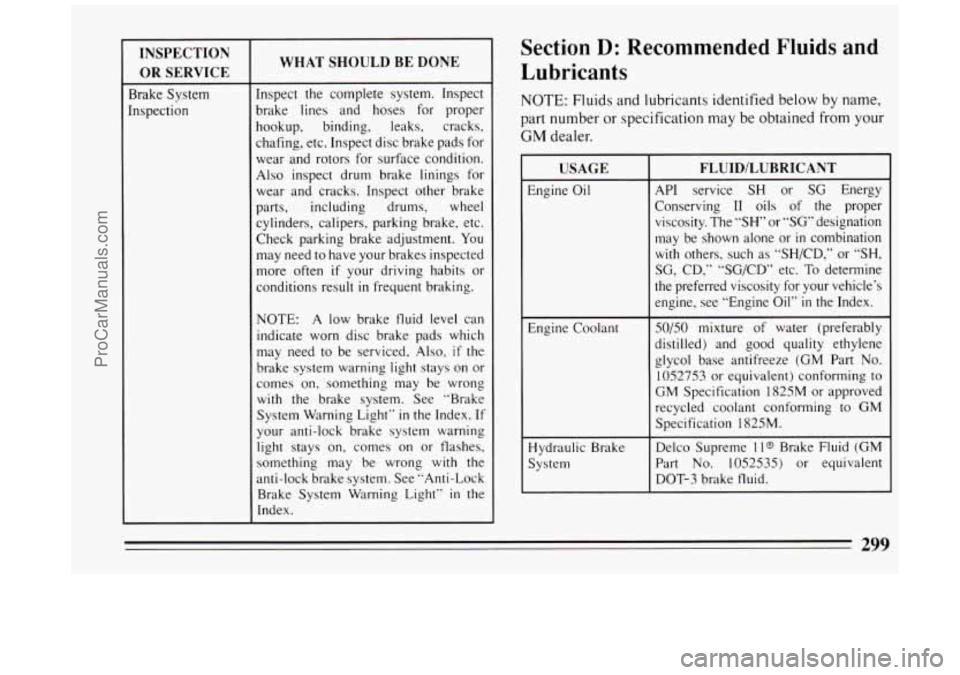
INSPECTION
OR SERVICE
Brake System
[nspection
WHAT SHOULD BE DONE
Inspect the complete system. Inspect
brake
lines and hoses for proper
hookup, binding, leaks, cracks,
chafing, etc. Inspect disc brake pads for
wear and rotors for surface condition.
Also inspect drum brake linings for
wear and cracks. Inspect other brake
parts, including drums, wheel
cylinders, calipers, parking brake, etc.
Check parking brake adjustment. You
may need
to have your brakes inspected
more often if your driving habits or
conditions result
in frequent braking.
NOTE:
A low brake fluid level can
indicate worn disc brake pads which
may need to be serviced, Also,
if the
brake system warning light stays on or
comes
on, something may be wrong
with the brake system. See ”Brake
System Warning Light”
in the Index. If
your anti-lock brake system warning
light stays on, comes on or flashes,
something may
be wrong with the
anti-lock brake system. See “Anti-Lock
Brake System Warning Light”
in the
Index.
Section D: Recommended Fluids and
Lubricants
NOTE: Fluids and lubricants identified below by name,
part number or specification may be obtained from your
GM dealer
I USAGE FLUID/LUBRICANT
API service
SH or SG Energy
Conserving I1 oils
of the proper
viscosity. The
“SH” or “SG” designation
may be shown alone or
in combination
with others, such as “SH/CD,” or
“SH,
SG, CD,” “SG/CD” etc. To determine
the preferred viscosity for your vehicle’s
engine, see “Engine Oil”
in the Index.
S0/50 mixture of water (preferably
distilled) and good quality ethylene
glycol base antifreeze
(GM Part No.
1052753 or equivalent) conforming to
GM Specification 182SM or approved
recycled coolant conforming to
GM
Specification 182SM.
Delco Supreme
1 I@ Brake Fluid (GM
Part
No. 1052535) or equivalent
DOT-3 brake fluid.
~ 299
ProCarManuals.com