1993 VOLKSWAGEN GOLF ECU
[x] Cancel search: ECUPage 16 of 156
Downloaded from www.Manualslib.com manuals search engine CONTROLS AND EQUIPMENT
--------------------------------------------------------------------------------~
General notes
• The belt must not be twisted.
• Two persons (including children) must never be secured with one belt.
• The be lts give maximum prot ection only in the correct seat position -see page 25.
• The belt shou
ld not be worn over hard or
breakable articles (glasses, bal l pens etc.) because this can cause injury to the body .
• Loose, bulky clothing (e.g. overcoats
over Jackets) affects the
fit and funct ion of
the belts .
• The lock tongue may only be inserted
into the lock part belonging to the approp
riate seat otherwise, the protect ive effect is impaired.
• The belts
must be kep t clea n otherwise
the redactors may not work prope rly (see
a lso" Care of car" section) •
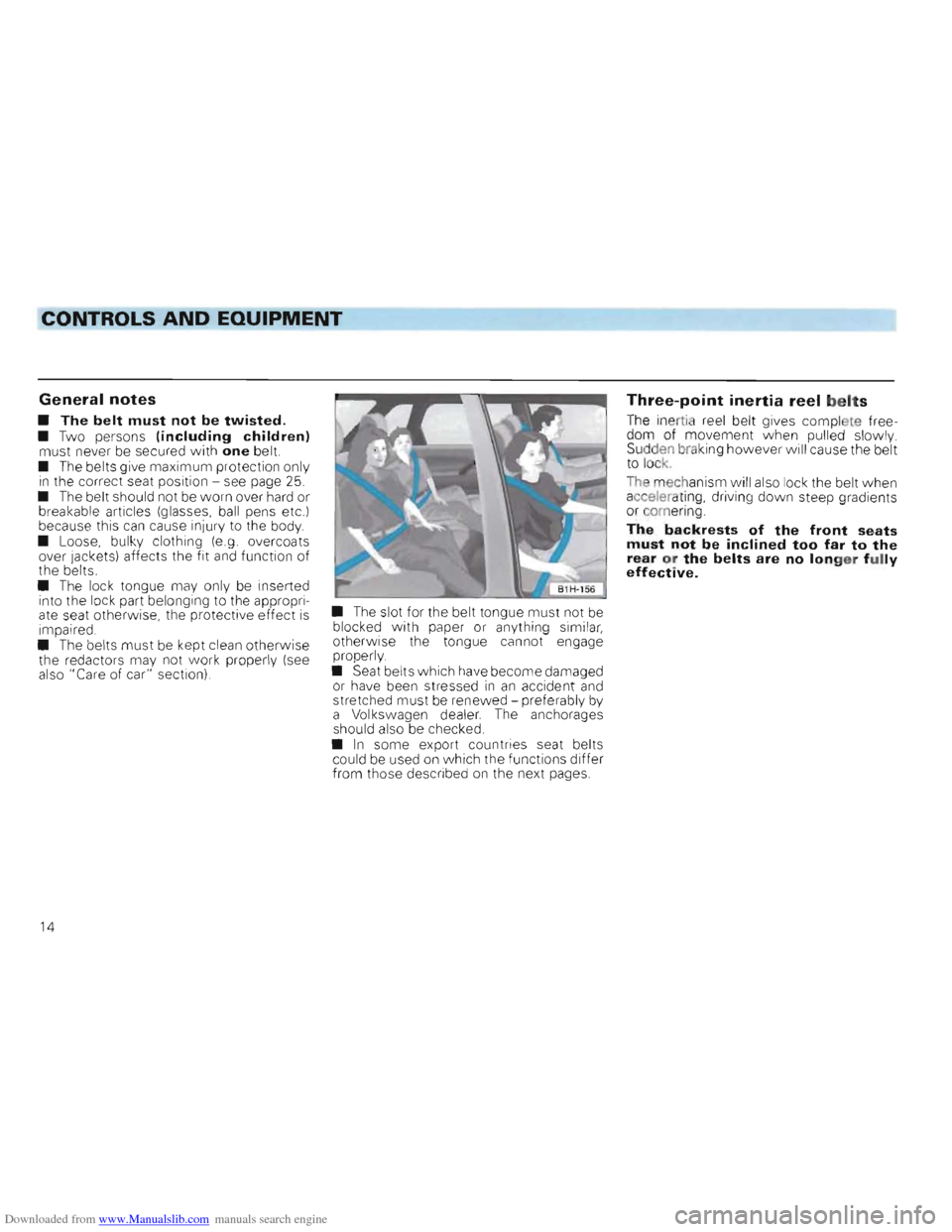
The
slot for the belt tongue must not be
blocked with paper or anything similar, otherwise the tongue cannot engage
proper ly.
• Seat belts which have become damaged
or have been stressed in an accident and
stretched must be renewed -preferab ly by
a
Vol kswagen dealer. The anchorages
should also be checked .
•
In some export countries seat belts
co uld be used on w hich the functio ns differ
from those described on the next pages.
Three-point inertia reel belts
The ine rtia ree l belt gives complete free
do m o f mov ement when pul[ed slowly.
Sud den brak ing
however will cause the belt
to loc k.
Th e mec hanism w
il[ a lso lock the belt w hen acc eler ati ng, driving down steep gradients
o r cornering.
The backrests of the front seats must not be inclined too far to th e rear or the belts are no longer fully effective.
14
Page 30 of 156
Downloaded from www.Manualslib.com manuals search engine CONTROLS AND EQUIPMENT
Luggage compartment
In the interests of good handling ensure that
the load (persons and luggage) is distributed
e ven ly. Heavy items should always be car
ried as near to the rear axle as possible or
better still, between the axles. The permissible axle and gross weights must on no account be exceeded see page 143.
Attention • It should be noted that when transporting heavy items the handling will change due to the displacement of the centre of gravity. Driving style and speed must be altered to suit. • The load must be stowed so that no items of luggage can fly forward if brakes are applied suddenly.
One should ensure that
- the heater element
wires in the rear window are not damaged by articles rubbing
against them and
- the ventilation slots
in the luggage com
partment side trim * are not co vered .
Attention
Never drive with the tailgate not properly closed as exhaust gas
can then be drawn into the vehicle interior.
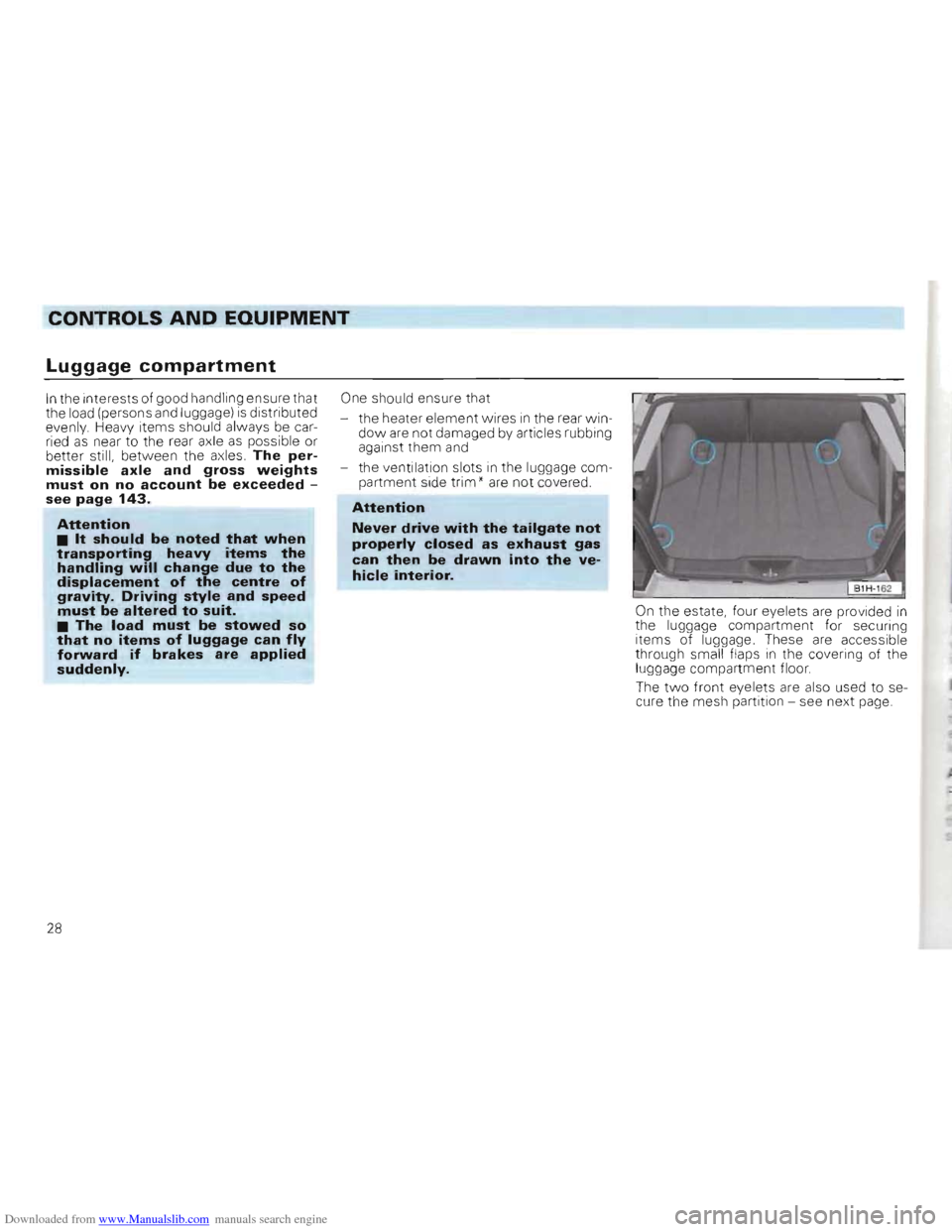
On the estate , four eye lets are provided in the luggage compartment fo r secur ing
items of luggage. These are accessib le
thr ough small flaps in the covering of the luggage compartment floor.
The
two front eyelets are also used to se
cure the mesh partition -see next page.
28
Page 31 of 156
Downloaded from www.Manualslib.com manuals search engine CONTROLS AND EQUIPMENT
esh partition* (Estate)
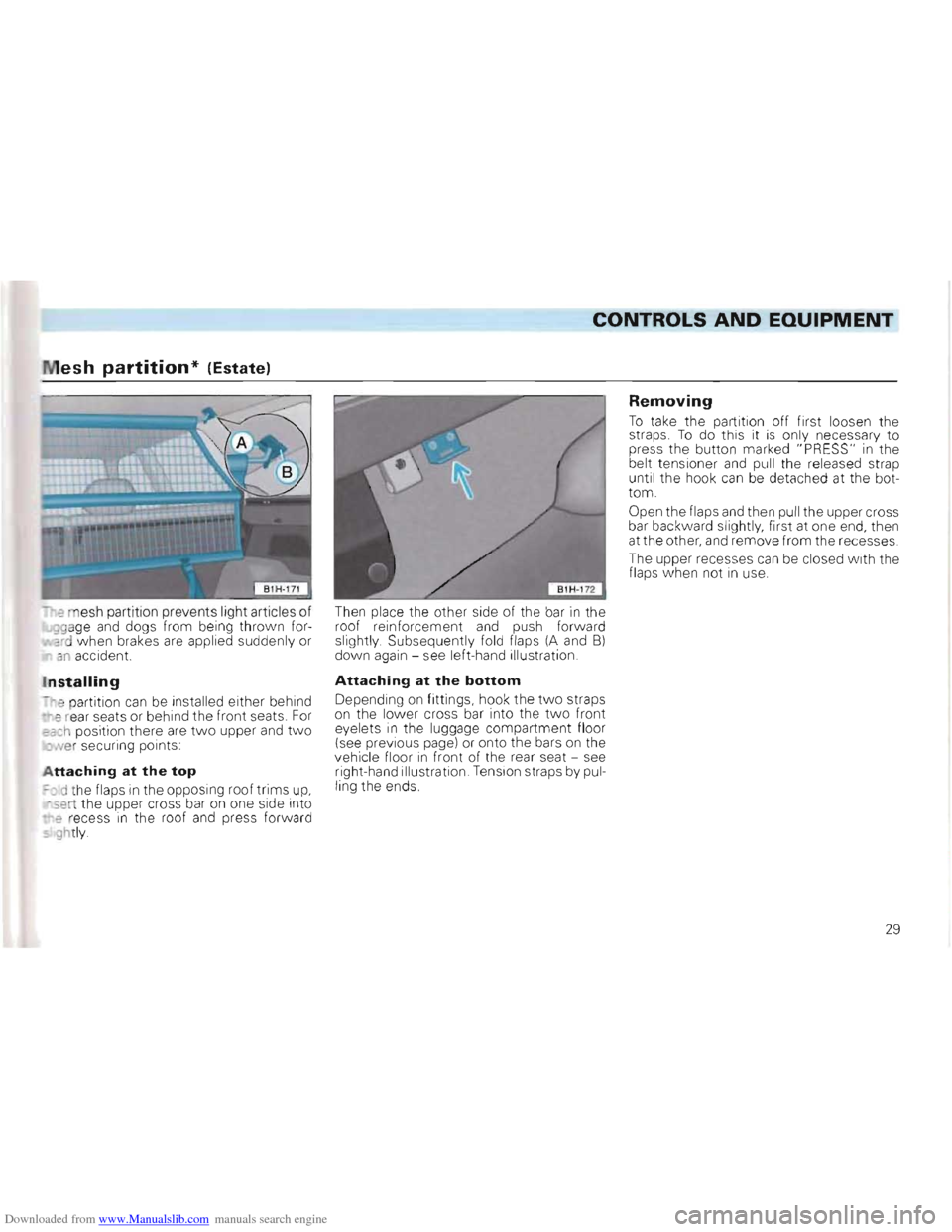
e m esh partit ion prevents light articles of '99age and dogs from being thrown forard when brakes are applied suddenly or ~ an accident.
Installing
-"e part ition can be installed either behind "9 rear seat s or behind the front seats. For "'a::h position there are two upper and two ~ ve r securing points:
Attaching at the top
~:)Id the flaps in the opposing roof trims up, 5ert the upper cross bar on one side into
• e recess in the roof and press forward 5' ghtly. Then
place the other side of the bar
in the
r o of reinforcement and push forward slightly Subsequently fold flaps (A and 8)
down again -see left-hand illustration.
Attaching at the bottom
Depending on fittings, hook the tw o straps
on the lower cross bar into the tw o front
e yelets
in the luggage compartment floor
( see previous page) or onto the bars on the
vehicle floor in front of the rear seat -see
right-hand illustration . Ten sion straps by pul
ling the ends .
Removing
To take the partition off first loosen the straps . To do this it is only necessary to
press the button marked "PRESS" in the
belt tensioner and pull the released strap
until the hook can be detached at the bot
tom.
Open the flaps
and then pull the upper cross
bar bac kward slightly, first at one end, then
at the other, and remo ve from the recesses .
The upper recesses
can be closed with the
flaps when not in use.
29
Page 32 of 156
Downloaded from www.Manualslib.com manuals search engine CONTROLS AND EQUIPMENT
Luggage compartment cover / Folding/sliding cover*
Articles of clothing can be placed on the luggage compartment cover.
Attention Do not place heavy hard articles on the luggage compartment cover or folding/sliding cover they could endanger the vehicle occupants or damage the folding/sliding cover if the brakes are applied suddenly_
Furthermore, the heater element wires in
the heated rear window could be damaged
by articles rubbing against them.
The folding/s liding cover
can be pushed to
gether to the front or rear .
When the tailgate of the saloo n is opened ,
the luggage compartment cover is also
lifted .
If large items of lug gag e are to be carried,
the cover
can be removed:
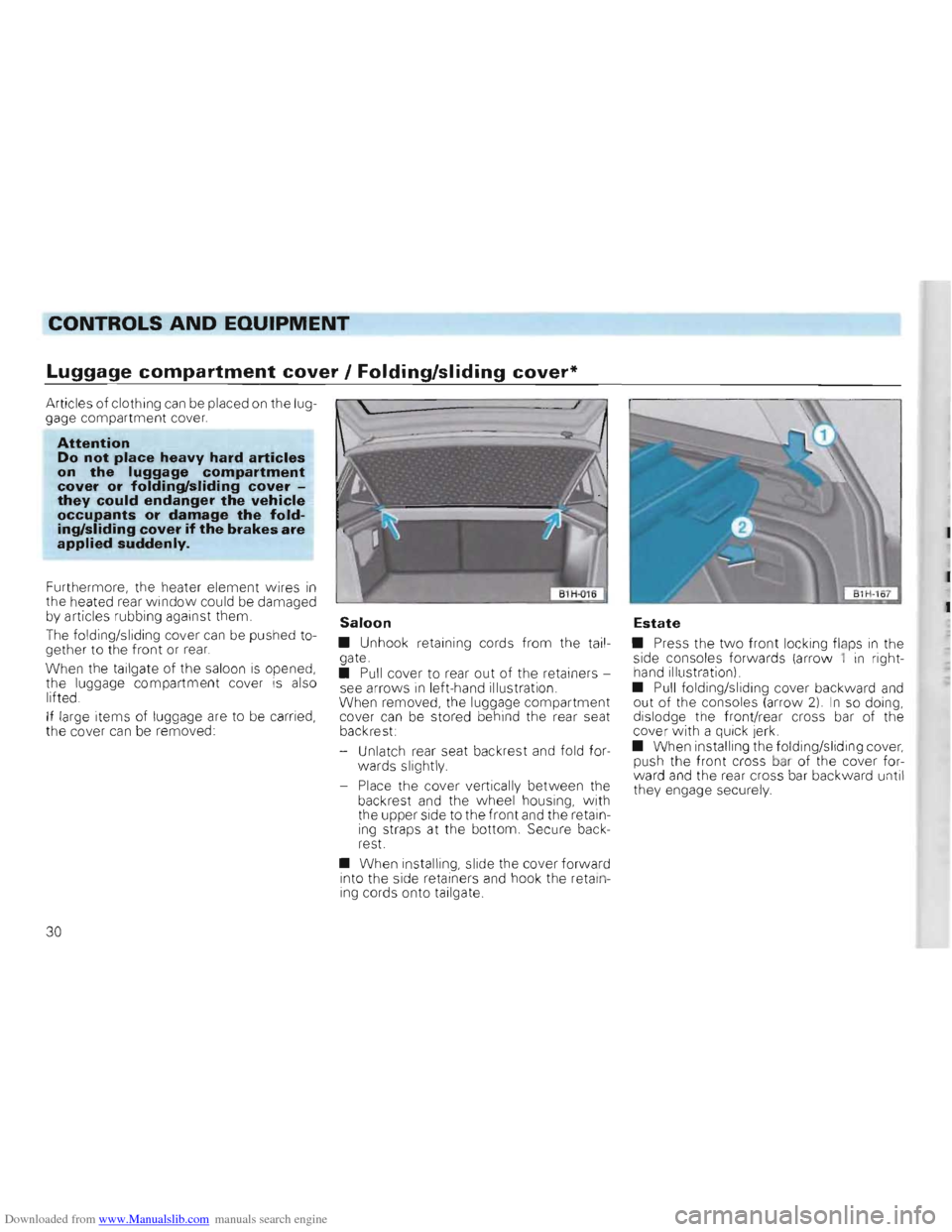
Saloon
• Unhook retaining cords fro m the tailgate.
• Pull cover to rear out of the retainers
see arrow s in left-hand illustration.
When removed, the luggag e co mpartment
cover
can be stored behind the rear seat
backrest:
- Unlat
ch rear seat backrest and fold for
wards slightly.
- Place the cove r vertically between the back rest and the wheel housing, with the upper side to the front and the retain
ing straps at the bottom. Secu re back
r est.
• When installing , slide the cover forward
into the side retainers and hook the retain
ing cords onto tailgate.
Estate
• Press the two front locking flaps in the
side consoles forwards (arrow 1 in right
hand illus tration).
•
Pull fo lding/sliding cover backward and out of the consoles (arrow 2) I n so doing,
dislodge th e front/ rear cross bar of the
cover with a qUi ck jerk.
• When
installing the folding/s liding cover, push the front cross bar of the cover for
ward and the rear cross ba r backward un til
the y engage securely.
30
Page 72 of 156
Downloaded from www.Manualslib.com manuals search engine CONTROLS AND EQUIPMENT
Roof rack I roof railing
When loads are to be carried on the roof, the
following should be noted:
• As the
rain channels are moulded into
the roof for streamlining reasons, the nor
mal type of roof rack cannot be used . To avoid ri sks we advise that on ly the cross
bars provided by the factory are used .
• These cross bars
are the basis for a com
plete roof load carrying system For safety
reasons when carrying luggage , bicycles,
surf boards, skis and boats , the appropriate
special adapters are required .
All the components of this syste m are avail
able from
Volkswagen dealers.
• Any damage which may occur to the vehicle as a result of using other roof load carrying systems or by incorrect fitting will not be covered by the warranty.
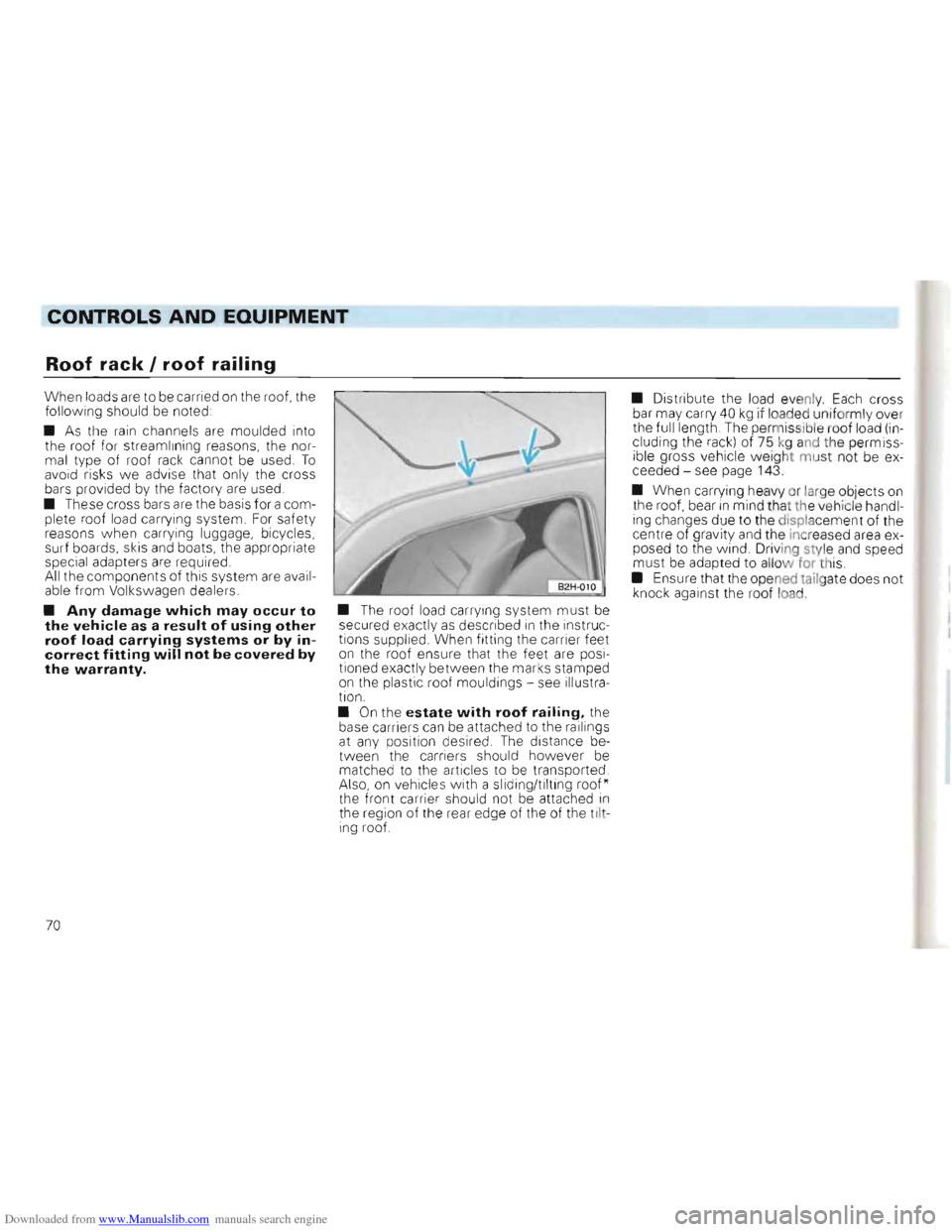
• The roof load ca rrying system must be
secured exactly as described in the instruc
tions supplied. When fitting the carrier feet
on the roof ensure that the feet are posi
tioned exactly between the marks stamped
on t
he plastic roof mou ldings -see illustra
tion.
•
On the estate with roof railing, the
base carriers can be attached to the ra ilings
at any position desired. The distance be
t w een the carriers should however be matched to the articles to be transported .
Also, on v e h icles with a sliding/ti lting roof*
the front ca rrier should not be attached in the region of the rear edge of the of the tilt
ing roof. •
Distribute the load eve
nly. Each cross
bar may carry 40 kg if loaded uniformly over
the full length . The permissibl e roo f load (in
cluding the rack) of 75 kg and the permiss
i ble gross vehicle weig ht m ust not be ex
ceeded -see page 143.
• When carrying heavy or lar ge objects on the roof, bear in mind tha t the veh icle handl
ing changes due to the displa cement of the
centre of gravity and the inc reased area e
xposed to the wind. Driving style and speed
m ust be adapted to allo w for thiS .
•
Ensu re that the ope ned tailgate does not
knock agai nst the roof load .
70
Page 79 of 156
Downloaded from www.Manualslib.com manuals search engine DRIVING TIPS
Trailer towing
The vehicle is intended main ly for the trans
portation of persons and luggage but it can, with the appropriate technical equipment,
also be used to tow a trailer.
Technical requirements
• If the vehicle is suppl ied with a factoryfi tted towing bracket, all that is technically
a nd legally necessary for trailer towing wil l
have been taken into account.
• If the trailer to be towed
has a 7 pin plug, an adapte r cable can be used whi ch IS ob
tained from a Volkswagen dealer.
• Volkswagen dealers have
all the necessary information on the In stallation of towing
brackets and the fitti ng of a heavy-duty cooling system. The installation should there
f ore be done by them .
Operations instructions
• On the Golf saloon with a factory
fitted towing bracket* the removable ball
coupling will
be fitted. Fitting/remo ving in
struc tions and instructions on correct stowage of the ball coupling in the spare wheel
well can be found in a linen bag in the ve
hicle luggage compartment.
•
On the Golf estate with a factory fitted
towing bracket* the remova ble ball coupl
ing is stored inside the vehicle next to the
spare wheel, together w ith instructions on
fitting.
• Pitching movements between towing
vehicle
and trailer can be reduced by hea vy
duty springs and shock absorbers on the
rear axle. If these springs and shock absorbers have not alread y been fitted at the
factory, they can, in many cases, be service
installed by a Volkswagen dealer.
• The permissible trailer weight -see
page 144 -m ust not
be exceeded on any account.
• If the the trailer weight
is below the
permissible maximum, a correspondingly
steeper gradient
can be climbed. •
The given trailer weights
are only appli
cable for altitudes up to 1000 m above sea level. As the engine output and thus the
climbing ability drops due to the decreasing
air density , the weight of vehic le and trailer
must also be reduced by 10 % for each
further 1000 m or part thereof.
• Where possible make full use of the
maximum permissible drawbar weight
on ball of the towing bracket -see page 144
but do not exceed it.
• While observing the permissible trailer
and drawbar weight, distribute the load in the trailer so that heavy objects are as nea r as possible to the axle. The objects must
also be secured so that they cannot slip
about.
• Check the ty
re pressures on the towing
v ehicle, and adjust for full load conditions,
and also check the pressures on the trailer
• T he headlight settings, should
be checked w ith trailer attached before mov
ing off and adjusted as necessary. On vehicles with headlight beam control it is on ly necessary to turn the knurled disc in dash in the appropriate directIOn .
77
Page 92 of 156
Downloaded from www.Manualslib.com manuals search engine GENERAL MAINTENANCE
Bonnet
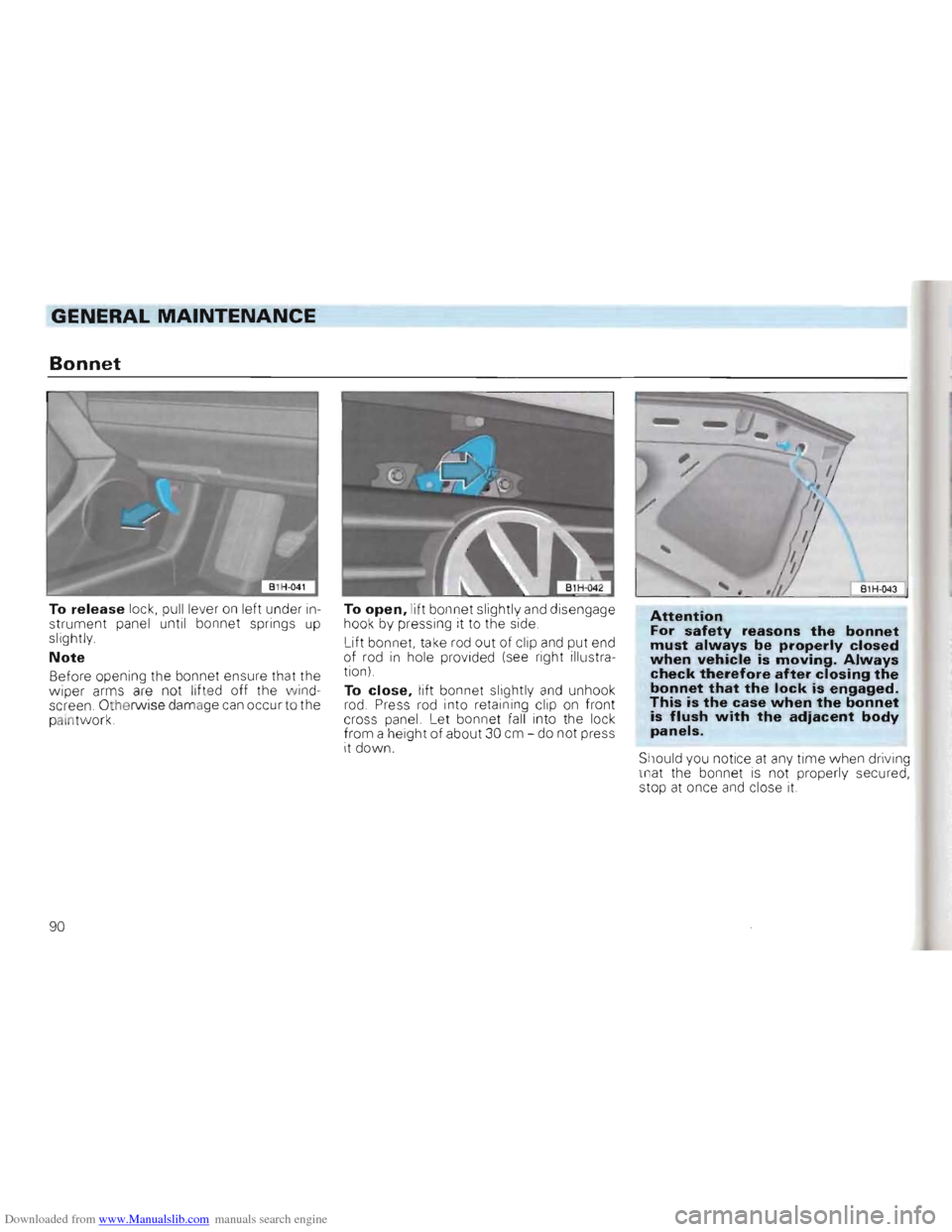
To release lock, pull lever on left under in
strument panel until bonnet springs up slightly.
Note
Before opening the bo nnet ensure that the
wiper arms are not lifted off the wind
screen. Othe rwise damage can occur to the
palntwork. To
open, lift
bonnet slightly and disengage
hook by pressing it to the side.
Lift bonnet, take rod out of
clip
and put end
of rod in hole provided (see right illustra
tion)
To
close, lift bonnet slightly and unhoo k
rod. Press rod into retaining cl ip on front
cross panel. Let bonnet fall into the lock
from a height of about 30 cm -do not press
it down.
B1H -043
Attention For safety reasons the bonnet must always be properly closed when vehicle is moving. Always check therefore after closing the bonnet that the lock is engaged. This is the case when the bonnet is flush with the adiacent body panels.
Should you notice at any time when driving
that the bonnet is not properly secured,
stop at once and close it.
90
Page 103 of 156
Downloaded from www.Manualslib.com manuals search engine GENERAL MAINTENANCE
• When disconnecting the bat
tery from th e vehic le e lectrical
system first disconnect the nega
tive cable and then the positive
cable.
The battery must not b e discon
nected with th e engine ru nning,
as this will damage t he e lectrica l
system (e lectro n ic components).
• When reconnecting t h e bat
tery connect the positive cable
first and then the negative cable.
The connect ing cables must on
no account interchang ed -can
cause wiring to burn out.
In order to protect the c asing from UV radiation, do not expose battery to direct sunlight.
Checking acid level
In norma l operating conditions the ba ttery re quires hardly any maintenance . At 111(;)11 am bient tem peratu res Ilowever It I S advIs
a b le to check th e acid le ve l a t r egula r inter als. It shou ld always be between the M IN
a nd MAX marks on th e batter y I
f th e ac
id leve l drops below the MIN mark, the aff ecte d c ells must be topped -up to the
MAX mark W ith dis tille d wa ter.
It
is recommen ded that the acid level is checked and correcte d by a Volkswag en dea ler.
Winter driving
W inte r wea ther is part icu larly hard on the
battery. Furt h er more at low temperatures it has only a par t of th e capacity it has at nor
ma l temperatures . We reco mmend there
for e th at
the bat te ry sho uld be c h ecked pre
f erably by a Volkswage1l dea le r before the onset of cold weat her an d charge d if
necessary
I f the vehicle is not driven for seve ral weeks when te m peratures are very low, the battery should be taken out and stored in a frost-free room, s o tha t it cannot freeze up and become damaged.
To ake battery out, first d isconnect the two cables an d th en remov e retainer.
Charging battery
W hen charg ing with a lo w curren t (e.g. with a smal l char ger) the battery cables need not
no rmally b e taken off. The instructions from the charger manufactu re r must however be
noted.
Bef ore
Quick charging, that is charging
wi th a high current, both battery cables
must b e disconnec ted .
T
he f o llowin g inf ormation must be noted:
• Whe n charging the
battery do not re
move caps.
• A discha rged battery
can freeze at -10°e. It is essential to thaw out a frozen battery before it is given a quick charge otherwise it may explode!
• The mains cable of the charger should
n ot be connec ted unti l afte r the clips of the charger have been prop erly secured to th e
battery terminals Red =pos itive
Black = negative
•
Recon nect cables correct ly after ch arging battery.
101