1993 VOLKSWAGEN GOLF ignition
[x] Cancel search: ignitionPage 57 of 156
Downloaded from www.Manualslib.com manuals search engine CONTROLS AND EQUIPMENT
Windscreen wiper and washer system
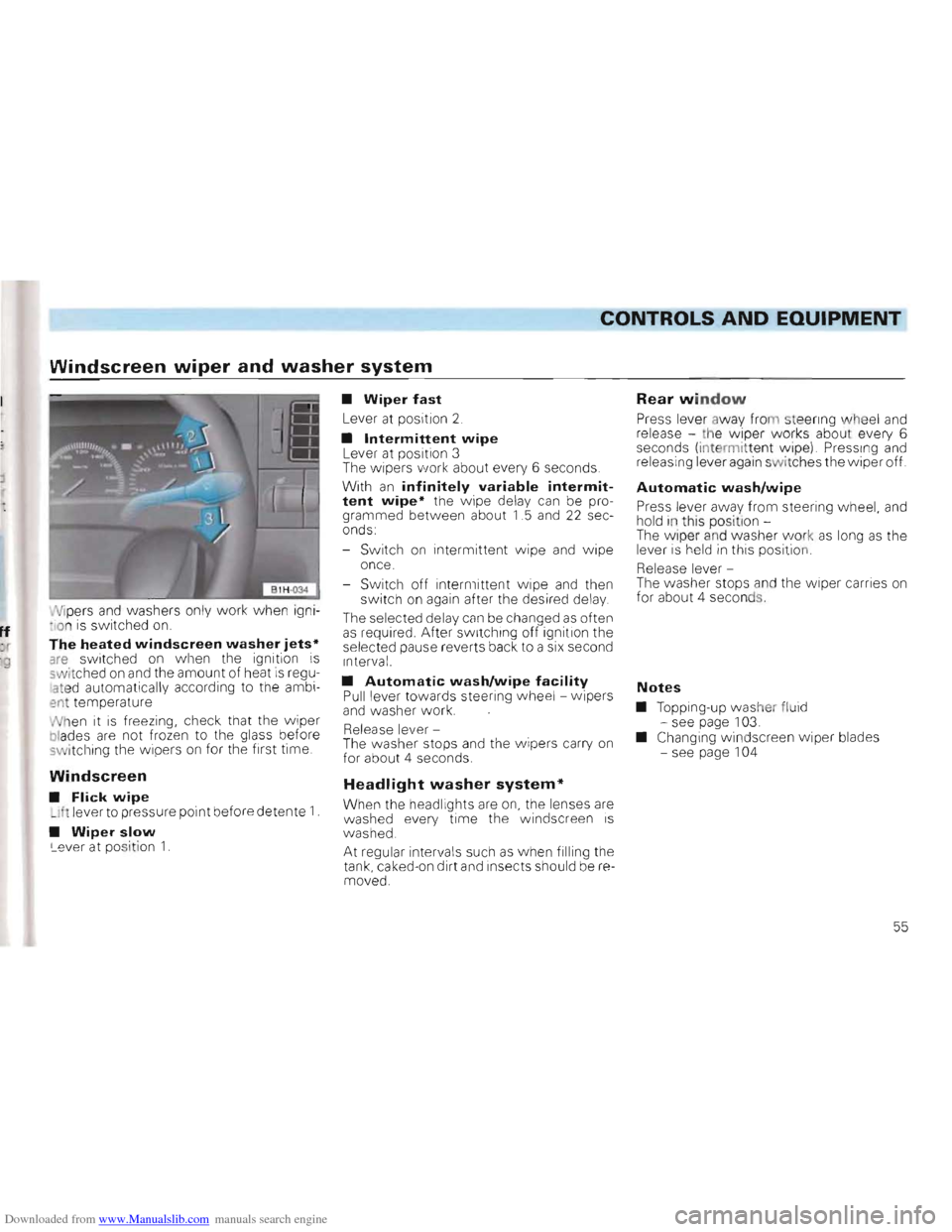
Vipers and washe rs o nly work w hen igni
t io n is switched on.ff : r The heated windscreen washer jets* are swit c hed o n when the ign ition is 9 swi tc hed on and the amoun t of heat is reguat ed automa tically acco rding to the ambi ent tem peratu re
Wh
en it is fr eez ing, ch eck that th e wipe r blades are not fro zen to t he g lass before switching the wipers on for the first time .
Windscreen
• Flick wipe _Ih lever to pressure point befo re deten te 1 .
• Wiper slow Le ve r at pos it io n 1.
• Wiper fast
Lever at posit ion 2
• Intermittent wipe Lever at posit io n 3 The w ipers "vork about every 6 seco nds.
W ith
an infinitely variable intermit
tent wipe* the wipe dela y can be pro
gram med betw een abou t 1.5 and 22 sec
o nds:
- Sw it c h
on intermitte nt wipe and wipe
once.
- Swi tc h off intermitte nt wi
pe an d then swi tch on again afte r the desired delay
The selec ted delay can be ch anged as oft e n as required. A fter switching off ignition the
se lec ted pause r ever ts back to a six seco nd
I n terv al.
• Automatic washJwipe facility Pull leve r tow ards steer ing whee l -wipe rs
and wash e r work.
R elease
lever-
The was he r st ops an d th e wi pers ca rry on
for abo ut 4 seconds.
Headlight w asher system*
Whe n the head lights are on, the lenses are
washed ev ery tim e the windsc reen is w ashed.
At r egular intervals such a s when filli ng t he tank, cake d-o n dir t a nd Insec ts should be re
m oved.
Rear window
Press lever aw ay fr om steenng whee l and release -th e wipe r works about every 6
seco nds (inte rm ittent wip e) Pressing and releasi ng lever agai n switches the w iper off.
Automatic wash/wipe
P ress lever away from stee ring wh eel, an d
ho ld in t his positi on The wip er an d was her wor k as long as th e
l ever is he ld in thi s posi tio n
Release leve r
T he was her stops and th e wiper carr ies on for abo ut 4 seco nd s,
Notes
• T opp ing-up was her fluid
- se e page 103. • Changing winds creen w ipe r blades
- see page 1 04
55
Page 64 of 156
Downloaded from www.Manualslib.com manuals search engine CONTROLS AND EQUIPMENT
•
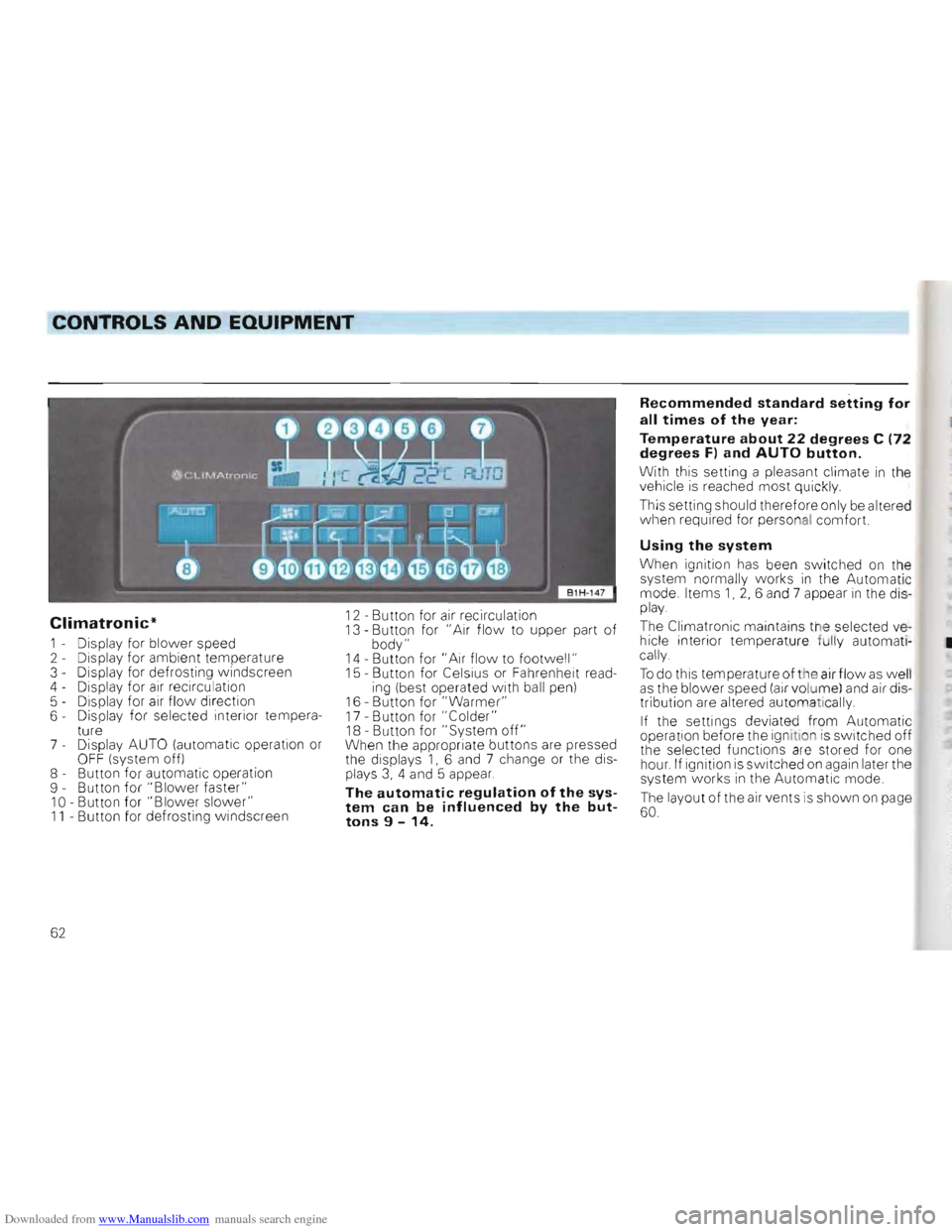
Climatronic*
1 - Display for blower speed
2 - Display for ambient temperature
3 - Display for defrosting windscreen
4 - Display for
air recirculation
5 - Dis play for air flow direction
6 - Displa y for selected interior tempera
ture
7 -
Display AUTO (automatic operation or OF F (system off)
8 - Button for automatic operation
9 - Button for "Blo
wer faster" 10 -Button for "Blower slower" 11 - Button for defrosting windscreen
12 -Button for air recirculation 13 -Button for "Air flow to upper part of body" 14 -Button for " Ai r flow to footwell " 15 -Button for Celsius or Fahrenheit reading (best operated with ball pen)
16 -Button for "Warmer" 17 -Button for "Colder" 18 -Button for" System off" When the appropriat e buttons are pressed
the disp lays 1, 6 and 7 change or the displays 3, 4 and 5 appear.
The automatic regulation of the system can be influenced by the buttons 9 -14.
Recommended standard setting for
all times of the year:
Temperature about 22 degrees C (72
degrees F) and AUTO button.
With this setting a pleasant climate in the
vehicle is reached most quickly
This setting should therefore only be alt ered
when required for personal comfort.
Using the system
When ignition has been swi tc hed on the
system normally works in the Automatic
mode. Items 1, 2, 6 and 7 appear in the display.
The Clim atronic maintains the selected vehicle interior temperature fully automati
cally.
To do this temperature of the air flow as well as the blower speed (air volume) and air dis
tribution are altered automat ically.
If the settings deviate d fr om Automatic
operation before the ignition is switched off
the selected functions are stored for one hour. If ignition is switched on again later the
system works in the Automatic mode.
The layout of the air vents is show n on page 60.
62
Page 66 of 156
Downloaded from www.Manualslib.com manuals search engine CONTROLS AND EQUIPMENT
Operating instructions
• Ensure that the sensor betvveen the
windscreen defrost outlets in the centre of
the instrument panel and the air grille next
to the radio is not covered.
• If, after switching on the ignition,
all sym
bols in the display area flash for about 15
seconds, there is a fault in the system -con
tact a Volkswagen dealer.
Notes for both air conditioning
systems
• To ensure that the heating, ventilation
and air conditioner can work properly, the air
inlet in front of the windscreen should be
kept free of ice, snow and leaves.
• The heat output depends
on the coolant
temperature -the full heat output is there
fore available when the engine IS warm.
• The stale air escapes through openings
in the luggage compartment side panels.
Therefore when loading the luggage com
partment ensure that the openings are not
covered .
• When the ambient temperature
is high
and the air very humid, condensed water can drip off the evaporator and form a
puddle under the vehicle. This is quite nor
mal and does not indicate a leak.
Notes for the normal air condi
tioner
• All controls except the rotar y switch A and buttons 0 and E can be set to any inter
mediate position.
•
To prevent the windows from misting up
the blower should be running slowly when driving at low speeds.
Using air conditioners economi
cally
In cooling operation the air conditioner com
pressor places demands on the engine and
therefo re influences the fuel consumption.
To keep the period switched on as short as possible, the following points should be
noted:
• If the
in side temperature is very high
after the car has been parked in the sun, it is recommended to open doors or windows briefly to enable the hot air to escape
• The air conditioner should not be
switched on during a Journey if the
windows or sliding/tilting roof* are open.
• If the desired interior temperature
can be attained w ithout switching on the air
cond itioner the fresh air operation should
be selected (does not apply to Climatronicl.
Operating faults
• Should the air cond i:ioner not work at
any time, either .
- the ambient temperatu re IS below about +5 °C,
-or the fuse has blown.
Check fuse and if necessary r
enew it - see
page 119. If the troub le is n ot due to a defec
tive fuse, SWitch the system off and have It
checked.
- the air conditioner
has svvitched off due
to coolant temperature being too high -see
page 45.
• If the cooling output drops off, switch
the AlC
off and have the system checked.
64
Page 67 of 156
Downloaded from www.Manualslib.com manuals search engine CONTROLS AND EQUIPMENT
Sliding/tilting roof*
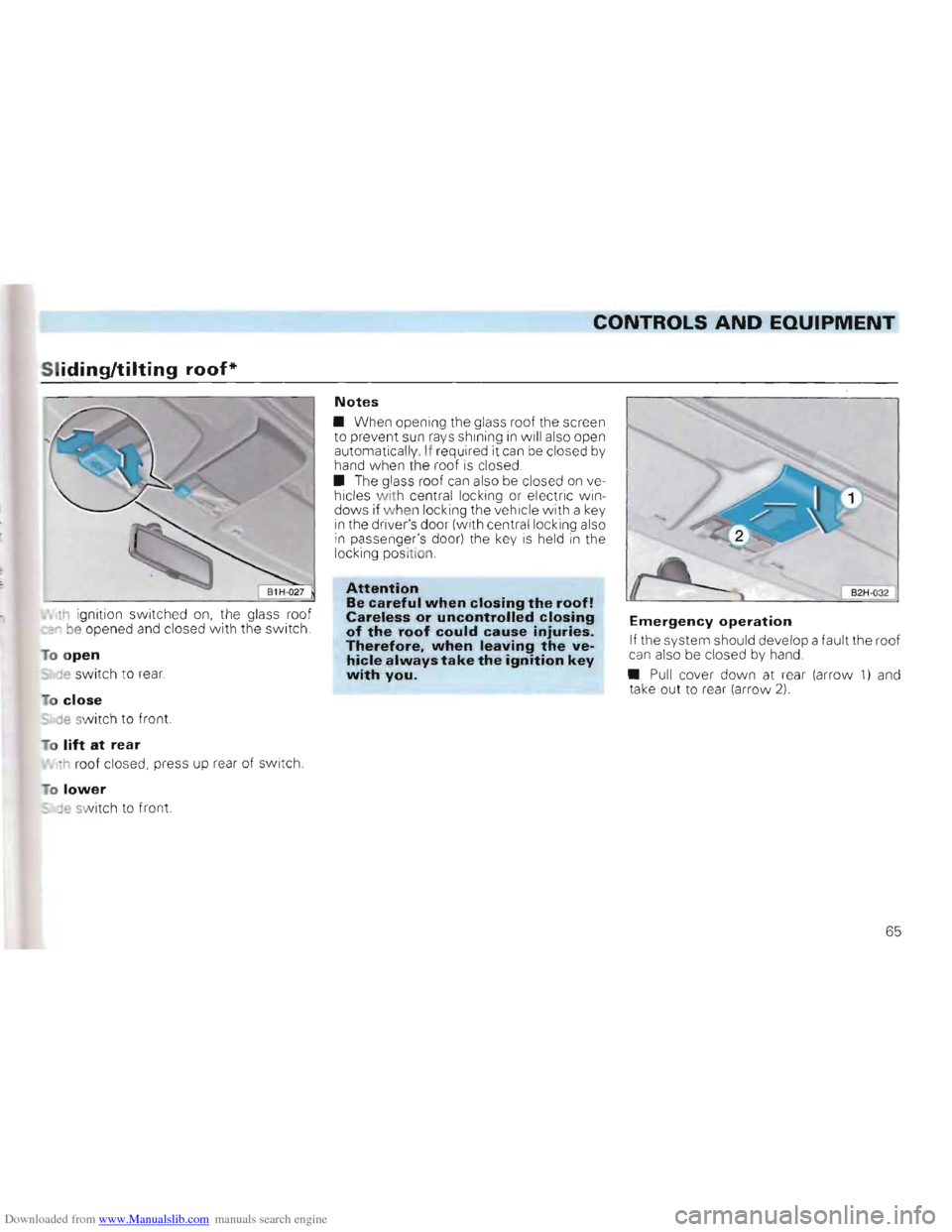
lh ignition sWit ched on, the glass roof
cl' be opened and closed with the switch.
T o
open
'de switch to rear.
o close
- de sw itc h to front.
To lift at rear
Ih ro of closed, press up rear of switch.
o
lower
lJe swi tc h to fro nt.
Notes
• When opening the glass roof the screen to prevent sun rays shining in w ill also open
automatical ly. I f req u ired it can be closed by hand whe n th e roof is closed .
• The glass roof can also be closedon ve
hicle s with central locking or electric win
dows if w he n loc king the vehicle with a key in the driv er' s door (with central locking al so in passeng er's door) the key is held in the
locking position.
Attention
Be careful when closing the roof!
Careless or uncontrolled closing
of the roof could cause injuries.
Therefore, when leaving the ve
hicle always take the ignition key
with you.
Emergency operation
If the system should develop a fault the roof
can also be c losed by hand .
• Pu
ll cover dow n at rear (arrow 1) and
take out to rear (arrow 2).
65
Page 69 of 156
Downloaded from www.Manualslib.com manuals search engine CONTROLS AND EQUIPMENT
Interior lights
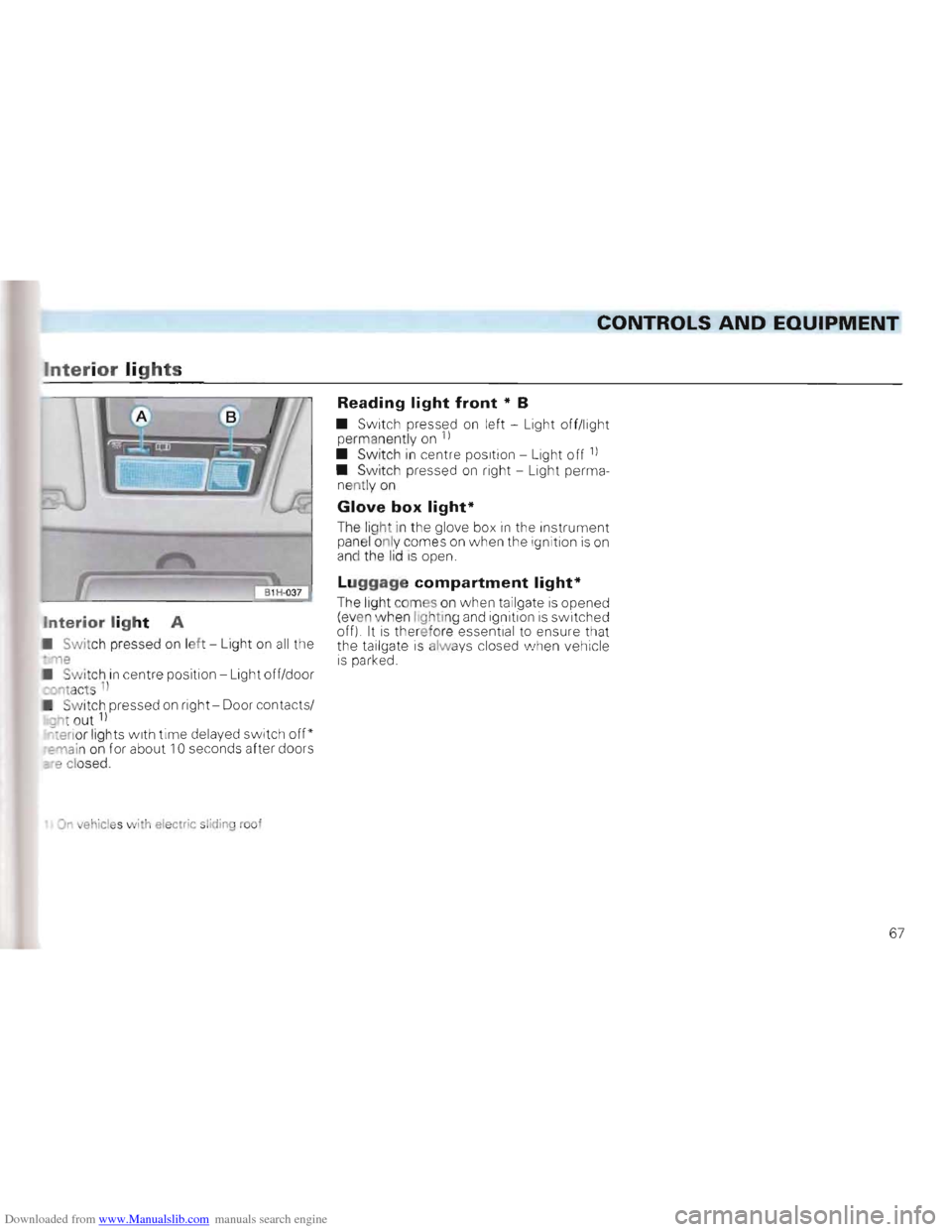
nterior lig h t A
Switch pr essed on leh -Light on all the "TIe SWitc h in centre position -Light off/door
:O'1t acts ]) Sw itch pressed on right -Door contacts/ 9"t out 1) ter io r lights with time delayed switch off"' E'TIain on for about 10 seconds after doors co e closed.
On veh ic le s with electric sliding roof
Reading light front * B
• Switch press ed on left -Light off/light
per manently on 1 )
• Switch in centre position -Light off 1)
• SWitch pressed on right -Light perma
n e ntly on
Glove box light*
The ligh t in the glove box in the instrument
pane l o nly com es on when the ignition is on and the lid I S open.
L uggage compartment light*
The light comes on when tailgate is opened
(ev en w hen li g hti ng and ignition is switched off) It is there for e essential to ensure that
the tailgate is always closed INhen vehicle is parked.
67
Page 76 of 156
Downloaded from www.Manualslib.com manuals search engine DRIVING TIPS
Trouble-free functioning of the exhaust emission control system is de
c isi ve for the enviro nment-friendly oper
ation of the vehicle .
The follow ing points should therefore
be noted:
• Vehicles fitted with a catal ytic con verter
may onl y be driven on unleaded petrol (see
page 82).
• Never drive until the fuel tank
is com
pletely empty on vehicles with a catal yst.
The irregular fuel supply ca n cause misfir
ing This allows un burnt fuel into the ex
haust system. This can cause overheating
and damage to the catalyst.
• If whilst driving, the engine misfires,
loses power and runs unevenly, this could
be due to a fault in the ignition system . In a
case like this, unburnt fuel can enter the ex
haust system and then escape to atmos
phere. Furthermore, the catalytic converter
could become damaged due to overheat
ing The vehicle speed
must be reduced im
mediately and the defect should be elImIn
ated at the nearest Volkswagen dealer.
• Do not sw itch
off ignition whilst driving
- see page 38 . •
Do not
overfill engine oil-see page 95.
•
Do not tow start vehicle for more than 50 m -see page 130.
Attention Due to high temperatures which can occur in the catalytic converter on petrol engine vehicles in very unfavourable conditions, the vehicle should not be parked so that the catalytic converter can come into contact with inflammable materials_
Note
Even in the case of a perfectl y working ex
haust emission control sy stem there can,
under certain engine operating conditions,
be a sulphur-type exhaust smell.
This depends upon the sulphur content
in
the fuel being used.
Quite often this
can be remedied by select
ing another brand of fuel or, filling up with
unleaded premium petrol.
74
Page 82 of 156
Downloaded from www.Manualslib.com manuals search engine DRIVING TIPS
Brake testing
For brake testing on a brake test stand th e
props haft does not have to be detached .
On the rear w heels the brake test is carried
out in the same way as on two-wheel drive
vehicle .
When testing the front w heel brakes how
ever there are some special points to
be noted:
• The
ve hicle must be reversed onto the
te st stand so that the test stand rollers drive
the front w heels backwards .
• Then the gear lever
must be moved into
1 st gear w ith the ignition on and then back
into neutral again Th is disengages the free
wheel lock in the back axle.
Note
On no account must the reverse gear be se
lected when the rollers are running other
wise the freewheel lock would be engaged
again.
This would cause the rear wheel s to
be driven suddenly.
80
Page 84 of 156
Downloaded from www.Manualslib.com manuals search engine GENERAL MAINTENANCE
Fuel
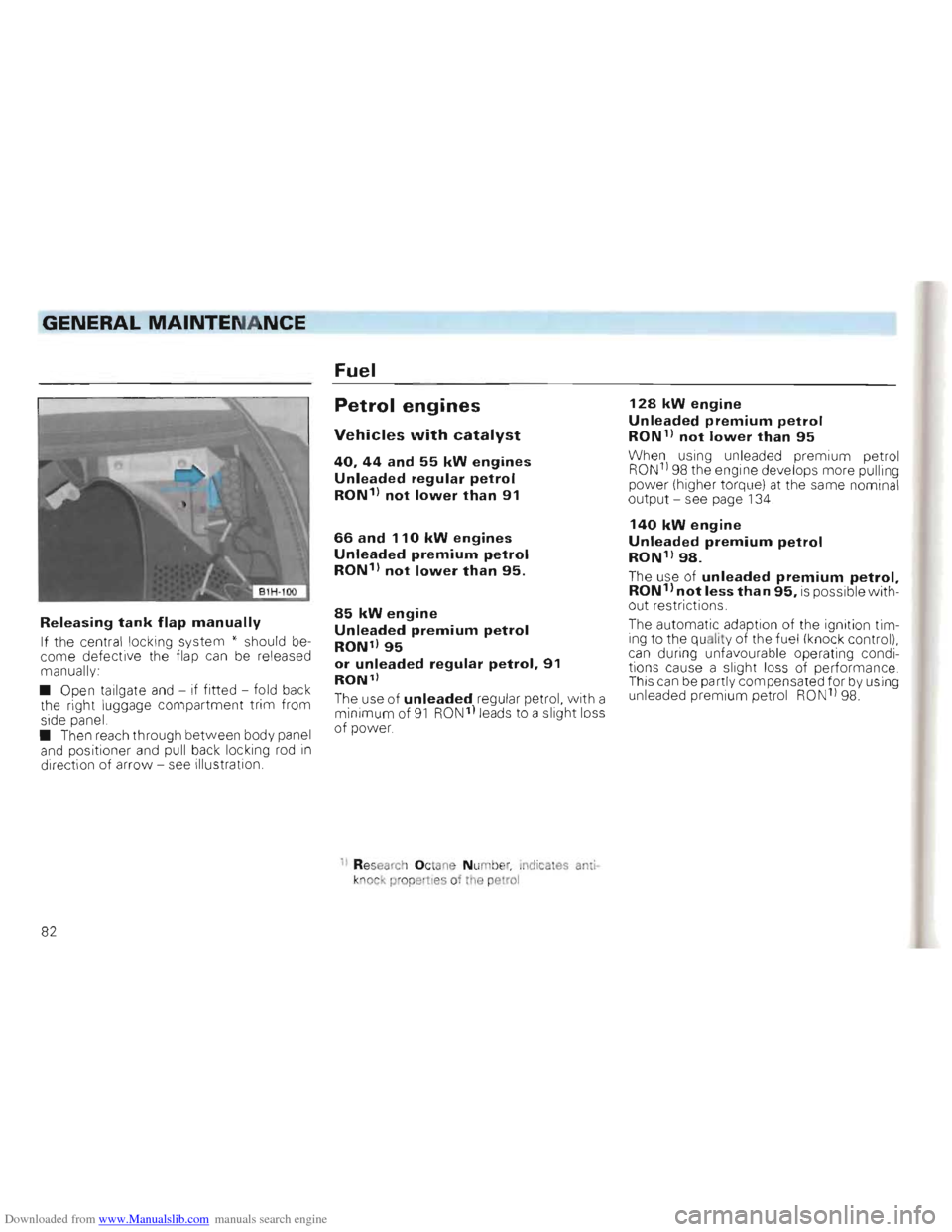
Releasing tank flap manually
If the central locking system * should become defective the flap can be released
manually :
• Open tailgate and -if
fitted -fold back
t he righ t luggage compartment trim from
side panel.
• Then reach through bet
ween body panel
and positioner and pull back loc king rod In directio n of arrow - see Illustration .
Petrol engines
Vehicles with catalyst
40. 44 and 55 kW engines
Unleaded regular petrol
RON1) not lower than 91
66 and 110 kW engines
Unleaded premium petrol
RON1) not lower than 95.
85 kW engine
Unleaded premium petrol
RON') 95
or unleaded regular petrol. 91
RON')
The use of unleaded regular petrol, with a
min imum of 91 RON ') leads to a slight loss
o f power
11 Re se arch O ctane Num b r, indicates anti
k nock properties of the pe rol
128 kW engine
Unleaded premium petrol
RON1) not lower than 95
When u sing un leaded premium petrol RON1) 98 the engine develops more pulling power (higher torque) at the same nominal output -see page 134.
140 kW engine
Unleaded premium petrol
RON') 98.
The use
of unleaded premium petrol. RON1) not less than 95. is possible without restrictions.
The automatic adaption
of the ignition tim
ing to the quality of the fuel (knock control),
can during unfavou rable operating condi
tions cause a s
light loss of performance
This can be partly compensated for by uS ing
un lead ed prem ium petro l RONlI 98 .
82