1993 CHEVROLET TRACKER warning
[x] Cancel search: warningPage 141 of 339

pedal as soon as you feel the vehicle
start to slide. Quickly steer the way you
want the vehicle to go. If you start
steering quickly enough, your vehicle
will straighten out. As
it does, straighten
the front wheels.
Of course, traction is reduced when
water, snow, ice, gravel, or other
material is
on the road. For safety,
you’ll want to slow down and adjust
your driving to these conditions. It is
important to slow down
on slippery
surfaces because stopping distance
will
be longer and vehicle control more
limited. While
driving on a surface with reduced
traction,
try your best to avoid sudden
steering, acceleration, or braking
(including engine braking by shifting to
a lower gear). Any sudden changes
could cause the tires to slide.
You may
not realize the surface
is slippery until
your vehicle is skidding. Learn to
recognize warning clues
- such as
enough water, ice
or packed snow on
the. road to make a “mirrored surface’’
- and slow down when you have any
doubt. Remember: the
rear wheel anti-lock
braking system (RWAL) helps avoid
only a rear braking skid. In a braking
skid (where the front wheels are no
longer rolling), release enough pressure
on the brakes to get the front wheels
rolling again. This restores steering
control. Push the brake pedal down
steadily when you have to stop
suddenly. As long as the front wheels
are rolling, you will have steering
control. Steer the way you want to go.
ProCarManuals.com
Page 165 of 339

thick, wet haze that may even coat your
windshield. You can often spot these fog
patches or mist layers with your
headlights. But sometimes they can be
waiting for you as you come over a hill
or dip into a shallow valley. Start your
windshield wipers and washer, to help
clear accumulated road dirt. Slow down
carefully.
Tips on Driving in Fog
If you get caught in fog, turn your
headlights on low beam, even in
daytime. You’ll see
- and be seen -
better. Don’t use your high beams.
The light
will bounce off the water droplets that
make up fog and reflect back at you.
Use your defogger. In high humidity,
even a light buildup of moisture on the
inside
of the glass will cut down on your
already limited visibility. Run your
windshield wipers and washer
occasionally. Moisture can build up on
the outside glass, and what seems to be
fog may actually be moisture on the
outside
of your windshield.
Treat dense
fog as an emergency. Try to
find a place to pull off the road.
Of
course you want to respect another’s property,
but you might need to put
something between you and moving
vehicles
- space, trees, telephone poles,
a private driveway, anything that
removes you from other traffic.
If visibility
is near zero and you must
stop but are unsure whether you are
away from the road, turn your lights on,
start your hazard warning flashers, and
sound your horn at intervals or when
you hear approaching traffic.
Pass other vehicles
in fog only if you
can see far enough ahead to pass safely.
Even then, be prepared to delay your
pass
if you suspect the fog is worse up
ahead. If other vehicles try to pass you,
make
it easy for them.
16399-
ProCarManuals.com
Page 166 of 339

Your Driving and the Road
H City Dnving
... 164
One of the biggest problems with city
streets is
the amount of traffic on them.
You’ll want to watch out for what the
other drivers are doing and pay attention
to traffic signals.
Here are ways to increase your safety in
city driving:
Know the best way to get to where
you are going. Try not to drive
around trying to pick out
a familiar
street
or landmark. Get a city map
and plan your trip into an unknown
part of the city just as you
would for
a cross-country trip.
Try to use the freeways that rim and
crisscross most large cities. You’ll
save time and energy. (See the next
section, “Freeway Driving.”)
Treat a green light as a warning
signal.
A traffic light is there because
the corner is busy enough to need it.
When a light turns green, and just
before you start to move, check both
ways for vehicles that have not
cleared the intersection
or may be
running the red light.
Obey all posted speed limits.
But
remember that they are for ideal road,
weather and visibility conditions. You
may need to drive below the posted
limit in bad weather or when visibility
is especially poor.
clear of intersections when you see or
hear emergency vehicles.
Pull to the right (with care) and stop
ProCarManuals.com
Page 168 of 339

Your Driving and the Road
make sure there isn’t another vehicle in
your
‘ ‘blind’ ’ spot.
If you are moving from an outside to a
center lane on a freeway having more
than two lanes, make sure another
vehicle isn’t about to move into the
same spot. Look at the vehicles two
lanes over and watch for telltale signs:
turn signals flashing, an increase
in
speed, or moving toward the edge of the
lane. Be prepared to delay your move.
Once you are moving on the freeway,
make certain you allow a reasonable
following distance. Expect to move
slightly slower at night.
... 166
Leaving the Freeway
When you want to leave the freeway,
move to the proper lane well in
advance. Dashing across lanes at the last
minute is dangerous. If you miss your
exit do not, under any circumstances,
stop and back up. Drive on to the next
exit.
At each exit point is a deceleration lane.
Ideally it should be long enough for you
to enter
it at freeway speed (after
signaling, of course) and
then do your
braking before moving onto
the exit
ramp. Unfortunately, not all deceleration
lanes are long enough
- some are too
short for all the braking. Decide when
to start braking. If
you must brake on the through
lane, and if there is traffic
close behind you, you can allow a little
extra time and flash your brake lights (in
addition
to your turn signal) as extra
warning that you are about
to slow
down and exit.
The exit ramp can be curved, sometimes
quite sharply. The exit speed is usually
posted. Reduce your speed according to
your speedometer, not to your sense of
motion. After driving for any distance at
higher speeds,
you may tend to think
you are going slower than you actually
are. For example,
40 mph (65 km/h)
might seem like only
20 mph (30 km/h).
Obviously, this could lead to serious
trouble
on a ramp designed for
20 mph (30 km/h)!
ProCarManuals.com
Page 176 of 339

Your Driving and the Road
rn
You may want to put winter
emergency supplies in your vehicle.
Include an ice scraper, a small brush
or broom, a supply of windshield
washer fluid, a rag, some winter outer
clothing, a small shovel, a flashlight,
a red cloth, and a couple of reflective
warning triangles. And, if
you will be
driving under severe conditions,
include
a small bag of sand, a piece
of old carpet or
a couple of burlap
bags to help provide traction.
Be sure
you properly secure these items
in
your vehicle.
... 174
Driving on Snow or Ice
Most of the time, those places where
your tires meet the road probably have
good traction.
However,
if there is snow or ice
between your tires and the road, you can
have a very slippery situation. You’ll
have a lot less traction or “grip” and
will need to be very careful.
t
What’s the worst time for this? “Wet
ice.
” Very cold snow or ice can be slick
and hard to drive on. But wet ice can be
even more trouble because it may offer
the least traction
of all. You can get
“wet ice” when it’s about freezing
(32°F; OOC) and freezing rain begins to
fall.
Try to avoid driving on wet ice
until salt and sand crews can get there.
Whatever the condition
- smooth ice,
packed, blowing or loose snow
- drive
with caution. Accelerate gently.
Try not
to break the fragile traction. If you
accelerate too fast, the drive wheels will
spin and polish the surface under the
tires even more.
ProCarManuals.com
Page 191 of 339
R
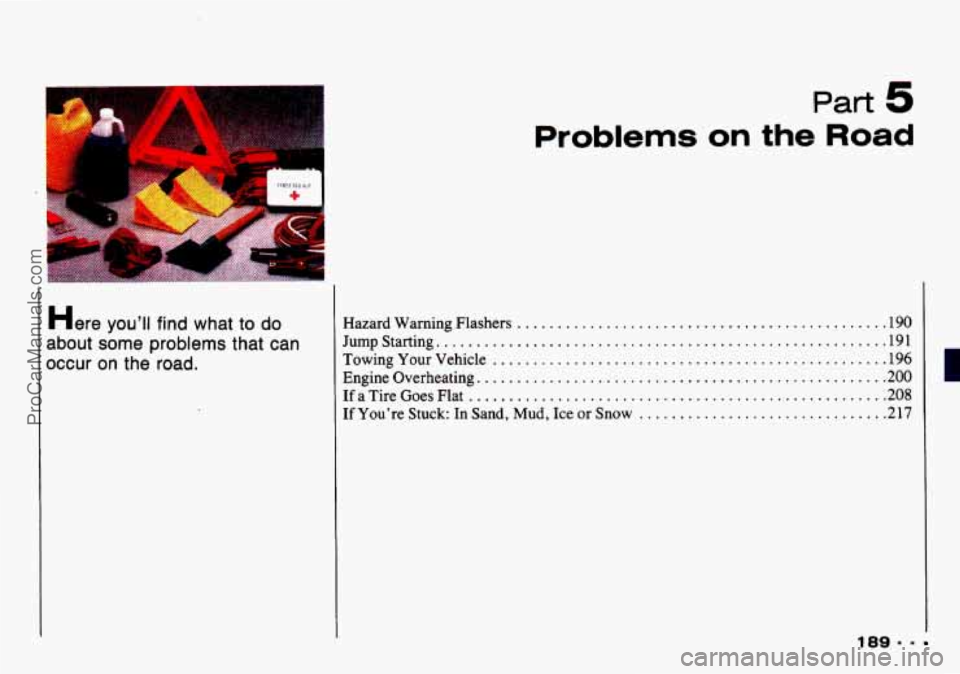
Here you’ll find what to do
about some problems that can
occur
on the road.
Problems on the Road
Hazard Warning Flashers . . . . . . . . . . . . . . . . . . . . . . . . . . . . . . . . . . . . . . . . . . . . . .190
rumpstarting ........................................................ 191
I‘owingYourVehicle ................................................. 196
3ngineOverheating
................................................... 200
[faTireGoesFlat .................................................... 208
[f You’re Stuck: In Sand, Mud, Ice or Snow . . . . . . . . . . . . . . . . . . . . . . . . . . . . . . .217
189- -
ProCarManuals.com
Page 192 of 339

Problems on the Road
I Hazard Warning fishers
Your hazard warning flashers let you
warn others. They also let police know
you have a problem. Your front and
rear turn signal lights will flash on and
off.
Press th e button in t :o mak 'our fr 'on t
and rear turn signal lights flash on and
off.
Your hazard warning flashers work no
matter what position your key is in, and
even
if the key isn't in. To turn
again.
off the flashers,
push the switch
When the hazard warning flashers are
on, your turn signals won't work.
Other Warning Devices
If you carry reflective triangles, you can
set one up at the side
of the road about
300 feet (100 m) behind your vehicle.
ProCarManuals.com
Page 198 of 339

Problems on the Road
10. Now start the vehicle with the good
battery and
run the engine for
awhile.
dead battery.
If it won't start after a few tries, it
probably needs service.
11. Try to start the vehicle with the
I
I-
12. Remove the cables in reverse order
to prevent electrical shorting. Take
care that they don't touch each
other or any other metal.
A. Heavy Metal Engine Part
B. Good Battery
C. Dead Battery
r
L
Towing Your Vehicle
Try to have a GM dealer or a
professional towing service tow your
Geo. The usual towing equipment is
a
sling-type (A) or a wheel-lift (B) or car
carrier
(C) tow truck.
If your vehicle has been changed or
modified since it was factory-new by
adding aftermarket items like fog lamps,
aero skirting, or special tires and
wheels, these instructions and
illustrations may not be correct.
Before you
do anything, turn on the
hazard warning flashers.
When you call, tell the towing service:
A dolly must be used when towing
from the front.
ProCarManuals.com