Page 81 of 339
Instrument Panel
1. Air Vent
2. Side Defroster Vent
3. Turn SignaULights
4. Instrument Cluster
5. Hazard Warning Flasher
6. Windshield Wiper/Washer Lever
7. Rear Window Wiper Switch
8. Comfort Controls
9. Audio System ControVHeadlight Beam
Lever
10. Lighter
1 1. Assist Grip
12. Glove Box
13. Transmission Shift Lever
14. Coinholder and Bin
15. Transfer Case Shift Lever
16. Parking Brake Lever
17. Ashtray
18. Rear Window Washer Switch
19. Ignition Switch
20. Horn
21. Fuse Block
22. Rear Window Defogger Switch
23. Brightness Control
79. =
ProCarManuals.com
Page 84 of 339

Features & Conrrols
Tachometer
The tachometer shows engine speed in
thousands
of revolutions per minute
(rpm).
You can use it while driving to
select correct shift points. The
tachometer may not return to zero when
the engine is not running.
NOTICE
Do not operate the engine with the
tachometer in the red area
engine damage may occur
9 82
Wanting Lights, Gages
and
Indicators
This section describes the warning lights
and gages that may be on your vehicle.
The pictures will help
you locate them.
Warning lights can signal that something
is wrong before it becomes serious
enough to cause an expensive repair or
replacement. Paying attention to your
warning lights and gages could also save
you or others from injury. Warning
lights go on when there may be
or is a problem with one
of your
vehicle’s functions.
As you will see in
the details on the next few pages, some
warning lights come on briefly when
you turn the ignition key just to let you
know they’re working. If you are
familiar with this section, you should
not be alarmed when this happens.
Gages can indicate when there may be
or is a problem with one of your
vehicle’s functions. Often’ gages
and
warning lights work together to let you
know when there’s a problem with your
vehicle.
ProCarManuals.com
Page 85 of 339

c
When one of the warning lights comes
on and stays on
when you are driving,
or when one of the gages shows there
may be a problem, check the section
that tells you what to do about
it. Please
follow the manual’s advice. Waiting to
do repairs can
be costly - and even
dangerous. So please get to know your
warning lights and gages. They’re a big
help.
Fuel Gage
Your fuel gage shows about how much
fuel
is in your tank. When the gage first
indicates
E, you still have a little fuel
left (about one
or two gallons), but you
need to get more right away.
Here are four concerns some owners
have had about the fuel gage. All these
situations are normal and do not indicate
that anything is wrong
with the fuel
gage.
At the gas station, the gas pump shuts
It takes more (or less) gas to fill up
off before the
gage reads
F.
than the gage reads. For example, the
gage reads
1/2 full, but it took more
(or less) than half of the tank’s
capacity to fill it.
The gage moves a little when you
turn, stop or speed up.
When you turn the engine off, the
gage doesn’t
go back to E.
83. 9
ProCarManuals.com
Page 86 of 339

Features & Controls
. . .a4
Brake System Warning Light
Your Geo’s hydraulic brake system is
divided into two parts.
If one part isn’t
working, the other part can still work
and stop you.
For good braking, though,
you need both parts working well.
Your vehicle also has rear wheel
anti-lock brakes. If the warning light
goes on, there could be a brake problem
with either your regular or rear wheel
anti-lock brakes,
or both. Have your
brake system inspected right away.
This light should come
on as you start
the vehicle. If it doesn’t come on then,
have
it fixed so it will be ready to warn
you if there’s a problem. This light will
also come on when you
set your parking brake, and it
will stay
on if your parking brake doesn’t release
fully. If it stays on after your parking
brake is fully released, it means you
may have a brake problem.
If the light comes on while driving, pull
off the road and stop carefully. You
may notice that the pedal is harder to
push.
Or, the pedal may go closer to the
floor. It may take longer to stop. If the
light is still on, have the vehicle towed
for service. (See “Towing
Your
Vehicle” in the Index.)
$ Your brake system may not
be working properly if the
brake warning light
is on. Driving
with the brake warning light on
can lead to an accident.
If the light
is still on after you’ve pulled off
the road and stopped carefully,
have the vehicle towed for service.
I
ProCarManuals.com
Page 120 of 339

Your Driving and the Road
m Road Signs
The road signs you see everywhere are
coded by color, shape and symbols. It’s
a good idea to know these codes
so that
you can quickly grasp the basic meaning
or intent
of the sign even before you
have a chance to read it.
A
WAY I
Color of Road Signs
RED means STOP. It may also indicate
that some movement is not allowed.
Examples are
DO NOT ENTER and
WRONG WAY.
NARROW BRIDGE
YELLOW indicates a general warning.
Slow down and be careful when you see
a yellow sign. It may signal a railroad
crossing ahead, a no-passing zone, or
line
some
other potentially dangerous
situation. Likewise, a yellow solid
painted on
the road means “Don’t
Cross.”
LA w7
LOW
SHOULDER
ORANGE indicates road construction or
maintenance. You’ll want to slow down
when you see an orange sign, as part
of
the road may be closed off or torn up.
And there may be workers and
maintenance vehicles around, too.
GREEN is used to guide the driver.
Green signs may indicate upcoming
freeway exits or
show the direction you
should turn to reach
a particular place.
... 118
ProCarManuals.com
Page 121 of 339
HOSPITAL INF(
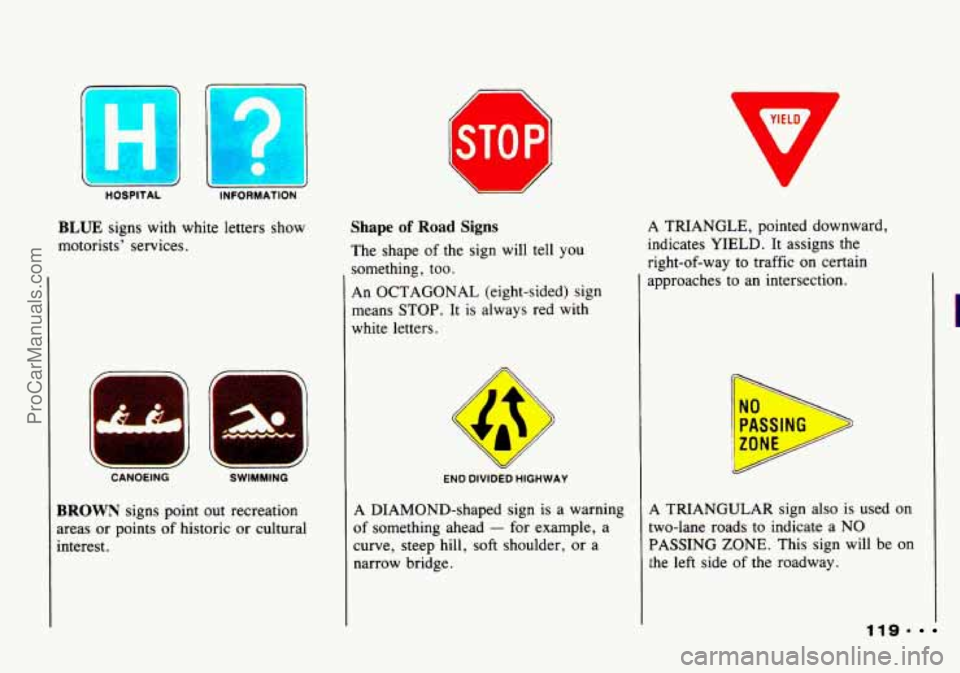
BLUE signs with white letters show
motorists' services.
CANOEING SWIMMING
BROWN signs point out recreation
areas or points
of historic or cultural
interest.
A
P V
YIELD
Shape of Road Signs
The shape of the sign will tell you
something, too.
An OCTAGONAL (eight-sided)
sign
means STOP. It is always red with
white letters.
w'
END DIVIDED HIGHWAY
A DIAMOND-shaped sign is a warning
of something ahead - for example, a
curve, steep hill,
soft shoulder, or a
narrow bridge. A TRIANGLE, pointed
downward,
indicates YIELD.
It assigns the
right-of-way to traffic on certain
approaches to an intersection.
A TRIANGULAR sign also
is used on
two-lane roads to indicate a NO
PASSING ZONE. This sign will be on
the left side
of the roadway.
119.
ProCarManuals.com
Page 124 of 339

Your Driving and the Road
Slowing down. If time allows, tap the
brake pedal once or twice in advance of
slowing or stopping. This warns the
driver behind
you.
Disabled. Your four-way flashers signal
that your vehicle is disabled or is a
hazard. See “Hazard Warning
Flashers” in the Index.
Trafilc Officer
The traffic police officer is also a source
of important information. The officer’s
signals govern, no matter what the
traffic lights or other signs say.
The next section discusses some
of the
road conditions you may encounter.
.122
Defensive Driving
The best advice anyone can give about
driving
is: Drive defensively.
Please
start with a very important safety
device
in your Geo: Buckle up. (See
“Safety Belts” in
the Index.)
Defensive driving really means “be
ready for anything.” On city streets,
rural roads, or freeways, it means
“always expect the unexpected.
”
Assume that pedestrians or other drivers
are going to be careless and make
mistakes. Anticipate what they might
do.
Be ready for their mistakes. Expect children
to dash out from behind
parked cars, often followed by other
children. Expect occupants in parked cars to open doors into traffic. Watch
for movement in parked cars
-
someone may be about to open a door.
Expect other drivers to run stop signs
when you are on a through street. Be
ready
to brake if necessary as you go
through intersections. You may not have
to use the brake, but if you do, you will
be ready.
[f you’re driving through a shopping
center parking lot where there are
well-marked lanes, directional arrows,
and designated parking areas, expect
ProCarManuals.com
Page 132 of 339
Your Driving and the Road
To Use Anti-Lock:
Use rear wheel anti-lock like regular
brakes.
You may feel the brakes vibrate,
or you may notice some noise outside
your vehicle, but this is normal. Let
anti-lock work for you, but remember:
Your front wheels can still stop rolling.
If that happens, release enough pressure
on the brakes to get the wheels rolling
again
so that you can steer.
With the four-wheel-drive option, you
won't have anti-lock braking when you
shift into four-wheel drive. But you will
have regular braking. When you shift
back into two-wheel drive, you will
have anti-lock again.
- 130
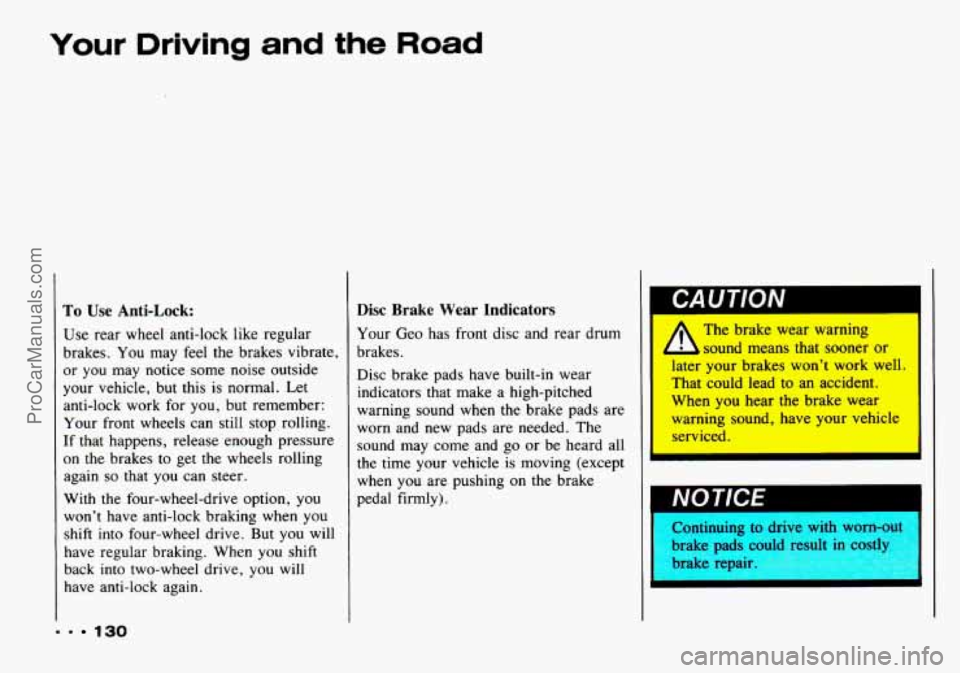
Disc Brake Wear Indicators
Your Geo has front disc and rear drum
brakes.
Disc brake pads have built-in wear
worn and new pads are needed. The
sound may come and go
or be heard all
the time your vehicle is moving (except
when you are pushing on the brake
pedal firmly).
t
The brake wear warning
l sound means that sooner or
1; : your brakes won't work well.
I'hat could lead to an accident.
When you hear the brake wear
cerviced.
indicators
that make
a high-pitched
warning
sound when the brake Pads are I I warning sound, have your vehicle
I
II
IVV I IUL
Continuing to drive with worn-out
brake pads cc
in cost'
brake rep;
'I
ProCarManuals.com