Page 106 of 339

Comfort Controls & Audio Systems
I
1. Slide the air intake lever to =.
2. Slide the airflow lever to Q to
direct air to the windshield vents.
3. Slide the temperature lever toward
4. Slide the fan lever to # .
When the windshield is clear, turn down
the fan speed.
To defog the side windows, slide the
airflow lever to
ZJ. For increased
airflow to the side vents, close the
center vents. the
right.
Air Conditioner Controls
The air conditioning system uses the
same controls as the heating system. The
function of each lever is explained under
“Heater Controls” in this part. The
incoming air is cooled and dehumidified
instead of being heated.
A/C: Push this button to change your
comfort control system from heating
to
air conditioning. A light will come on
when the air conditioning is on. The
A/C button can also control the
humidity in your vehicle.
Cooling
The air conditioner works best if you
keep your windows closed. On very hot
days, open the windows just long
enough for the hot air to escape.
1. Push the A/C button.
2. Move the air intake lever to
for normal cooling. For
faster
cooling move the lever tom.
3. Move the airflow lever to -$ .
4. Move the temperature control lever
5. Move the fan control lever to # .
toward the left.
... 104
ProCarManuals.com
Page 186 of 339

Your Driving and the Road
they are not. It’s important to check
occasionally to be sure the trailer bulbs
are still working.
Driving on Grades
Reduce speed and shift to a lower gear
before you start down a long or steep
downgrade. If you don’t shift down, you
might have to use your brakes
so much
that they would get hot and no longer
work well.
On a long uphill grade, shift down and
reduce your speed
to around 45 mph
(70 km/h) to reduce the possibility of
engine and transmission overheating.
If your trailer weighs more than 1,000
pounds
(450 kg), and you have a manual
transmission with fifth gear, it’s better
not to use fifth gear. Just drive
in fourth
gear (or, as you need to, a lower gear).
Parking on Hills
You really should not park your vehicle,
with a trailer attached, on a hill. If
something goes wrong, your rig could
start to move. People can be injured,
and both your vehicle and the trailer can
be damaged.
But
if you ever have to park your rig on
a hill, here’s how to do
it:
1. Apply your regular brakes, but don’t shift into
P (Park)
yet, or into gear
for a manual transmission.
the trailer wheels.
2. Have someone place chocks under
3. When the wheel chocks are in place,
release the regular brakes until the
chocks absorb the load.
apply your parking brake, and then
shift
to P (Park), or R (Reverse) for
a manual transmission.
vehicle, be sure the transfer case is
in a drive gear - not in N (Neutral).
4. Reapply the regular brakes. Then
5. If you have a four-wheel-drive
... 184
ProCarManuals.com
Page 191 of 339
R
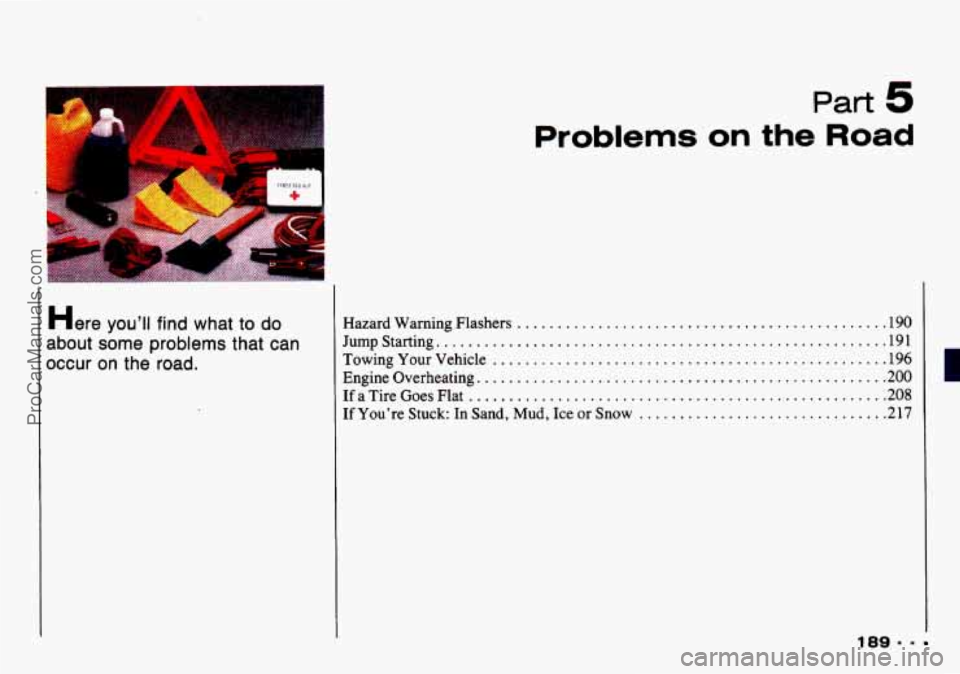
Here you’ll find what to do
about some problems that can
occur
on the road.
Problems on the Road
Hazard Warning Flashers . . . . . . . . . . . . . . . . . . . . . . . . . . . . . . . . . . . . . . . . . . . . . .190
rumpstarting ........................................................ 191
I‘owingYourVehicle ................................................. 196
3ngineOverheating
................................................... 200
[faTireGoesFlat .................................................... 208
[f You’re Stuck: In Sand, Mud, Ice or Snow . . . . . . . . . . . . . . . . . . . . . . . . . . . . . . .217
189- -
ProCarManuals.com
Page 202 of 339
Problems on the Road
Position the sling crossbar under and
forward
of the rear bumper.
. = = 200
A L
Attach a separate safety chain around
the outboard end of each side of the rear
axle.
H Engine Overheating
You will find a coolant temperature
gage on your Geo instrument panel.
ProCarManuals.com
Page 206 of 339

Problems on the Road
c
Engine damage from running yollr I
engine without coolant isn’t
covered by your warranty.
I
If there seems to be no leak, check to
see if the electric engine fan
is running.
If
the engine is overheating, the fan
should be running. If it isn’t, your
vehicle needs service.
How to Add Coolant to the Coolant
Recovery
Tank
If you haven’t found a problem yet, but
the coolant level isn’t at or above
FULL, add a 50/50 mixture of clean
water
(preferably distilled) and the
proper antifreeze at the coolant recovery
tank. (See “Engine Coolant”
in the
Index for more information about the
proper coolant mix.)
A Adding only plain water to
L your cooling system can be
dangerous. Plain water, or some
other liquid, like alcohol, can boil
before the proper coolant mix will.
Your vehicle’s coolant warning
system is set for the proper coolant
mix. With plain water, or the
wrong mix, your engine could get
too hot but you wouldn’t get the
overheat warning. Your engine
could catch fire and you or others
could be burned. Use a 50/50 mix
of clean water and a proper
antifreeze.
ProCarManuals.com
Page 242 of 339

Service & Appearance Care
How to Check Lubricant:
If the level is below the bottom of the
filler plug hole, you’ll need to add some
lubricant.
If the differential is at operating
temperature (warm), add enough
lubricant to raise the level to the bottom
of the filler plug hole.
If the differential
is cold, add enough
lubricant to raise the level to
1/2 inch
(12 mm) below the filler plug hole.
What to Use:
Refer to the Maintenance Schedule to
determine what kind of lubricant to use.
See “Recommended Fluids and
Lubricants” in the Index.
Engine Coolant
The following explains your cooling
system and how to add coolant when it
is low. If you have a problem with
engine overheating, see “Engine
Overheating” in the Index.
The proper coolant for your Geo will:
Give freezing protection down to
Give boiling protection up to 258°F
Protect against rust and corrosion.
Help keep the proper engine
Let the warning lights work as they
-34°F (-37°C).
(125°C).
temperature. should.
What to Use:
Use a mixture of one-half clean water
(preferably distilled) and one-half
antifreeze or approved recycled coolant
that meets “GM Specification 6038M,”
which won’t damage aluminum parts.
Also use GM Engine Coolant
Supplement (sealer) with a complete
coolant change. If you use these, you
don’t need to add anything else.
ProCarManuals.com
Page 245 of 339
Radiator Pressure Cap
IVU I IIJt
Your radiator pressure cap is a 13
- i (90 kPa) pressure-type cap and
must be tightly installed to prevent
coolant
loss and possible engine
damage from overheating. Be sure
the arrows on the cap line up with
the overflow tube on the radiato
filler neck.
I
When you replace your radiator pressure
cap, an
AC* cap is recommended.
Thermostat
Engine coolant temperature is controlled
by a thermostat in the engine coolant
system. The thermostat stops the flow
of
coolant through the radiator until the
coolant reaches a preset temperature.
When you replace your thermostat, an
AC@ thermostat is recommended.
Power Steering Fluid
How to Check Power Steering Fluid:
Unscrew the cap and wipe the dipstick
with a clean rag. Replace the cap and
completely tighten it. Then remove the
cap again and look at the fluid level on
the dipstick.
ProCarManuals.com
Page 256 of 339
Service & Appearance Care
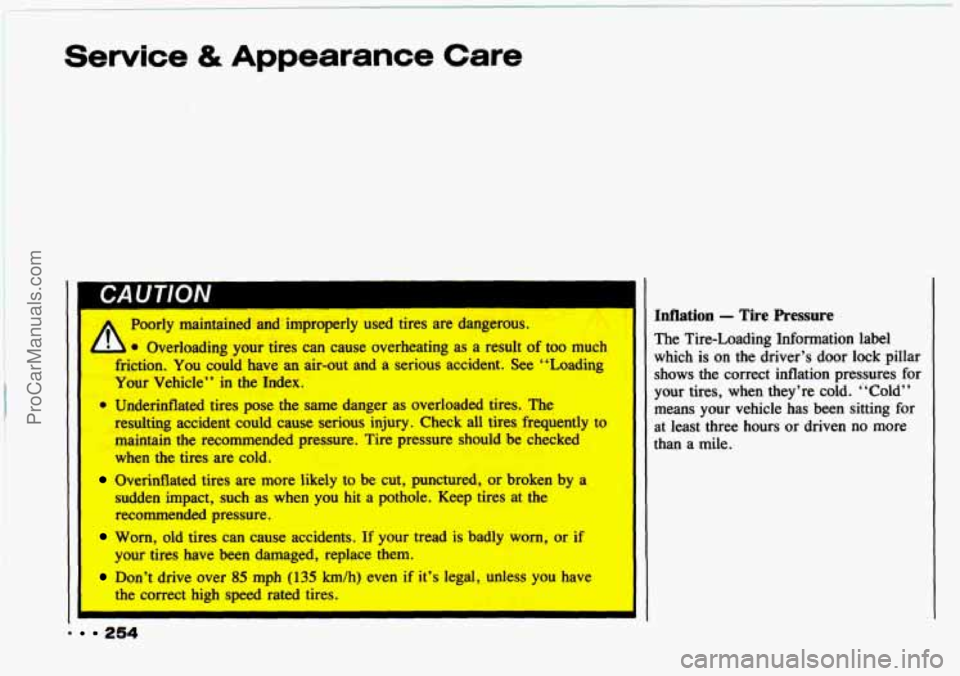
A
Poorly maintained and improperly used tires are dangerous.
9 Overloading your tires can cause overheating as a result of too much
friction. You could have an air-out and a serious accident. See “Loading
Your Vehicle” in the Index.
resulting accident could cause serious injury. Check all tires frequently to
maintain the recommended pressure. Tire pressure should be checked
when
the tires are cold.
Overinflated tires are more likely to be cut, punctured, or broken by a
sudden impact, such as when you hit a pothole. Keep tires at the
recommended pressure.
your tires have been damaged, replace them.
the correct high speed rated tires.
* Underinflated tires pose the same danger as overloaded tires. The
Worn, old tires can cause accidents. If your tread is badly worn, or if
Don’t drive over 85 mph (135 kmh) even if it’s legal, unless you have
Inflation - Tire Pressure
The Tire-Loading Information label
which
is on the driver’s door lock pillar
shows the correct inflation pressures for
your tires, when they’re cold. “Cold”
means your vehicle has been sitting
for
at least three hours or driven no more
than a mile.
9 254
ProCarManuals.com