Page 13 of 386
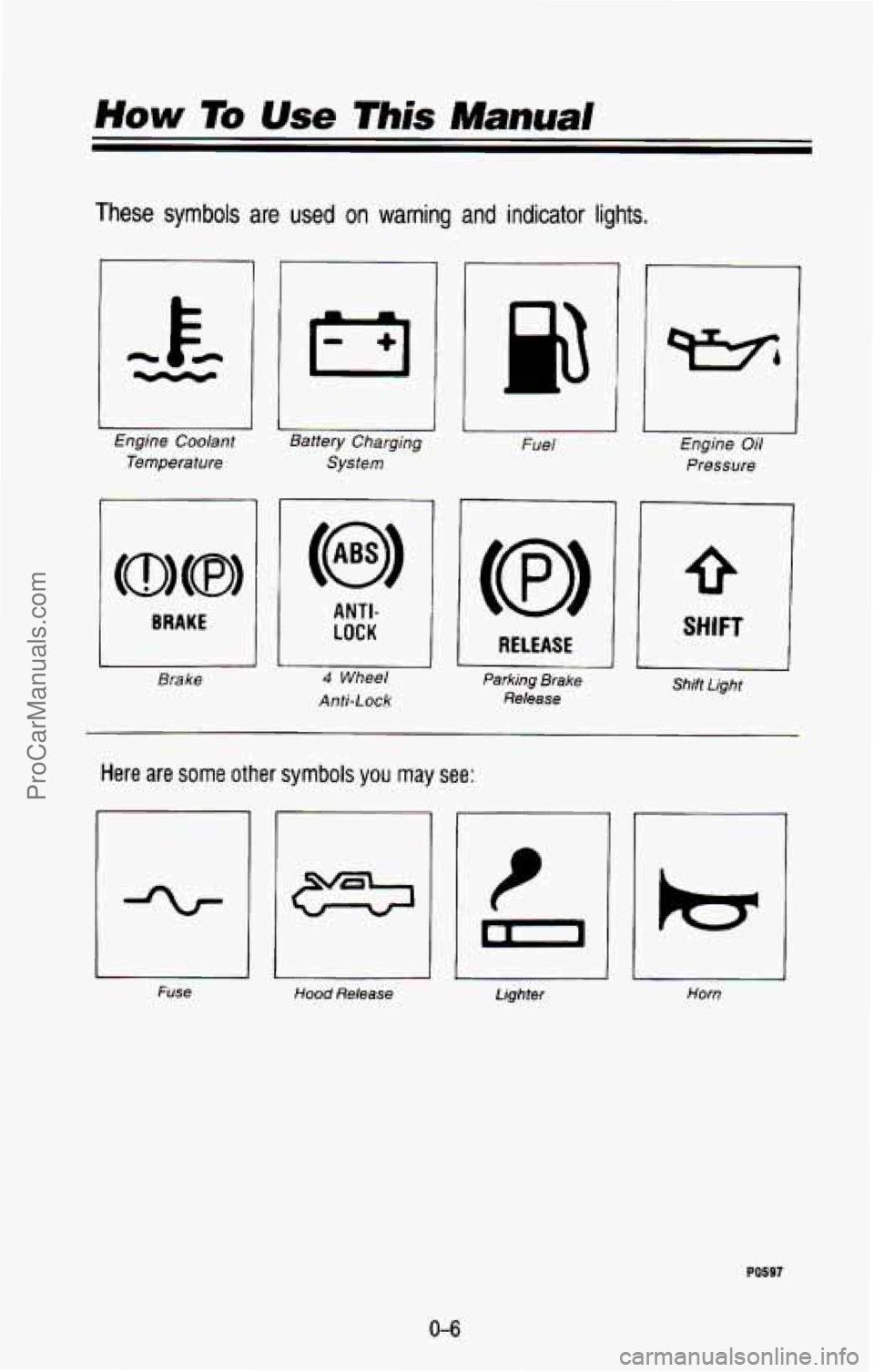
These symbols are used on warning and indicator lights.
Engine Coolant Temperature
BRAKE
Brake
I-,
Battery Charging
System Fuel
ANTI-
LOCK 1
1 4 Wheel
Anti-Lock
RELEASE
Parking Brake
Release
I
Engine Oil
Pressure
I
I SHIFT
1
Shift Light
Here are some other symbols you may see:
Fuse Hood Release Lighter Horn
PO597
0-6
ProCarManuals.com
Page 87 of 386

Features & Controls
Torque Lock
The parking brake should be set first whenever leaving the dri\
ver’s seat. If
you are parked on a hill and the transmission is placed in P (Park) before
the parking brake is set, the weight of the vehicle may put too much force
on the parking pawl in the transmission. It may be difficult to pull the selector
lever
out of P (Park). This is called “torque lock.” To prevent this, the parking
brake should be set
BEFORE moving the selector lever to P (Park).
When preparing to move the vehicle, the selector lever should be moved out
of P (Park) BEFORE releasing the parking brake. Set the parking brake first,
then release the transmission from
P (Park), even on level surfaces.
If “torque lock” does occur, you may have to have another vehicle nudge
your vehicle uphill
a little to take some of the pressure off the transmission
while you pull the selector lever out of
P (Park).
Shifting lnto P (Park) (Automatic Transmission Models Only)
It can be dangerous to get out of your vehicle if the shift lever is not I
A fully in P (Park) with the parking brake firmly set. Your vehicle can
roll.
If you have left the engine running, the vehicle can move suddenl\
y.
You or others could be injured.
To be sure your vehicle won’t move,
when you’re on fairly level ground, use the steps that foll\
ow.
If you have four-wheel drive, and your transfer case is in N (Neutral), I
your vehicle will be free to roll-even if your shift lever is in P
(Park). So, be sure the transfer case is in a drive gear-not in N
(Neutral).
If you are parking on a hill, or if you’re pulling a trailer, also see
I “Parking on Hills” or “Towing a Trailer” in the Index. I
2-24
ProCarManuals.com
Page 141 of 386
Featurns & Controls
30
Oil Pressure Gage
Standard Ciusier
Tachometer
Cluster
K2116
K2117
The oil pressure gage shows the engine oil pressure in psi (\
pounds per square inch) when the engine
is running. Canadian vehicles indicate pressure
in kPa (kilopascals). Oil pressure may vary with engine speed\
, outside
temperature and
oil viscosity, but readings above the low pressure zone
indicate the normal operating range.
2-78
ProCarManuals.com
Page 142 of 386
A reading in the low pressure zone may be caused by a dangerouslv low oil
level or other problem causing low oil pressure. Check your oi\
l as soon as
possible.
CAUTION
Don’t keep driving if the oil pressure is low. If you do, your engine
can become so hot that it catches on fire, You or others could be
burned. Check your oil as soon as possible and have your vehicle
serviced.
e NOTICE
I
Damage to your engine from neglected oil problems can rnstly at,,
not covered by your ‘Avanty.
I
Voltmeter
Standard Cluster
14
Tachometer Cluster
19
GL
K2336
When your engine is not running, but the ignition is on (in \
the Run position),
this gage
shows your battery’s state of charge in DC volts. When the engine
is running, the gage shows the condition
of the charging system. Readings
between the low and high warning zones indicate the normal ope\
rating range.
Readings in either warning zone indicate a possible problem in \
the electrical
system.
2-79
ProCarManuals.com
Page 182 of 386
If your engine ever stops while you’re driving, brake normally but don’t
pump your brakes. If you do, the pedal may get harder to push down. If
your engine stops, you will still have some power brake assist. But you
will use it when you brake. Once the power assist is used up, it may
take longer
to stop and the brake pedal will be harder to push.
Anti-lock Brakes (ABS)
Your vehicle has an advanced electronic braking system that can help\
keep it
under control.
When you start your vehicle and begin to drive away, you may hear
a
momentary motor or clicking noise. This is the ABS system testing itself.
AM41 5006
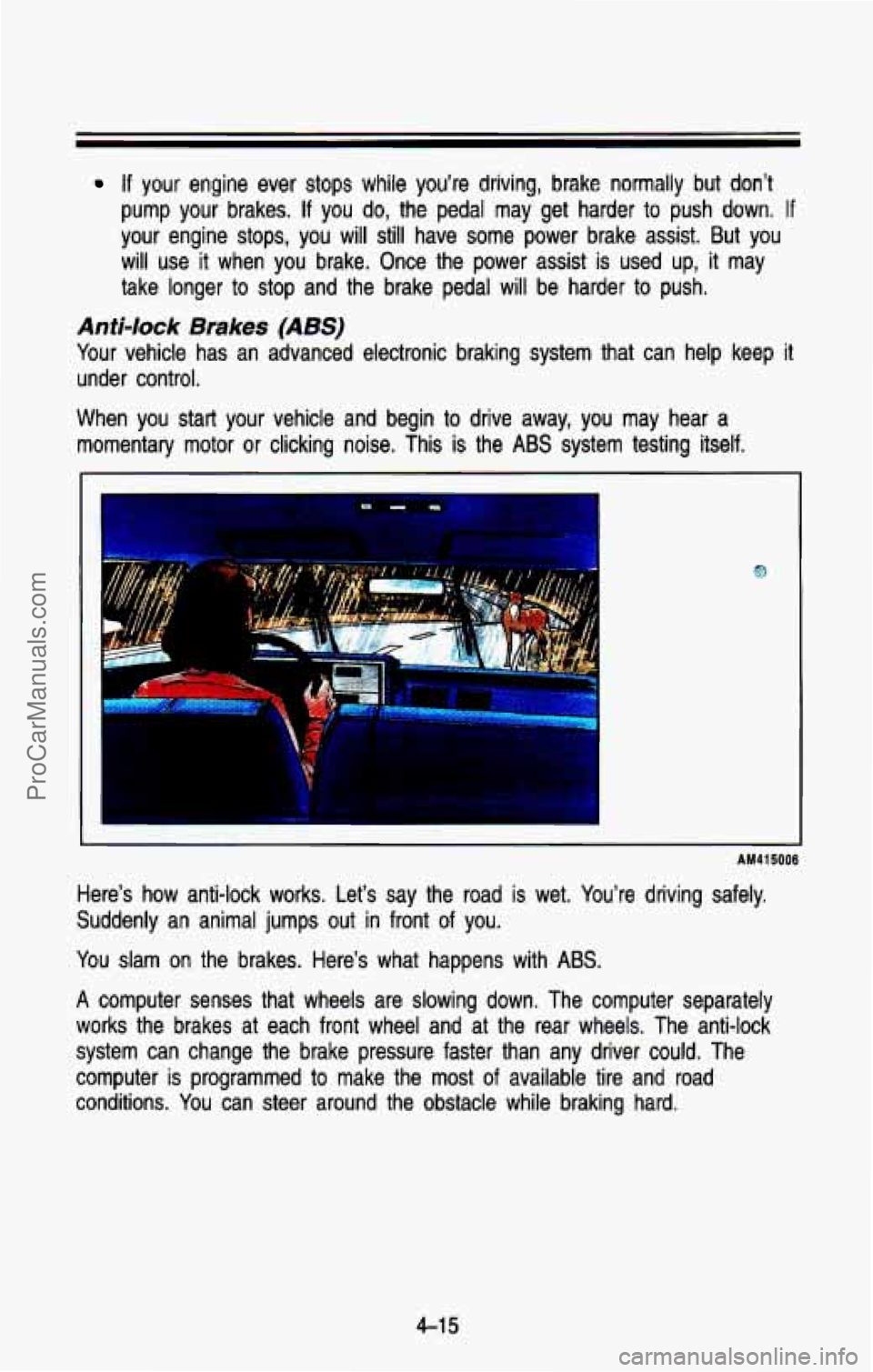
Here’s how anti-lock works. Let’s say the road is wet. Y\
ou’re driving safely.
Suddenly an animal jumps out in front of you.
You slam on the brakes. Here’s what happens with ABS.
A computer senses that wheels are slowing down. The computer sepa\
rately
works the brakes at each front wheel and at the rear wheels. \
The anti-lock
system can change the brake pressure faster than any driver co\
uld. The
computer is programmed to make the
most of available tire and road
conditions. You can steer around the obstacle while braking hard.
4-1 5
ProCarManuals.com
Page 183 of 386
Your Driving and fhe Road
AM41501 6
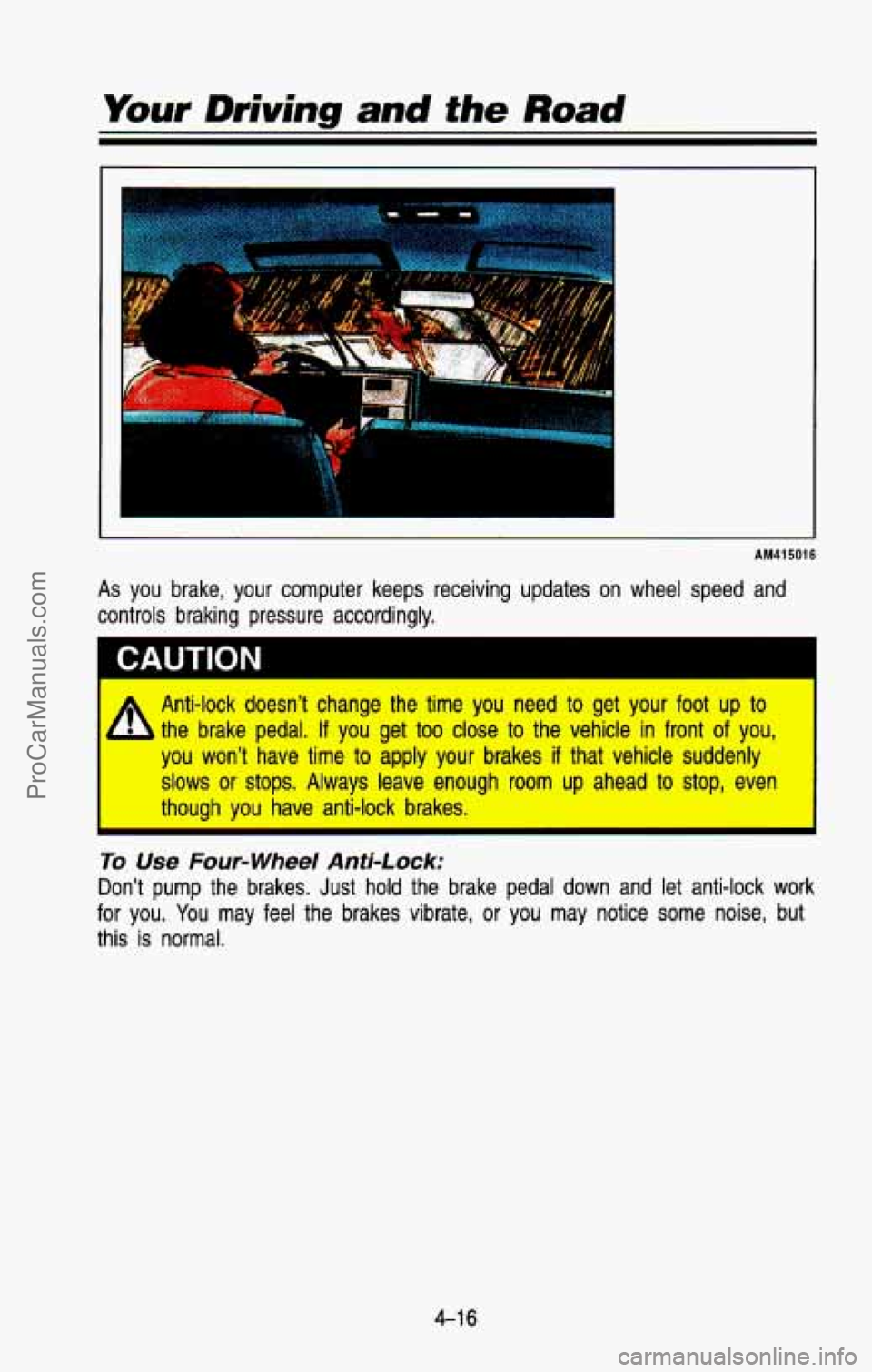
As you brake, your computer keeps receiving updates on wheel speed and
controls braking pressure accordingly.
CAUTION I
A Anti-lock doesn’t change the time you need to get your foot up to
- the brake pedal, If you get too close to the vehicle in front of you,
you won’t have time to apply your brakes if that vehicle suddenly
slows or stops. Always leave enough room up ahead to stop, even
I though you have anti-lock brakes. I
To Use Four-wheel Anti-Lock:
Don’t pump the brakes. Just hold the brake pedal down and let anti-lock work
for you.
You may feel the brakes vibrate, or you may notice some noise, but
this
is normal.
4-1 6
ProCarManuals.com
Page 200 of 386
AM440002
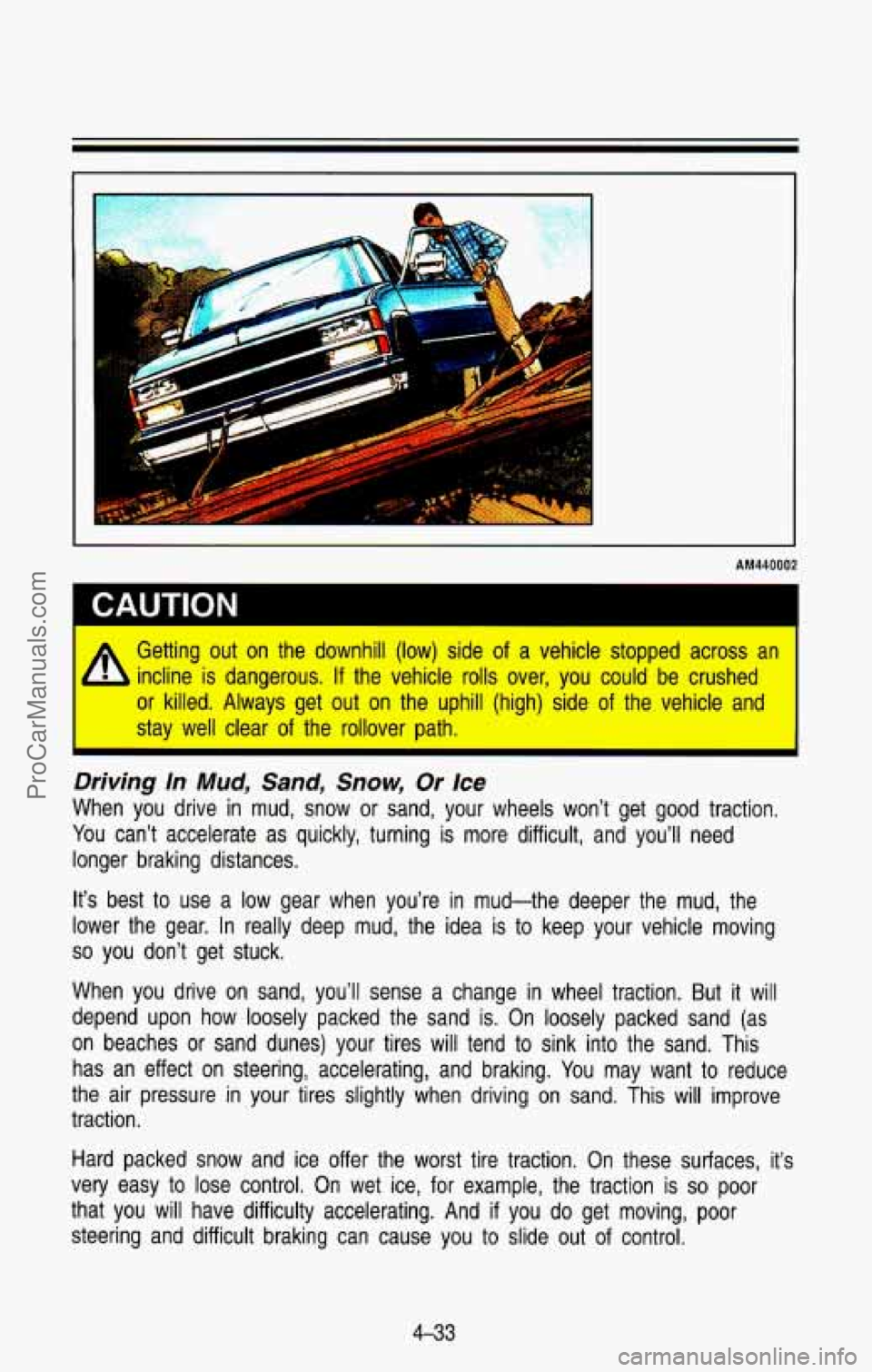
I Getting out on the downhill (low) side of a vehicle stopped across an
- , incline is dangerous. If the vehicle rolls over, you could be crushed
or killed. Always get out on the uphill (high) side of the vehicle and
stay well clear of the rollover path. F
Driving In Mud, Sand, Snow, Or Ice
When you drive in mud, snow or sand, your wheels won’t get\
good traction.
You can’t accelerate as quickly, turning is more difficult, and \
you’ll need
longer braking distances.
It’s best to use a low gear when you’re in mud-the deeper the \
mud, the
lower the gear. In really deep mud, the idea is
to keep your vehicle moving
so you don’t get stuck.
When you drive on sand, you’ll sense a change in wheel tra\
ction. But
it will
depend upon how loosely packed the sand is. On loosely packed \
sand (as
on beaches or sand dunes) your tires will tend to sink into the\
sand. This
has an effect on steering, accelerating, and braking. You may want to reduce
the air pressure
in your tires slightly when driving on sand. This will improve
traction.
Hard packed snow and ice offer the worst tire traction. On these surfaces, it’s
very easy to lose control. On wet ice, for example, the tract\
ion is
so poor
that you will have difficulty accelerating. And
if you do get moving, poor
steering and difficult braking can cause you to slide out
of control.
4-33
ProCarManuals.com
Page 206 of 386
Hydroplaning doesn’t happen often. But it can if your tires haven’t much tread
or
if the pressure in one or more is low. It can happen if a lot of water is
standing on the road. If you can see reflections from trees, \
telephone poles, or other vehicles, and raindrops “dimple” the water’s s\
urface, there could be hydroplaning.
Hydroplaning usually happens on higher speed roads. There just isn’t a hard
and fast rule about hydroplaning. The best advice is to slow \
down when it is
raining, and be careful.
Some Other Rainy Weather Tips
Turn on your headlights-not just your parking lights-to help ma\
ke you
more visible to others.
Look for hard-to-see vehicles coming from behind. You may want to use
your headlights even in daytime
if it’s raining hard.
Besides slowing down, allow some extra following distance. And \
be
especially careful when you pass another vehicle. Allow yourself\
more
clear room ahead, and be prepared to have your view restricted\
by road spray.
If the road spray is so heavy you are actually blinded, drop back.
Don’t pass until conditions improve. Going more slowly is be\
tter than
having an accident.
Use your defogger
if it helps.
Have good tires with proper tread depth. (See “Tires” in\
the Index.)
4-39
ProCarManuals.com
 wh")