1993 CHEVROLET SUBURBAN pressure
[x] Cancel search: pressurePage 292 of 386

k
NOTICE
f YOU use the proper coolant, you don’t have to add extra inhibitors or
idditives which claim to improve the system. These can be harmful
Adding Coolant
‘1 L
L
L
PO206
To Check Coolant: When your engine is cold, the coolant level should be at
COLD, or a little higher. When your engine is warm, the level shoul\
d be up
to HOT, or a little higher.
To Add Coolant: If you need more coolant, add the proper mix at the
coolant recovery tank.
I CAUTION
4
Turning the radiator pressure cap when the engine and radiator are
hot can allow steam and scalding liquids to blow out and burn you
badly. With the coolant recovery tank, you will almost never have to
add coolant at the radiator. Never turn the radiator pressure
I cap-even a little-when the engine and radiator are hot. I
Add coolant mix at the recovery tank, but be careful not to spill it.
~ ~~
1 CAUTION I
You can be burned if you spill coolant on hot engine parts. Coolant
- b contains ethylene glycol, and it will burn if the engine parts are hot
I enough. Don’t spill coolant on a hot engine. I
6-27
ProCarManuals.com
Page 293 of 386

Service & Appearance Care
Radiator Pressure Cap
I
I
-
- K2515
1 NOTICE
four radiator pressure cap is a 15 psi (105 kPa) pressure-type cap and
nust be tightly installed to prevent coolant loss and possible engine
mage from overheating. Be sure the arrows on the cap line up \
with
werffow tube
on the radiator filler neck.
-m recommended.
I
Thermostat
Engine coolant temperature is controlled by a thermostat in the engine coolant
system. The thermostat stops the
flow of coolant through the radiator until the
coolant reaches a preset temperature.
When you replace
your thermostat, an AC@ thermostat is recommended.
6-28
ProCarManuals.com
Page 311 of 386
Loading Your Vehicle
MFD BY GENERAL MOTORS CORP L-4
I
. , .. .-. .. ,. . ,FFECT
CROWN ABOVE.
1
TIRE SIZE
-EL XISPEED RIM PSVKPA (COLD)
SPA
SEE OWNERS MANUAL FOR ADDITIONAL INFORMATION
K2134
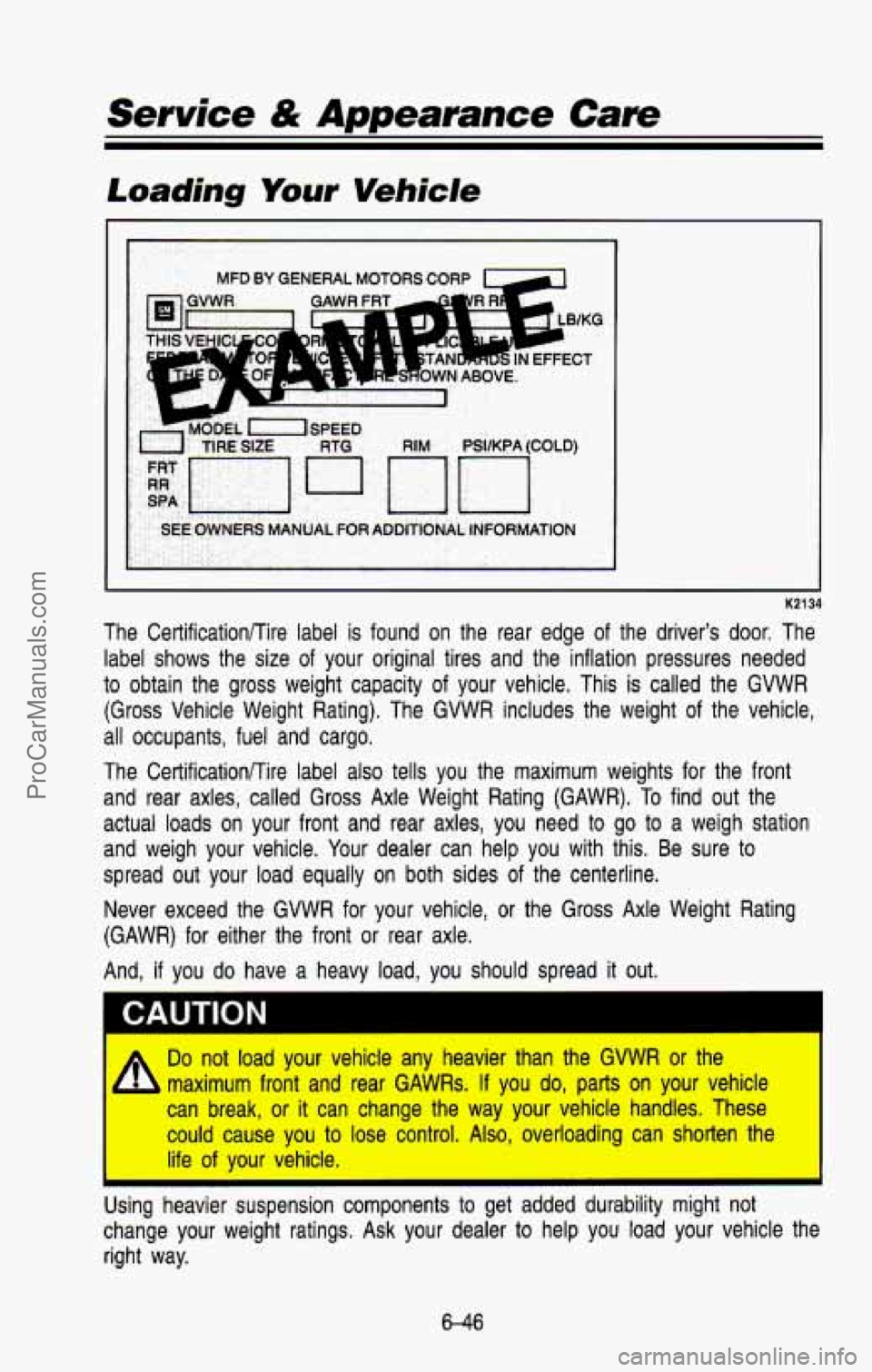
The Certificationflire label is found on the rear edge of the driver's door. The
label shows the size of your original tires and the inflation \
pressures needed
to obtain the gross weight capacity of your vehicle. This is called the GVWR
(Gross Vehicle Weight Rating). The GVWR includes the weight o\
f the vehicle,
all occupants, fuel and cargo.
The Certificationnire label also tells you the maximum weights for the front
and rear axles, called Gross Axle Weight Rating (GAWR). To find out the
actual loads on your front and rear axles, you need to go to\
a weigh station
and weigh your vehicle. Your dealer can help you with this. Be sure to
spread out your load equally on both sides of the centerline. \
Never exceed the GVWR
for your vehicle, or the Gross Axle Weight Rating
(GAWR) for either the front or rear axle.
And,
if you do have a heavy load, you should spread it out.
A
Do not load your vehicle any heavier than the GVWR or the I
maximum front and rear GAWRs. If you do, parts on your vehicl\
e
can break, or
it can change the way your vehicle handles. These
could cause you
to lose control. Also, overloading can shorten the
life of your vehicle.
Using heavier suspension components
to get added durability might not
change your weight ratings. Ask your dealer to help you load your vehicle the
right way.
6-46
ProCarManuals.com
Page 314 of 386
Poorly maintained and improperly used tires are dangerous. Overloading your tires can cause overheating as
a result of too
much friction. You could have an air-out and a serious accident.
See “Loading Your Vehicle”
in the Index.
The resulting accident could cause serious injury. Check all tires
frequently to maintain the recommended pressure. Tire pressure
should
be checked when your tires are cold,
0 Overinflated tires are more likely to be cut, punctured, or broken
by sudden impact, such as when you hit a pothole. Keep tires
at the recommended pressure.
0 Worn, old tires can cause accidents, If your tread is badly worn,
or if your tires have been damaged, replace them.
Even if it’s legal, don’t drive over 85 mph (135 kmh) if you
have
16 inch tires.
See “Special Tire Inflation”
in this section for more information on
loading
and inflation pressures at speeds above 65 mph (105 kmh).
Underinflated tires pose the same danger as overloaded tires.
Inflation-Tire Pressure
The Certification/Tire label which is on the rear edge of the driver’s door, or
on the incomplete vehicle document in the cab, shows the correct inflation
pressures for your tires, when they’re cold. “Cold” mea\
ns your vehicle has
been sitting for at least three hours or driven no more than a mile.
You can operate some vehicles at reduced inflation pressures only when you’ll
be carrying reduced loads. On those vehicles, the minimum cold \
inflation
pressures for a typical reduced load are printed
on the “Improved Ride Tire
Pressure” label located on the driver’s door. Weigh the v\
ehicle to find the
load on each tire and see the label for the minimum cold inflation pressures
for that load.
6-49
ProCarManuals.com
Page 315 of 386
Don’t let anyone tell you that underinflation or overinflation is all right. It’-
9. If your tires don’t have enough air (underinflation) you can get
Too much flexing
Too much heat
tire overloading
Bad wear
Bad handling
Bad fuel economy.
I If your tires have too much air (overinflation), you can get:
Unusual wear
Bad handling
Rough ride
Needless damage from road hazards.
nth
or more. Also, check the
tire pressure of the spare tire.
How to Check: Use a good quality pocket-type gage to check tire pressure.
Simply looking at the tires will not tell you the pressure, e\
specially if you
have radial tires-which may look properly inflated even
if they’re
underinflated.
If your tires have valve caps, be sure to put them back on. The\
y help
prevent leaks by keeping out dirt and moisture.
Special Tire Inflation
If you have 16 inch tires on your vehicle, and:
- You’ll be driving for very long at speeds of 66 mph (105 km/h) to 75
mph
(120 km/h) where legal, inflate tires 10 psi (70 kPa) more than
the recommended
cold inflation pressure,
- You’ll be driving for very long at speeds of 76 mph (120 kmih) to 85
mph (135 km/h) where legal, cold inflation pressure should be
increased
by 10 psi (70 kPa) and you must also reduce axle load
capacity by
10%. Do not drive over 85 mph (135 kmlh) even if
it’s legal.
- Inflation pressures should never exceed 10 psi (70 kPa) above the
inflation specified for the maximum
load of the tire.
6-50
ProCarManuals.com
Page 317 of 386
Service & Appearance Care
Tire lnspecfion and Rotation
To make your tires last longer, have them inspected and rotated at the
mileages recommended in the Maintenance Schedule. See “Scheduled
Maintenance Services” in the Index.
FRT FRT
L
I I
K2655
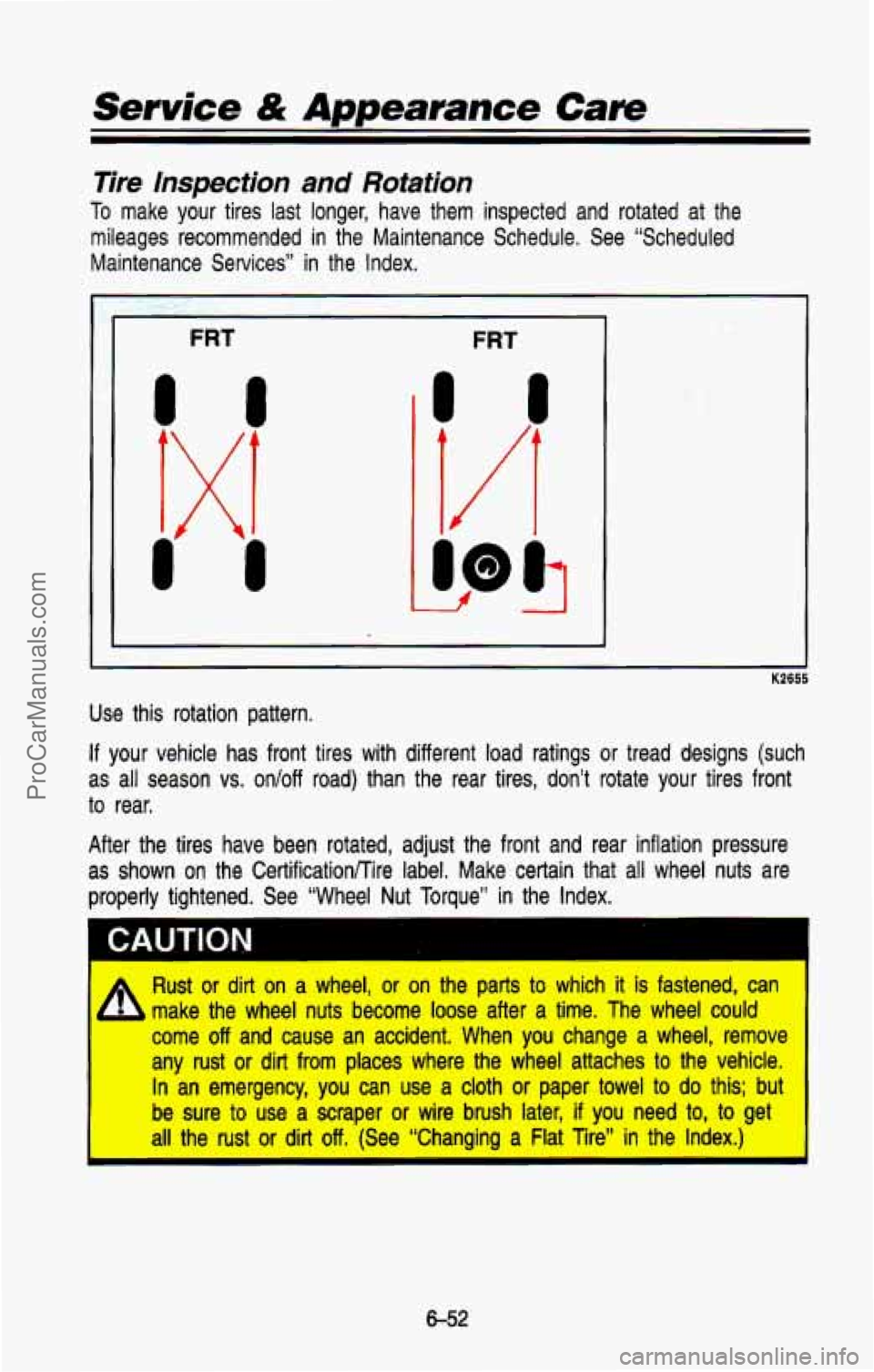
Use this rotation pattern,
If your vehicle has front tires with different load ratings or tr\
ead designs (such
as all season vs. on/off road) than the rear tires, don’t rotate \
your tires front
to rear,
After the tires have been rotated, adjust the front and rear \
inflation pressure
as shown on the CertificationRire label. Make certain that all \
wheel nuts are
properly tightened.
See “Wheel Nut Torque” in the Index.
1 CAUTION
Rust or dirt on a wheel, or on the parts to which it is fastened, can
make the wheel nuts become loose after a time. The wheel could
come
off and cause an accident. When you change a wheel, remove
any rust or dirt from places where the wheel attaches
to the vehicle.
In an emergency, you can use a cloth or paper towel to
do this; but
be sure to use a scraper or wire brush later, if you need to, to get
I
I all the rust or dirt off. (See ‘Changing a Flat Tire” in the Index.) I
&52
ProCarManuals.com
Page 324 of 386
Using Solvent-Type CIeaner on Fabric
First, see if you have to use solvent-type cleaner at all. Some spots and
stains will clean
off better with just water and mild soap.
If you need to use it, then:
Gently scrape excess soil from the trim material with a clean, dull knife
or scraper. Use very little cleaner, light pressure and clean cloths
(preferably cheesecloth). Cleaning should start at the outside \
of the stain,
“feathering” toward the center. Keep changing
to a clean section of the
cloth
.
When you clean a stain from fabric, immediately dry the area with an air
hose, hair dryer, or heat lamp
to help prevent a cleaning ring. (See
previous NOTICE.)
Fabric Profection
Your vehicle has upholstery that has been treated with ScotchgardTM \
Fabric
Protector, a
3M product. ScotchgardTM protects fabrics by repelling oil and
water, which are the carriers
of most stains. Even with this protection, you
still need
to clean your upholstery often to keep it looking new.
Further information on cleaning is available by calling
1-800-433-3296 (in
Minnesota,
1-800-642-61 67).
Special Cleaning Problems
Greasy or Oily Stains: Like grease, oil, butter, margarine, shoe polish, coffee
with cream, chewing gum, cosmetic creams, vegetable oils, wax c\
rayon, tar
and asp ha1
t .
Carefully scrape off excess stain.
Then follow the solvent-type instructions above.
Shoe polish, wax crayon, tar and asphalt will stain if left on a vehicle
seat fabric. They should be removed as soon as possible. Be c\
areful, because the cleaner will dissolve them and may cause them
to bleed.
Non-Greasy Stains: Like catsup, coffee (black), egg, fruit, fruit juice, milk,
soft drinks, wine, vomit, urine and blood.
Carefully scrape off excess stain, then sponge the place with cool water.
If a stain remains, follow the foam-type instructions above.
If an odor lingers after cleaning vomit or urine, treat the area with a
watedbaking soda solution:
1 teaspoon (5 ml) of baking soda to 1 cup
(250 ml) of lukewarm water.
Finally, if needed, clean lightly with solvent-type cleaner.
6-59
ProCarManuals.com
Page 326 of 386

Cleaning the Outside of the Windshield and Wiper Blades
If the windshield is not clear after using the windshield washer, or if the wiper
blade chatters when running, wax or other material may be on the blade or
windshield,
Clean the outside windshield with
GM Windshield Cleaner, Bon-Ami Powder@
(GM Part No. 1050011). The windshield is clean if beads do not form when
you rinse it with water.
Clean the blade by wiping vigorously with a cloth soaked in full strength
washer solvent. Then rinse the blade with water.
Wiper blades should be checked on a regular basis and replaced\
when worn.
Cleaning the Outside of Your Vehicle
The paint finish on your vehicle provides beauty, depth of color, gloss
retention and durability.
Washing Your Vehicle
The best way to preserve your vehicle’s finish is to keep it clean by washing
it often with lukewarm or cold water.
Don’t wash your vehicle in the direct rays
of the sun, Don’t use strong soaps
or chemical detergents. Use liquid hand, dish or car washing (non-detergent)
soaps. Don’t use cleaning agents that contain acid
or abrasives. All cleaning
agents should be flushed promptly and not allowed to dry on t\
he surface, or
they could stain. Dry the finish with a soft, clean chamois or a
100% cotton
towel to avoid surface scratches and water spotting.
High pressure vehicle washes may cause water to enter your vehicle.
Finish Care
Occasional waxing or mild polishing of your vehicle may be necessary to
remove residue from the paint finish. You can get GM approved cleaning
products from your dealer. (See “Appearance Care and Materia\
ls” in the
Index.)
Your vehicle has a “basecoatlclearcoat” paint finish. The clearcoat gives more
depth and
gloss to the colored basecoat.
Machine compounding
or aggressive polishing on a basecoatlctearcoat I f
paint finish may dull the finish or leave swirl marks.
6-6 1
ProCarManuals.com