1993 CHEVROLET SUBURBAN change time
[x] Cancel search: change timePage 193 of 386
Your Driving and the Road
Tune your senses to different kinds of signals. Your eyes, for example, need
to constantly sweep the terrain for unexpected obstacles. Your ears need to
listen for unusual tire or engine sounds. With your arms, hand\
s, feet, and
body you’ll need to respond
to vibrations and vehicle bounce.
Controlling your vehicle is the key to successful off-road driving. One of the
best ways to control your vehicle
is to control your speed. Here are some
things to keep in mind.
At higher speeds:
you approach things faster and you have less time to scan the\
terrain
for obstacles.
you have less time to react.
you have more vehicle bounce when you drive over obstacles.
you’ll need more distance for braking, especially since you’\
re on an
unpaved surface.
A
When you’re driving off road, bouncing and quick changes in I
direction can easily throw you out of position. This could cause you
to lose control and crash.
So, whether you are driving on or off the
road, you and your passengers should wear your safety belts.
Scanning the Terrain
Off-road driving can take you over many different kinds of terrain. You need
to be familiar with the terrain and its many different features. Here are some
things to consider.
Surface Conditions
Off-roading can take you over hard-packed dirt, gravel, rocks, grass, sand,
mud, snow or ice. Each of these surfaces affects the steering, acceleration,
and braking of your vehicle in different ways. Depending upon the kind of
surface you are on, you may experience slipping, sliding, wheel spinning,
delayed acceleration, poor traction, and longer braking distances\
.
Surface Obstacles
Unseen or hidden obstacles can be hazardous. A rock, log, hole, rut, or
bump can startle you
if you’re not prepared for them. Often these obstacles
are hidden by grass, bushes, snow
or even the rise and fall of the terrain
itself. Here are some things to consider:
Is the path ahead clear?
Will the surface texture change abruptly up ahead?
4-26
ProCarManuals.com
Page 194 of 386
Does the travel take you uphill or downhill? (There’s more discussion of
these subjects later.)
Will you have to stop suddenly or change direction quickly?
When you drive over obstacles
or rough terrain, keep a firm grip on the
steering wheel. Ruts, troughs, or other surface features can jerk the wheel
out of your hands
if you’re not prepared.
When you drive over bumps, rocks, or other obstacles, your wheels can leave
the ground.
If this happens, even with one or two wheels, you can’t control
the vehicle as well or at all.
Because you will
be on an unpaved surface, it’s especially important to avoid
sudden acceleration, sudden turns, or sudden braking.
In a way, off-road driving requires a different kind of alertness from driving on
paved roads and highways. There are no road signs, posted spee\
d limits or
signal lights. You have to use your
own good judgment about what is safe
and what isn’t.
I CAUTION
Drinking and driving can be very dangerous on any road. And this is
- b certainly true for off-road driving. At the very time you need special
alertness and driving skills, your reflexes, perceptions and jud\
gment
can be affected by even a small amount
of alcohol. You could have
a serious-or even fatal-accident
if you drink and drive or ride with
a driver who has been drinking. (See “Drunken Driving” in the
Index.)
Driving On Oft-Road Hills
Off-road driving often takes you up, down, or across a hill. Driving safely on
hills requires good judgment and an understanding of what your vehicle can
and can’t do. There are some hills that simply can’t be driven, no matter how
well-built the vehicle.
I CAUTION
A Many hills are simply too steep for any vehicle. If you drive up them,
62 you will stall. If you drive down them, you can’t control your speed. If
you drive across them, you will roll over. You could be seriously
injured or killed.
If you have any doubt about the steepness, don’t
drive the hill.
4-27
ProCarManuals.com
Page 212 of 386
Before Leaving on a Long Trip
Make sure you’re ready. Try to be well rested. If you must start when you’re
not fresh-such as after a day’s work-don’t plan to make too many miles
that first part of the journey. Wear comfortable clothing and shoes you can
easily drive in.
Is your vehicle ready for a long trip? If you keep it serviced and maintained,
it’s ready to go. If it needs service, have it done before starting out. Of
course, you’ll find experienced and able service experts
in your vehicle’s
dealerships all across North America. They’ll be ready and w\
illing to help
if
you need it.
Here are some things you can check before a trip:
e
e
On
Windshield Washer Fluid: Is the reservoir full? Are all windows clean
inside and outside?
Wiper Blades: Are they in good shape?
Fuel, Engine Oil, Other Fluids: Have you checked all levels?
Lights: Are they all working? Are the lenses clean?
Tires: They are vitally important to a safe, trouble-free trip. Is the tread
good enough for long distance driving? Are the tires all inflated to the
recommended pressure?
Weather Forecasts: What’s the weather outlook along your route?
Should you delay your trip a short time to avoid a major storm system?
Maps: Do you have up-to-date maps?
the Road
Unless you are the only driver, it is good to share the driving task with
others. Limit turns behind the wheel to about
100 miles (160 km) or two
hours at a sitting. Then, either change drivers or stop for s\
ome refreshment
like coffee, tea or soft drinks and some limbering up. But do stop and move
around. Eat lightly along the way. Heavier meals tend
to make some people
sleepy.
On two-lane highways or undivided multilane highways that do not have
controlled access, you’ll want to watch for some situations not usually found
on freeways. Examples are: stop signs and signals, shopping cen\
ters with
direct access to the highway, no passing zones and school zones, vehicles
turning left and right
off the road, pedestrians, cyclists, parked vehicles, and
even animals.
4-45
ProCarManuals.com
Page 224 of 386
I NOTICE
’
I advice in this section.
Wing a trailer improperly can damage your vehicle and result in costly
epairs not covered by your warranty. To pull a trailer correctly, follow the
Every vehicle is ready for some trailer towing,
If it was built with trailering
options, as many are, it’s ready for heavier trailers. But \
trailering is different
than just driving your vehicle by itself. Trailering means changes in handling,
durability, and fuel economy. Successful, safe trailering takes \
correct equipment, and it has to be used properly.
That’s the reason for this section. In
it are many time-tested, important
trailering tips and safety rules. Many of these are important for your safety
and that of your passengers,
So please read this section carefully before you
pull a trailer.
If You Do Decide To Pull A Trailer
If you do, here are some important points.
e
e
There are many different laws having to do with trailering. Make sure
your rig
will be legal, not only where you live but also where you’ll be\
driving.
A good source for this information can be state or provincial
police.
Consider using sway control with a utility model
if your trailer will weigh
3,000 pounds (1361 kg) or less, or with a wagon model if your trailer
will weigh
4,000 pounds (1800 kg) or less. You should always use sway
control with a utility model
if your trailer will weigh more than 3,000
pounds (1 361 kg), or with a wagon model if your trailer will weigh more
than
4,000 pounds (1800 kg). You can ask a hitch dealer about sway
controls.
Don’t tow a trailer at all during the first
500 miles (800 km) your new
vehicle is driven. Your engine, axle, or other parts could be damaged.
Then, during the first
500 miles (800 km) that you tow a trailer, don’t
drive over
50 mph (80 kmlh) and don’t make starts at full throttle. That
will help your engine and other parts
of your vehicle wear in at the
heavier loads.
4-57
ProCarManuals.com
Page 257 of 386
1 CAUTION
* Rust or dirt on the wheel, or on the parts to which it is fastened, ’
h can make the wheel nuts become loose after a time. The wheel
I could corne off and cause an accident. When you change a wheel,
remove any rust or dirt fmm the places where the wheel attaches to
the vehicle. In an emergency, you can use a cloth or a paper towel
to do this; but be sure to use a scraper ~r wire brush later, if you
need to, to get all the rust or dirt off.
Remove any rust or dirt from the wheel bolts, mounting surfaces or spare
wheel. Place the spare on the wheel mounting
surface.
CAUTION
Never use oil or grease on studs or nuts. If you do, the nuts might
come loose. Your wheel could fall
off, causing a serious accident.
I
K2127
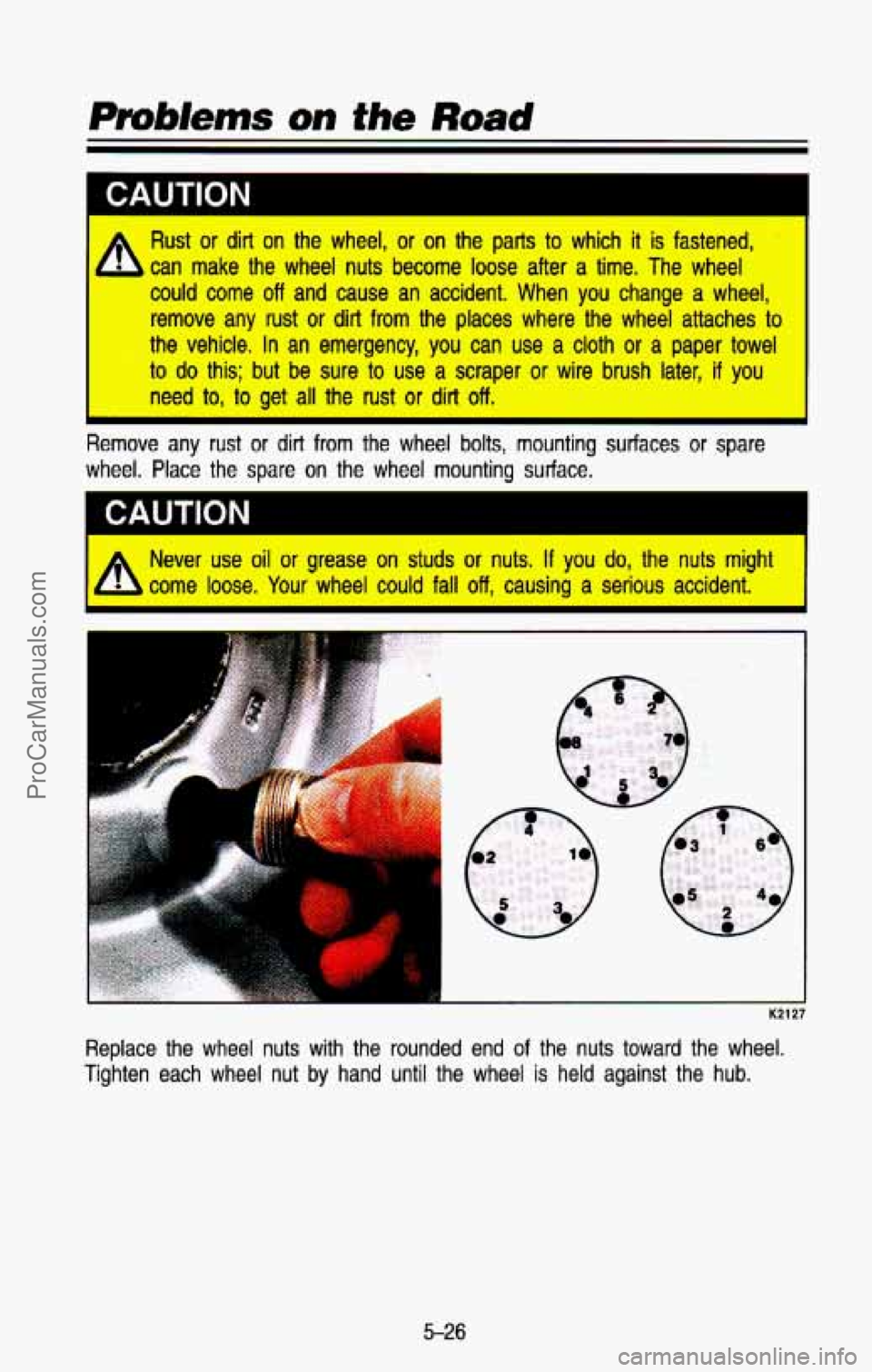
Replace the wheel nuts with the rounded end of the nuts toward the wheel.
Tighten each wheel
nut by hand until the wheel is held against the hub.
5-26
ProCarManuals.com
Page 280 of 386
These numbers on an oil container show its viscosity, or thickness.
Do not use other viscosity oils such as SAE 1OW-40 or SAE 2OW-50.
Energy Conserving II
Oils with these words on the container will help you save fuel.
This doughnut-shaped logo (symbol) is used on most oil contai\
ners to help
you select the correct oil,
You should look for this on the
oil container, and use only those oils that
display the logo.
GM Goodwrench@ oil (in Canada, GM Engine Oil) meets all the requirements
for your vehicle.
Engine Oil Addifives:
Don't add anything to your oil. Your GM dealer is ready to advise if you think
something should be added.
When to Change Engine Oil:
See if any one of these is true for you;
Most trips are less than 4 miles (6 km).
It's below freezing outside and most trips are less than 10 miles (16 km).
The engine is at low speed most of the time (as in door to door
You tow a trailer often.
Most trips are through dusty places.
The vehicle is frequently operated off-road. delivery, or in stop-and-go
traffic),
If any one of these is true for your vehicle, then you need to change your oil
and filter every 3,000 miles (5000 km) or 3 months-whichever comes first.
Vehicles with Light Duty Emissions (8500 GVWR or less).
If none of them is true, change the oil every 7,500 miles (1 2 500 km) or 12
months-whichever comes first. Change the filter at the first oil change and at
every other oil change after that.
Vehicles with Heavy Duty Emissions (8501 GVWR or more).
If none of them is true, change the oil every 6,000 miles (1 0 000 km) or 12
months-whichever comes first. Change the filter at the first oil change and at
every other oil change after that if mileage determines when you change your
6-1 5
ProCarManuals.com
Page 281 of 386

Service & Appearance Care
oil. If time determines when you change your oil, change the filter ea\
ch time
you change your oil.
Engine Block Heater:
An engine block heater can be a big help if you have to park outside in very
cold weather,
0°F (-18°C) or colder. If your vehicle has this option, see
“Engine Block Heater” in the Index.
What to Do with Used Oil:
Used engine oil contains things that have caused skin cancer in
laboratory animals. Don’t let
used oil stay on your skin for very long.
Clean
your skin and nails with soap and water, or a good hand ,,:: :‘:-;
cleaner. Wash or properly throw away clothing or rags containing-:’-:;$ ~
used engine oil.
. ,A:<< --.
L. .. . .. ,-. f .- , L ., -J ’,: ._ - -
..:.: ;,i, j I -.. : j ,!
Used oil can be a real threat to the environment. If YOU change your own oil,
be sure to drain all free-flowing oil from the filter before disposal. Don’t ever
dispose of oil by putting it in the trash, pouring it on the ground, into sewers,
or into streams or bodies of water. Instead, recycle it by taking it to a place
that collects used oil. If you have a problem properly disposing of your used
oil, ask your dealer, a service station or a local recycling center for help.
Air Cleaner
c
PO21 6
Refer to the Maintenance Schedule to determine when to replace the air
cleaner filter and crankcase ventilation filter. See “Schedule\
d Maintenance Services” in the Index.
6-1 6
ProCarManuals.com
Page 282 of 386
I CAUTION
I 10 Operating the engine with the air cleaner off can cause you or others
to be burned. The air cleaner not only cleans the air, it
stops flame
if the engine backfires.
If it isn’t there, and the engine backfires, y(--
could be burned. Don’t drive with it
off, and be cr-ful working on
the engine with the air cleaner
off.
~
NOTICE I
If the air cleaner is off, a backfire can cause a damaging engine fire. And,
dirt
can easily get into your engine, which will damage it. Always have the
air cleaner
in place when you’re driving.
Ib remove the air cleaner filter on a gas engine, turn the wing nuts
counterclockwise. Remove the cover and change the filter.
-
Automatic Transmission Fluid
When to Check and Change:
A good time to check your automatic transmission fluid level is when the
engine
oil is changed. Refer to the Maintenance Schedule to determine when
to change your fluid. See “Scheduled Maintenance Services” in \
the Index.
How to Check:
Because this operation can be a little difficult, you may choose to have this
done at a General Motors dealership Sewice Department.
If you do it yourself, be sure to follow all the instructions here, or you could
get
a false reading on the dipstick.
NOTICE I
I
Too much or too little fluid can damage your transmission. Too much can
mean that some of the fluid could come out and fail
on hot engine parts,
I
starting a fire. Be sure to get an accurate reading if you check-your
transmission fluid.
Wait at least
30 minutes before checking the transmission fluid level if you
have been driving:
When outside temperatures are above 90°F (32°C).
At high speed for quite a while.
In heavy traffic-especially in hot weather.
While pulling a trailer.
6-1 7
ProCarManuals.com