1993 CHEVROLET DYNASTY engine
[x] Cancel search: enginePage 1785 of 2438
SYSTEMS TEST
WARNING: APPLY PARKING BRAKE AND/OR
BLOCK WHEELS BEFORE PERFORMING A TEST
WITH THE ENGINE OPERATING.
OBTAINING DIAGNOSTIC TROUBLE CODES
(1) Connect DRBII scan tool to the data link con-
nector located in the engine compartment near the
powertrain control module (PCM). (2) Start the engine if possible, cycle the transaxle
selector and the A/Cswitch if applicable. Shut off
the engine. (3) Turn the ignition switch on, access Read Fault
Screen. Record all the fault messages shown on the
DRBII scan tool. Observe the malfunction indicator
lamp (check engine lamp on the instrument panel).
The lamp should light for 3 seconds then go out (bulb
check).
STATE DISPLAY TEST MODE
The switch inputs used by the powertrain control
module (PCM) have only two recognized states,
HIGH and LOW. For this reason, the PCM cannot
recognize the difference between a selected switch po-
sition versus an open circuit, a short circuit, or a de-
fective switch. If the change is displayed, it can be
assumed that the entire switch circuit to the PCM is
functional. From the state display screen access ei-
ther State Display Inputs and Outputs or State Dis-
play Sensors.
STATE DISPLAY INPUTS AND OUTPUTS
Connect the DRBII scan tool to the vehicle and ac-
cess the State Display screen. Then access Inputs and
Outputs. The following is a list of the engine control
system functions accessible through the Inputs and
Outputs screen. Park/Neutral Switch (automatic transaxle only)
Speed Control Resume
Brake Switch
Speed Control On/Off
Speed Control Set
A/C Switch Sense
S/C (Speed Control) Vent Solenoid
S/C (Speed Control) Vacuum Solenoid
Torque Converter Clutch Solenoid (3 speed auto-
matic transaxle)
A/C Clutch Relay
EGR Solenoid
Auto Shutdown Relay
Radiator Fan Relay
Purge Solenoid
Malfunction Indicator (Check Engine) Lamp
STATE DISPLAY SENSORS
Connect the DRBII scan tool to the vehicle and ac-
cess the State Display screen. Then access Sensor
Display. The following is a list of the engine control
system functions accessible through the Sensor Dis-
play screen. Oxygen Sensor Signal
Coolant Temperature
Coolant Temp Sensor
Throttle Position
Minimum Throttle
Battery Voltage
MAP Sensor Reading
Idle Air Control Motor Position
Added Adaptive Fuel
Adaptive Fuel Factor
Barometric Pressure
Min Airflow Idl Spd
Engine Speed
Fault #1 Key-On Info
Module Spark Advance
Speed Control Target
Fault #2 Key-On Info
Fault #3 Key-On Info
Speed Control Status
Charging System Goal
Theft Alarm Status
Speed Control Switch Voltage
Map Sensor Voltage
Vehicle Speed
Oxygen Sensor State
MAP Gauge Reading
Throttle Opening (percentage)
Total Spark Advance
CIRCUIT ACTUATION TEST MODE
The circuit actuation test mode checks for proper
operation of output circuits or devices which the pow-
ertrain control module (PCM) cannot internally rec-
ognize. The PCM can attempt to activate these
outputs and allow an observer to verify proper oper-
ation. Most of the tests provide an audible or visual
indication of device operation (click of relay contacts,
spray fuel, etc.). With the exception of an intermit-
tent condition, if a device functions properly during
its test, it can be assumed that the device, its associ-
ated wiring, and its driver circuit are in working or-
der.
OBTAINING CIRCUIT ACTUATION TEST
Connect the DRBII scan tool to the vehicle and ac-
cess the Actuators screen. The following is a list of
the engine control system functions accessible
through Actuators screens. Stop All Tests
Ignition Coil #1
Fuel Injector #1
Idle Air Control Motor Open/Close
Ä FUEL SYSTEMS 14 - 45
Page 1786 of 2438
Radiator Fan Relay
A/C Clutch Relay
Auto Shutdown Relay
Purge Solenoid
S/C Servo Solenoids
Generator Field
Tachometer Output
Torque Converter Clutch Solenoid (3 speed auto-
matic transaxle only)
EGR Solenoid
All Solenoids/Relays
ASD Fuel System Test
Speed Control Vacuum Solenoid
Speed Control Vent Solenoid
THROTTLE BODY MINIMUM AIR FLOW CHECK
PROCEDURE
(1) Connect DRBII scan tool.
(2) Remove air cleaner assembly. Plug the heated
air door vacuum hose. (3) Warm engine in Park or Neutral until the cool-
ing fan has cycled on and off at least once. (4) Hook-up timing check device and tachometer.
(5) Disconnect the coolant temperature sensor and
set basic timing to 12ÉBTDC 62ÉBTDC.
(6) Shut off engine. Reconnect coolant temperature
sensor. (7) Disconnect the PCV valve hose from the intake
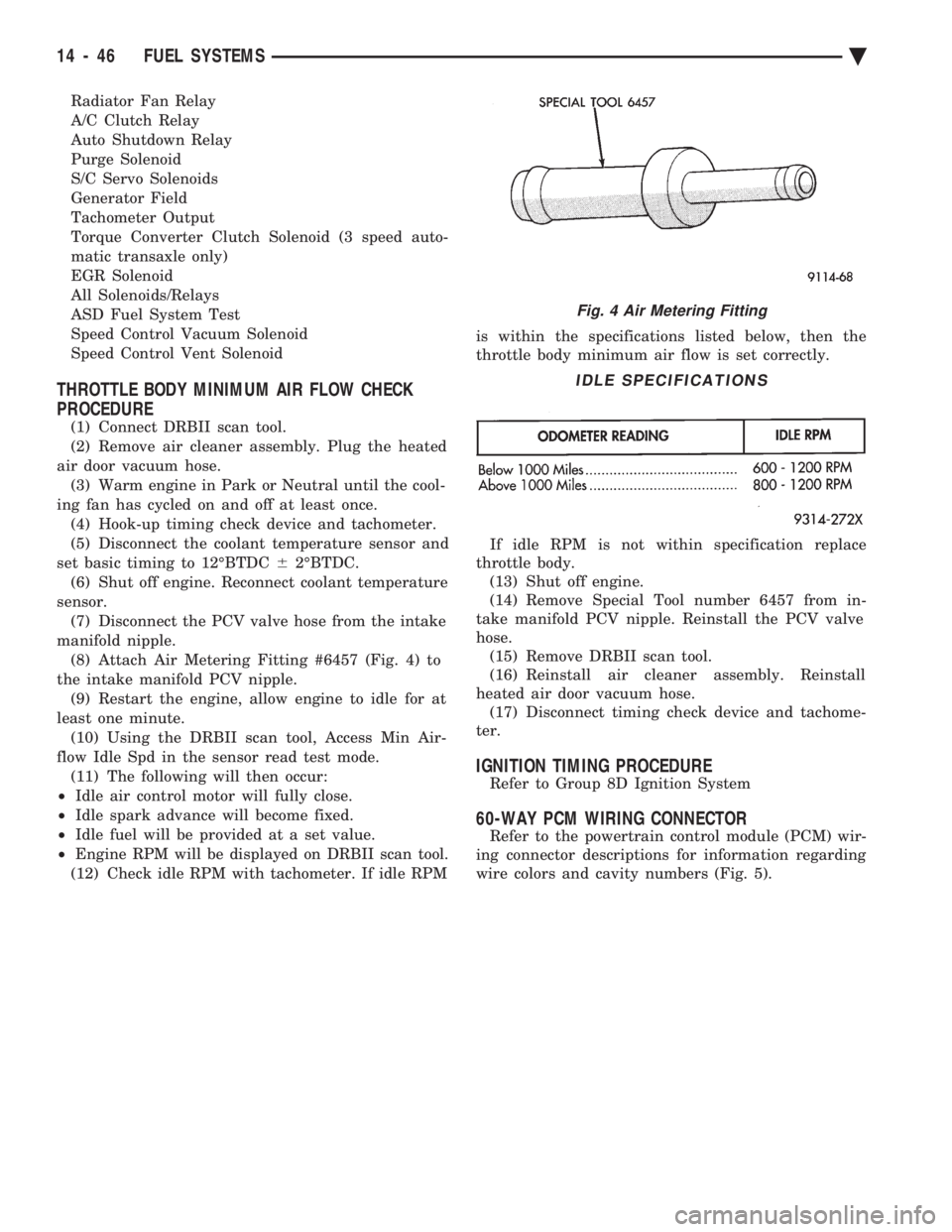
manifold nipple. (8) Attach Air Metering Fitting #6457 (Fig. 4) to
the intake manifold PCV nipple. (9) Restart the engine, allow engine to idle for at
least one minute. (10) Using the DRBII scan tool, Access Min Air-
flow Idle Spd in the sensor read test mode. (11) The following will then occur:
² Idle air control motor will fully close.
² Idle spark advance will become fixed.
² Idle fuel will be provided at a set value.
² Engine RPM will be displayed on DRBII scan tool.
(12) Check idle RPM with tachometer. If idle RPM is within the specifications listed below, then the
throttle body minimum air flow is set correctly.
If idle RPM is not within specification replace
throttle body. (13) Shut off engine.
(14) Remove Special Tool number 6457 from in-
take manifold PCV nipple. Reinstall the PCV valve
hose. (15) Remove DRBII scan tool.
(16) Reinstall air cleaner assembly. Reinstall
heated air door vacuum hose. (17) Disconnect timing check device and tachome-
ter.
IGNITION TIMING PROCEDURE
Refer to Group 8D Ignition System
60-WAY PCM WIRING CONNECTOR
Refer to the powertrain control module (PCM) wir-
ing connector descriptions for information regarding
wire colors and cavity numbers (Fig. 5).
Fig. 4 Air Metering Fitting
IDLE SPECIFICATIONS
14 - 46 FUEL SYSTEMS Ä
Page 1788 of 2438
2.2L/2.5L SINGLE POINT FUEL INJECTIONÐSERVICE PROCEDURES INDEX
page page
Canister Purge Solenoid ................... 53
Electric Exhaust Gas Recirculation Transducer (EET) Service ............................... 53
Fuel Fitting ............................. 50
Fuel Injector ............................ 51
Fuel Lines and Hoses ..................... 48
Fuel Pressure Regulator ................... 51 Fuel System Pressure Release Procedure
...... 48
Heated Oxygen Sensor (O
2Sensor) .......... 54
Idle Air Control Motor ..................... 53
Manifold Absolute Pressure Sensor ........... 53
PCM Service ............................ 54
Throttle Body ............................ 48
Throttle Position Sensor ................... 52
FUEL LINES AND HOSES
Perform the Fuel System Pressure Relief Procedure
before servicing the fuel system. The procedure must
be done to bleed fuel pressure from the system before
removing clamps or hoses. Use care when removing fuel hoses to prevent dam-
age to hose or hose nipple. Always use new hose
clamps, of the correct type, during reassembly. Tighten
hose clamps to 1 N Im (10 in. lbs.) torque. Do not use
aviation style clamps on this system or hose
damage may result.
FUEL SYSTEM PRESSURE RELEASE PROCEDURE
CAUTION: Before servicing the fuel pump, fuel lines,
fuel filter, throttle body, or fuel injector, release fuel
system pressure.
(1) Loosen fuel filler cap to release fuel tank pres-
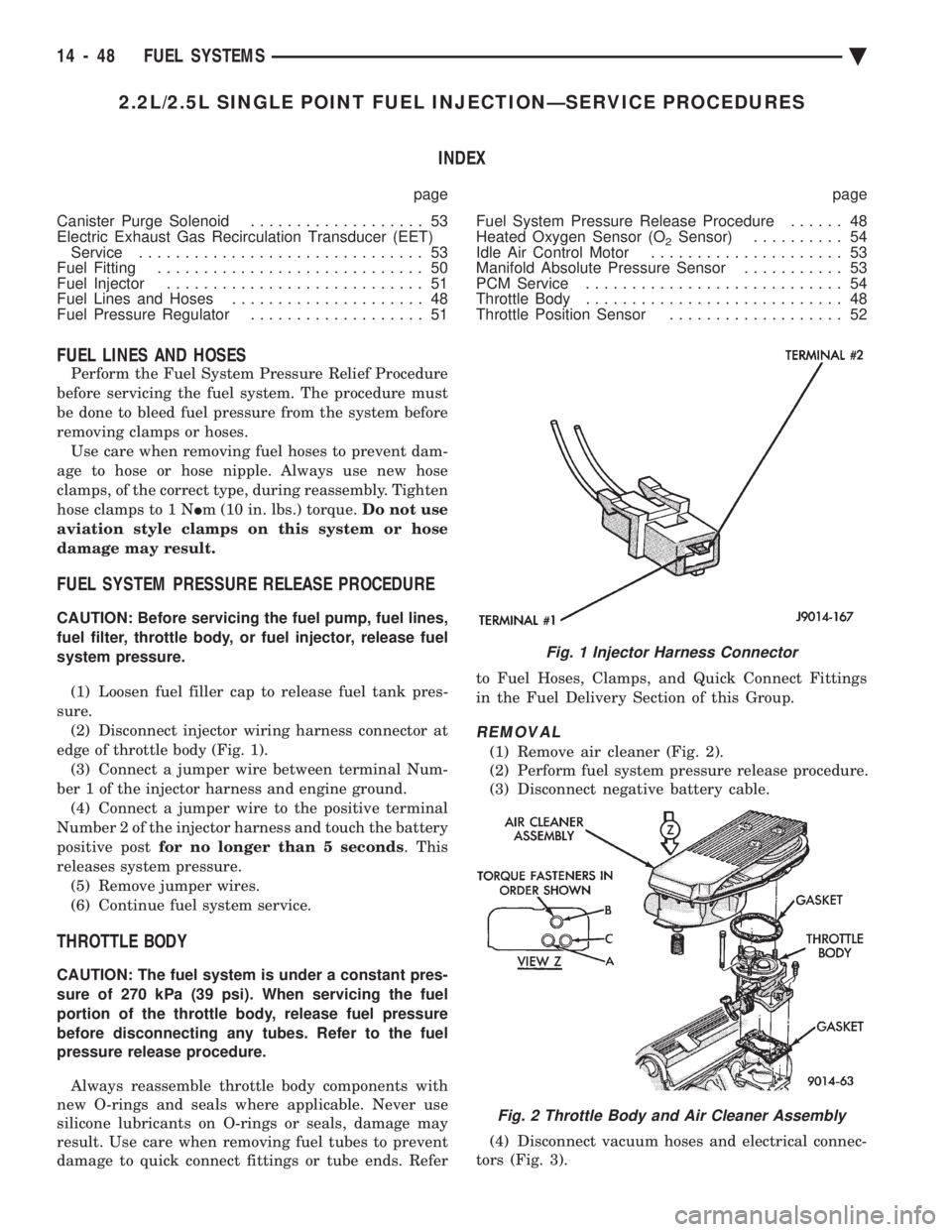
sure. (2) Disconnect injector wiring harness connector at
edge of throttle body (Fig. 1). (3) Connect a jumper wire between terminal Num-
ber 1 of the injector harness and engine ground. (4) Connect a jumper wire to the positive terminal
Number 2 of the injector harness and touch the battery
positive post for no longer than 5 seconds . This
releases system pressure. (5) Remove jumper wires.
(6) Continue fuel system service.
THROTTLE BODY
CAUTION: The fuel system is under a constant pres-
sure of 270 kPa (39 psi). When servicing the fuel
portion of the throttle body, release fuel pressure
before disconnecting any tubes. Refer to the fuel
pressure release procedure.
Always reassemble throttle body components with
new O-rings and seals where applicable. Never use
silicone lubricants on O-rings or seals, damage may
result. Use care when removing fuel tubes to prevent
damage to quick connect fittings or tube ends. Refer to Fuel Hoses, Clamps, and Quick Connect Fittings
in the Fuel Delivery Section of this Group.
REMOVAL
(1) Remove air cleaner (Fig. 2).
(2) Perform fuel system pressure release procedure.
(3) Disconnect negative battery cable.
(4) Disconnect vacuum hoses and electrical connec-
tors (Fig. 3).
Fig. 1 Injector Harness Connector
Fig. 2 Throttle Body and Air Cleaner Assembly
14 - 48 FUEL SYSTEMS Ä
Page 1792 of 2438
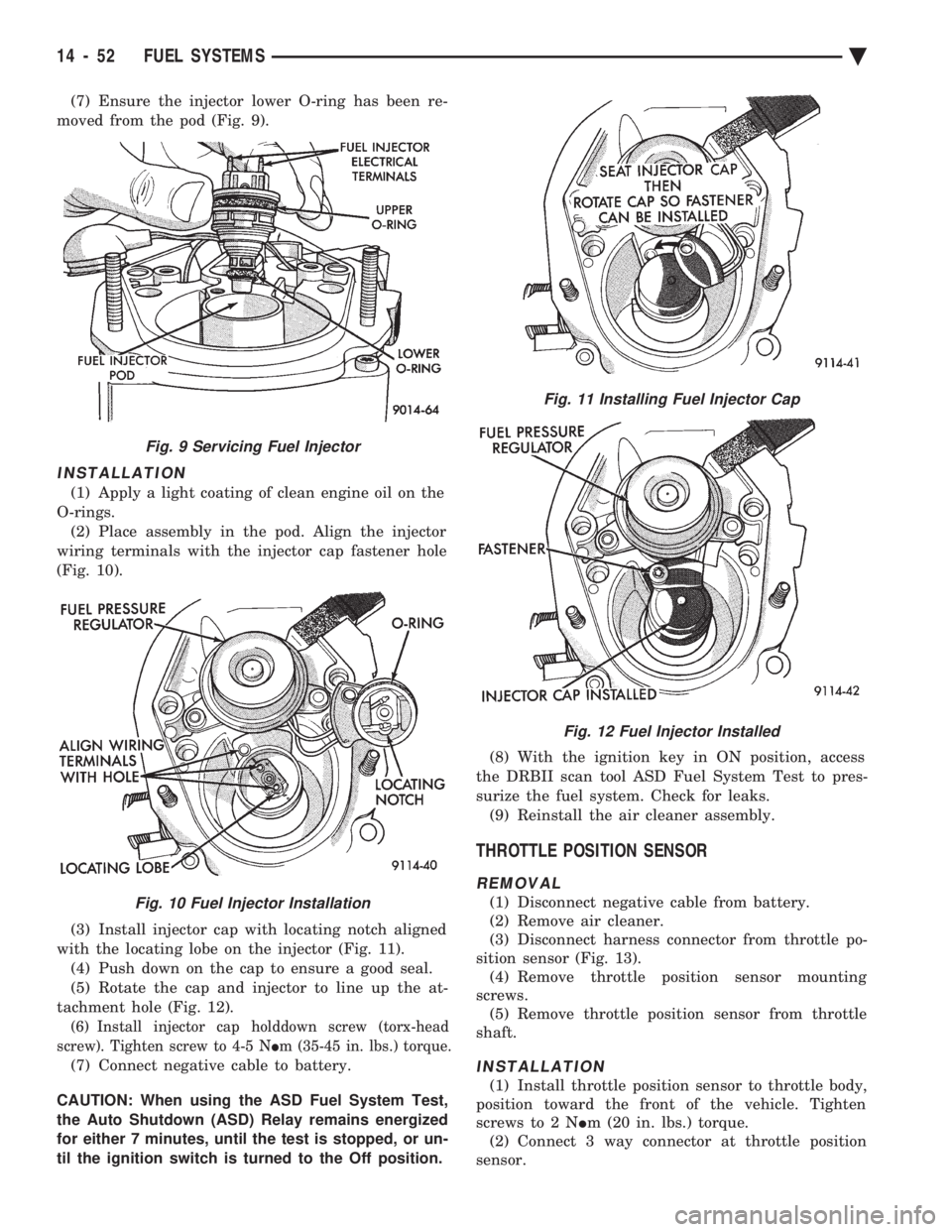
(7) Ensure the injector lower O-ring has been re-
moved from the pod (Fig. 9).
INSTALLATION
(1) Apply a light coating of clean engine oil on the
O-rings. (2) Place assembly in the pod. Align the injector
wiring terminals with the injector cap fastener hole
(Fig. 10).
(3) Install injector cap with locating notch aligned
with the locating lobe on the injector (Fig. 11). (4) Push down on the cap to ensure a good seal.
(5) Rotate the cap and injector to line up the at-
tachment hole (Fig. 12).
(6) Install injector cap holddown screw (torx-head
screw). Tighten screw to 4-5 N Im (35-45 in. lbs.) torque.
(7) Connect negative cable to battery.
CAUTION: When using the ASD Fuel System Test,
the Auto Shutdown (ASD) Relay remains energized
for either 7 minutes, until the test is stopped, or un-
til the ignition switch is turned to the Off position. (8) With the ignition key in ON position, access
the DRBII scan tool ASD Fuel System Test to pres-
surize the fuel system. Check for leaks. (9) Reinstall the air cleaner assembly.
THROTTLE POSITION SENSOR
REMOVAL
(1) Disconnect negative cable from battery.
(2) Remove air cleaner.
(3) Disconnect harness connector from throttle po-
sition sensor (Fig. 13). (4) Remove throttle position sensor mounting
screws. (5) Remove throttle position sensor from throttle
shaft.
INSTALLATION
(1) Install throttle position sensor to throttle body,
position toward the front of the vehicle. Tighten
screws to 2 N Im (20 in. lbs.) torque.
(2) Connect 3 way connector at throttle position
sensor.
Fig. 9 Servicing Fuel Injector
Fig. 10 Fuel Injector Installation
Fig. 11 Installing Fuel Injector Cap
Fig. 12 Fuel Injector Installed
14 - 52 FUEL SYSTEMS Ä
Page 1795 of 2438
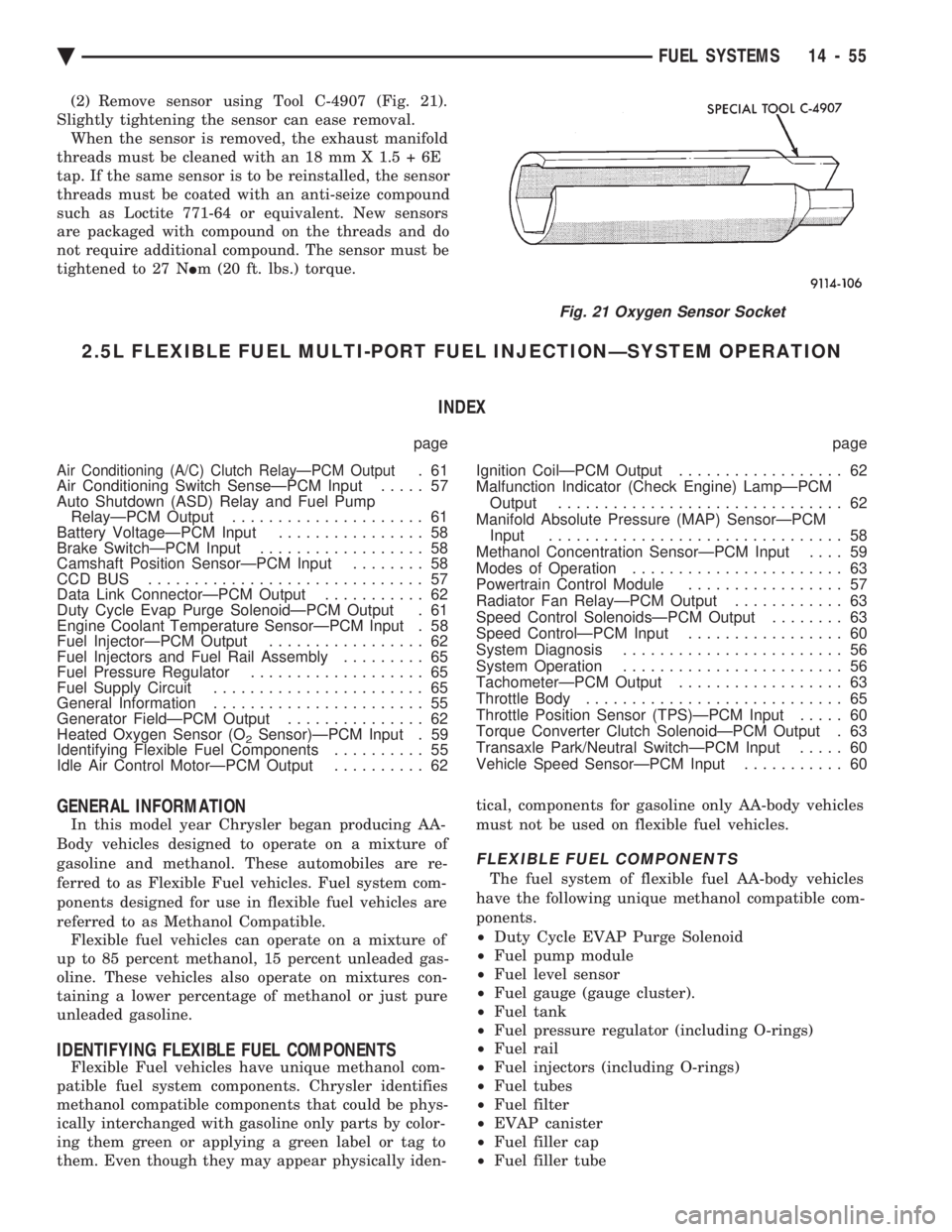
(2) Remove sensor using Tool C-4907 (Fig. 21).
Slightly tightening the sensor can ease removal. When the sensor is removed, the exhaust manifold
threads must be cleaned with an 18 mm X 1.5 + 6E
tap. If the same sensor is to be reinstalled, the sensor
threads must be coated with an anti-seize compound
such as Loctite 771-64 or equivalent. New sensors
are packaged with compound on the threads and do
not require additional compound. The sensor must be
tightened to 27 N Im (20 ft. lbs.) torque.
2.5L FLEXIBLE FUEL MULTI-PORT FUEL INJECTIONÐSYSTEM OPERATION
INDEX
page page
Air Conditioning (A/C) Clutch RelayÐPCM Output.61
Air Conditioning Switch SenseÐPCM Input ..... 57
Auto Shutdown (ASD) Relay and Fuel Pump RelayÐPCM Output ..................... 61
Battery VoltageÐPCM Input ................ 58
Brake SwitchÐPCM Input .................. 58
Camshaft Position SensorÐPCM Input ........ 58
CCD BUS .............................. 57
Data Link ConnectorÐPCM Output ........... 62
Duty Cycle Evap Purge SolenoidÐPCM Output . 61
Engine Coolant Temperature SensorÐPCM Input . 58
Fuel InjectorÐPCM Output ................. 62
Fuel Injectors and Fuel Rail Assembly ......... 65
Fuel Pressure Regulator ................... 65
Fuel Supply Circuit ....................... 65
General Information ....................... 55
Generator FieldÐPCM Output ............... 62
Heated Oxygen Sensor (O
2Sensor)ÐPCM Input . 59
Identifying Flexible Fuel Components .......... 55
Idle Air Control MotorÐPCM Output .......... 62 Ignition CoilÐPCM Output
.................. 62
Malfunction Indicator (Check Engine) LampÐPCM Output ............................... 62
Manifold Absolute Pressure (MAP) SensorÐPCM Input ................................ 58
Methanol Concentration SensorÐPCM Input .... 59
Modes of Operation ....................... 63
Powertrain Control Module ................. 57
Radiator Fan RelayÐPCM Output ............ 63
Speed Control SolenoidsÐPCM Output ........ 63
Speed ControlÐPCM Input ................. 60
System Diagnosis ........................ 56
System Operation ........................ 56
TachometerÐPCM Output .................. 63
Throttle Body ............................ 65
Throttle Position Sensor (TPS)ÐPCM Input ..... 60
Torque Converter Clutch SolenoidÐPCM Output . 63
Transaxle Park/Neutral SwitchÐPCM Input ..... 60
Vehicle Speed SensorÐPCM Input ........... 60
GENERAL INFORMATION
In this model year Chrysler began producing AA-
Body vehicles designed to operate on a mixture of
gasoline and methanol. These automobiles are re-
ferred to as Flexible Fuel vehicles. Fuel system com-
ponents designed for use in flexible fuel vehicles are
referred to as Methanol Compatible. Flexible fuel vehicles can operate on a mixture of
up to 85 percent methanol, 15 percent unleaded gas-
oline. These vehicles also operate on mixtures con-
taining a lower percentage of methanol or just pure
unleaded gasoline.
IDENTIFYING FLEXIBLE FUEL COMPONENTS
Flexible Fuel vehicles have unique methanol com-
patible fuel system components. Chrysler identifies
methanol compatible components that could be phys-
ically interchanged with gasoline only parts by color-
ing them green or applying a green label or tag to
them. Even though they may appear physically iden- tical, components for gasoline only AA-body vehicles
must not be used on flexible fuel vehicles.
FLEXIBLE FUEL COMPONENTS
The fuel system of flexible fuel AA-body vehicles
have the following unique methanol compatible com-
ponents.
² Duty Cycle EVAP Purge Solenoid
² Fuel pump module
² Fuel level sensor
² Fuel gauge (gauge cluster).
² Fuel tank
² Fuel pressure regulator (including O-rings)
² Fuel rail
² Fuel injectors (including O-rings)
² Fuel tubes
² Fuel filter
² EVAP canister
² Fuel filler cap
² Fuel filler tube
Fig. 21 Oxygen Sensor Socket
Ä FUEL SYSTEMS 14 - 55
Page 1796 of 2438
² Methanol Concentration Sensor
² Pressure relief/Rollover valve
² PCV Valve
² All fuel system and emission system hoses and
tubes
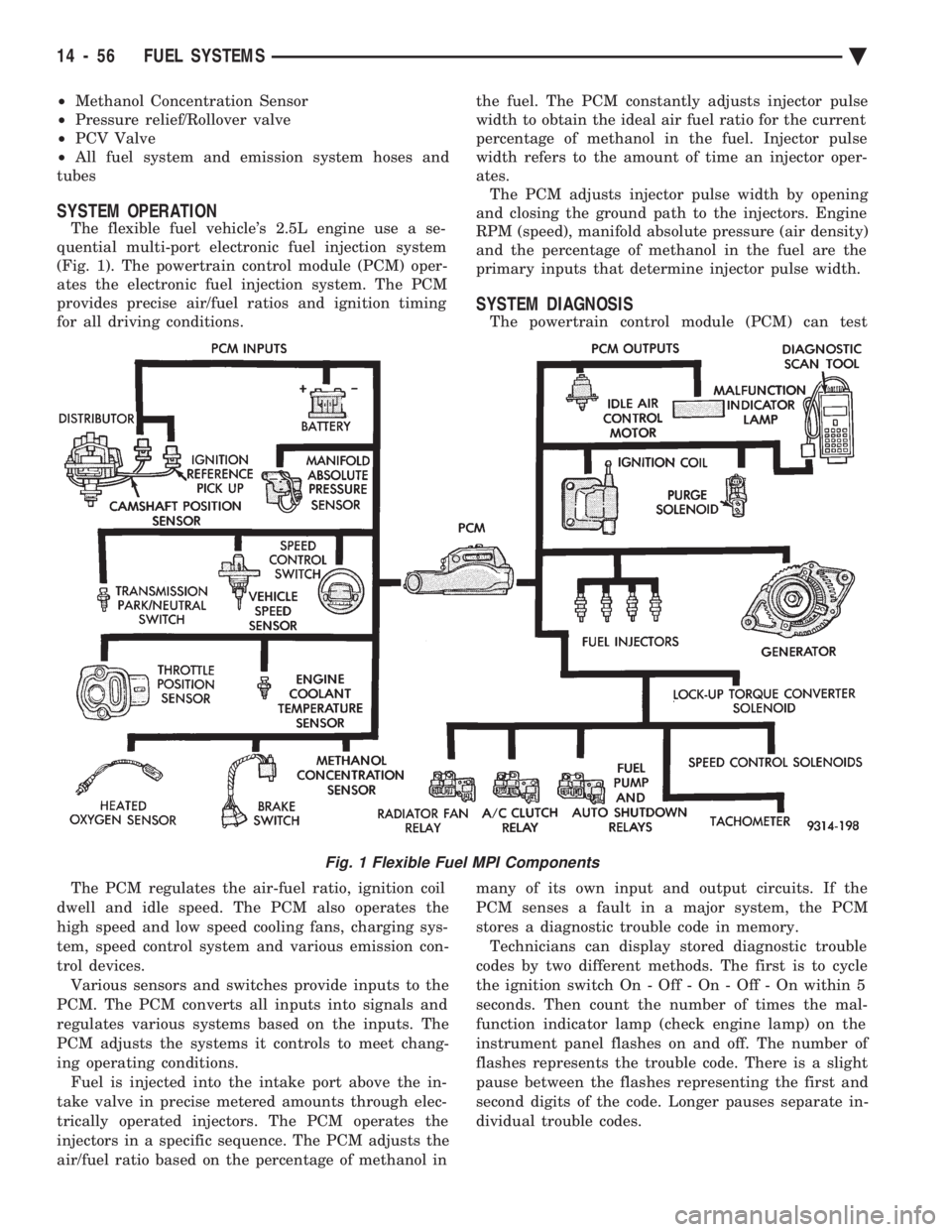
SYSTEM OPERATION
The flexible fuel vehicle's 2.5L engine use a se-
quential multi-port electronic fuel injection system
(Fig. 1). The powertrain control module (PCM) oper-
ates the electronic fuel injection system. The PCM
provides precise air/fuel ratios and ignition timing
for all driving conditions.
The PCM regulates the air-fuel ratio, ignition coil
dwell and idle speed. The PCM also operates the
high speed and low speed cooling fans, charging sys-
tem, speed control system and various emission con-
trol devices. Various sensors and switches provide inputs to the
PCM. The PCM converts all inputs into signals and
regulates various systems based on the inputs. The
PCM adjusts the systems it controls to meet chang-
ing operating conditions. Fuel is injected into the intake port above the in-
take valve in precise metered amounts through elec-
trically operated injectors. The PCM operates the
injectors in a specific sequence. The PCM adjusts the
air/fuel ratio based on the percentage of methanol in the fuel. The PCM constantly adjusts injector pulse
width to obtain the ideal air fuel ratio for the current
percentage of methanol in the fuel. Injector pulse
width refers to the amount of time an injector oper-
ates. The PCM adjusts injector pulse width by opening
and closing the ground path to the injectors. Engine
RPM (speed), manifold absolute pressure (air density)
and the percentage of methanol in the fuel are the
primary inputs that determine injector pulse width.
SYSTEM DIAGNOSIS
The powertrain control module (PCM) can test
many of its own input and output circuits. If the
PCM senses a fault in a major system, the PCM
stores a diagnostic trouble code in memory. Technicians can display stored diagnostic trouble
codes by two different methods. The first is to cycle
the ignition switch On - Off - On - Off - On within 5
seconds. Then count the number of times the mal-
function indicator lamp (check engine lamp) on the
instrument panel flashes on and off. The number of
flashes represents the trouble code. There is a slight
pause between the flashes representing the first and
second digits of the code. Longer pauses separate in-
dividual trouble codes.
Fig. 1 Flexible Fuel MPI Components
14 - 56 FUEL SYSTEMS Ä
Page 1797 of 2438
The second method of reading diagnostic trouble
codes uses the DRBII scan tool. For diagnostic trou-
ble code information, refer to the On-Board Diagnos-
tics section in this group.
CCD BUS
Various modules exchange information through a
communications port called the CCD Bus. The pow-
ertrain control module transmits vehicle load data on
the CCD Bus.
POWERTRAIN CONTROL MODULE
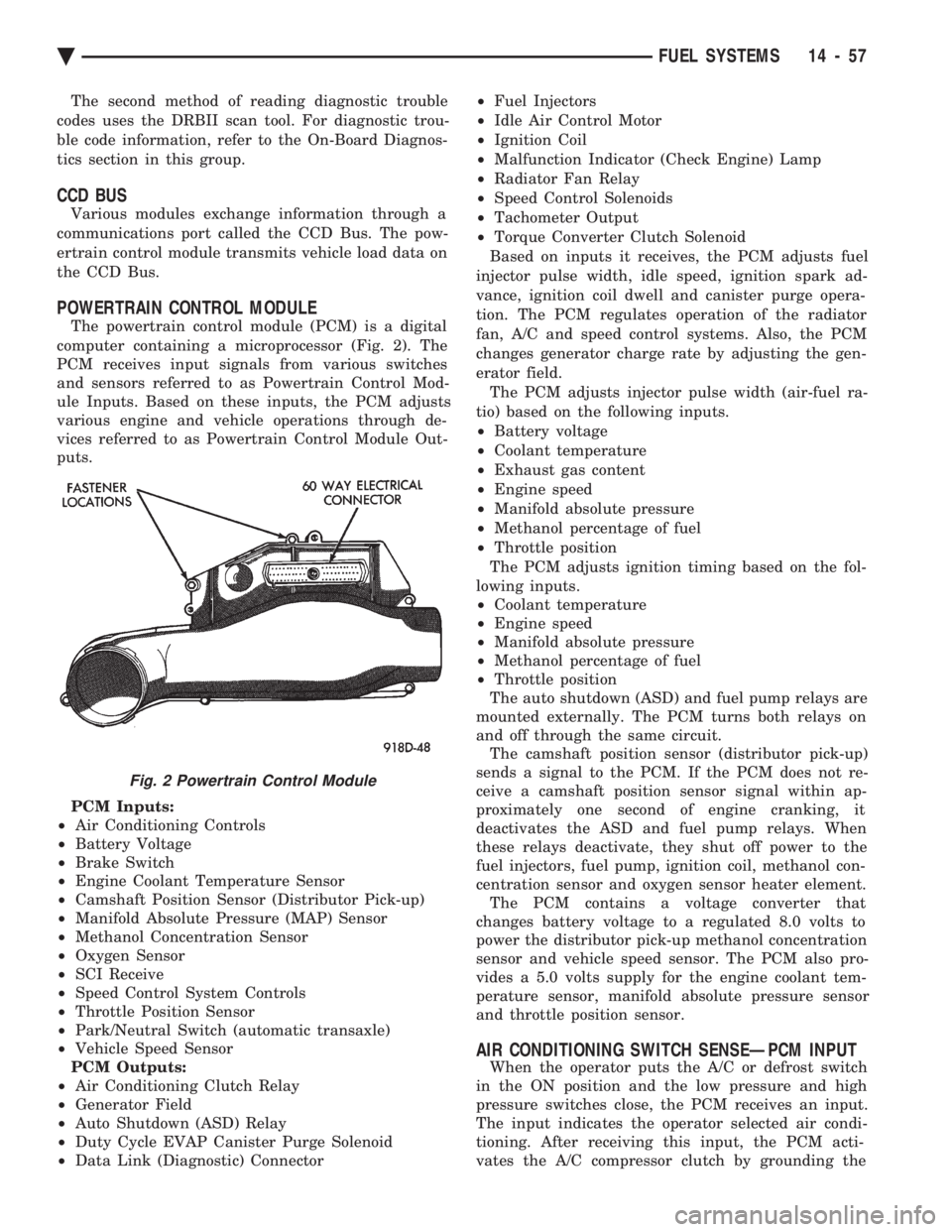
The powertrain control module (PCM) is a digital
computer containing a microprocessor (Fig. 2). The
PCM receives input signals from various switches
and sensors referred to as Powertrain Control Mod-
ule Inputs. Based on these inputs, the PCM adjusts
various engine and vehicle operations through de-
vices referred to as Powertrain Control Module Out-
puts.
PCM Inputs:
² Air Conditioning Controls
² Battery Voltage
² Brake Switch
² Engine Coolant Temperature Sensor
² Camshaft Position Sensor (Distributor Pick-up)
² Manifold Absolute Pressure (MAP) Sensor
² Methanol Concentration Sensor
² Oxygen Sensor
² SCI Receive
² Speed Control System Controls
² Throttle Position Sensor
² Park/Neutral Switch (automatic transaxle)
² Vehicle Speed Sensor
PCM Outputs:
² Air Conditioning Clutch Relay
² Generator Field
² Auto Shutdown (ASD) Relay
² Duty Cycle EVAP Canister Purge Solenoid
² Data Link (Diagnostic) Connector ²
Fuel Injectors
² Idle Air Control Motor
² Ignition Coil
² Malfunction Indicator (Check Engine) Lamp
² Radiator Fan Relay
² Speed Control Solenoids
² Tachometer Output
² Torque Converter Clutch Solenoid
Based on inputs it receives, the PCM adjusts fuel
injector pulse width, idle speed, ignition spark ad-
vance, ignition coil dwell and canister purge opera-
tion. The PCM regulates operation of the radiator
fan, A/C and speed control systems. Also, the PCM
changes generator charge rate by adjusting the gen-
erator field. The PCM adjusts injector pulse width (air-fuel ra-
tio) based on the following inputs.
² Battery voltage
² Coolant temperature
² Exhaust gas content
² Engine speed
² Manifold absolute pressure
² Methanol percentage of fuel
² Throttle position
The PCM adjusts ignition timing based on the fol-
lowing inputs.
² Coolant temperature
² Engine speed
² Manifold absolute pressure
² Methanol percentage of fuel
² Throttle position
The auto shutdown (ASD) and fuel pump relays are
mounted externally. The PCM turns both relays on
and off through the same circuit. The camshaft position sensor (distributor pick-up)
sends a signal to the PCM. If the PCM does not re-
ceive a camshaft position sensor signal within ap-
proximately one second of engine cranking, it
deactivates the ASD and fuel pump relays. When
these relays deactivate, they shut off power to the
fuel injectors, fuel pump, ignition coil, methanol con-
centration sensor and oxygen sensor heater element. The PCM contains a voltage converter that
changes battery voltage to a regulated 8.0 volts to
power the distributor pick-up methanol concentration
sensor and vehicle speed sensor. The PCM also pro-
vides a 5.0 volts supply for the engine coolant tem-
perature sensor, manifold absolute pressure sensor
and throttle position sensor.
AIR CONDITIONING SWITCH SENSEÐPCM INPUT
When the operator puts the A/C or defrost switch
in the ON position and the low pressure and high
pressure switches close, the PCM receives an input.
The input indicates the operator selected air condi-
tioning. After receiving this input, the PCM acti-
vates the A/C compressor clutch by grounding the
Fig. 2 Powertrain Control Module
Ä FUEL SYSTEMS 14 - 57
Page 1798 of 2438
A/C clutch relay. To compensate for increased engine
load, the PCM also adjusts idle speed to a scheduled
RPM.
BATTERY VOLTAGEÐPCM INPUT
The powertrain control module (PCM) monitors the
battery voltage input to determine fuel injector pulse
width and generator field control. If battery voltage
is low, the PCM increases injector pulse width to
compensate.
BRAKE SWITCHÐPCM INPUT
When the brake switch activates, the powertrain
control module (PCM) receives an input indicating
that the brakes are being applied. After receiving the
input, the PCM vents the speed control servo. Vent-
ing the servo turns the speed control system off.
ENGINE COOLANT TEMPERATURE SENSORÐPCM
INPUT
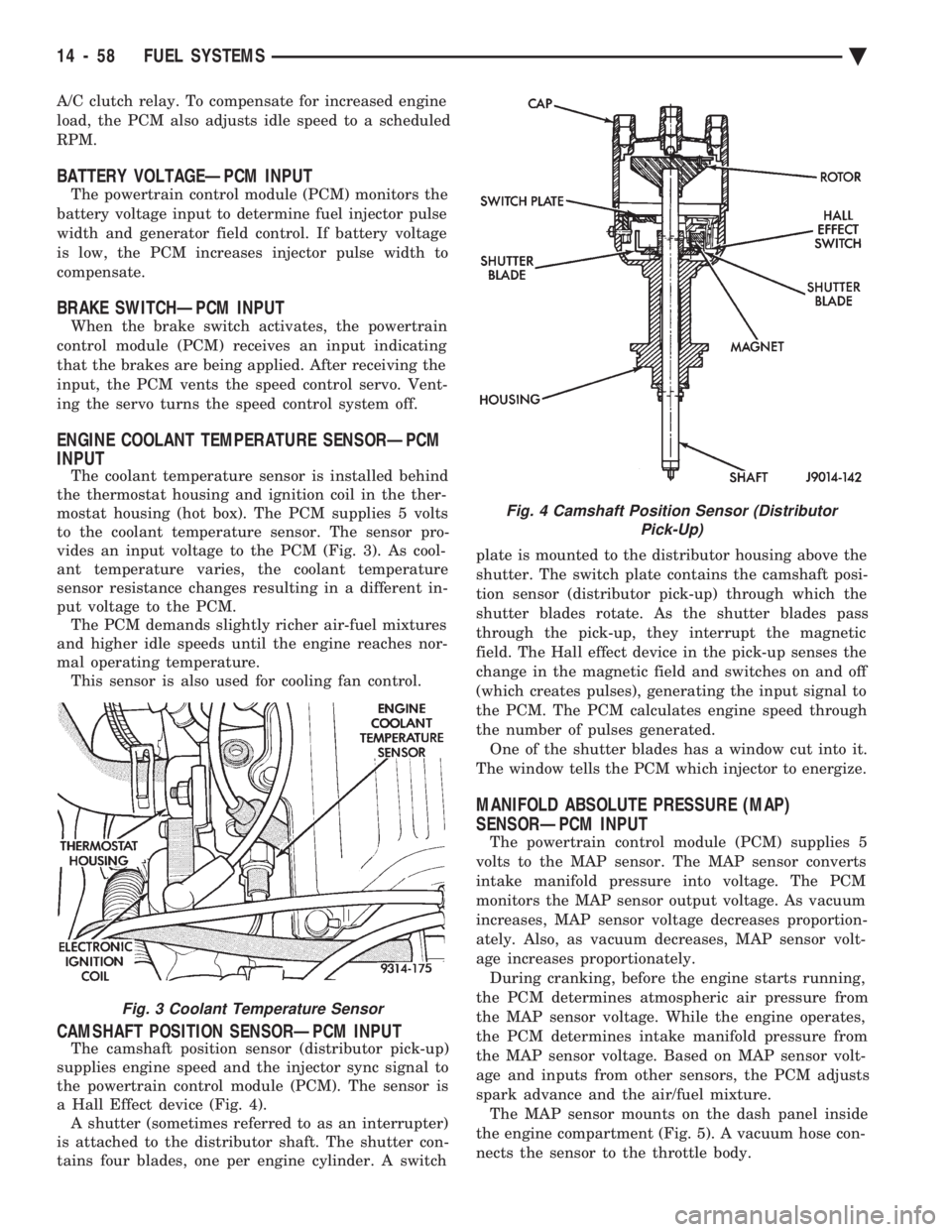
The coolant temperature sensor is installed behind
the thermostat housing and ignition coil in the ther-
mostat housing (hot box). The PCM supplies 5 volts
to the coolant temperature sensor. The sensor pro-
vides an input voltage to the PCM (Fig. 3). As cool-
ant temperature varies, the coolant temperature
sensor resistance changes resulting in a different in-
put voltage to the PCM. The PCM demands slightly richer air-fuel mixtures
and higher idle speeds until the engine reaches nor-
mal operating temperature. This sensor is also used for cooling fan control.
CAMSHAFT POSITION SENSORÐPCM INPUT
The camshaft position sensor (distributor pick-up)
supplies engine speed and the injector sync signal to
the powertrain control module (PCM). The sensor is
a Hall Effect device (Fig. 4). A shutter (sometimes referred to as an interrupter)
is attached to the distributor shaft. The shutter con-
tains four blades, one per engine cylinder. A switch plate is mounted to the distributor housing above the
shutter. The switch plate contains the camshaft posi-
tion sensor (distributor pick-up) through which the
shutter blades rotate. As the shutter blades pass
through the pick-up, they interrupt the magnetic
field. The Hall effect device in the pick-up senses the
change in the magnetic field and switches on and off
(which creates pulses), generating the input signal to
the PCM. The PCM calculates engine speed through
the number of pulses generated. One of the shutter blades has a window cut into it.
The window tells the PCM which injector to energize.
MANIFOLD ABSOLUTE PRESSURE (MAP)
SENSORÐPCM INPUT
The powertrain control module (PCM) supplies 5
volts to the MAP sensor. The MAP sensor converts
intake manifold pressure into voltage. The PCM
monitors the MAP sensor output voltage. As vacuum
increases, MAP sensor voltage decreases proportion-
ately. Also, as vacuum decreases, MAP sensor volt-
age increases proportionately. During cranking, before the engine starts running,
the PCM determines atmospheric air pressure from
the MAP sensor voltage. While the engine operates,
the PCM determines intake manifold pressure from
the MAP sensor voltage. Based on MAP sensor volt-
age and inputs from other sensors, the PCM adjusts
spark advance and the air/fuel mixture. The MAP sensor mounts on the dash panel inside
the engine compartment (Fig. 5). A vacuum hose con-
nects the sensor to the throttle body.
Fig. 3 Coolant Temperature Sensor
Fig. 4 Camshaft Position Sensor (Distributor Pick-Up)
14 - 58 FUEL SYSTEMS Ä