1993 CHEVROLET DYNASTY engine
[x] Cancel search: enginePage 1717 of 2438
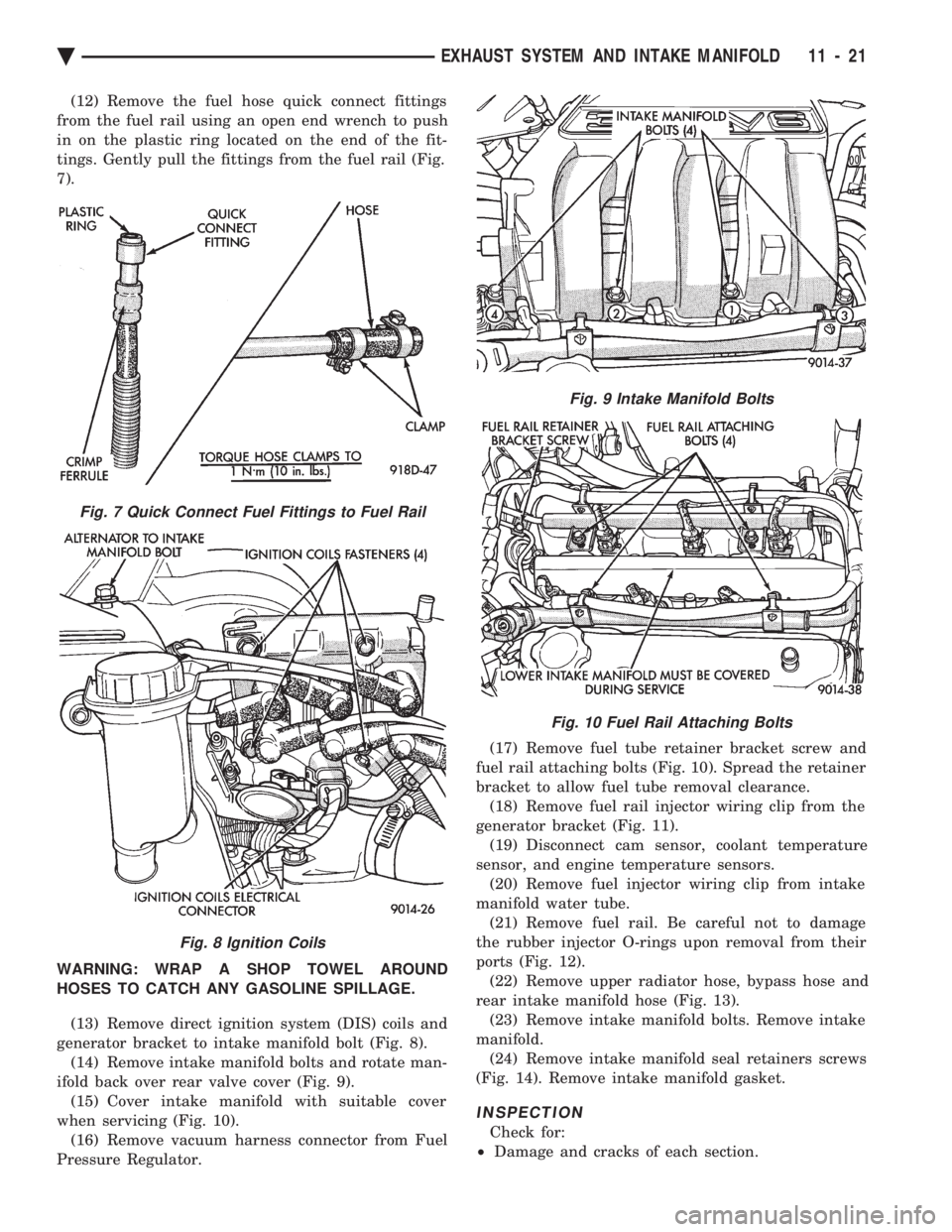
(12) Remove the fuel hose quick connect fittings
from the fuel rail using an open end wrench to push
in on the plastic ring located on the end of the fit-
tings. Gently pull the fittings from the fuel rail (Fig.
7).
WARNING: WRAP A SHOP TOWEL AROUND
HOSES TO CATCH ANY GASOLINE SPILLAGE.
(13) Remove direct ignition system (DIS) coils and
generator bracket to intake manifold bolt (Fig. 8). (14) Remove intake manifold bolts and rotate man-
ifold back over rear valve cover (Fig. 9). (15) Cover intake manifold with suitable cover
when servicing (Fig. 10). (16) Remove vacuum harness connector from Fuel
Pressure Regulator. (17) Remove fuel tube retainer bracket screw and
fuel rail attaching bolts (Fig. 10). Spread the retainer
bracket to allow fuel tube removal clearance. (18) Remove fuel rail injector wiring clip from the
generator bracket (Fig. 11). (19) Disconnect cam sensor, coolant temperature
sensor, and engine temperature sensors. (20) Remove fuel injector wiring clip from intake
manifold water tube. (21) Remove fuel rail. Be careful not to damage
the rubber injector O-rings upon removal from their
ports (Fig. 12). (22) Remove upper radiator hose, bypass hose and
rear intake manifold hose (Fig. 13). (23) Remove intake manifold bolts. Remove intake
manifold. (24) Remove intake manifold seal retainers screws
(Fig. 14). Remove intake manifold gasket.
INSPECTION
Check for:
² Damage and cracks of each section.
Fig. 7 Quick Connect Fuel Fittings to Fuel Rail
Fig. 8 Ignition Coils
Fig. 9 Intake Manifold Bolts
Fig. 10 Fuel Rail Attaching Bolts
Ä EXHAUST SYSTEM AND INTAKE MANIFOLD 11 - 21
Page 1719 of 2438
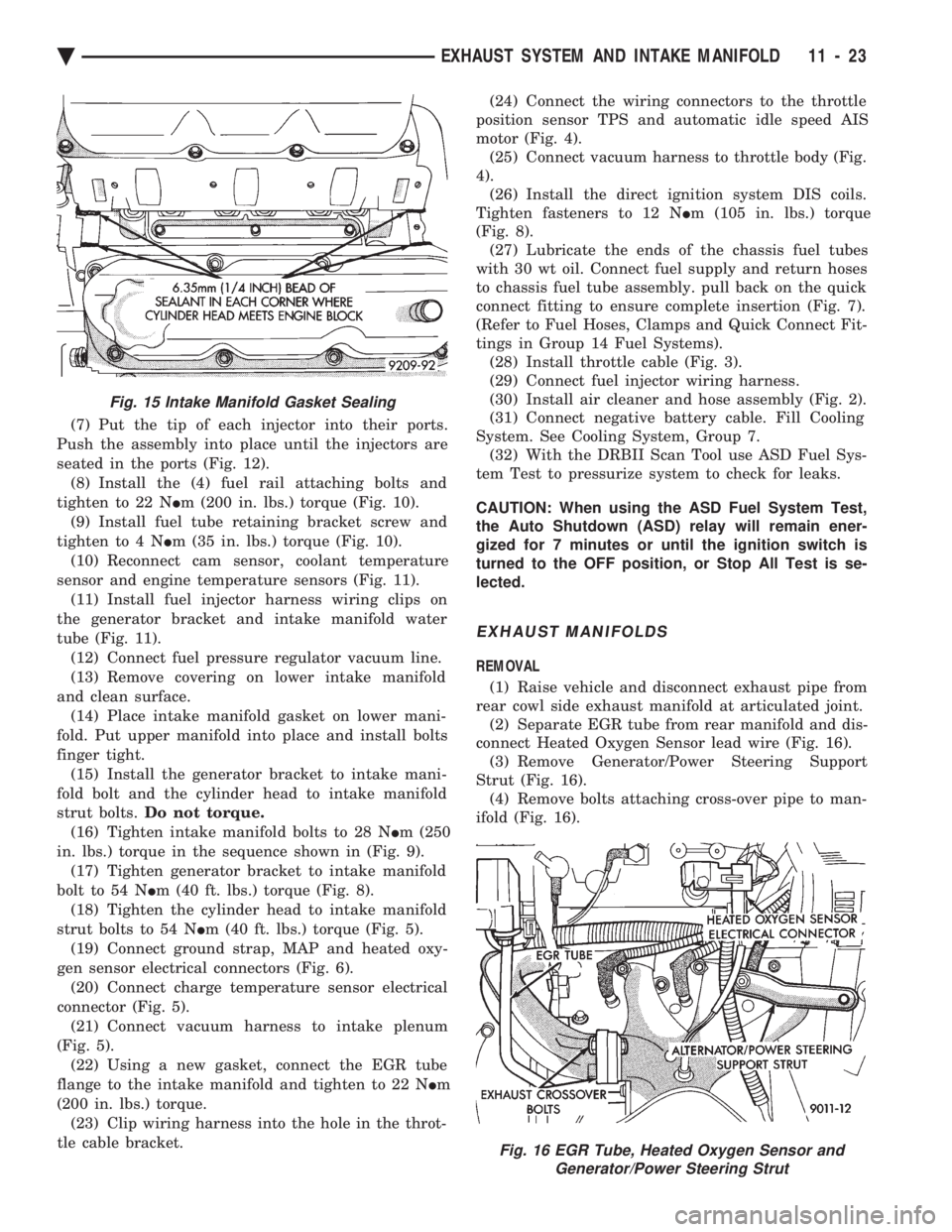
(7) Put the tip of each injector into their ports.
Push the assembly into place until the injectors are
seated in the ports (Fig. 12). (8) Install the (4) fuel rail attaching bolts and
tighten to 22 N Im (200 in. lbs.) torque (Fig. 10).
(9) Install fuel tube retaining bracket screw and
tighten to 4 N Im (35 in. lbs.) torque (Fig. 10).
(10) Reconnect cam sensor, coolant temperature
sensor and engine temperature sensors (Fig. 11). (11) Install fuel injector harness wiring clips on
the generator bracket and intake manifold water
tube (Fig. 11). (12) Connect fuel pressure regulator vacuum line.
(13) Remove covering on lower intake manifold
and clean surface. (14) Place intake manifold gasket on lower mani-
fold. Put upper manifold into place and install bolts
finger tight. (15) Install the generator bracket to intake mani-
fold bolt and the cylinder head to intake manifold
strut bolts. Do not torque.
(16) Tighten intake manifold bolts to 28 N Im (250
in. lbs.) torque in the sequence shown in (Fig. 9). (17) Tighten generator bracket to intake manifold
bolt to 54 N Im (40 ft. lbs.) torque (Fig. 8).
(18) Tighten the cylinder head to intake manifold
strut bolts to 54 N Im (40 ft. lbs.) torque (Fig. 5).
(19) Connect ground strap, MAP and heated oxy-
gen sensor electrical connectors (Fig. 6). (20) Connect charge temperature sensor electrical
connector (Fig. 5). (21) Connect vacuum harness to intake plenum
(Fig. 5). (22) Using a new gasket, connect the EGR tube
flange to the intake manifold and tighten to 22 N Im
(200 in. lbs.) torque. (23) Clip wiring harness into the hole in the throt-
tle cable bracket. (24) Connect the wiring connectors to the throttle
position sensor TPS and automatic idle speed AIS
motor (Fig. 4). (25) Connect vacuum harness to throttle body (Fig.
4). (26) Install the direct ignition system DIS coils.
Tighten fasteners to 12 N Im (105 in. lbs.) torque
(Fig. 8). (27) Lubricate the ends of the chassis fuel tubes
with 30 wt oil. Connect fuel supply and return hoses
to chassis fuel tube assembly. pull back on the quick
connect fitting to ensure complete insertion (Fig. 7).
(Refer to Fuel Hoses, Clamps and Quick Connect Fit-
tings in Group 14 Fuel Systems). (28) Install throttle cable (Fig. 3).
(29) Connect fuel injector wiring harness.
(30) Install air cleaner and hose assembly (Fig. 2).
(31) Connect negative battery cable. Fill Cooling
System. See Cooling System, Group 7. (32) With the DRBII Scan Tool use ASD Fuel Sys-
tem Test to pressurize system to check for leaks.
CAUTION: When using the ASD Fuel System Test,
the Auto Shutdown (ASD) relay will remain ener-
gized for 7 minutes or until the ignition switch is
turned to the OFF position, or Stop All Test is se-
lected.
EXHAUST MANIFOLDS
REMOVAL
(1) Raise vehicle and disconnect exhaust pipe from
rear cowl side exhaust manifold at articulated joint. (2) Separate EGR tube from rear manifold and dis-
connect Heated Oxygen Sensor lead wire (Fig. 16). (3) Remove Generator/Power Steering Support
Strut (Fig. 16). (4) Remove bolts attaching cross-over pipe to man-
ifold (Fig. 16).
Fig. 15 Intake Manifold Gasket Sealing
Fig. 16 EGR Tube, Heated Oxygen Sensor and Generator/Power Steering Strut
Ä EXHAUST SYSTEM AND INTAKE MANIFOLD 11 - 23
Page 1731 of 2438
FRAME INDEX
page page
Crossmember ........................... 17
Frame Dimensions ........................ 9 General Information
........................ 9
GENERAL INFORMATION
In this section, references are made to Vehicle
Family (Body) codes. To determine the vehicle family
identification code, refer to the Introduction Group at
the front of this manual.
FRAME DIMENSIONS
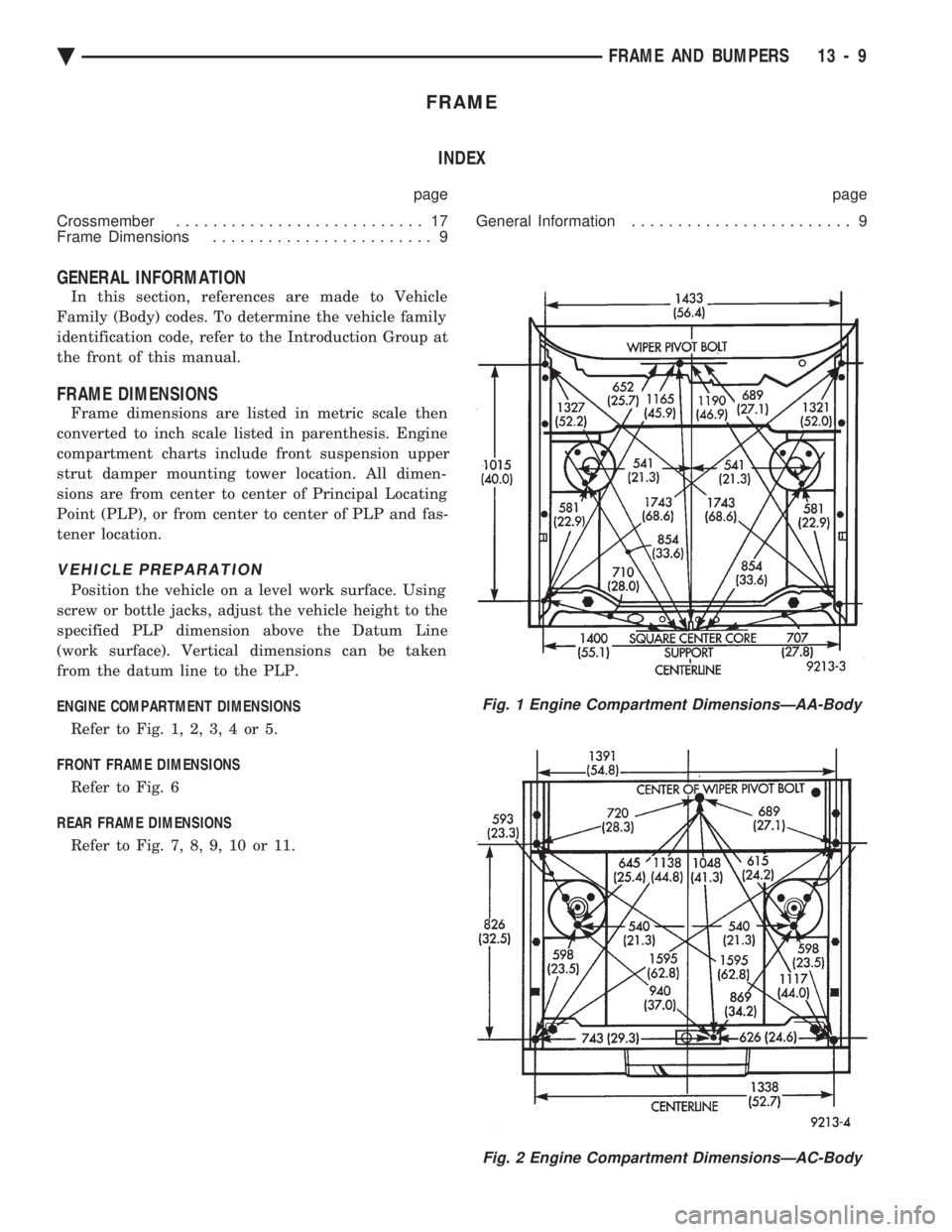
Frame dimensions are listed in metric scale then
converted to inch scale listed in parenthesis. Engine
compartment charts include front suspension upper
strut damper mounting tower location. All dimen-
sions are from center to center of Principal Locating
Point (PLP), or from center to center of PLP and fas-
tener location.
VEHICLE PREPARATION
Position the vehicle on a level work surface. Using
screw or bottle jacks, adjust the vehicle height to the
specified PLP dimension above the Datum Line
(work surface). Vertical dimensions can be taken
from the datum line to the PLP.
ENGINE COMPARTMENT DIMENSIONS Refer to Fig. 1, 2, 3, 4 or 5.
FRONT FRAME DIMENSIONS Refer to Fig. 6
REAR FRAME DIMENSIONS Refer to Fig. 7, 8, 9, 10 or 11.
Fig. 1 Engine Compartment DimensionsÐAA-Body
Fig. 2 Engine Compartment DimensionsÐAC-Body
Ä FRAME AND BUMPERS 13 - 9
Page 1732 of 2438
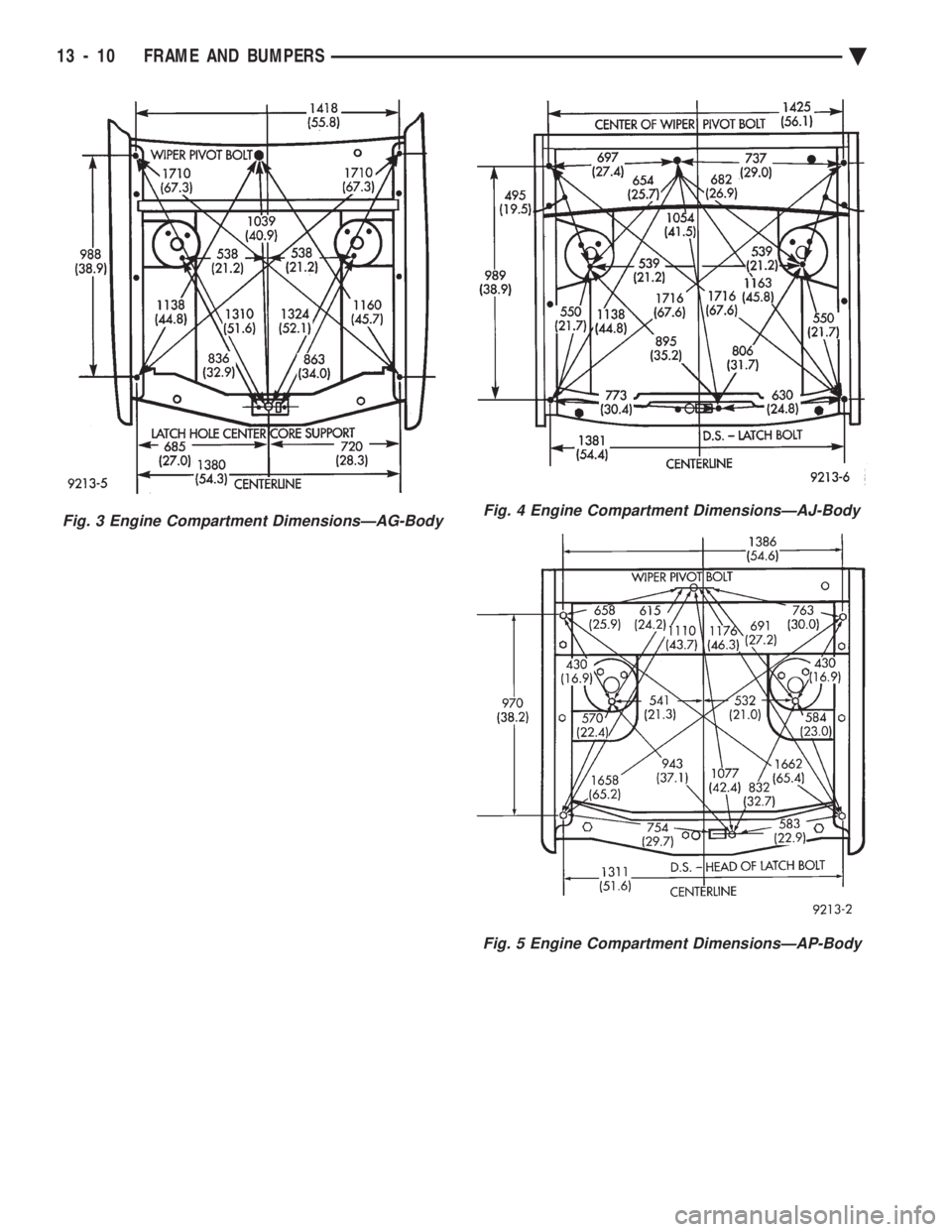
Fig. 5 Engine Compartment DimensionsÐAP-Body
Fig. 3 Engine Compartment DimensionsÐAG-BodyFig. 4 Engine Compartment DimensionsÐAJ-Body
13 - 10 FRAME AND BUMPERS Ä
Page 1739 of 2438
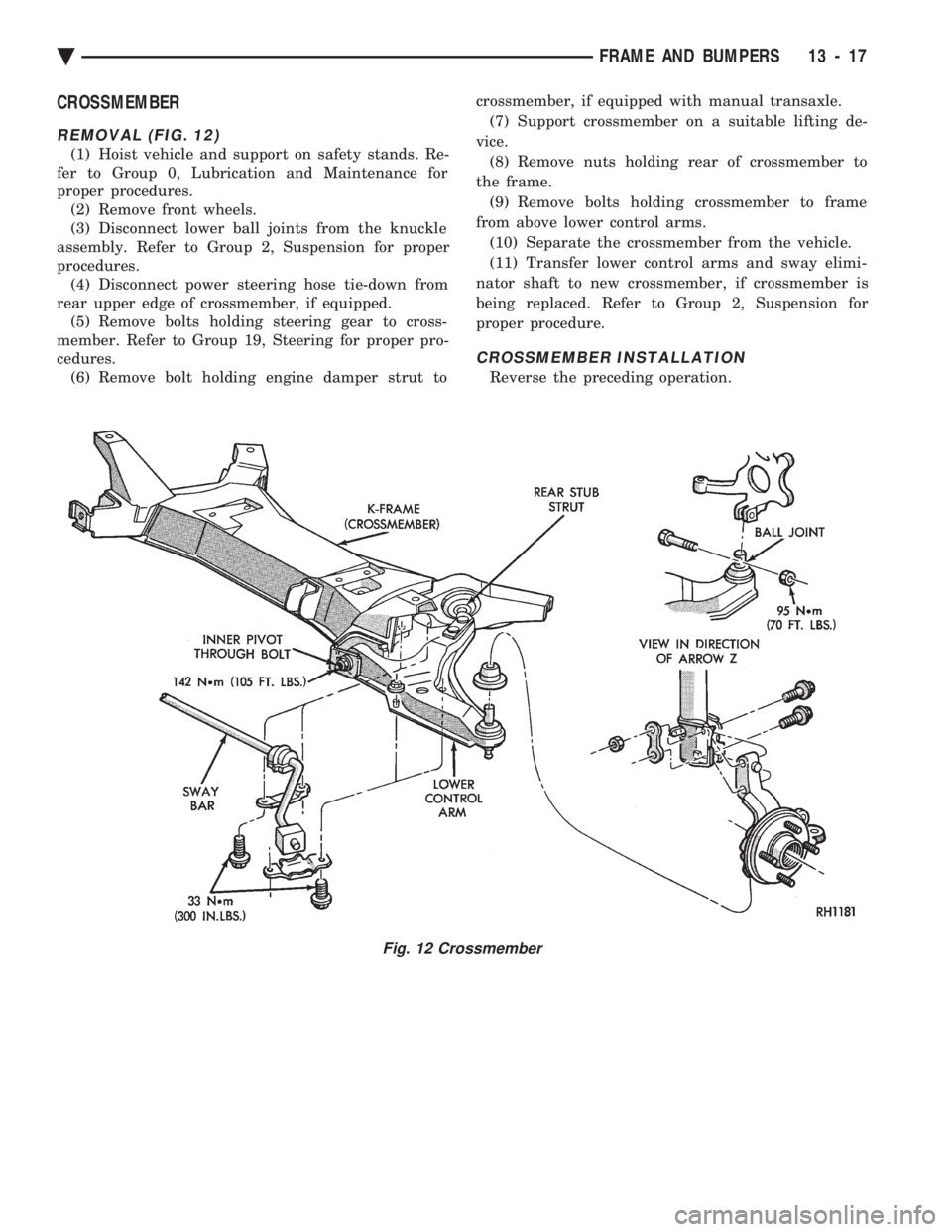
CROSSMEMBER
REMOVAL (FIG. 12)
(1) Hoist vehicle and support on safety stands. Re-
fer to Group 0, Lubrication and Maintenance for
proper procedures. (2) Remove front wheels.
(3) Disconnect lower ball joints from the knuckle
assembly. Refer to Group 2, Suspension for proper
procedures. (4) Disconnect power steering hose tie-down from
rear upper edge of crossmember, if equipped. (5) Remove bolts holding steering gear to cross-
member. Refer to Group 19, Steering for proper pro-
cedures. (6) Remove bolt holding engine damper strut to crossmember, if equipped with manual transaxle.
(7) Support crossmember on a suitable lifting de-
vice. (8) Remove nuts holding rear of crossmember to
the frame. (9) Remove bolts holding crossmember to frame
from above lower control arms. (10) Separate the crossmember from the vehicle.
(11) Transfer lower control arms and sway elimi-
nator shaft to new crossmember, if crossmember is
being replaced. Refer to Group 2, Suspension for
proper procedure.
CROSSMEMBER INSTALLATION
Reverse the preceding operation.
Fig. 12 Crossmember
Ä FRAME AND BUMPERS 13 - 17
Page 1741 of 2438
FUEL SYSTEMS
CONTENTS
page page
2.2L TURBO III MULTI-PORT FUEL INJECTIONÐ GENERAL DIAGNOSIS ................. 95
2.2L TURBO III MULTI-PORT FUEL INJECTIONÐ ON-BOARD DIAGNOSTICS ............. 100
2.2L TURBO III MULTI-PORT FUEL INJECTIONÐ SERVICE PROCEDURES ............... 107
2.2L TURBO III MULTI-PORT FUEL INJECTIONÐ SYSTEM OPERATION .................. 83
2.2L/2.5L SINGLE POINT FUEL INJECTIONÐ GENERAL DIAGNOSIS .................. 35
2.2L/2.5L SINGLE POINT FUEL INJECTIONÐ ON-BOARD DIAGNOSTICS .............. 41
2.2L/2.5L SINGLE POINT FUEL INJECTIONÐ SERVICE PROCEDURES ................ 48
2.2L/2.5L SINGLE POINT FUEL INJECTIONÐ SYSTEM OPERATION .................. 24
2.5L FLEXIBLE FUEL MULTI-PORT FUEL INJECTIONÐGENERAL DIAGNOSIS ....... 66
2.5L FLEXIBLE FUEL MULTI-PORT FUEL INJECTIONÐON-BOARD DIAGNOSTICS . . . 70
2.5L FLEXIBLE FUEL MULTI-PORT FUEL INJECTIONÐSERVICE PROCEDURES ..... 77
2.5L FLEXIBLE FUEL MULTI-PORT FUEL INJECTIONÐSYSTEM OPERATION ....... 55 3.0L MULTI-PORT FUEL INJECTIONÐ
GENERAL DIAGNOSIS ................. 125
3.0L MULTI-PORT FUEL INJECTIONÐ ON-BOARD DIAGNOSTICS ............. 130
3.0L MULTI-PORT FUEL INJECTIONÐ SERVICE PROCEDURES ............... 138
3.0L MULTI-PORT FUEL INJECTIONÐ SYSTEM OPERATION ................. 113
3.3L AND 3.8L MULTI-PORT FUEL INJECTIONÐ GENERAL DIAGNOSIS ................. 157
3.3L AND 3.8L MULTI-PORT FUEL INJECTIONÐ ON-BOARD DIAGNOSTICS ............. 162
3.3L AND 3.8L MULTI-PORT FUEL INJECTIONÐ SERVICE PROCEDURES ............... 169
3.3L AND 3.8L MULTI-PORT FUEL INJECTIONÐ SYSTEM OPERATION ................. 145
ACCELERATOR PEDAL AND THROTTLE CABLE .............................. 21
FUEL DELIVERY SYSTEM ................. 3
FUEL TANKS .......................... 14
GENERAL INFORMATION .................. 1
SPECIFICATIONS ...................... 178
GENERAL INFORMATION
Throughout this group, references are made to a
particular vehicle by letter designation. A chart
showing the breakdown of these designations is in-
cluded in the Introduction Section at the front of this
service manual. The Fuel System consists of the fuel tank, fuel
pump, fuel filter, throttle body, fuel injectors, fuel
tubes and vacuum tubes. The Fuel Delivery System consists of the fuel
pump, fuel filter, fuel lines and fuel hoses. The Fuel Tank Assembly consists of the fuel tank,
filler tube, a fuel gauge sending unit assembly and a
pressure-vacuum filler cap. Also, the Evaporation Control System is part of the
fuel system. The evaporation control system is de-
signed to reduce the emission of fuel vapor into the
atmosphere. The description and function of the Evaporation
Control System is found in Group 25 of this manual.FUEL REQUIREMENTS
Your vehicle was designed to meet all emission
regulations and provide excellent fuel economy when
using high quality unleaded gasoline.
VEHICLES WITHOUT TURBOCHARGED ENGINES
Use unleaded gasoline having a minimum octane
rating of 87.
VEHICLES WITH TURBOCHARGED ENGINESÐEXCEPT 16 VALVE 2.2L ENGINES
These vehicles will operate satisfactorily on both
regular unleaded gasoline having a minimum octane
rating or 87, and premium unleaded gasoline having
a minimum octane rating of 91. The use of premium
unleaded gasoline will improve performance.
VEHICLES WITH 2.2L 16 VALVE ENGINES
The use of premium unleaded gasoline having a
minimum octane of 91 is recommended. If premium
unleaded is not available, then unleaded gasoline
Ä FUEL SYSTEMS 14 - 1
Page 1742 of 2438
with a minimum octane of 87 may be used. However,
the use of lower octane gasoline will result in re-
duced performance.
FLEXIBLE FUEL AA-BODY VEHICLES
These vehicles will operate on either unleaded gas-
oline with a minimum posted octane of 87 or M85
fuel. M85 fuel is a mixture of 85 percent methanol
and 15 percent unleaded gasoline. The vehicle also
will operate on mixture of M85 and unleaded gaso-
line with a minimum posted octane of 87. Do not
use 100 percent methanol in these vehicles.
THE FOLLOWING IS APPLICABLE TO ALL VEHICLES
Light spark knock at low engine speeds is not
harmful to your engine. However, continued heavy
spark knock at high speeds can cause damage and
should be reported to your dealer immediately. En-
gine damage resulting from operating with a heavy
spark knock may not be covered by the new vehicle
warranty. In addition to using unleaded gasoline with the
proper octane rating, gasolines that contain deter-
gents, corrosion and stability additives are recom-
mended. Using gasolines that have these additives
will help improve fuel economy, reduce emissions,
and maintain vehicle performance. Generally, pre-
mium unleaded gasolines contain more additive than
regular unleaded. Poor quality gasoline can cause problems such as
hard starting, stalling, and stumble. If you experi-
ence these problems, try another brand of gasoline
before considering service for the vehicle.
GASOLINE/OXYGENATE BLENDS
Some fuel suppliers blend gasoline with materials
that contain oxygen such as alcohol, MTBE (Methyl
Tertiary Butyl Ether) and ETBE (Ethyl Tertiary Bu-
tyl Ether). The type and amount of oxygenate used
in the blend is important. The following are generally used in gasoline
blends: Ethanol - (Ethyl or Grain Alcohol) properly blended, is used as a mixture of 10 percent ethanol
and 90 percent gasoline. Gasoline blended with eth-
anol may be used in your vehicle. Methanol - (Methyl or Wood Alcohol) is used in a
variety of concentrations when blended with un-
leaded gasoline. You may find fuels containing 3 per-
cent or more methanol along with other alcohols
called cosolvents. Do not use gasolines containing Methanol.
Use of methanol/gasoline blends may result in
starting and driveability problems and damage criti-
cal fuel system components. Problems that are the result of using methanol/gas-
oline blends are not the responsibility of Chrysler
Motors and may not be covered by the new vehicle
warranty. MTBE/ETBE - Gasoline and MTBE (Methyl Ter-
tiary Butyl Ether) blends are a mixture of unleaded
gasoline blended and up to 15 percent MTBE. Gaso-
line and ETBE (Ethyl Tertiary Butly Ether) are
blends of gasoline and up to 17 percent ETBE. Gas-
oline blended with MTBE or ETBE may be used in
your vehicle. Clean Air Gasoline
Many gasolines are now being blended that con-
tribute to cleaner air, especially in those areas of the
country where pollution levels are high. These new
blends provide a cleaner burning fuel and some are
referred to as reformulated gasoline. In areas of the country where carbon monoxide lev-
els are high, gasolines are being treated with oxy-
genated materials such as ETBE, MTBE and
ethanol. The use of gasoline blended with these ma-
terials also contributes to cleaner air. Chrysler Corporation supports these efforts toward
cleaner air and recommends that you use these gas-
olines as they become available. Materials Added to Fuel
Indiscriminate use of fuel system cleaning agents
should be avoided. Many of these materials intended
for gum and varnish removal may contain active sol-
vents of similar ingredients that can be harmful to
fuel system gasket and diaphragm materials.
14 - 2 FUEL SYSTEMS Ä
Page 1743 of 2438
FUEL DELIVERY SYSTEM INDEX
page page
Chassis Fuel Tubes ...................... 11
Flexible Fuel Components ................... 3
Fuel FilterÐAll Vehicles .................... 9
Fuel Hoses, Clamps, and Quick Connect Fittings . 10
Fuel Pump Assembly ...................... 5
Fuel Pump Module Installation ............... 9
Fuel Pump Module Removal ................. 8
Fuel Pump Pressure TestÐ2.2L/2.5L TBI and 3.0L MPI Engines ........................... 7
Fuel Pump Pressure TestÐAll Except 2.2L/2.5L TBI and 3.0L MPI ....................... 6
Fuel Pump Strainer Service .................. 9 Fuel System Pressure
...................... 6
Fuel System Pressure Release ProcedureÐ 2.2L/2.5L TBI ........................... 4
Fuel System Pressure Release ProcedureÐ3.0L . . 5
Fuel System Pressure Release ProcedureÐExcept 2.2L/2.5L TBI and 3.0L ................... 4
General Information ........................ 3
Identifying Flexible Fuel Components .......... 3
Mechanical Malfunctions .................... 8
Methanol Concentration SensorÐFlexible Fuel AA-Body .............................. 4
Service Precautions for Flexible Fuel Vehicles .... 3
GENERAL INFORMATION
Beginning this model year, Chrysler began produc-
ing AA-Body vehicles designed to operate on a mix-
ture of gasoline and methanol. These automobiles are
referred to as Flexible Fuel vehicles. Flexible fuel vehicles can operate on a mixture of
up to 85 percent methanol, 15 percent unleaded gas-
oline. These vehicles also operate on mixtures con-
taining a lower percentage of methanol or just pure
unleaded gasoline. In many cases, the procedures for servicing flexible
fuel components is identical to gasoline only compo-
nents. Refer to the particular Service Procedure in
this section. If the service procedure for flexible fuel
component differs from a gasoline only component,
the title of each service procedure identifies the ap-
plication.
SERVICE PRECAUTIONS FOR FLEXIBLE FUEL
VEHICLES
Methanol is more toxic than gasoline. Always re-
lease fuel system pressure before servicing fuel sys-
tem components and wear methanol resistant gloves
and eye protection. Avoid breathing methanol vapors or ingesting
methanol. Headaches, dizziness and even uncon-
sciousness could result from breathing these vapors.
Serious injury, blindness and even death could result
from ingesting methanol. Methanol vapors are extremely flammable and can
travel along the ground. Service vehicles in well ven-
tilated areas and avoid ignition sources. Never
smoke while servicing the vehicle. Do not allow methanol to contact skin. Prolonged
contact with methanol can cause dry skin or an al-
lergic skin reaction. Also, prolonged contact could re-
sult in absorption through the skin.
IDENTIFYING FLEXIBLE FUEL COMPONENTS
Flexible Fuel vehicles have unique methanol com-
patible fuel system components. Chrysler identifies
methanol compatible components that could be phys-
ically interchanged with gasoline only parts by color-
ing them green or applying a green label or tag to
them. Even though they may appear physically iden-
tical, components for gasoline only vehicles must not
be used on flexible fuel vehicles.
FLEXIBLE FUEL COMPONENTS
Flexible fuel AA-body vehicles uses many unique
fuel system components. The unique parts are green
in appearance or have a green tag or label attached
to them. While components used on gasoline only ve-
hicles may look similar or identical, they cannot be
used on flexible fuel vehicles. When servicing a com-
ponent, always use an original equipment or equiva-
lent flexible fuel replacement. The fuel system of flexible fuel AA-body vehicles
have the following unique components.
² Fuel pump module
² Fuel level sensor
² Fuel gauge (gauge cluster).
² Fuel tank
² Fuel pressure regulator (including O-rings)
² Fuel rail
² Fuel injectors (including O-rings)
² Fuel tubes
² Fuel filter
² EVAP canister
² Fuel filler cap
² Fuel filler tube
² Pressure relief/Rollover valve
² All fuel system and emission system hoses and
tubes
Ä FUEL SYSTEMS 14 - 3