1993 CHEVROLET CORVETTE wheel
[x] Cancel search: wheelPage 176 of 370
Downloaded from www.Manualslib.com manuals search engine P TO Use Anti-L.ock:
Don't pump the brakes. Just hold the
brake pedal downand let anti-lock
work for you. You may feel the brake
pedal
vibrate, or you -may notice some
noise,
but thi.s is normal.
When the ABS is active, the ABS
ACTIVE light- conies on to-indicate luw
traction conditions.
Adjust your -driving
accordingly.
When
you start your vehicle and begin
to drive away, you may hear a
momentary motsr Qr .clicking, noise-and
you. my even notice that, yow bmke
pedd -moves a little while this is going
on.
This is the ABS test-ing itself. You-
may also hear and feel this durihg a
hard stop.
Corvette ASR (Acceleration SIip
R.egulati0.n) System
Yo& vehicle has an ASR system that
limits wheel
spin. This is especially
useful in slippery road conditions. The
ASR system works at all speeds. It
limits
wheel spin by reducing englne
torque
by cLusing the throttle and
managing
sp'ark and .applyiag the rear
brakes. You may €&el the system
working., .or
you may notice some noise,
but this is normal.
Page 177 of 370
Downloaded from www.Manualslib.com manuals search engine Your Driving and the Road
Corvette ASR System (CONT.)
The ASR system comes on when the
ignition is -turned
on and operates at all
speeds. When your ASR system is
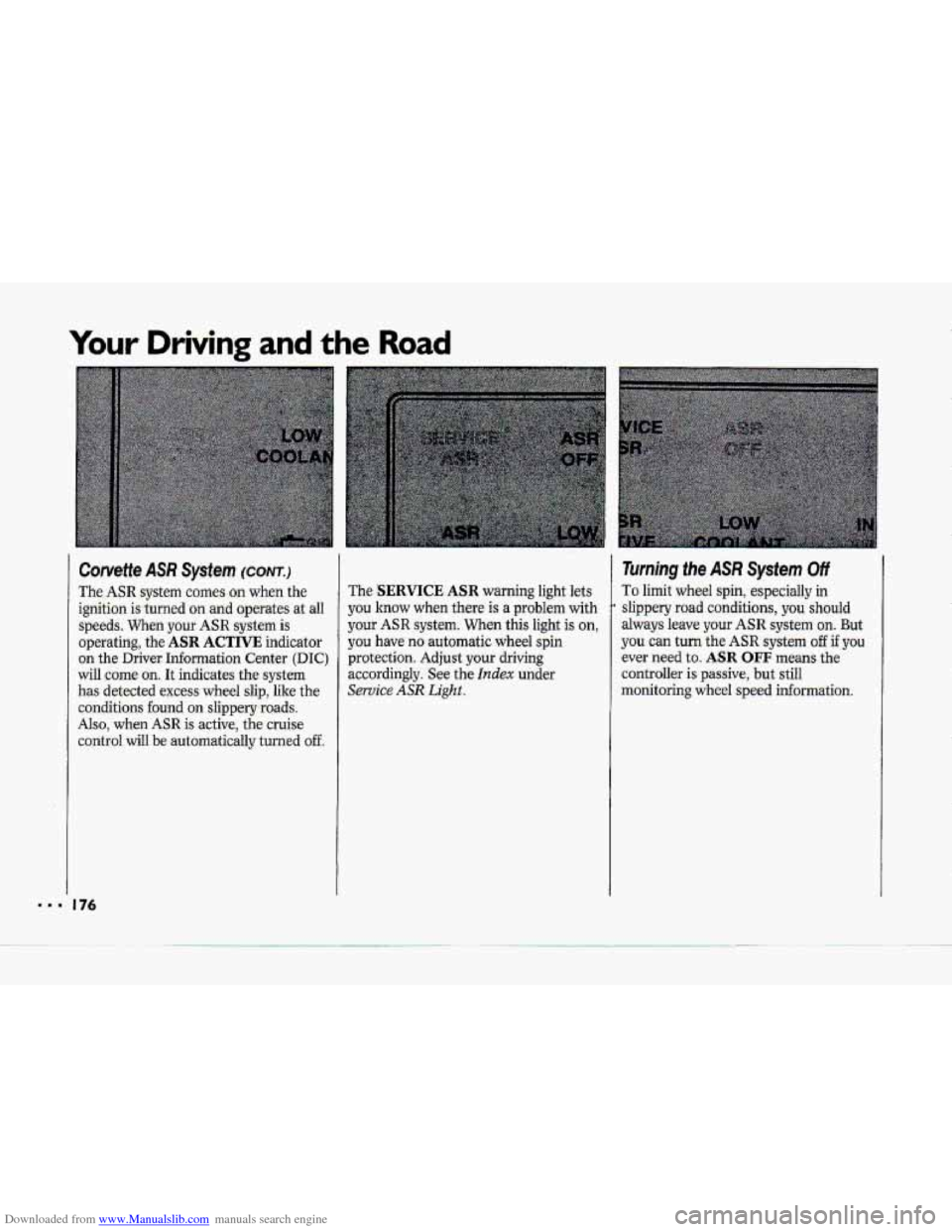
operating, the
ASR ACTIVE indicator
on the Driver Information Center
(DIC)
will come on. It indicates the system
has detected excess wheel slip, like the
conditions found on slippery-roads.
Also, when ASR is active, the cruise
control
will be automaticaIly turned off
The SERVICE ASR warning light lets
you know
when there is a problem with
your ASR system. When this light is on,
you have no-automatic wheel spin
protection. Adjust your driving
accordingly, See the
Index under
Service ASR Light..
Turning the ASR System Off
To limit wheel spin, especially in
slippery road conditions, you should
always leave your ASR. system on. But
you can turn the ASR system off if you
ever need to. ASR OFF means the
controller is passive, but still
monitoring wheel
speed informauon.
Page 178 of 370
Downloaded from www.Manualslib.com manuals search engine i
T"
$"'
I
r
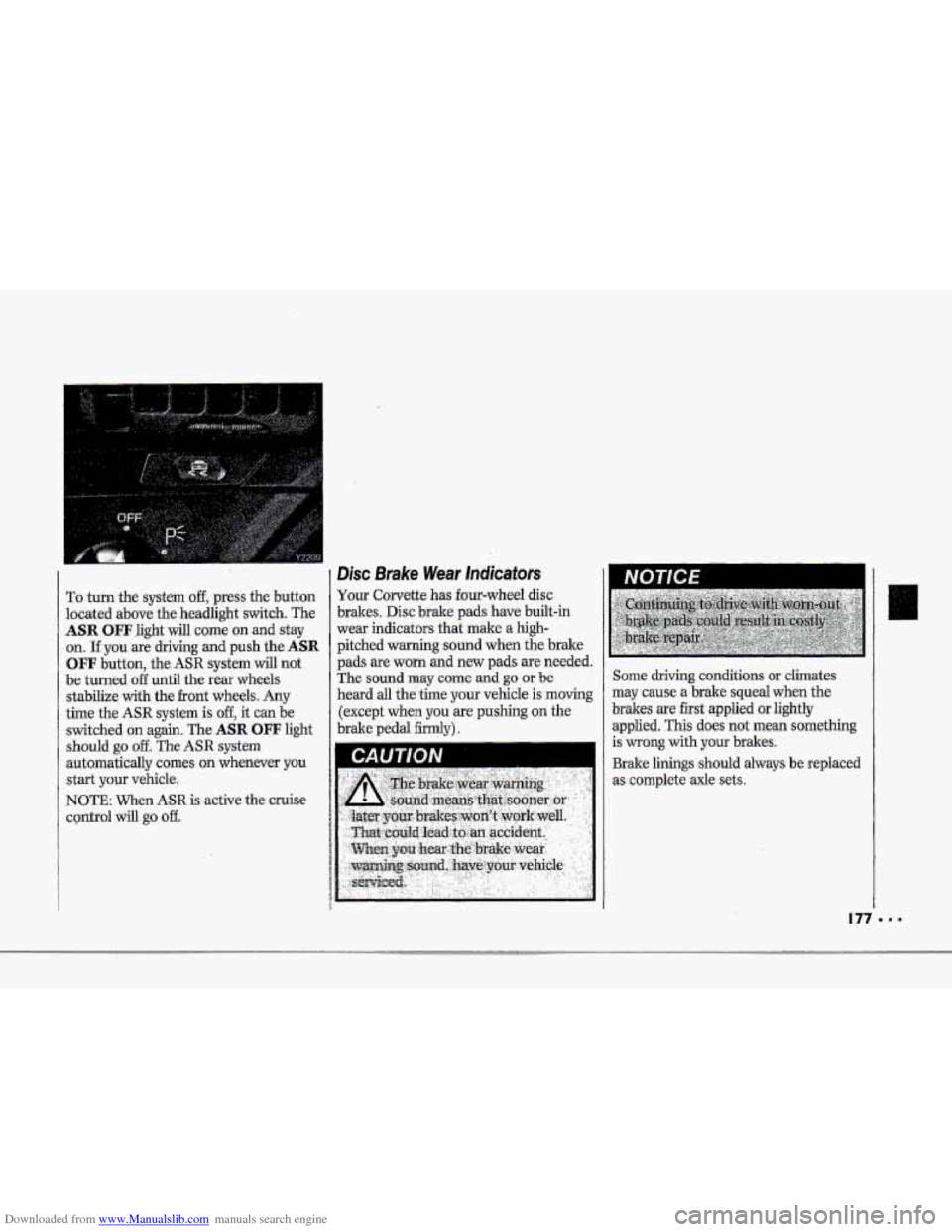
To turn the system off, press the button
located above the headlight switch. The
ASR OFFlight will come on and stay
on. If you are driving and push the ASR
OFF button, the ASR system will not
be turned off until the rear wheels
stabilize with the front wheels.
Any
time the ASR system is off, it can be
switched.
on again. The ASR OFF light
should
go off. The ASR system
automatically comes
on whenever you
start your vehicle.
NOTE: When ASR is active the cruise
CQntrOl will go off.
Disc Brake Wear lndicators
Your Corvette has four-wheel disc
brakes. Disc brake pads have built-in
wear indicators that make
a high-
pitched warning sound when the brake
pads are worn and new pads are needed.
The sound may come and
go or be
heard
aIl the time your vehicle is moving
(except when you
are pushing on the
brake pedal firmly). Some
driving conditions or climates
may cause a brake squeal when
the
brakes are first applied or lightly
applied. This does not mean
something
is wrong with your brakes.
Brake linings should always be replaced
as complete axle sets.
Page 180 of 370
Downloaded from www.Manualslib.com manuals search engine r" i
'4
f
-/_
i
t-
i
Power Steering
If you lose power steering assist
because the engine stops
or the system
fails to function, you c-an steer but it
will take much more effort.
i.
steering Tips-Dtiving on Curves
It's important to tale curves at a
reasonable
speed.
A lot of the "driver lost control"
accidents mentioned
on. the news
happen on .curves. .Here's why:
Experienced driver
or beginner, each of
us is subject to the same laws of physics
when
driving on'curves; The.;traction of
the tixes against the road surface makes
it possible
for the vehicle to change its
path when you turn the front wheels. If
there's no traction, inertia will keep the
vehicle going in the same direction. If
yuu"ve mer tried to steer a vehicle on
wet ice> you:U understand this.
The traction you can get in a curve
depends on the condition of your tizies
and
the road surface, the angle at which
the-curve
is banked, and your speed,
While you're in
a curve, speed is the one
factor you can control.
Suppose you're steering through. a. sharp
a.xve. Then you suddenly acwlerate. If
excess wheel spin is detected, ASR will
reduce erigine torque to the wheels. Lf
your ASR system is off, those two
control systems-steering and
acceleration-can ovGrwhelm those
i places where-the tires meet the road and
~ make you lose control.
1 What should you do if this ever
happens? Let
up on the accelerator
pedal, steer
the vehicle the way you
want it to go, and slow down.
Page 181 of 370
Downloaded from www.Manualslib.com manuals search engine ..I
Your Driving and the Road
’I
Steering Tips-Driving on Curves
(CONT.)
Speed limit signs near curves warm that
you should adjust your speed.
Of
course, the posted speeds are based on
good weather and road conditions.
Under less favorable conditions you’ll
want to
go slower.
If you need to reduce your speed as you
approach
a curve, do it before you enter
the curve, while your hont wheels are
straight ahead.
Try
to adjust your speed so you can
Wive” through the curve. Maintain a
reasonable, steady speed. Wait to
accelerate until you are out
of the curve,
and then accelerate gently into the
straightaway.
When you drive into
a curve at night,
it’s harder to see the road ahead
of you
because it bends away
from the straight
beams
of your lights. This is one good
reason to drive slower.
I80
Steering in Emergencies
There are times when steering can be
more effective than braking. For
example,
you come over a hill and find
a truck stopped
in your lane, or a car
suddenly pulls out
€ram nowhere, or a
child darts out from between parked
cars and stops right in front of you. You
can avoid these problems by braking-if
you can stop in time. But sometimes
you can’t; there isn’t
room. That’s the
time for evasive action-steering
around the problem.
Your Corvette
can perform very well in
emergencies like these. First apply your
brakes. It is better
to remove as much
speed as you can
from a possible
collision. Then steer around the
9
problem, to the left or right depending
on the space available.
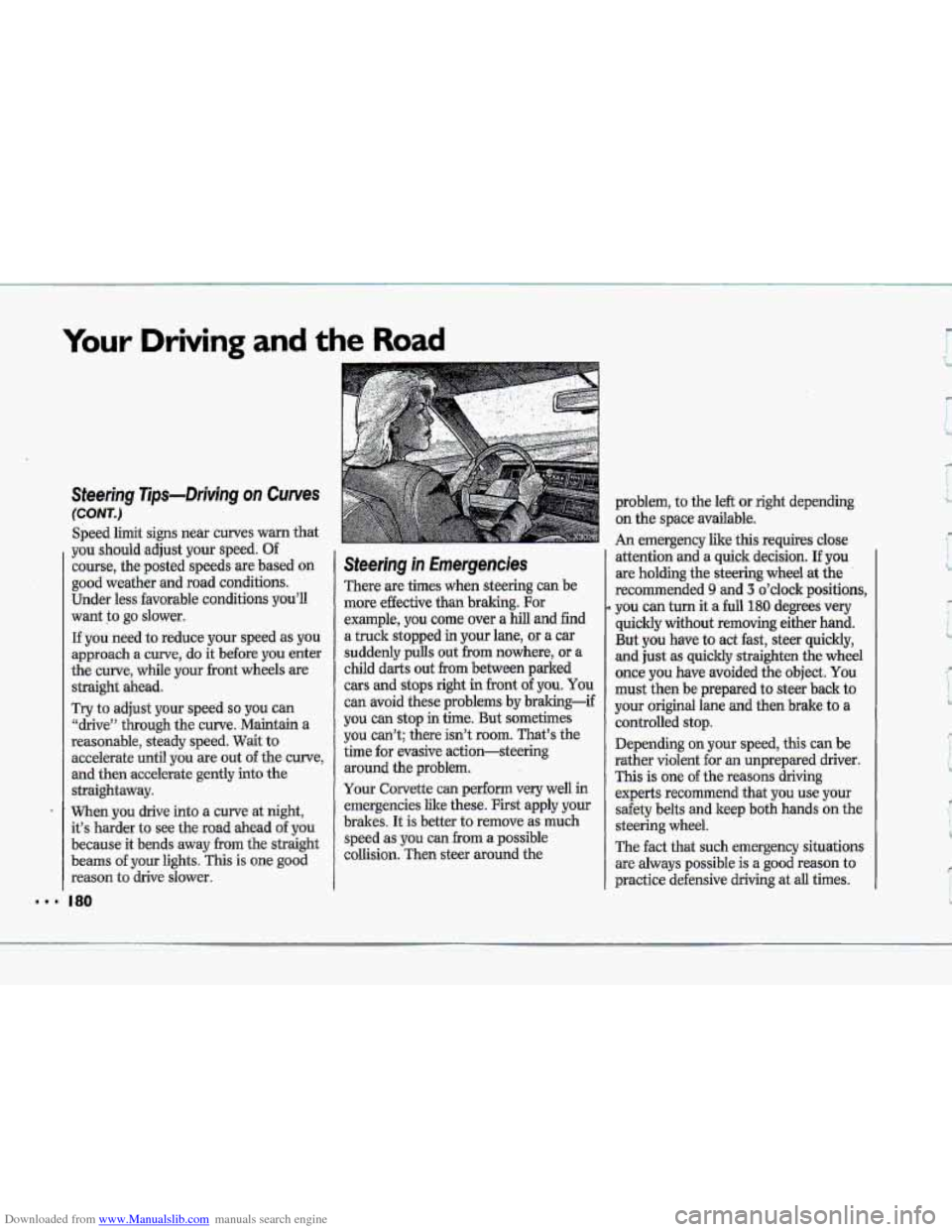
An emergency like this requires close
attention and a quick decision.
If you
are holding the steering wheel at the
recommended
9 and 3 o’clock positions,
you can turn it a full 180 degrees very
quickly without removing either hand.
But you have to act fast, steer quickly,
and just as quickly straighten the wheel
once
you have avoided the object. You
must then be prepared to steer back to
your original lane and then brake to a
controlled stop.
Depending on your speed, this can be
rather violent for an unprepared driver.
This is one of the reasons driving
experts recommend that you use your
safety belts and keep both hands
on the
steering wheel.
The fact that such emergency situations
are always possible is
a good reason to
practice defensive driving at
all times.
Page 182 of 370
Downloaded from www.Manualslib.com manuals search engine T
i
,+
I i
r.
!
Ofl-Road .Recovery
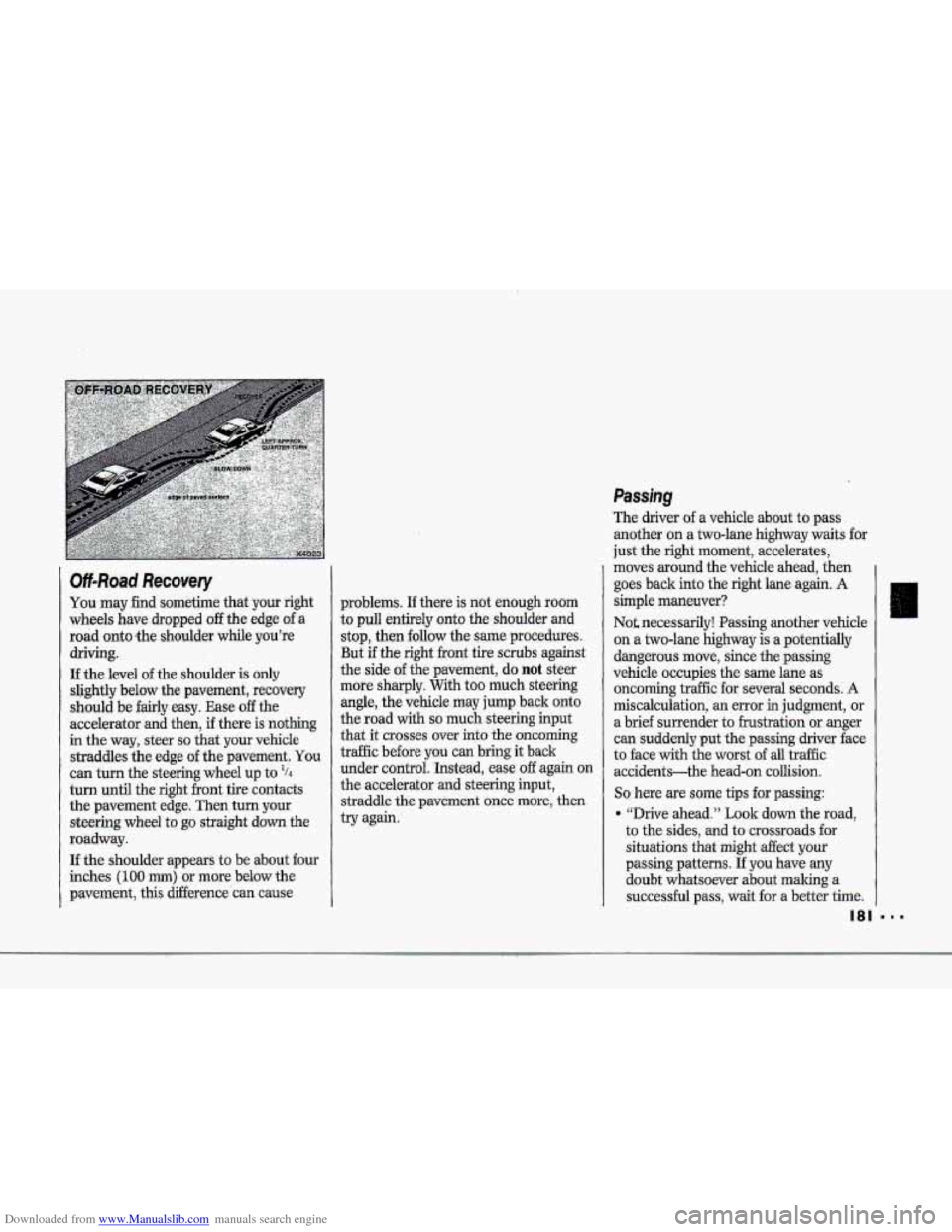
You may hd sometime that your right
wheels bave dropped 08 the edge of-a
road mtwthe &odder while you’re
driving.
ff- the level of the shoulder is only
slightly below the pavement, recovery
should be fairly easy. Ease off the
accelerator and then, if there is nothing
in the way, steer so that. your%Wde
straddles the edge of. the pavement. You
can turn the steering wheel up to ‘h
turn until theight. front tire contacts
the pavement
edge. Then turn your
stetking wheel to go straight dm the
rcradway.
If the- shoulder appears to be about four
inches (100 mm) or more below the
pavement,. this difference.cm cause
problems. If there is not boough room
to pull entirely onto the shoulder and
stgp, then fdbw the same procedures.
But if the riglit €rant tire scrubs against
the side. af the pavement, do not skstr
more.sharplyy. With too much steering-
angle, the vehicle may jump back o~to
the road with so much steering input
that it-cmsses over into the oncoming
tr&c ,before you can bring it back
under control.. ;Instead, ease off again an
the? accelerator and steeping input,
straddle
the pavement once more, then
try again.
Page 194 of 370
Downloaded from www.Manualslib.com manuals search engine I 9 II
!-
i
Driving a Long Distance
Although most long trips today are
made on freeways, there are still many
made
on regular highways.
Long-distance driving
on freeways and
regular highways is the same in some
ways. The trip has to be planned and
the vehicle prepared, you drive at
higher-than-city speeds, and there are
longer turns behhd the wheel. You’ll
enjoy your
trip more if you and your
vehicle
are in good shape. Here are
some.fips for
a successful long trip.
Before Leaving on a Long Trip
Make sure you’re ready. Try to be well
rested.
If you must start when you’re
not fresh-such as after
a day’s work-
don’t plan to
make too many miles that
first part of the journey. Wear
comfortable clothing and shoes you
can
easily drive in.
Is your vehicle ready for a long trip? If
you keep it serviced and maintained, it’s
ready to
go. If it needs service, have it
done before starting
out. Of course,
you’ll find experienced and able service
experts in Chevrolet dealerships all
across North America. They’ll be ready
and willing to help if you need it. Here
&e some
things you can check
before
a trip:
Windshield Washer Fluid: .Is the
reservoir full? Are ,all windows
clean
inside and outside?
shape?
you checked all levels?
lenses clean?
safe, trouble-hee trip. Is the tread
good enough for lofig-distance
drivhg? Are the tires all inflated to
the recammended pressure?
weather outlook
along your route?
Should you delay your trip a
short
time to avoid a major storm system?
0 Maps: Do you have up-to-date maps?
Wiper Blades: Are they in good
Fuel,, Enme Oil, Other Fluids: Have
Lights: Are they all working? Are the
Tires: They are vitally important to a
Weather Forecasts: What’s the
193
Page 195 of 370
Downloaded from www.Manualslib.com manuals search engine Your Driving and the Road
On She Road
Uidess you are the -only driver, it is good
to share the driving task with others.
Limit turns behind
the wheel to about
100 miles (160 km) Or two hours at a
sitting.-Then, either change drivers ar
stop for some rdreshment like coffee,
tea or
soft drinks and some limbering
up.
But do stop and move around. Eat
lightly along the way. Heavier meals
tend to
mdke some people sleepy.
On two-lane highways or
undivided
multilane highways that do not have
controlled .access,.you’ll
wmt to watch
for some situations :not usustlly found
on freeways. Examples: are: stop signs
and signals, shopping tenters with
direct access
to the highway, no passing
zones and school zones, vehicles
turning
le& and- right off the-road,
pedestrians, cyclists, parked vehicles, and even a&&.
Highway Hypnosis
Is thete-actually such a condition as
“highway hypnosis”? Or
is it just plain
falling asleep at the wheel? Call it
highway hypnosis, lack
of awareness, or
whatever.
There is
something about an easy
stretch
of road with the same scenery,
along with the
hum of the tires on the
road, the drone of the engine; and the
rush of the wind against the vehicle that
can make you sleepy. Don’t let it
happen
to you! If it does, your vehicle
can leave the road in less than a
second, and you could crash and be
injured.
What can you do about highway
hypnosis? First, be aware that it can
happen.
Then here
are some tips:
4 Make sure your vehicle is well
ventilated,
with a comfortably cool
interior.
Keep your eyes moving. Sca.n the road
ahead and
-to the sides. Check your
rearview mirrors frequently and your
instruments from time to time. This
can help you avoid
a fixed stare.
Wear good sunglasses in bright light.
Glare can cause drowsiness. But
don’t
wear sunglasses at night. They will.
drastically reduce-your,overall.~sion
at the very time you need all the.
seeing power
you have.
If you get sleepy, pull off the road into
a rest, service, &‘parking area and
take a nap, get so.me exercise, or both.
For safety, treat drowsiness on the
highway
as an emergency.
As in any driving situation, keep pace
with traffic and allow adequate
foIlowing distances.