Page 197 of 370
Downloaded from www.Manualslib.com manuals search engine Your;briving and. , ,., the Road
Hill an.d Mountain Roads (C.ONT.)
*- As you go over the top of a hilI, be
alert. There could
be something in
your lane, like a stalled car or an
accident.
* You may see highway signs 0x1
mountains that warn of special
problems. Examples are long
grades,
passing or na passing zones, a falling
rocks area, or winding roads. Be alert
to these and take appropfiate action.
Winter driving can present special
problems. See the .Index under Winteu.
Driving.
Parking on UMs
Hills and mountains mean spectacular
scenery. But please be car.eful where
you stop if you decide to look at the
view or t.ake pictures. .Look €or pull-offs
or parking areas .provided for scenic
viewing.
Another part of this manual tells .how to
use
your parking brake (see the Index
under Fuiking Brake). But on a
mountain or steep hill, you can do one
more thing. You can turn your kont
wheels
to keep your vehicle frorn.r.olling
downhill or out .into traffic.
Here'.s how:
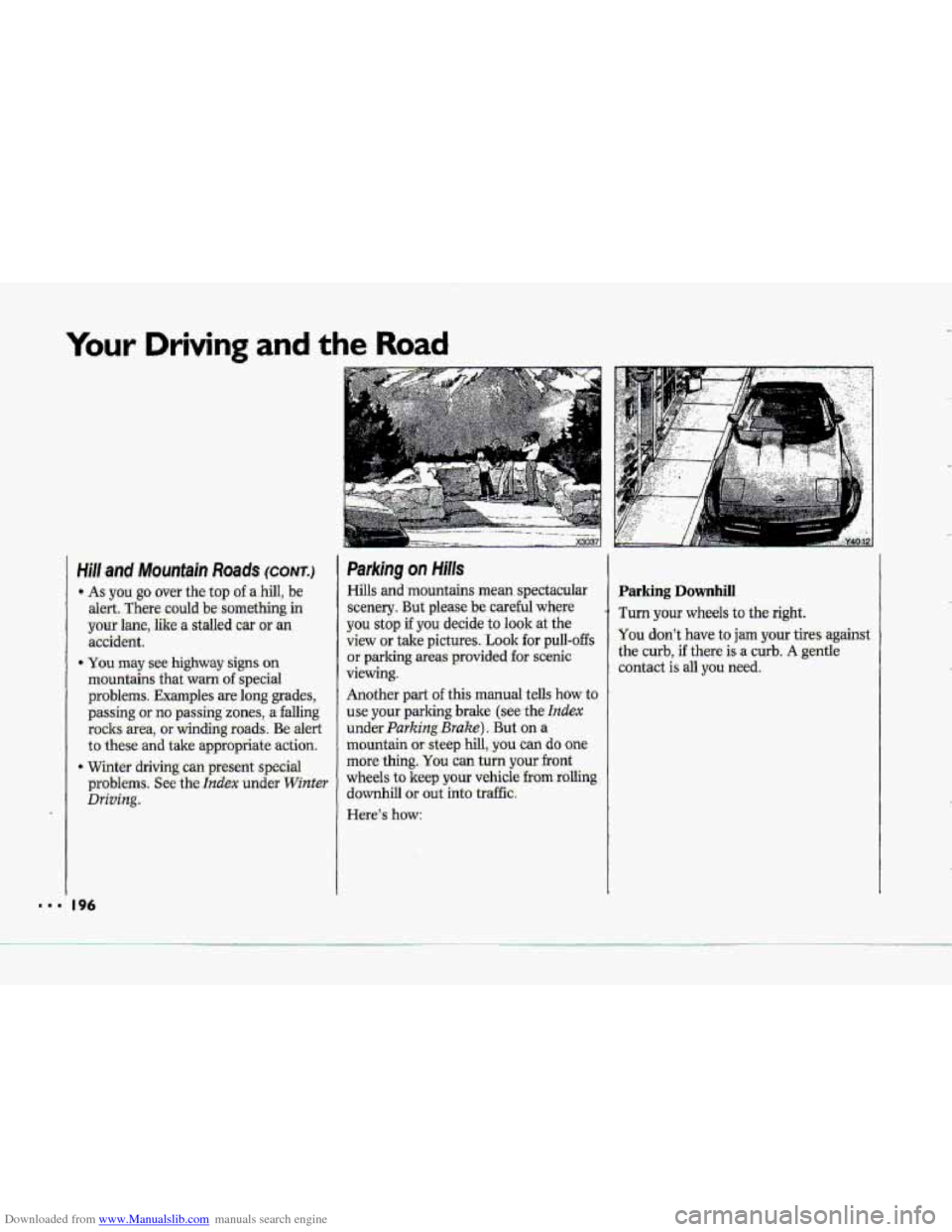
Parking Downhill
Turn your wheels to the right.
You don't have to jam your tires against
the curb, if there is a curb. A-gentle
c6xltact
is all you need.
Page 198 of 370
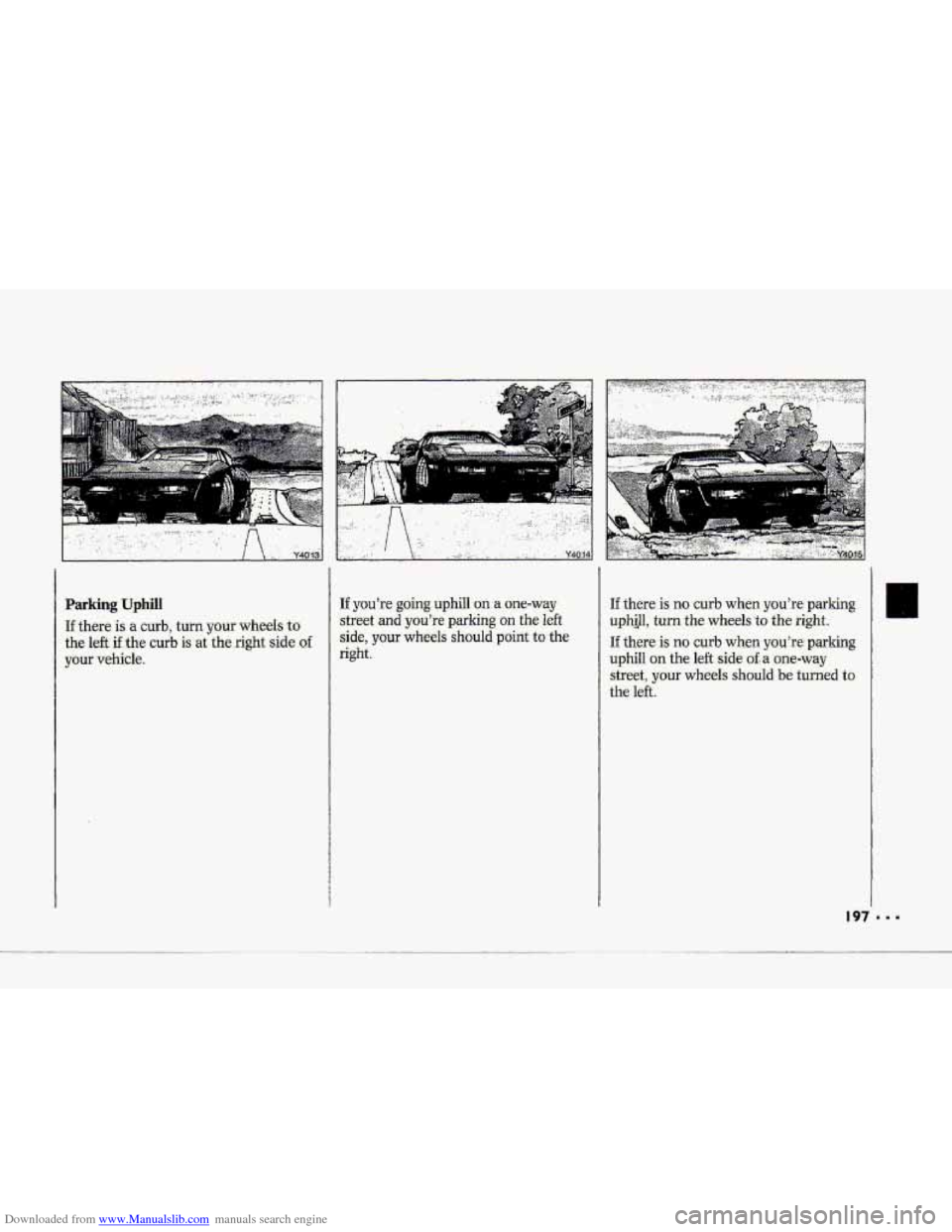
Downloaded from www.Manualslib.com manuals search engine Parkifig Uphill
If there is a -curb, turn. your wheels to
the left ifthe curb is at the.right side :of
your vehicle.
If you’re going uphill on a one-way
street aad you’re parldng. on the,left
side, your wheels should poifit to the
right.
If there is no curb when yo,u’re parking
uph.j,ll, turn. the wheels to the right.
If there is no curb when you’re- parking
-uphill Qn the 1efi:side oh one-%ay
street, .your wheels should be turned to
the left.
c
Page 209 of 370
Downloaded from www.Manualslib.com manuals search engine Problems on the Road
Jump Siaithg (C0;NT.)
9. Attach the cable at least 18 inches
(45 em> away from the dead battery,
but -not near engine
parts that move.
The dectrical cowection is just as
good there, but the chance of sparks
getting back to., the batt-ery is much
less.
10. Now start the vehicle with the go0.d
battery and run the engine
for a
while.
11. Try’to start the vehicle with the
dead battery.
If it won’t start after a>few tries, it
probably needs service.
108
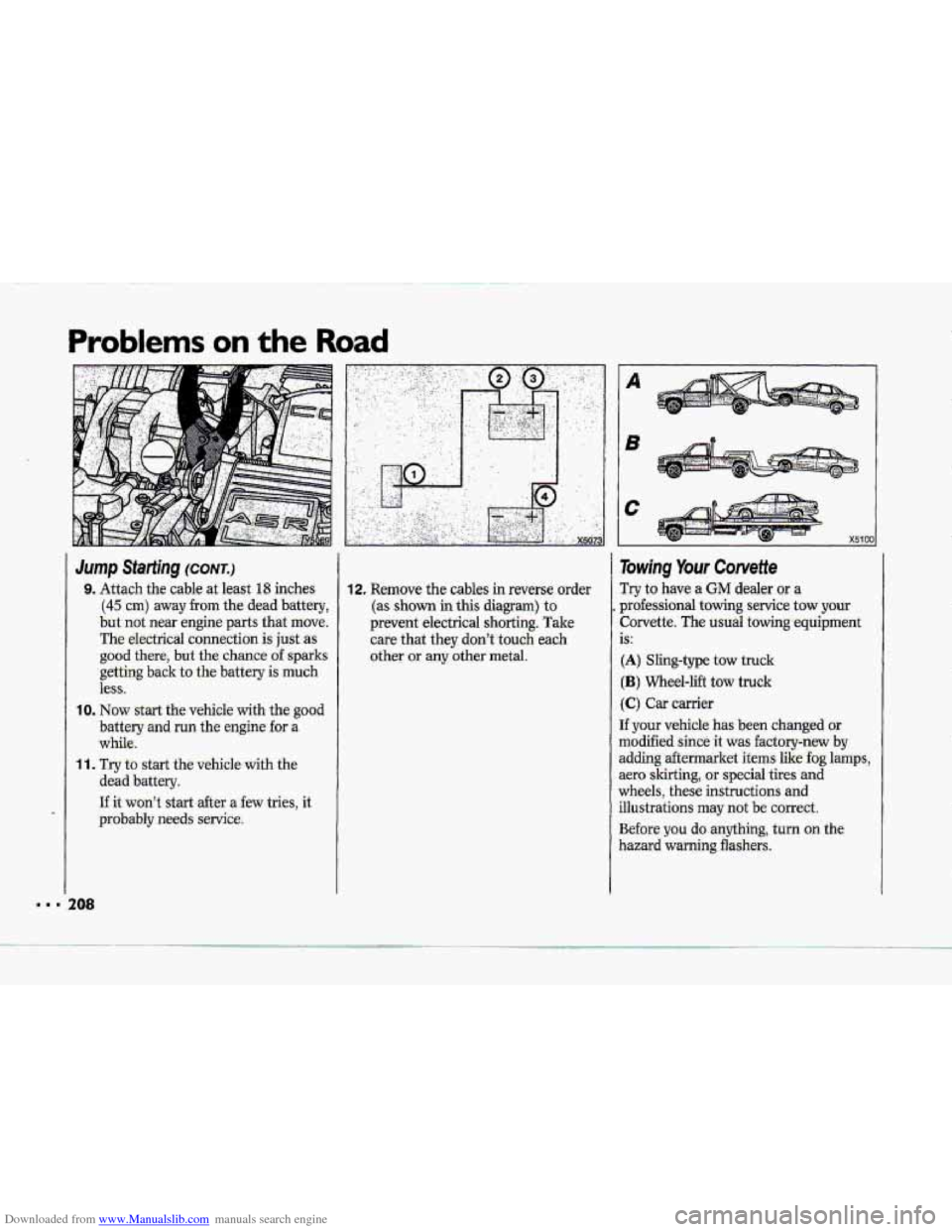
12, Remove the cables in reverse order
(as shown in this diagram) to
prevent electrical shorting. Take
care that they don’ttouch each
other or any other m&al.
Towing Your Corvette
Try to have a GM dealer or a
professional towing service tow your
Corvette, The usual towing equipment
is
:
(A) Sling-twe tow truck
(B) Wheel-lift tow truck
(C) Car carrier
If your vehicle has-been changed or
modified since it was factory-new by
adding aftermarket items like fog lamps,
aero skirting, or special-tires and
wheels, these instructions and
illustrations may not be correct.
Before
you do anything, turn on the
hazard warning
flashers.
Page 210 of 370
Downloaded from www.Manualslib.com manuals search engine When you cdI, tell the towing service:
That your vehicle cannot be towed
-horn the rear with sling-type
equipment.
That your vehicle has rear-wheel
The make, model, and year of your
drivei
vehicle.
Whether you can still movethe shift
If there was an accident, what was
When the towing service arrives, let the
tow.operator know that this manual
contains detailed. t,owing instructions
and illustrations.
The operator may want to see them.
lever.
damaged.
A.
I
..
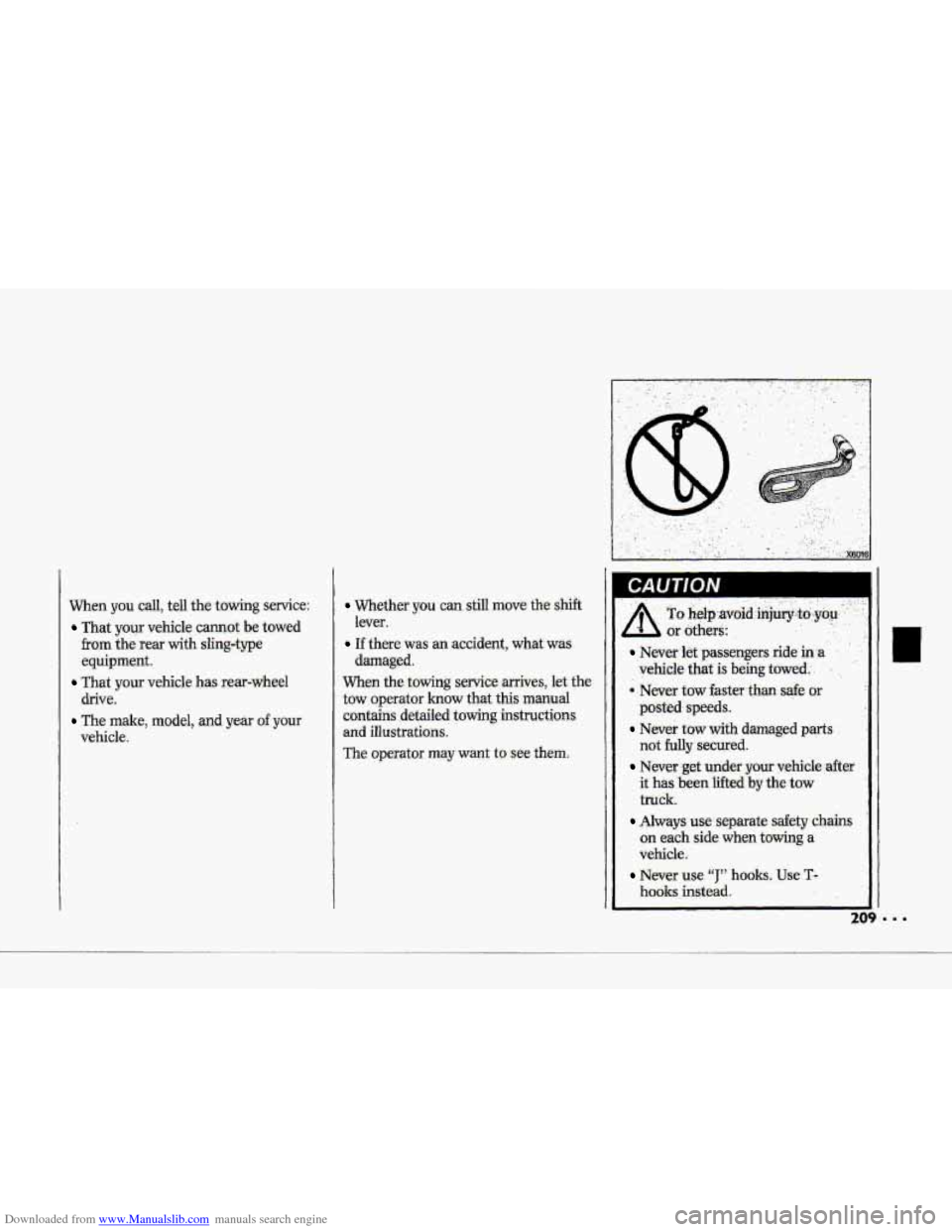
Never.&t .passengers ride in:a .. ’ .
vghiele that is being towed:: . . .
0. N&er tow fasterthan safe or
.posted: speeds.
Never &w with damaged parts
not fully secmed.
Never -get under your vehicle:&er
if has-been Wed by the tow
truck.
on each side when towing a
vehicle.
Never .use “r’ hrioks. Use T-
ho-o€cs.instead.
Always we separate sa€ety,chahs
2
Page 211 of 370
Downloaded from www.Manualslib.com manuals search engine Towhg Your Corvette (CONT.)
When your vehicle is being towed, have
the ignition key
off. The steering wheel
should-be.
clamp,ed in a straight-ahead
position, with a clamping device
designed fur towing s-ervice. DO not use
the vehicle's stewing column iock for
this. The transmission shoLild be in
N [Neutral), and the.parlepg brake
released.
Don't have your vehicle tqwed on the
rear wheels,. unless you must. If the
vehicle
must. be t0we.d on the rear
wheels, dan't go more than 3mph
I
(56 km/h) or farther than 50 miles
(80.h) or your transmission will be
-damaged. Go slow over rough ground,
and position one wheel at a time
(angled 450j if you have- to go over
eurbs.and
rises. .Wheels &the lifted end
should be-
at. least 4 inches (10 cm)
above the ground. If these limits must
be
exceeded, then the rear wheels have
to be supported .on-a dolly.
I
.,
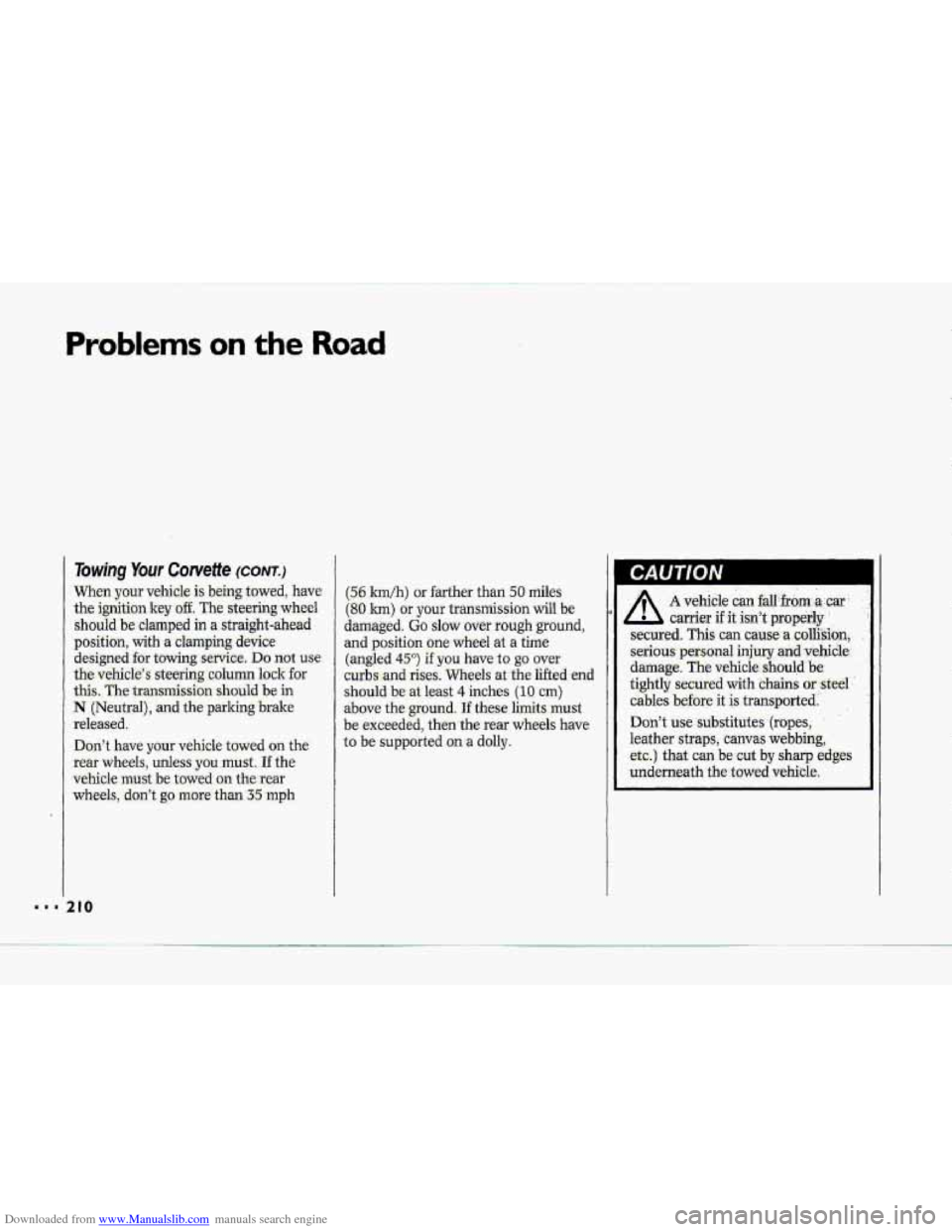
A
A vehicle can faH~~~m~a:c~
carrier if ,it isn't propgilp '
secured., This can cause a.colii$ion,
serious. pelrsonal injury .and:.vehicle.
damage.
The vehicle..shou[d be
t-ightly secured with chains or--sted -'
cables before it is transported-'
Don't use substitutes '(ropes,
leather straps, canvas webbing,
etc:.) that- can be cut by sharp edges
underneath the t.owed vehicle,
Page 225 of 370
Downloaded from www.Manualslib.com manuals search engine Problems on the Road
lJu Tire Goes Flat
It’s unusual for a tire to “blow out”
while you’re driving, especially if-you
maintain
your tires properly. If air goes
out of a tire, it’s much more likely to
leak out
slowly. But if you should ever
have a “blowout,” here are a few tips-
about what to expect
and what to do:
If a front tire fails, the flat tire will
create a drag that pulls the vehicle
toward that side. Take yuur foot 08 the
accelerator pedal
and grip the steering
wheel firmly. Steer to maintain lane
p-osition, then gently brake to -a stop
well out of the. traffic lam.
A rear blowout, particularly on a curve,
acts much like a skid and may require
the
same corre&ion you’d use in a skid.
h any rear bhwout, remove yop foot
from the accelerator pedal. Get the
vehicle under control by steering the
way you want the vehicbto go. It may
be very bumpy and noisy, hut you can
still steer. Gently brake to B stop, well
off’ the road if posiible.
If your tire go& flat, the next section
shows how to use your jacking
equipment to change a flat tire sdely.
e
Page 226 of 370
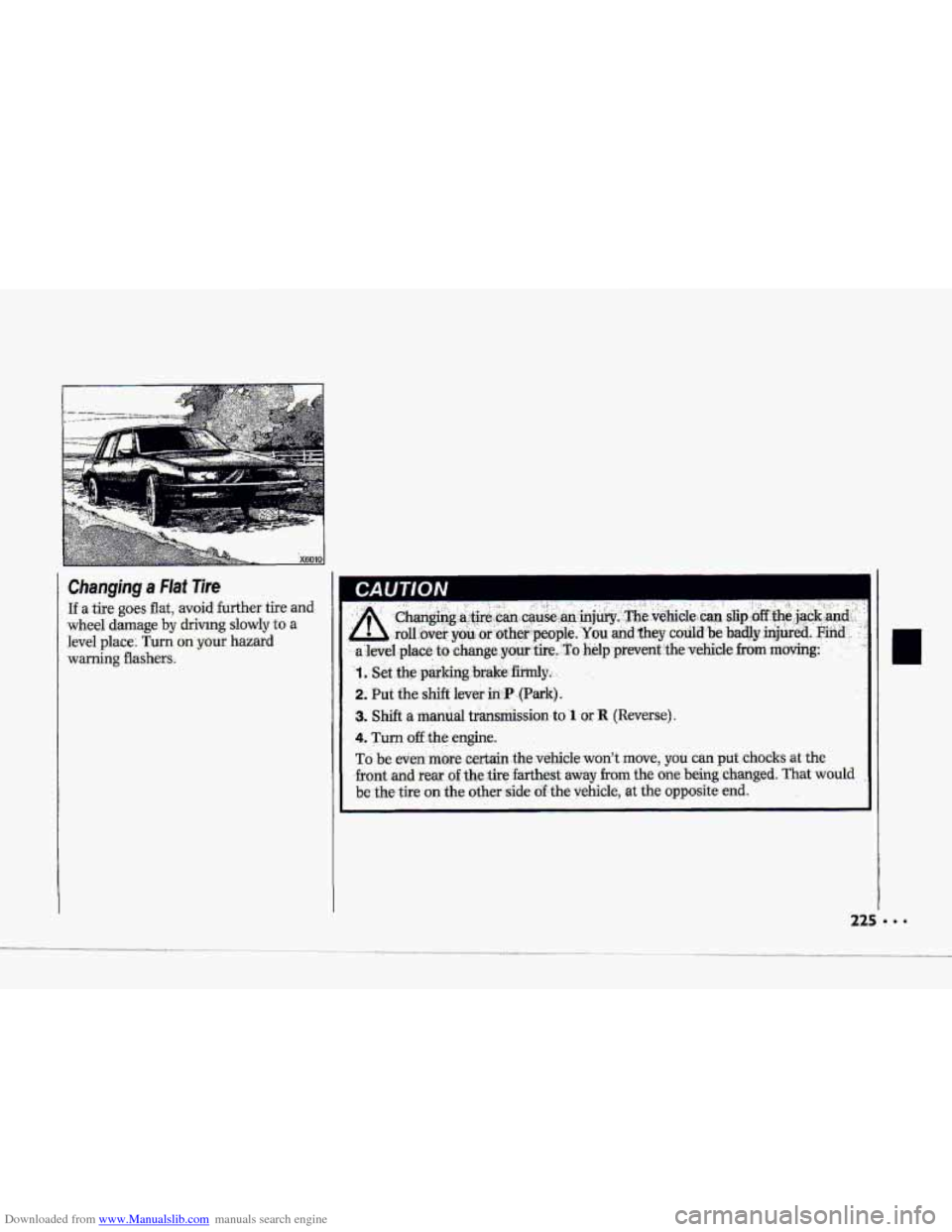
Downloaded from www.Manualslib.com manuals search engine If a tire gaes aat, avoid further tire and
wheel damage by drivmg..slowly.to a
level place: Turn on -your ha-zmd
warning flashers.
II
Page 227 of 370
Downloaded from www.Manualslib.com manuals search engine Problems on thc Road
ucket
I- JI
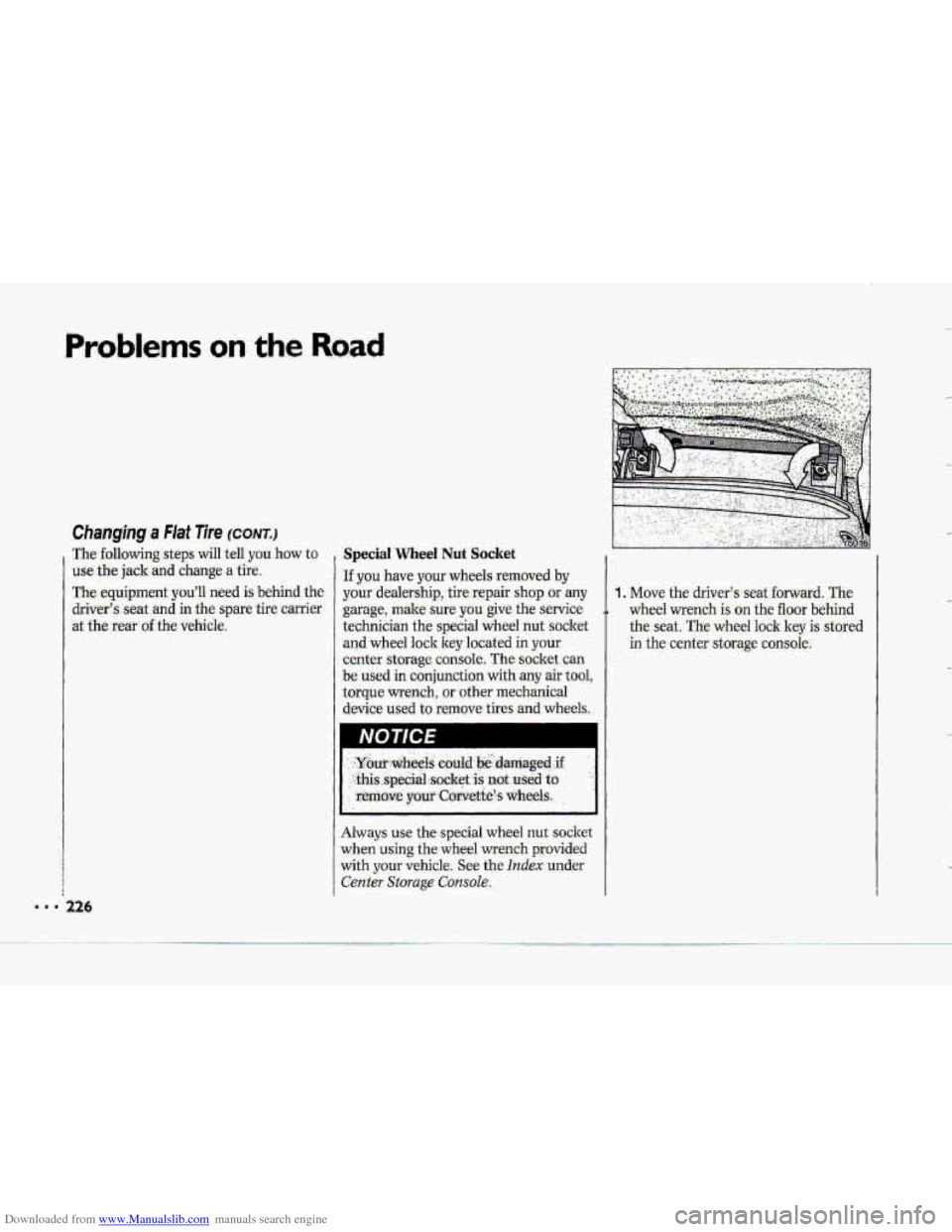
Always use the special wheel nut socket
when using the wheel wrench provided
with your vehicle. See the Index under
Center Storage Console.
I.-