1993 CHEVROLET CORVETTE flat tire
[x] Cancel search: flat tirePage 281 of 370
Downloaded from www.Manualslib.com manuals search engine Service & Appearance Care
I
= * 280
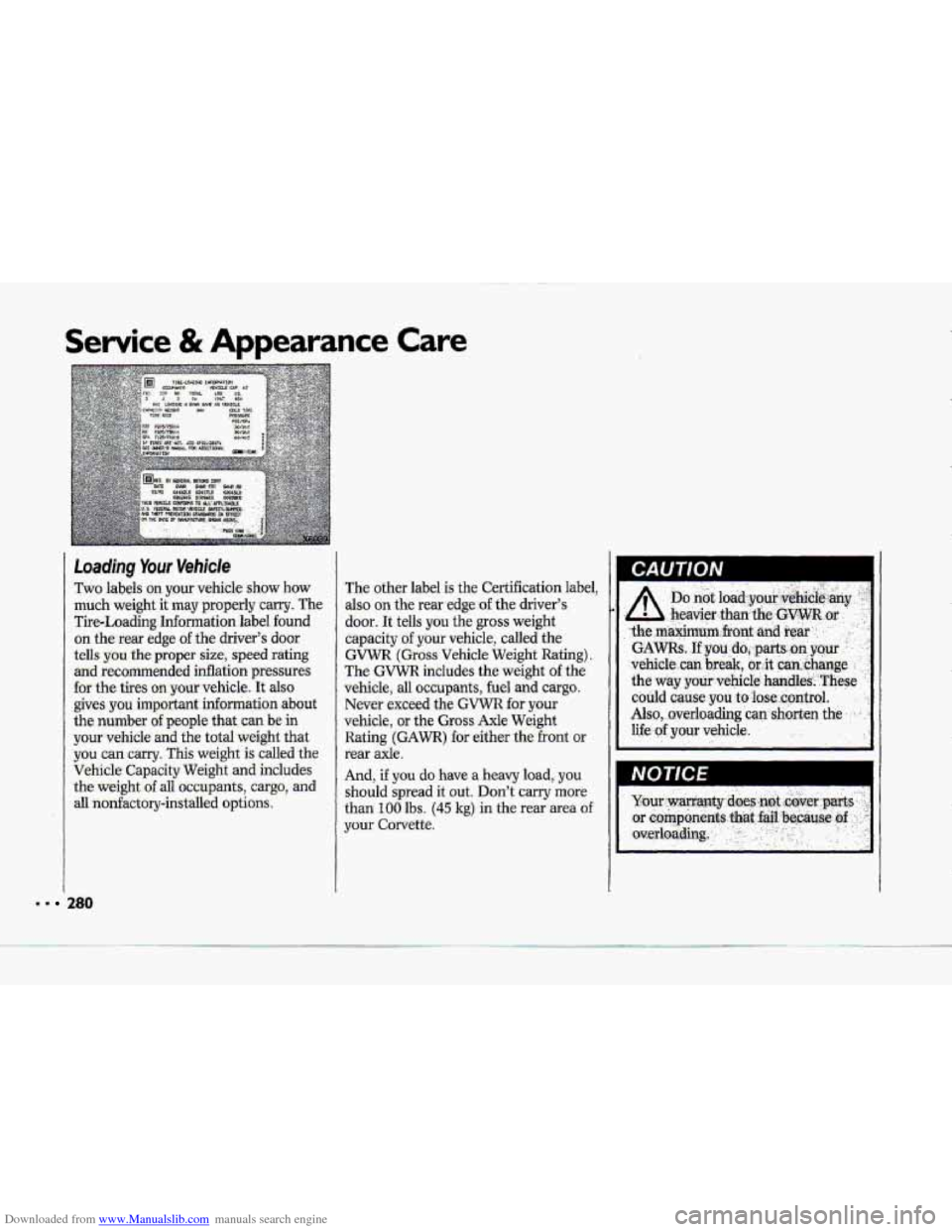
Two labels on your vehicle show how
much weight
it may properly carry. The
Tire-Loading Information label found
on
the rear edge of the driver's door
tells
you the proper size, speed rating
and recommended inflation pressures
€or the tires
on your vehicle. It also
gives you impartant information about
the number
of people that can be in
your vehicle and the total weight that
you can carry. This weight is called the
Vehicle Capacity Weight and includes
the weight of all occupants, cargo, and
all nonfactory-installed options. The other
label is the Certification label,
also on the rear
edge of the driver's
door. It
tells you the gross weight
capacity of
your vehicle, called the
GVWR (Gross Vehicle Weight Rating).
The
GVWR includes the weight of the
vehicle, all occupants, fuel and cargo.
Never exceed the GVWR
for your
vehicle, or the Gross Axle Weight
Rating
(GAWR) for either the front or
rear axle.
And, if you do have a heavy load, you
should spread it out. Don't carry more
than
100 lbs. (45 kg) in the rear area of
your Corvette.
I I
U
i
Page 283 of 370
Downloaded from www.Manualslib.com manuals search engine Senrice & Appearance Care
CAUTION
Inflation-Tire Pressure
The Tire-Loading Information label
! which is on the rear edge of the driver’s
door
shows the correct inflation
pressures for your tires, when they’re
cold. “Cold” means your vehicle has
been sitting for at least three hours or
driven no more than a mile.
If you have to check tires when they’re
not cold,
add 4 psi (28 kPa) to the
numbers on the sticker.
. 282
Page 284 of 370
Downloaded from www.Manualslib.com manuals search engine When to Check:
Check your tires once a month or more.
Don’t forget your compact spare tire. It
should be at 60 psi (420 1tPa).
How to Check:
Use the tire pressure gage provided in
your center storage console to check
tire pressure. Simply looking
at the tires
will not tell you the pressure, especially
if you have radial tires-which may look
properly inflated even if they’re
underinflated.
If your tires have valve caps, be sure to
put them back
on. They help prevent
leaks
by keeping out dirt and moisture.
Tire Rotation
The tires on your Corvette are
directional, asymmetrical, and are
different sizes
front tu rear. Due to this,
your tires should not be rotated. Each
tire
and wheel should be used only in
theqosition it
is in.
Page 287 of 370
Downloaded from www.Manualslib.com manuals search engine ...
Service & Appearance Care
Tra~ti~n-A, 6, C
33% traction grades, from highest to
.lowest are:
A, B, and C. They represent
the tire's ability to stop
on wet pavement
as measured under controlled conditions
on specified ,government test surfaces
of
asphalt and concrete. A tire marked C
may have podr.traction p-erformance.
Warning: The traction grade assigned
to.
this tire is based on braking (straight-
ahead) traction
tests and does not
include cornering (turning) traction.
186.
Temperature-A, B, C
The temperature grades are A (the
highest),
B, and'C, representing the
tire's-resistance to the generation of
heat and its ability to dissipate heat
when tested under controlled conditions
on a specified indoor laboratory test
wheel: Sustained high temperature can
cause the inaterid af the tire to
degenwate.-and
reduce tire @e, and
excessive temperature can
lead to.
sudden tire failure. The-grade
C
corresponds to. a level of performance
which
dl passenger car tires must meet
under:the Federal
Motor Vehicle Sa€ety
Standard
NO.. 109. Grades B.and A
represent higher levels of perfomnance on
the laboratory test wheel than the
minimum
required by law.
Warning: The temperatute grade for
this tire 'is established for a tire that is
properly inftated and not overloaded.
Excessive
speed, underinflation, or
excessive loading, iither separately or in
combination, cah cause heat buildup
and possible
tire failure.
Those grades are
molded on the
sidewalls of passenger car tires.
While the tires available
as standard or
optional equipment on General
Motors
vehicles may vary with. respect to these
grades, all such
tires meet Gene$d.
Motors performance
standards and
have
been appToved for use QII General
Motors vehicles. All passenger type
(P
Metric) tifes .must conform to federal
safety requirements in addition to these.
grades.
Page 309 of 370
Downloaded from www.Manualslib.com manuals search engine Service & Appearance Care
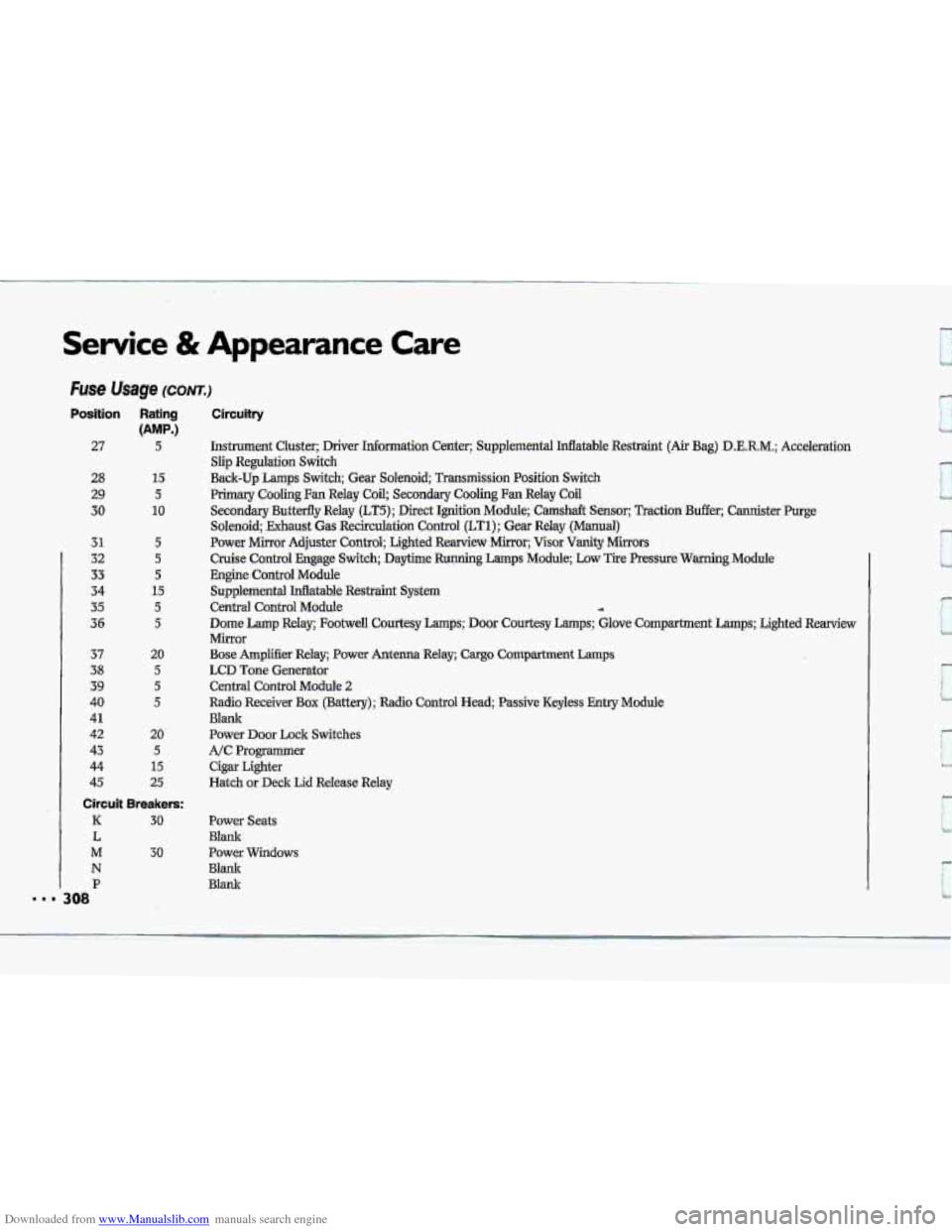
Fuse Usage (CONT.)
Position Rating
(AMP.)
27 5
28 15
29 5
30 10
31 5
32 5
33 5
34 15
35 5
36 5
37 20
38 5
39 5
40 5
41
42 20
43 5
44 15
45 25
Circuit Breakers:
K 30
L
M
N
P
3.0
1 308
Circuitry
Instrument Cluster; Driver Information Center; Supplemental Inflat\
able Restraint (Air Bag) D.E.R.M.; Acceleration
Slip Regulation
Switch
Back-up Lamps Switch Gear Solenoid; Transmission Position Switch
Primary Coaling Fan Relay Coil; Secondary Cooling Fan Relay Coil '
Secondary Butterfly Relay (LT5); Direct Ignition Module; Camshaft Sensor; Traction Buffer; Cannist\
er Purge
Solenoid; Exhaust
Gas Recirculation Control (LT1); Gear Relay (Manual)
Power
Mirror Adjuster Control; Lighted Rearview Mirror; Visor Vanity Mirrors
Cruise Control Engage Switch Daytime Running Lamps Module; Low Tire Pressure Warning Module
Engine Control Module
Supplemental Inflatable Restraint System
Central Control Module
Dome Lamp Relay; Footwell Courtesy Lamps; Do.0~ Cpurtesy Lamps; Glove Compartment Lamps; Lighted Rearview
Mirror
Bose
Amplifier Relay; Power Antenna Relay; Cargo Compartment Lamps
LCD Tone Generator
Central Control Module
2
Radio Receiver Box (Battery); Radio Control Head; Passive Keyless Entry Module
Blank
Power Door Lock Switches
A/C Programmer
Cigar Lighter
Hatch or Deck
Lid Release Relay
4
Power Seats
Blank
Power Windows
Blank
Blank
Page 323 of 370
Downloaded from www.Manualslib.com manuals search engine Maintenance Schedule
Introduction
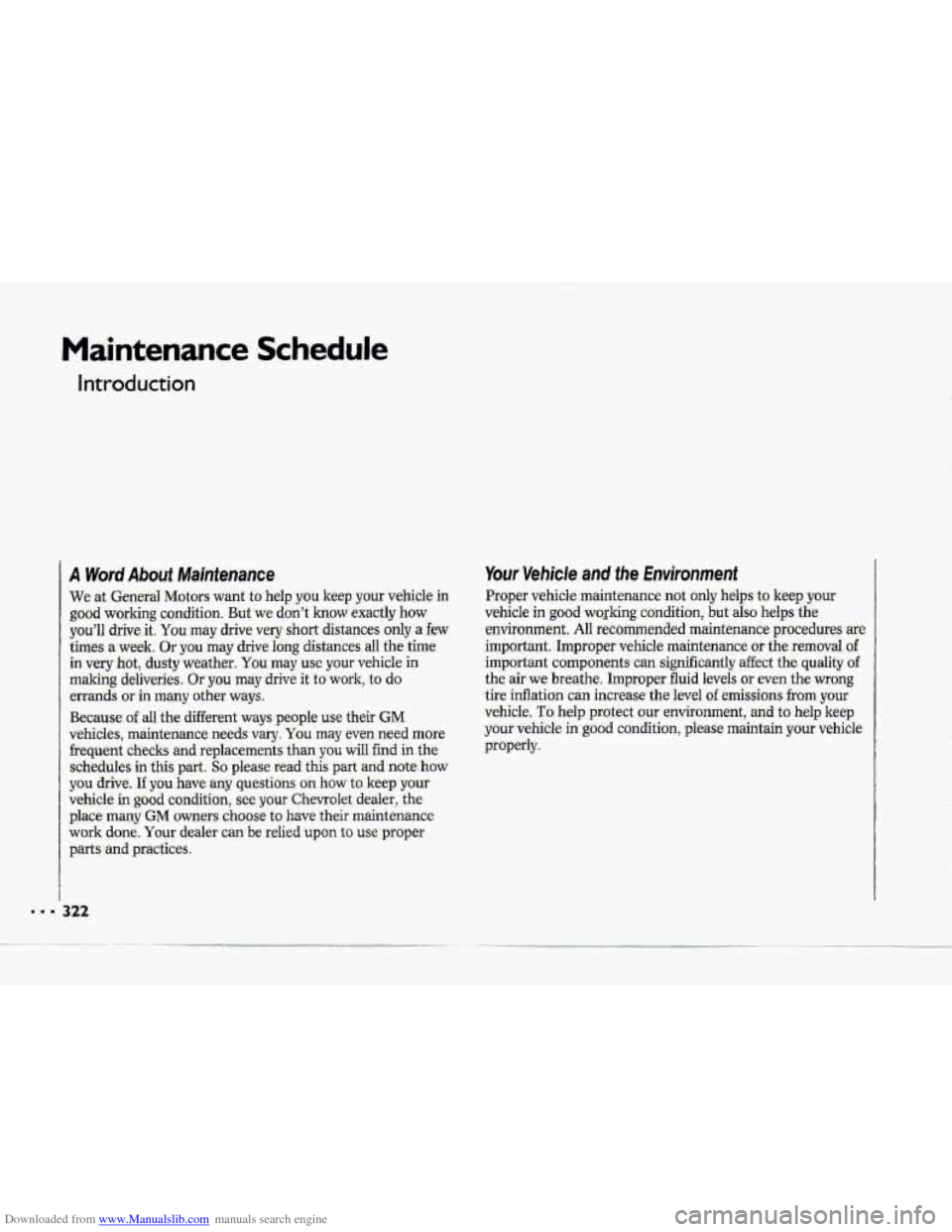
A Word About Maintenance
We at General Motors want to help you keep your vehicle in
good working condition. But we don’t know exactly how
you’ll drive it. You may drive very short distances only a few
times a week. Or you may drive long distances all the time
in very hot, dusty weather.
You may use your vehicle in
making deliveries. Or you may .drive it to work, to do
errands or in many other ways.
Because
of all the different ways people use their GM
vehicles, maintenance needs vary. You may even need more
frequent che~ks and replacements than you will find in the
schedules
in this part. So please read this part and note how
you drive. If you have any questions on how to keep your
vehicle
in good condition, see your Chevrolet dealer, the
place many GM owners choose to have their maintenance
work done. Your dealer cq be relied upon to use proper
parts and practices.
Your Vehicle and the Environment
Proper vehicle maintenance not only helps to keep your
vehicle in good woxking condition, but
also helps the
environment.
All recommended maintenance procedures are
important. Improper vehicle maintenance or the removal
of
important components can significantly affect the quality of
the air we breathe. Improper fluid levels or even the wrong
tire inflation can increase the level
of emissions from your
vehicIe.
To help protect our environment, and to help keep
your vehicle in good condition, please maintain your vehicle.
properly.
Page 334 of 370
Downloaded from www.Manualslib.com manuals search engine a
w
c
Section B: Owner Checks & Servrces
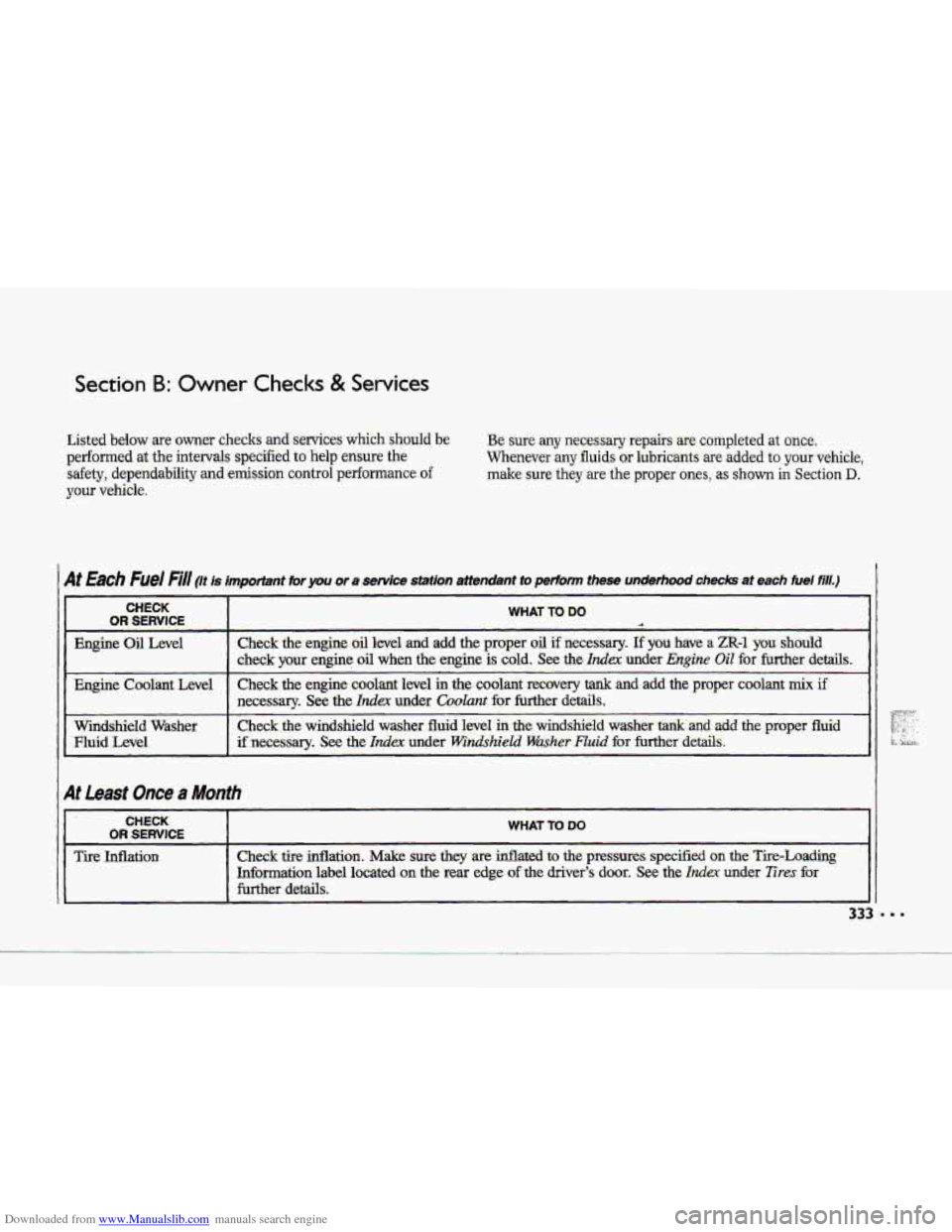
Listed below are owner checks and s&vice:s which should be
performed at the intervals specified to help ensure th-e
safety, dependability and emission control performance of
your vehicle.
Be sure any r~ecessary repairs .are completdat once,
Whenever any fluids or lubricants-are added to your vehicle,
make
sure they are the proper ones, -as shown in Section D.
CHECK
OR SERVICE _. -
Engine Oil Level
Engine
Coolant Level
Windshield WashGl
Fluid .Level
WHAT .TO. DO *
Check the engine oil level and add the proper oil if necess-ary. If you have a ZR-1 you-should
check your engine oil when the engine is cold. See the Indecx under Engine OiG for Mer details.
Check the engine. coolant level in the coolant recovery tank and add the proper coalant mix if
necessary. See the Index under Coolant for further details.
Check the windshield washer flui.d level in the windshield washer’ tank and add the proper fluid
if necessary. See the Ida under W7ndshieZd Wusher.nuid for further details.
At Least Once a Month
CHECK WHAT TO DO 0R.SERVICE
Tire Inflation Check tire inflation. Make sure they are inflated to the pressures specified on the Tire-Loading
Information label. located on the rear edge of the driver’s door. See the Index under Eres for
further details.
333 . .
Page 358 of 370
Downloaded from www.Manualslib.com manuals search engine 1-
-
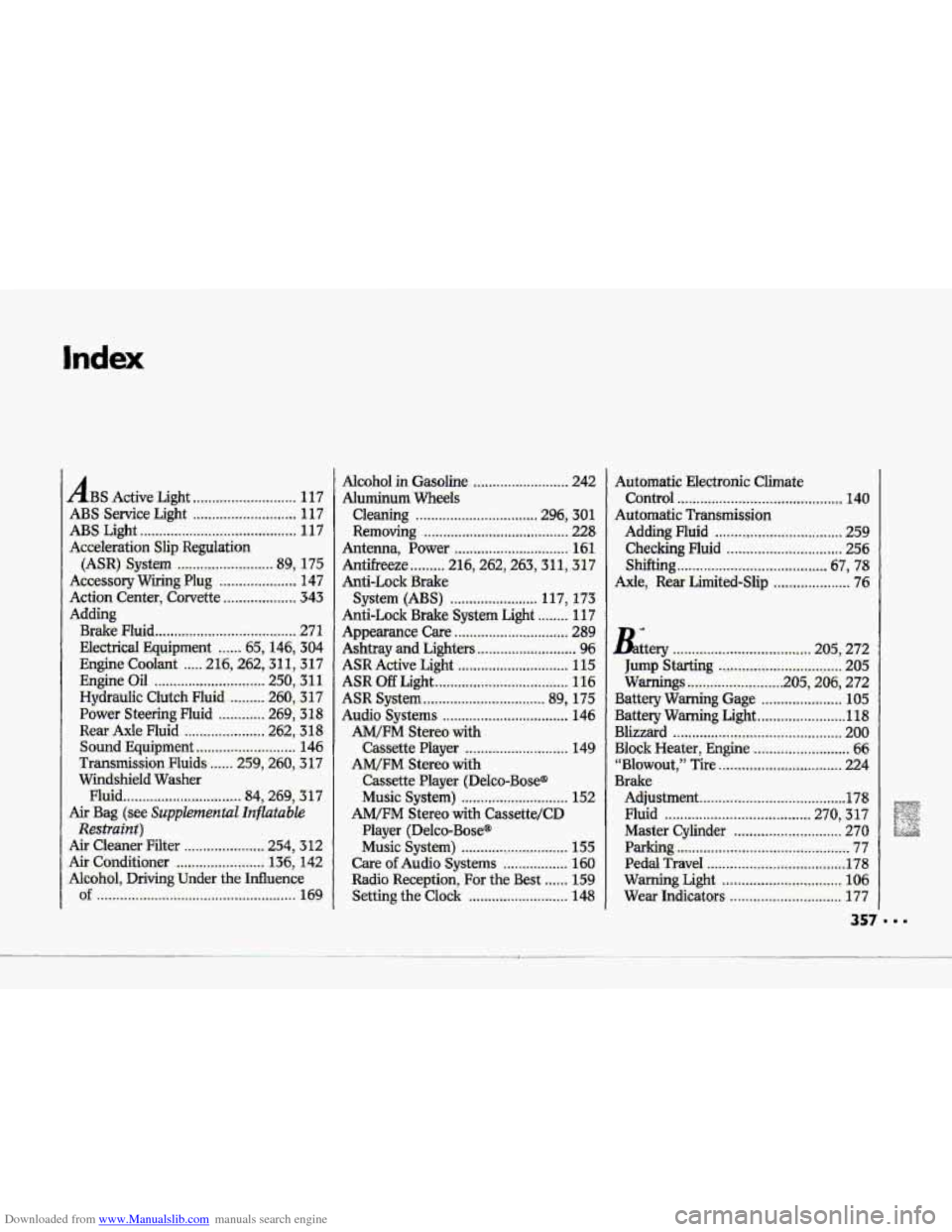
ABS Active Light ........................... 117
ABS Service Light ........................... 117
ABS Light ......................................... 117
Acceleration Slip Regu’laticin
(ASR) System .......................... 89,. 175
Accessory Wiring . Plug .................... 147
Action Center, Corvette ................... 343
Adding
Brake Fluid
.......... ........... ............ . 27 1
Electrical Equipment ...... 65, 146, 304
Engine Coolant ..... 216, 262,311,3.27
Engine Oil ............................... 250, 31 1
Hydraulic Clatch Fluid’ ......... 260, 3 17
Power Steeting Fluid ............ 269, 318
Rear Axle Fluid ..................... 262, 318
Sound Equipment ........................... 146
Transmission Fluids. ..... 25.9,260, 317
Windshield Washer
Fluid ............................... 84, 269, 3 17
Air .Bag (see Supplemental Inflatable
AirCieaner Filter ..................... 254, 312
.Air Conditioner ....................... 136., ‘142
Alcohol, .Driving Under thi Influence
of ..................................................... 169
Restraint)
Alcohol in Gasoline ......................... 242
Aluminum Wheels
Cleaning
................................ 296. 301
Antenna, Power ............................... 161
Antifreeze ......... 216, 262, 263, 311., 317
Anti-Lock Br.& e
Removing ....................................... 228
System (ABS) ....................... 117? 1-73
Anti-Lock Brake System Light ........ 117
Ashtray and Lighters .......................... 96
ASR Off Light .............................. .... 116
ASR System ................................. 89, 175
Cassette Playek ........................... 149
Music System) ............................ 152
Music System) ............................ 155
Appearance Care .............................. 289
ASR Active Light ............................. 115
Audio Systems ................................. 146
AM/FM Stereo with
.AM/F M. Stereo-with
Cassette Player
(Delco-Base@
AM/FM Stereo with CassetteKD
Player (Delco-Bose*
Care of Audio Systems ................. 160
-Radio Reception. For the Best ...... 159
Setting.the Clock ............................ I48
Automatic Electroriic Climate
Aptomatic
Transmission
Control ........................................... 140
Adding Fluid ................................. 259
Axle, Rea Liniited-Slip ....................... 76
Checking Fluid ................................. 2.56
Shifting., ....................................... 67, 78
&ry ..................................... 205, 272
Jump Starting ..........................?........ 205
Warnings .......................... 205, 206, 272
Battery Warning . Gage ..................... 105
Battery Warning Light ....................... 118
Blizzard ............ ..i.. ........................... 200
Block Heater, Engine ......................... 66
“Blowout, ” Tire .................................. 224
Brake AdjustmenL
..................................... 178
Fluid ...................................... 270, 317
Master Cylinder ............................ 270
Parking ............................................. 77
Pedal Travel .................................... 178
Warning Light .................................. 106
Wear Indicators .............................. 177
351 I..
.