1993 CHEVROLET CORVETTE seats
[x] Cancel search: seatsPage 10 of 370
Downloaded from www.Manualslib.com manuals search engine I T
‘p
‘T
‘T
T
T
How to Use this Manual
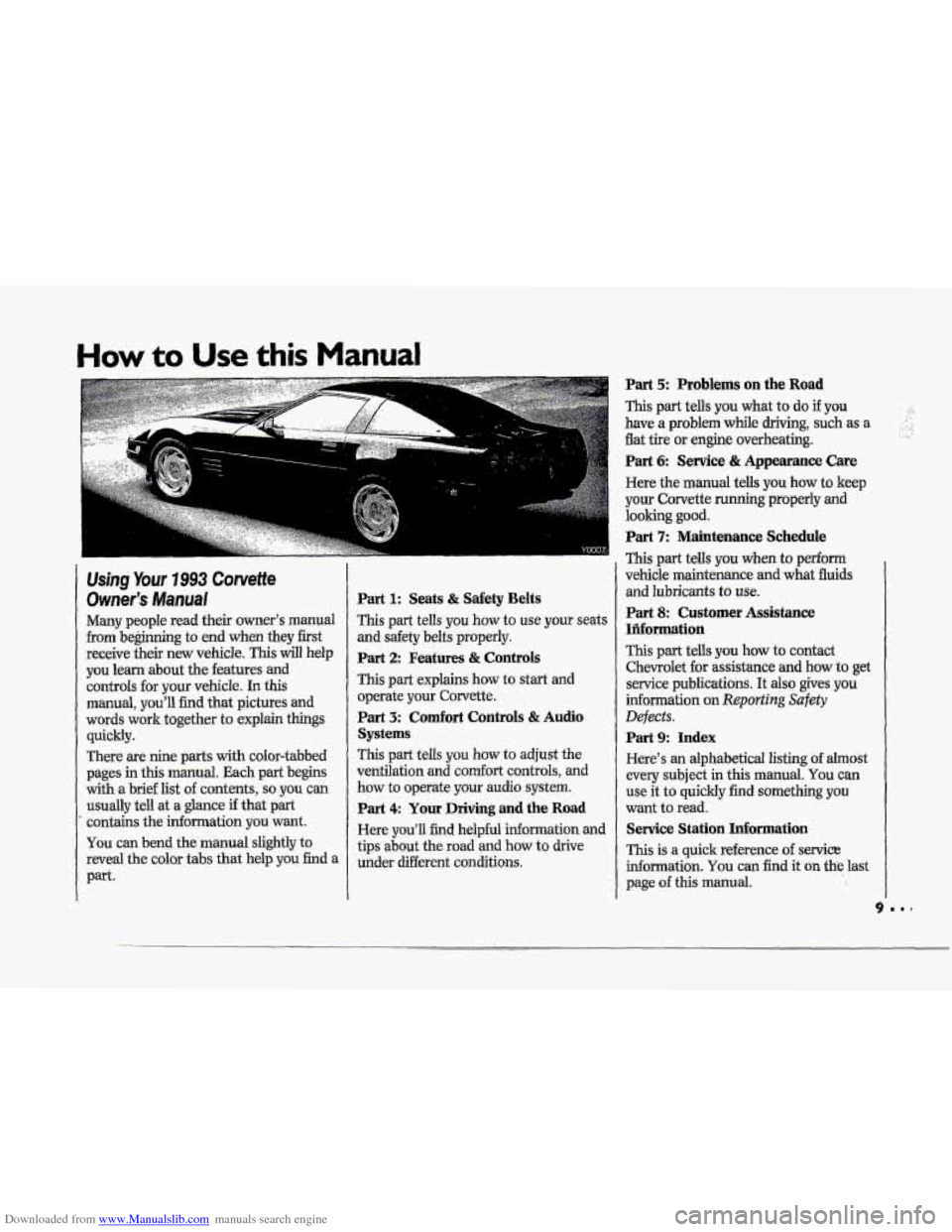
Ushg Your 7993 Corvette
Owner’s Manual
Many people read their owner’s manual
from beginning to end when they first
receive their
new vehicle. This will help
you learn about
the features and
controls for
your vehicle. In this
manual, you’ll find that pictures and
words
work together to explain things
quickly.
There
are nine parts with color-tabbed
pages
in this manual. Each part begins
with
a brief list of contents, so you can
usually tell at a- glance if that part
contains the infomation you want.
You can bend the manual slightly to
reveal the color tabs that help-
you find a
Part.
--
L.
Part 1: Seats & Safety Belts
This part tells you how to use your seats
and safety belts properly.
Part 2: fleatures & Controls
This part explains how to start and
operate your Corvette.
Part 3: Comfort Controls & Audio
Systems
This part tells you how to adjust the
ventilation and com€ort controls, and
how to
operate your audio system.
Part 4 Your Driving and the Road
Here you’ll find helpful information an(
tips about the road and how to drive
under different conditions.
d
Part 5: Problems on the Road
This part tells you what to do if you
have a problem while driving, such as a
flat tire
or engine overheating.
Part 6 Senrice & Appearance Care
Here the manual tells you how to keep
your Corvette
running properly and
looking good.
Part 7: Maintenance Schedule
This part tells you when to perform
vehicle maintenaxice
and what fluids
and hbricm‘ts to use.
Part 8: Customer Assistance
IHormation
This part tells you how to contact
Chevrolet for assistance and how to get
service publications. It also gives you
information on Reporting Safety
Defects.
Part 9: Index
Here’s an alphabetical listing of almost
every subject in this manual. You can
use it to quickly find something you
want to read.
Service Station Information
This is a quick re€erence of service
information.
You can find it on the last
page of this manual.
Page 14 of 370
Downloaded from www.Manualslib.com manuals search engine T
T
‘I-
T
I-
H ere YOU’II find informatjon about
the seats in your Corvette, your
Supplemental Inflatable Restraint
system (“air bag”) and how to use
your safety belts, properly.- You can
also learn about some things you
should not do with safety belts.
Part 1
Seats & Safety Belts
Seats and. SeRt Controls .. . ... ...... . . . , . . ... .. . . .. ... . . . .. , .. . . . . ... . . ..... .. .. ....... . . . . . . . ..-.. . ... .. . .... . .... . 14
Safety Belts ........................................................................\
........................................ 17
How to Wear Safety Belts Properly .....,..................................................................\
.. 22
Driver Posltmn .................................................. f .........................._....................,,....... 23
Supplemental E-datable Restraint System (Air Bag) ....... .... ..... . .. . , ..... . . . ...... ...... ., .... ,. 26
Safety Belt Use During Pregnancy ........................................................................\
.... 31
Passenger Position. ... . . . . . ... . . . . . . . . . . . . . . . . .. . . . . . . . . . . . . . . . . . . . . . . . . . . . . . , . . . . . . . .. . , ..........+.x.. . ... . . . . . . . . . . . ,v. 3 1
Children.. ... . . . ... . . .-. . . . . . . . . . . . . , . . . . .. . * .... . . . , . .. . . . . . . , . . . . . . . *. . . . , . . . . . . . . . . . . .. . . . . . . . . . ,. . . . . . . . . . . . . . . . . , . . . . . . . . . .32
Smaller Children and Babies ..................l........................f............................\
........f.... 32
Child Restraints ... . .... . . . . . .. , .. .. . . ... . .... . .. ... . ... . . . . .. ,... . . . .. ... .. ... .:. . . ... . ._.. . . . . . ....*. . . ..... . . .. . . ... .. 33
Larger- Children .... , . . . . . . . . . . .. . . . . , , . . . . . . -. . . , . , . . . . , . .. . . -. , , . . . . . . . . . . . . . .. . . . . . . . . . -. . . . . . . . . . . . . . . . . . . . . . . . . . . . .36
Safety Belt Extender .. ..... ...................... .. .... .. ... .. ,._.. ......._... ..... .. ... ................... .... .. .. ... 37
Replacing Safety Belts After a Crash ... . .. . . ._ ._.. . .. . .. . . ... . . ._&. .. .. ... . ... . . .. . . ... . ... . .. . .. . .. . .. .. . .. 38
..
13
Page 15 of 370
Downloaded from www.Manualslib.com manuals search engine Seots and Sed Controls
This section tells you about the seats
and how tu adjust them.
b l & Safety Belts
CAUTION
E
A
~ ~ ~~~~ ~~~
YOU can lose controi of the
vehicle ;if you try to adjust a
manual
driver's seat while the
vehicle
is moving. The sudden
movement could startle
and
confuse you, or make ,you push a
pedal when you don't want to.
Adjust the driver's seat only when
the vehicle
is not moving.
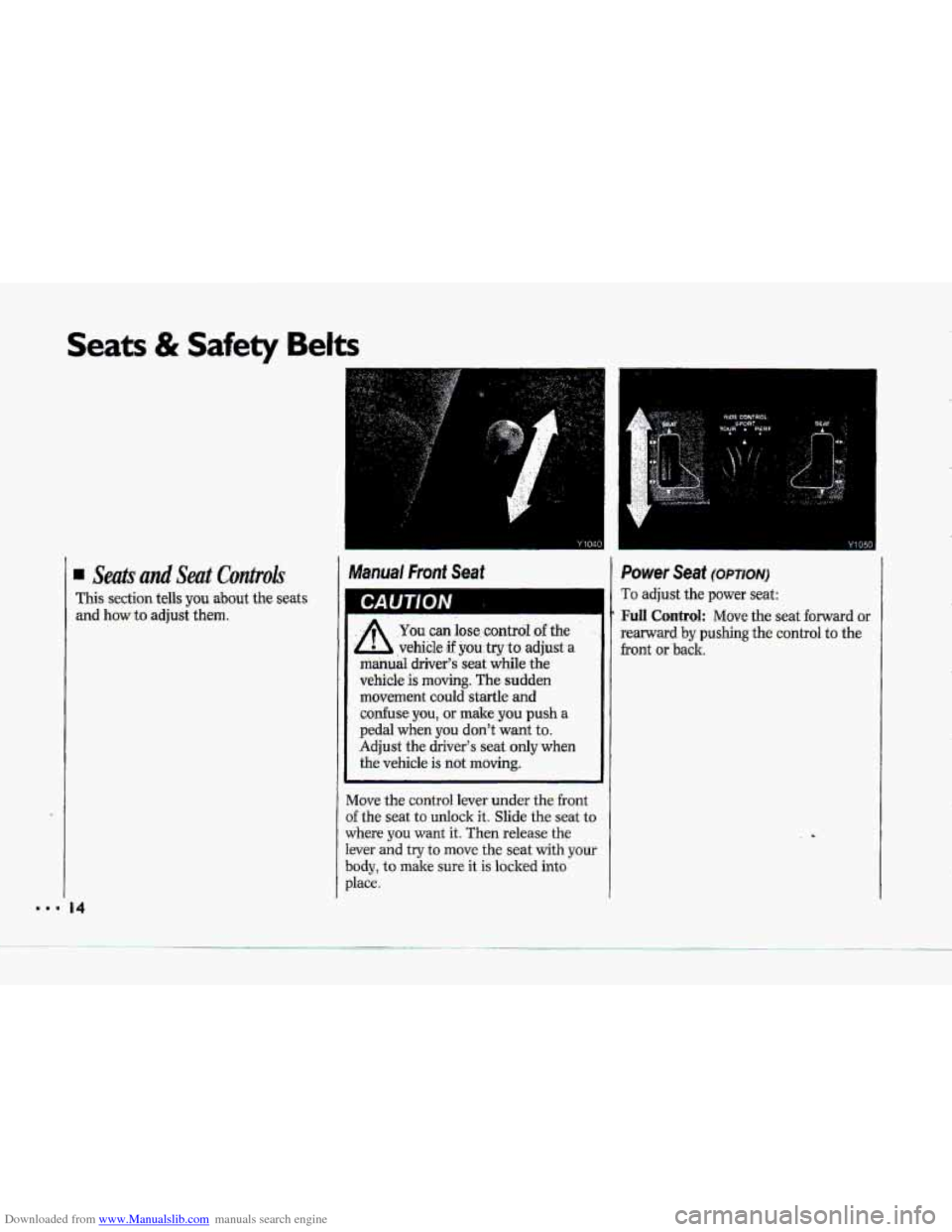
/love the control lever under the front
f the seat to udocls. it. Slide the seat to
rhere you want
it. Then release the
:ver and try to move the seat with your
ody, to make sure it is locked into
lace.
Power Seat (OPTION)
To adjust the power seat:
Full Control: Move the seat forward or
rearward by
pushing the control to the
front or back.
L
"" 14
Page 16 of 370
Downloaded from www.Manualslib.com manuals search engine '-=I-
-=. ,,,*
-T-
Y c Y1077
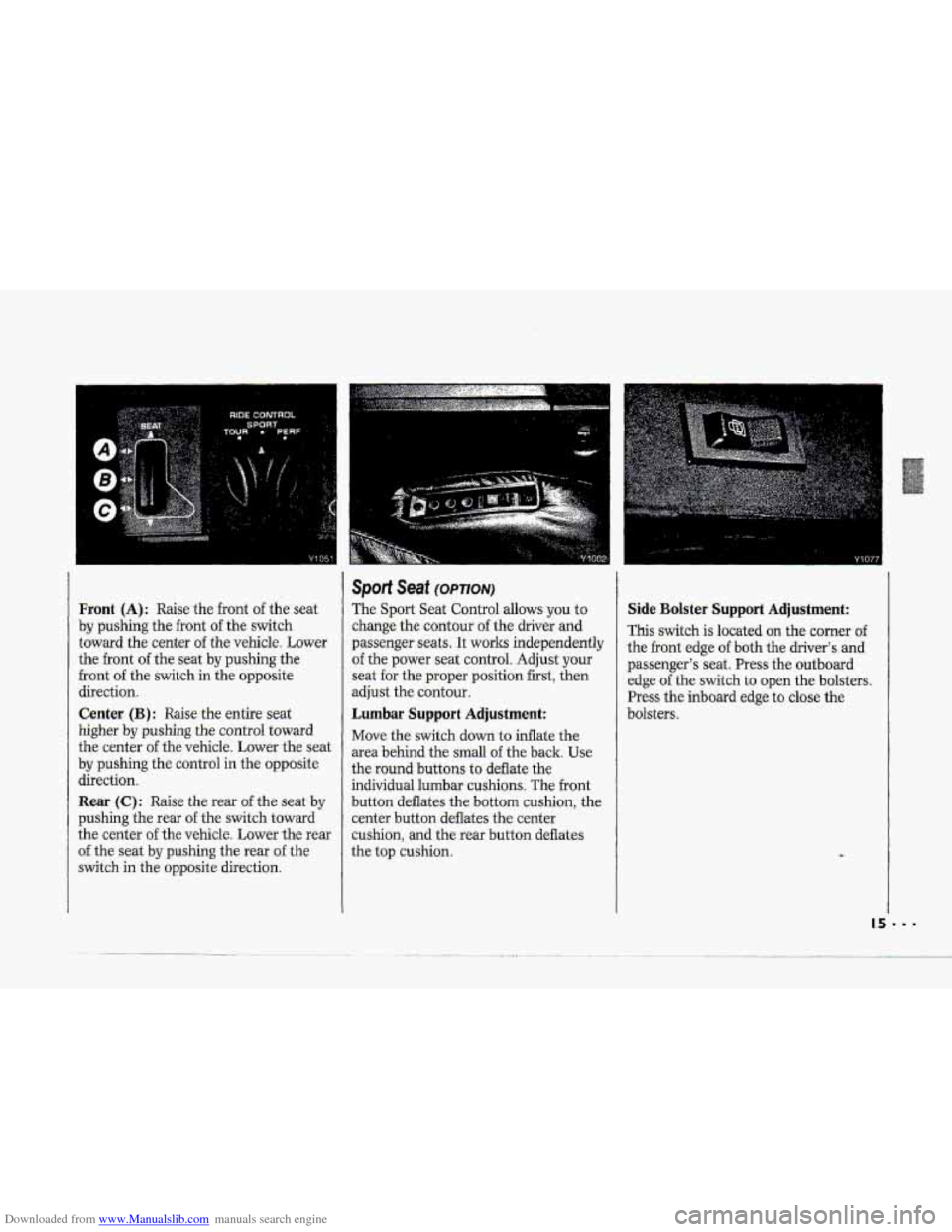
Front (A): Raise the front of the seat
by pushing the front of the switch
toward. the center
of the vehicle. Lower
the front of the sgat by pushing the
front
of the switch in the opposite
direction.
Center (B): Raise the entire seat
higher by pushing the control toward
the center
of the vehicle. Lower the ssat
by pushing the control in the opposite
direction.
Rem (C) : Raise the rear of the seat by
pushing the rear of the switch toward
the center
of- the vehicle. Lower the.rear
of the seat by pushing the rear of the
switch in the opposite direction.
Sport Seat (OPT/QNI
The Sport Seat Control allows you to
change
the contour of the driver and
passenger seats. It works independently
of the power seat control. Adjust your
seat €or the proper position first, then
adjust the contour.
Lumbar Support Adjustment:
Move the switch down to inflate the
area behind the small
of the back. Use
the-round buttons to deflate the
individual lumbar cushions, The
front
button deflates the bottom cushion, the
center button deflates the center
cushion,
and the rear button deflates
the
top cushion.
Side Bolster Support Adjustment:
Thisiswitch is-located on the corner of
-the front edge of both the driver's and
passenger's seat.
Press the outboard
edge
of the switch to open the bolsters.
Press the inboard edge to close
the
bolsters.
4
Page 18 of 370
Downloaded from www.Manualslib.com manuals search engine -r
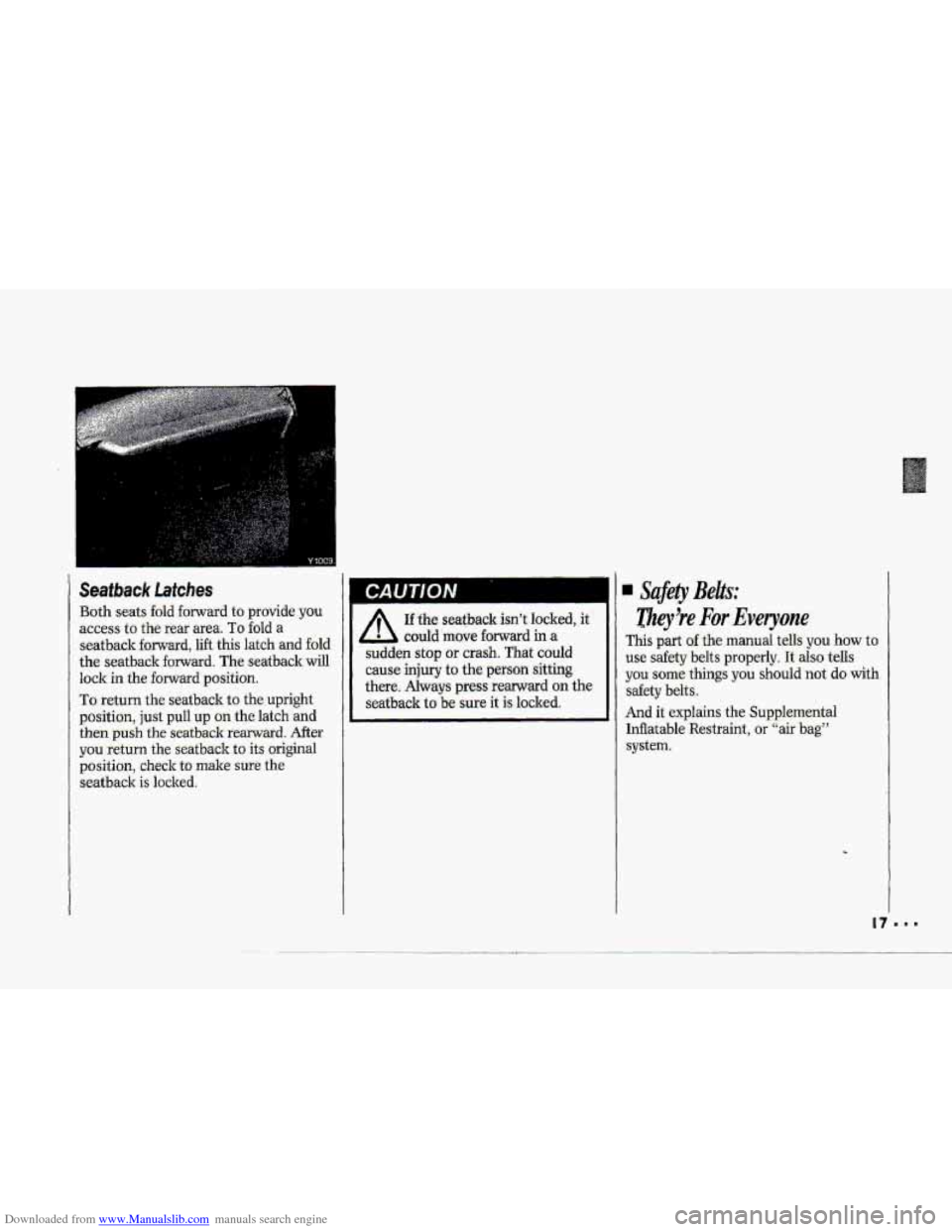
Seatback Latches
Both seats fold forward to provide you
access to the rear area. To fold a
seatback forward, lift this latch and fold
the seatback forward. The seatback will
lock in the forward position.
To return the seatback to the upright
position,
just pull up on the latch and
then push the seatback rearward. After
you return the seatback to its original
position,
check to make sure the
seatback is locked.
A
If the seatback isn't locked, it
could move forward in a
sudden stop or crash. That could
cause injury to the person sitting
there.
Always press rearward on the
seatback
to be sure it is locked.
9 Safety Belts:
ney're For Everyone
This part of the manual tells you now to
use safety belts properly. It also teils
you some things you should not do with
safety belts.
And
it explains the Supplemental
Inflatable Restraint,
or "air bag"
system.
4
Page 19 of 370

Downloaded from www.Manualslib.com manuals search engine -. -
Seats & Safety Belts
.. .
.. . , ., ..
let ahyone.--d& kh&ie’, .
. . .. , , , .. ..
. they -can’t wear a .sdcty
properly:
.If you care in a.crash and . .’
you!re not yearing a safety.belt.,
your iajuries can ,ibe..much worse.
You
can hit things,inside the
vehicle
or be ejected from it. You
can be seriously injured or killed. In
t’hesame crash, you might not be if
you are :buckled up. Always fasten
your
.safety belt, and check that
your -passenger’s.belt is fastened
properly t
oo.
18
This figure lights up when you turn the
key to Run or Start when your safety
belt isn’t buckled,
and you’ll hear a
chime,
too. It’s the reminder to buckle
up.
In many states and Canadian provinces,
the law says
to wearsafety belts. Here’s
why: They work.
You never lnow- if you’ll be in a crash.
If you do have a crash, you don’t know
if it will be a bad one.
A few crashes are very mild. In them,
you won’t get hurt even if you’re not
buckled up. And some crashes m be
so serious, 1ike.being-hit by a train, that
even buckled
up a person wouldn’t
survive.
But most crashes are in
between.
In many of them, people who
buckle-up can survive and someti-mes
walk
away. Without belts they could be
badly hurt or killed.
After 25 years of safety :belts in vehicles,
the facts are clear.
In most crashes
buckling up does matter ... a lot!
Page 21 of 370
Downloaded from www.Manualslib.com manuals search engine ...
Seats & Safety Belts
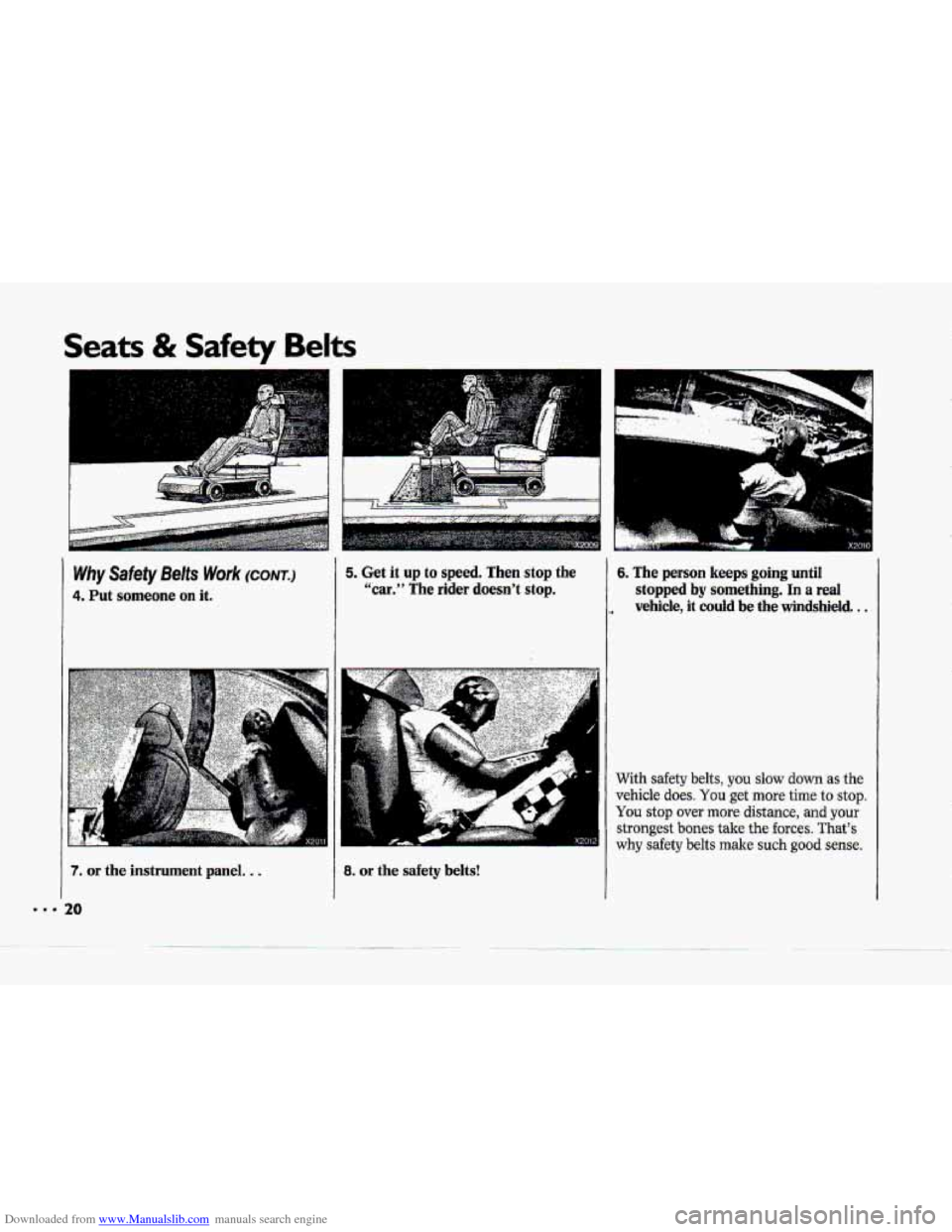
Why Safety Belts Work (CONT.)
4. Put someone on it.
A
7. or the instrument panel. ..
20
5. Get it up to speed. Then stop the
‘‘car.” The rider doesn’t stop.
8. or the safety belts!
- x2c
6. The person keeps going until
stopped
by something. In a real
. vehicle, it could be the windshield. ..
With safety belts, you slow down as the
vehicle does. You get more time to stop.
You stop over more distance, and your
strongest bones take the forces. That’s
why safety belts make such good sense.
Page 23 of 370
Downloaded from www.Manualslib.com manuals search engine Seats & . ~ty Belts
3
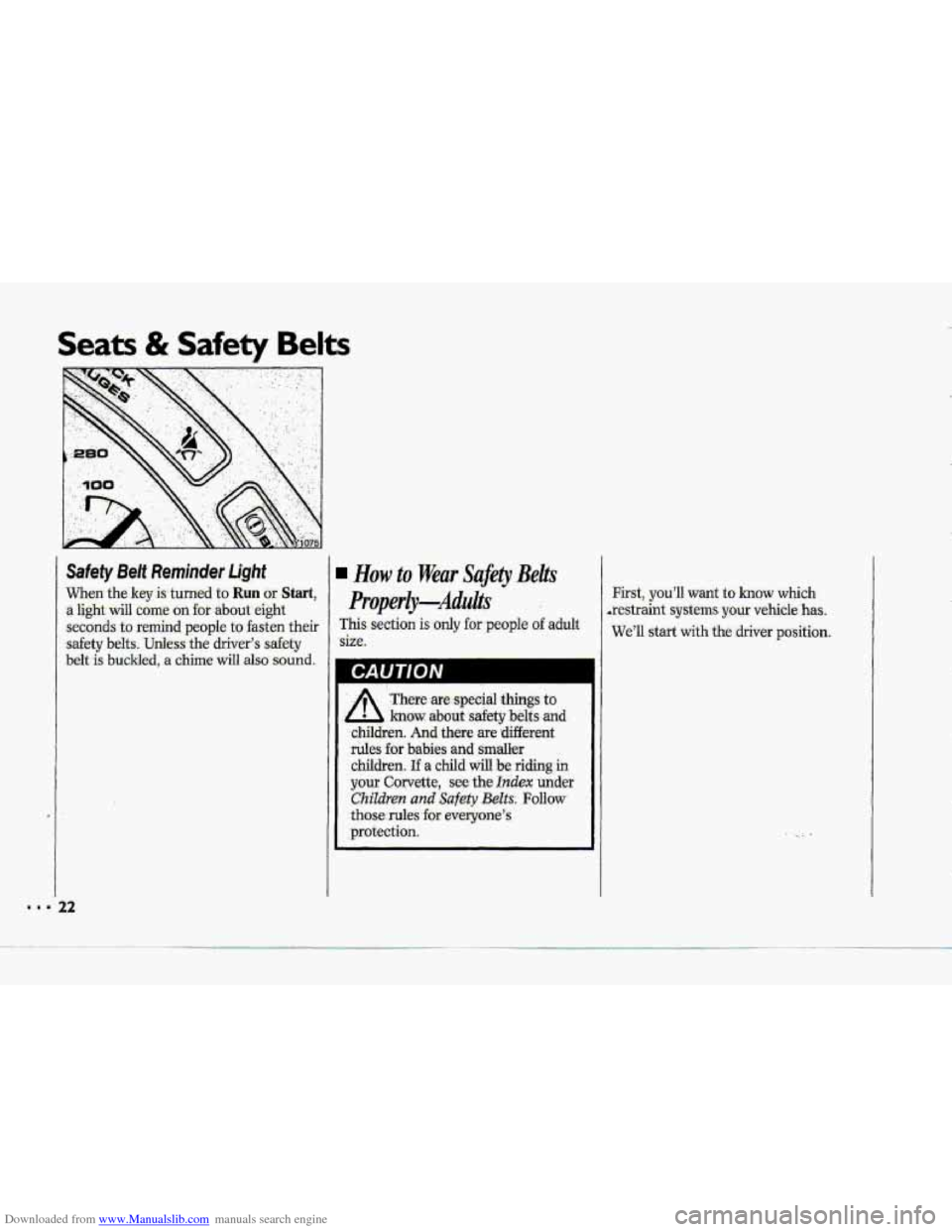
Safety Belt Reminder Light
When- the ley is- turned to Run or Start,
a light yill come on for:about eight
s.eeonds to remind people to fasten their
safety
belts, Unless-the driver’s safety
bekis buckled, a chime will also sound..
!2
How tu Wear Safety Belts
prOQperly-Adu&8
This-section is .only for pe.ople of adult
size.
.A:
‘There are :-spec-id .things- to
ch.ildren. And there are :dif€erent
rules .for bzibies and smaller
children. If a child will be riding in
your Corvette, see the ln.dex under
Children and Safety Belts. Folluw
-thosemles -€or everyone’s
.protection.
0- know about .safety belts and
First, you’ll want to know which
.restraint systems your vehicle has.
We’ll start with the driver position.