1993 CHEVROLET CORVETTE stop start
[x] Cancel search: stop startPage 142 of 370
Downloaded from www.Manualslib.com manuals search engine 4
$"
i i
I i
?- i
i
i I
r I
r"
!
The outside ternperatufe sensor reading
is filtered (to minimize false readings)
as follows:
If- the outside temperature decreases,
the -&splayed temperature
will update
immediately.
I€- the outside temperature increases
(such as when stopped in traffic), the
displayed temperature will not update
until one
of the following eonditiom
is met:
Vehicle speed is above 25 mph
Vehicle speed 'is above 45 mph
Updates will occur continuously as long
as the vehicle speed remains above
25 mph (40 Wh).
zf the ignition is turned off for more
than three hours, the current outside air
tempepature when the vehicle is restarted
will be stored in the system immediately.
The third sensor
is the in-vehicle
tempefature sensor, located
in-the
center air outlet on the passenger side.
If you block or cover either interior
sensor, the sensor
will give your system
a false reading.
(40 ,nn/h) for at least 3 minutes, or
(72 krn/h) for 1% minutes.
AUTO (Automatic): This system
autmnatically
adjusts to the
temperature range you select.
rt stays
at. this temperature
with the least
possible noise level
and it will select
the best mode (Heater,
Air
Conditioning or Bi-Level) and fm
speed to keep you comfortable. The
fan blower
will vary its speed
automatically unless you ovenide
it
with theVqrAbutton,
1 .I Set the temperature you want with
2. Press AUTO. An indicator light will
3. Press A (Vent) to allow outside. air
the
TEMP SET switch.
glow above
this.hutton.
to
flaw into the vehicle.
d
Page 160 of 370
Downloaded from www.Manualslib.com manuals search engine c
COMP (Compres,sion): Pressing this
button makes soft -and
loud passages
more
,equal in volume. An indicator
light
will come on when the button is
pres-sed. Press again to resume normal
Play.
SCAN: Press this-to sample the
beginning
of each track or passage. An
indicator light will
come on when. the
button is pressed. Press again
to stop
scanning,
REFT (Repeat): Press to return to
the beginning of a selection aftex' 10
seconds or more of play. After 10
seconds or less of play, the player will
return to the beginning of the previom
selection.
When. Finished with the Compact
Disc Player:
If you rotate the SCV/V-OL hob to
OFF or turn. off the ignition, the disc
will stay in the player :and- start again
when
you turn on the ignition or power
switch, The disc will. begin playing at
the point where it had been stopped.
STOP/PLAY: Press to stop the disc
player; the radio
will play. Press again
to play the disc (the player will start
playing the disc where it was stopped
earlier).
EJCT (Eject) : Press to eject the disc;
the
radio will play. This button will
also work when the radio or ignitidn is
o€€. The disc will be automatically
pul1e.d
back into. the CD pl-ayer if it is
not. removed from the CD opening
after 30 seconds, when the ignitioni--s
off or the SCV/VOL knob is rotated to
OFF.
Undersfandjng-Radio Reception
FM Stereo
FM stereo will give you the best sound,
but
FM-. signals will reach only about 10
to 40 miles (16 to. 65 lm) . Tall buildings
or hills can interfere with
FM signals,
causing the sound tocome-and go.
AM
The range for -most AM stations, is
greater
than for FM, especially ahight.
The longer range, however, can cause
statbns to interfere with each other.
AM can also pick up noise from things
like: storms and power lines. To lower
this noise,
try reducing the-treble level.
159 8.
Page 169 of 370
Downloaded from www.Manualslib.com manuals search engine 111
Your Driving and the Road
Defensive Driving
The best advice anyone can give about
driving
is: Drive defensively.
Please start with
a very important safety
device
in your Corvette: Buckle up.
(See the Index under Safety Belts,)
Defensive driving redy means “be
ready for
anything.” On city streets,
rural roads,
or freeways, it ‘means
“always expect the unexpected.“’
Assume that pedestrians or other
drivers
are going to be, careless and
make mistakes. Anticipate what they
might do.
Be ready for their mistakes.
Expect children to dash out
from
behind parked cars, often followed by
other children. Expect occupants in
parked cars to open doors into traffic.
Watch for movement in parked cars-
someone may be about to open a door.
I68
Expect other drivers to run stop signs
when
you are on a through street. Be
ready to brake if necessary as you gd
through intersections. You may not
have to use the brake, but if you do, you
will be ready.
If you’re driving
through a shopping
center parking lot where there are well-
marked lanes, dectional
arrows, and
designated parking areas, expect some drivers to ignore all these makings and
dash straight toward one
part of the ,lot.
Pedestrians can be careless. Watch for
them. In general, you must give way to
pedestrians even
if you lmow you have
the right of
way.
Rear-end collisions are about the most
preventable
of accidents. Yet they are
common.
Allow enough following
distance. It’s the best defensive
driving
maneuver, in both. city-and rural
driving. You never kmw.when the
vehicle in front
of you is going to brake
or turn suddenly.
Here’s a
final bit of information about
defensive driving.
The most dangerous
time
for driving in the U.S . is very early
on Sunday morning, In fact,
GM
Research studies show that the most
and the least dangerous times for
driving, every week, fall on the same
day. That day is Sunday. The most
dangerous
time is Sunday from 3 a.m.
to 4 a.m. The safest time is Sunday &om
10 a.m. to 11 a.m. Driving the same
distance on a Sunday at 3 a.m. isn’t just
a little more dangerous than it is
at 10
am. It’s about 134 times more
dangerous!
That leads to the
next section.
Page 174 of 370
Downloaded from www.Manualslib.com manuals search engine A,,
“Riding” yom brakes. can
cause them to overheat $u:,~&e
point that they.won’t work well.
You might not be able to-stop .your
vehicle in time -to avoid an accident.
If you “ride” your bides,. they w3’i
get, suhot they :direquire a bt of
pedal force to slow you down.
Avoid “riding” the’brakes.
INoTIcE .
If you keep pace with the traffic and
allow realistic following distances, you
will eliminate a lot of unnecessary
braking. That means better braking and
longer brake
life.
If your engine ever stops while you’re
driving, brake normally but don’t
pump your brakes. If you do, the
pedal may get harder to push down. If
your engine stops, you wilI still have
some power brake assist. But you will
use it when you brake. Once the
power assist is used up, it may take
Homgez ta stop and the brake pedal will
be harder to push.
Anti-L~ck Brakes (ABS)
Your Corvette has an advanced
electronic braking system that will help
prevent skidding.
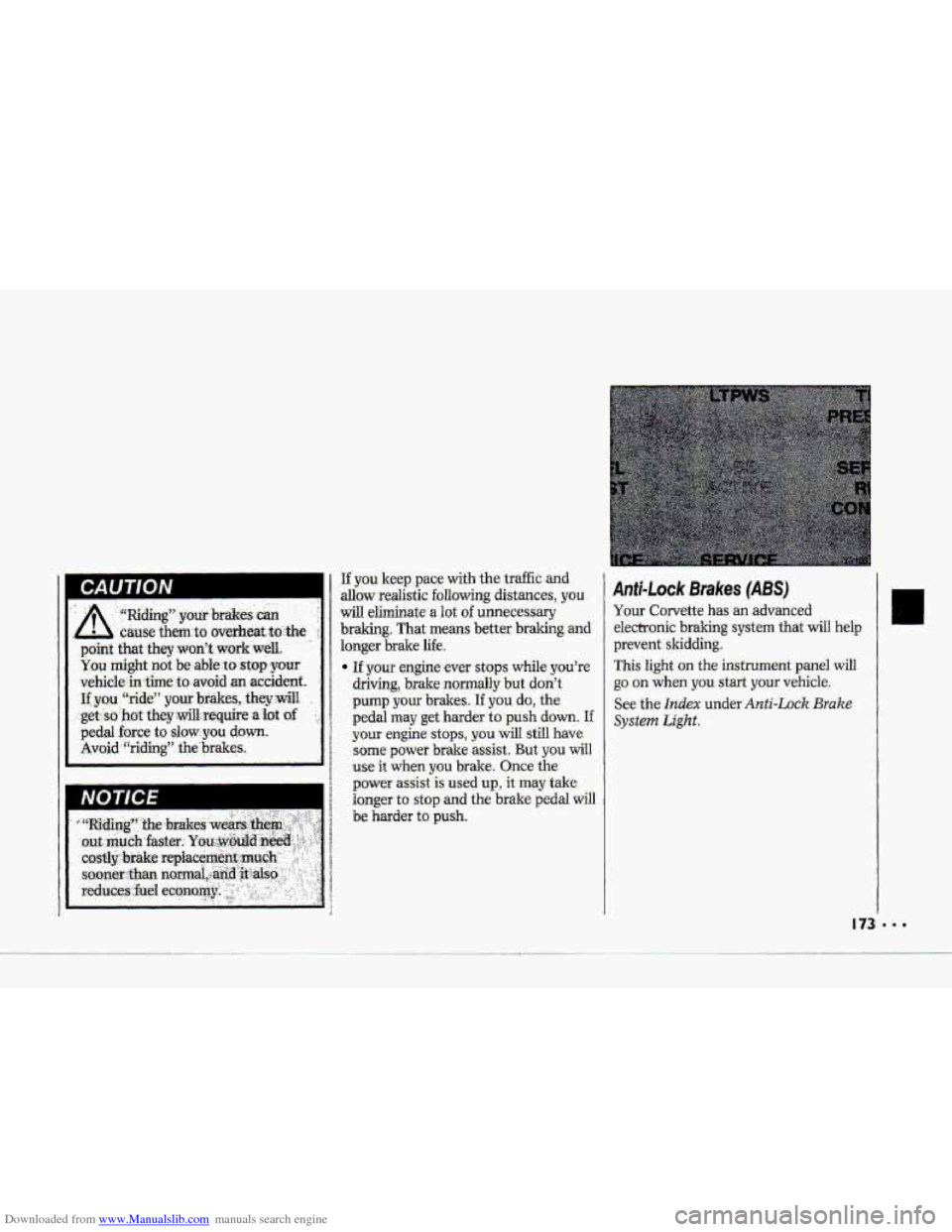
This light on the instrument panel will
go on when you start your vehicle.
See the Index under Anti-Lock Brake
System Light.
Page 176 of 370
Downloaded from www.Manualslib.com manuals search engine P TO Use Anti-L.ock:
Don't pump the brakes. Just hold the
brake pedal downand let anti-lock
work for you. You may feel the brake
pedal
vibrate, or you -may notice some
noise,
but thi.s is normal.
When the ABS is active, the ABS
ACTIVE light- conies on to-indicate luw
traction conditions.
Adjust your -driving
accordingly.
When
you start your vehicle and begin
to drive away, you may hear a
momentary motsr Qr .clicking, noise-and
you. my even notice that, yow bmke
pedd -moves a little while this is going
on.
This is the ABS test-ing itself. You-
may also hear and feel this durihg a
hard stop.
Corvette ASR (Acceleration SIip
R.egulati0.n) System
Yo& vehicle has an ASR system that
limits wheel
spin. This is especially
useful in slippery road conditions. The
ASR system works at all speeds. It
limits
wheel spin by reducing englne
torque
by cLusing the throttle and
managing
sp'ark and .applyiag the rear
brakes. You may €&el the system
working., .or
you may notice some noise,
but this is normal.
Page 183 of 370
Downloaded from www.Manualslib.com manuals search engine row urlvrng ana tne noaa
‘I
PaSShg (COW.)
Watch for traffic signs, pavement
markings,
-and lines. If you can see a
sign
up ahead that might indicate a
turn
or an intersection, delay your
pass. A broken center line usually
indicates -it’s all right
to pass,
(providing the road ahead
is clear).
Never cross a solid line on.your side
of the lane or a double solid line, even
if the road seems empty of
approaching traffic.
* If you suspect that the- driver of the
vehicle
you want to. pass isn’t .aware
of-your presence, tap the horn a
couple of times before. passing.
Do not.get too close- to the vehicle
you want
to pass while you’re
awaiting an opportunity. For one
thing, following tQo closely reduces
your area
of vision, especi-ally if you’re
following
a larger vehicle. Also, you
won’t have adequate space if the
vehicle
,ahead suddenly slows dr
stops. Keep back a- reasonable
distance.
I 82
When it 1cr.oks like a chance to:pass is
.doming up, start to-accelerate but stay
in the- right lane and don’t -get- too
close. Time your move so, you will be
increasing speed as’the time comes to
move into the other
lane.3 the. way is
clear to pass, you will have a “running
start’” that
more than makes up fix
the distance you would lose by
dropping back. And
if something
happens to Cause you to cancel your
pass, you need only slow down and
drop back again and wait for another
opportunity.
If other vehicles .are lined up to pass a
slow vehicle, wait your turn. But: take
care that someone- isn’t trying to pass
you as you pull out to pass the slow
vehicle. Remember to glance, over
your shoulder andxheck the blind
spot.
Check your mirr-ors, glance over your
shoulder, aad start your left lane
change-,signal before
,moving aut of
the right lane to pass. When you are
far enough ahead of the. passed
vehicle to see-its front in your inside
mirror, activate.your right lane ,change
signal
and move back into the right
lane; (Remember that-your right
0-utside mirror is-convex. The vehicle
you just passed ‘may seem to be
farther away+from you than it redly
is.)
Try n0t.t.o pass more than one vehicle
at a time on two-lane roads.
Reconsider before passing the next
vehicle.
.vehicle too rapidly. Even though the
brake lights. are not flashing, it may be
slowing dawn or starting to turn.
If you’re- being passed, make it easy
for the following. driver to get ahead
of
you. Perhaps you can ease. a little to
the right;
Don’t overtake a slowly .m,oving
Page 187 of 370
Downloaded from www.Manualslib.com manuals search engine Your Driving and the Road
Remember that your hedlights light up
€arless of a roadway when you are .in a
turn or cuwe.
Keep your eyes: moving; that way, it's
easier to pick aut d.imly lighted objects.
Just as sour headlights should be
checked regulaily-far proper aim, so;
should your .eyes be mmined regularly.
Some drivers suffer from night
blindness-the inabiIity to
see in dim
light-and
wen? even aware .of it,
b '
c..
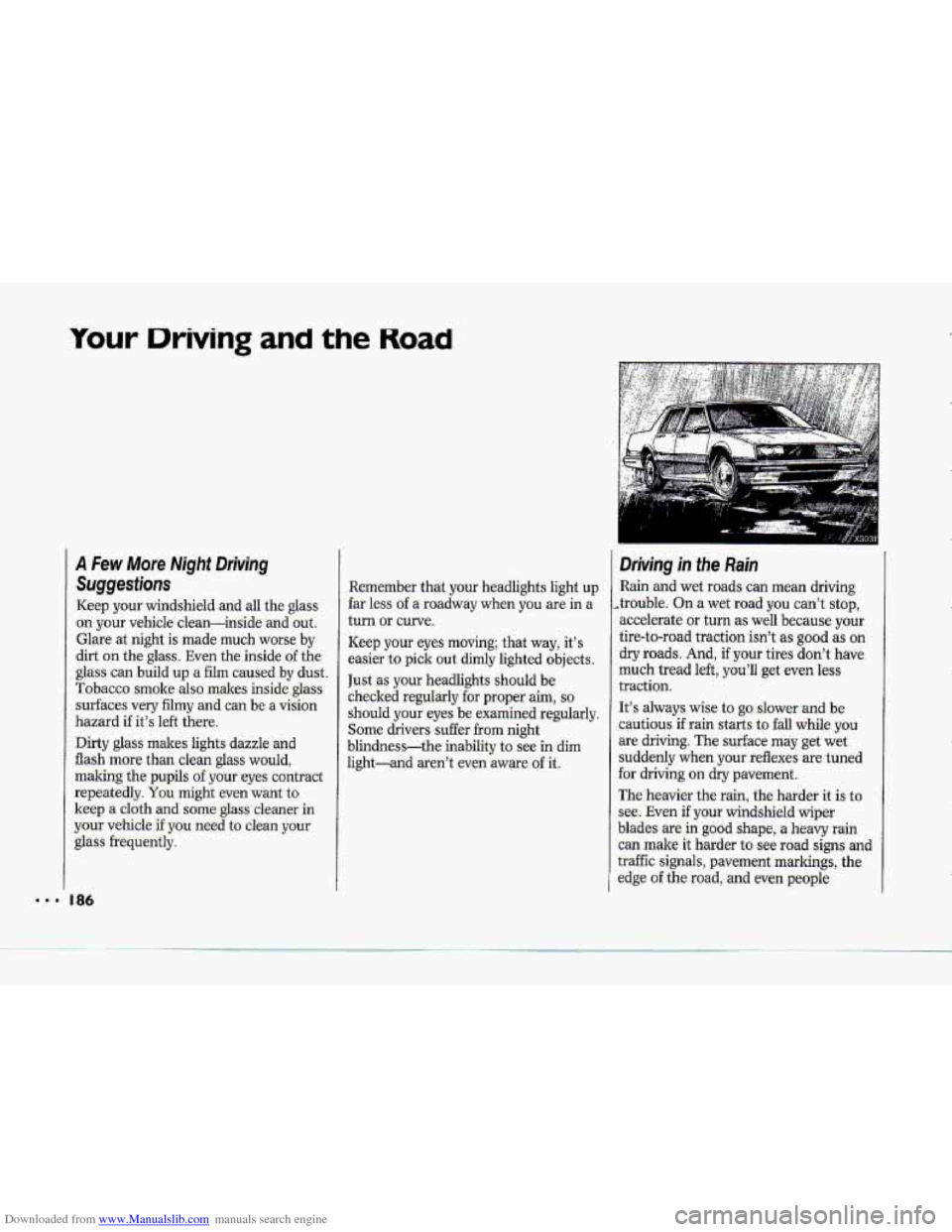
Driving in the.Rain
-Rainiand wet roads can mestll dtiving
,.trouble. On a wet road you can'-t stop.,
accelerate
or turn as well because your
tire-to-roacl traction.
isn't as good as on
dry roads. And, if your tires don't have
traction.
It% always wise t;p g~ slower and be
cautious'if rai.n starts to fall While ybir
are driving. The surface may get wet
suddenly when. your:reflexes are. tuned
far driving CI~ dry pavement.
Thei;he.avier. the rain,
the hatdef it is to-
see. Eveh if your windshield wiper
blades are in good shape, a heavy rain
can male it harder to see road signs and
traffic signals, pavement markings, the
edge of the road, and even pegple
much tread left, youl~ get even less
Page 191 of 370
Downloaded from www.Manualslib.com manuals search engine Your Driving and the Road
Tips on Driving in Fog (CONT.)
something between you and moving
vehicles-space, trees, telephone poles,
a private driveway, anything that
removes you
from other trafic.
If visibility is near zero and you must
stop but are unsure whether you are
away
from the road, turn your lights on,
start your hazard warning flashers, and
sound your horn at intervals or when
you hear approaching traffic.
Pass other vehicles in fog only if you
can see far enough ahead to pass safely.
Even then, be prepared to delay your
pass if you suspect the fog is worse up
ahead. If other vehicles try to pass you,
make it easy for them.
City Driving
One of the biggest problems with city.
streets
is the amount o€ traffic on them.
You’ll want to watch
out for what the
other drivers are doing
and pay
attention
to traffic signals.
Here are ways to increase your safety in
city driving:
* Know the best way to get to where
you-are going.
Try not to drive around
trying to pick out a familiar street or
landmark. Get a city map
and plan
your trip into an unknown part of the
city
just .as you would for a cross-
country trip.
9 Try to use the freeways that rim and
crisscross
most large cities. You’ll
save time
and energy. (See the next
section,
Freeway Driving.)
Treat a green light as a warning
.signal, A traffic light is there because
the corner
is busy .enough to need it.
When a light turns green, and just
before you start to move, check both
ways for vehicles. that have not
cleared
the intersection or may be
running the red light.
Obey all posted speed limits. But
remenher that they are
for ideal road,
weather
and visibility conditions. You
may need to drive bglow the .posted
limit
.in b.ad weather or when visibility
is especially poor,
clear
of intersections when you see or
hear emergency vehicles.
9 Pull to the right (with care) and stop
c