Page 76 of 308
Downloaded from www.Manualslib.com manuals search engine Features & Controls
Turn Signal and Lane Change
Indicator
(CONI)
To signal a lane change, just raise or
lower the lever
until the green arrow
starts to flash. Hold it there until you
complete your lane change. The lever
will return by itself when you release it.
As you signal a turn or a lane change, if
the arrows don’t flash but just stay on, a
signal bulb may be burned out and other
drivers won’t see your turn signal.
If a bulb is burned out, replace it to help
avoid an accident.
If the green arrows
don’t go
on at all when you signal a
turn, check the fuse (see
the Index under
Fuses & Circuit Breakers) and for
burned-out bulbs.
74
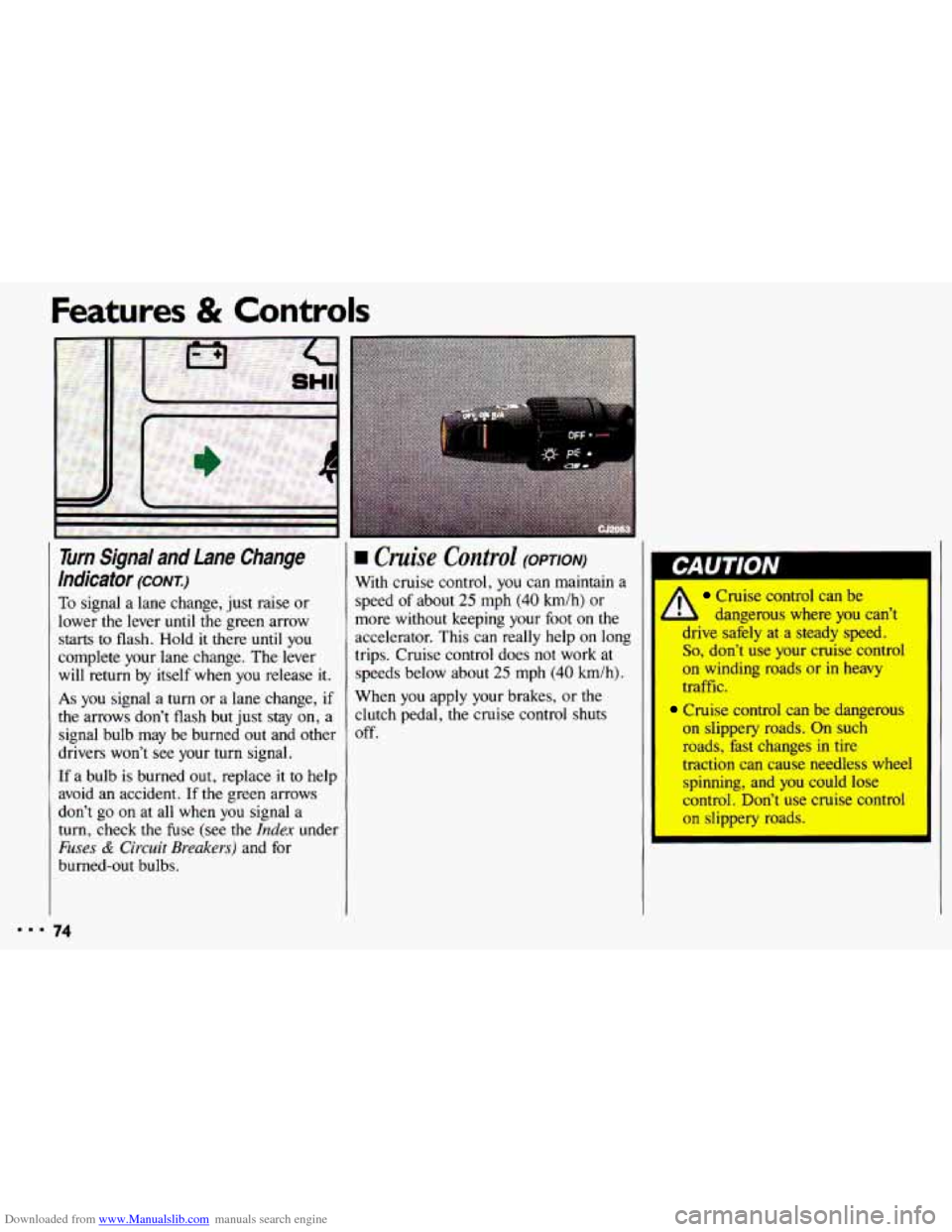
rn Cruise Control (OPTION)
With cruise control, you can maintain a
speed of about
25 mph (40 h/h) or
more without keeping your foot on the
accelerator. This can really help on long
trips. Cruise control does not work at
speeds below about
25 mph (40 km/h).
When you apply your brakes, or the
clutch pedal, the cruise control shuts
off.
Cruise control can be
l dangerous where you can’t
drive safely at a steady speed.
So, don’t use your cruise control
on winding roads or-in heavy
traffic.
Cruise control can be dangerous
on slippery roads. On such
roads, hst changes in
tire
traction can cause needless wheel
spinning, and you could
lose
control. Don’t use cruise control
on slippery roads.
Page 77 of 308
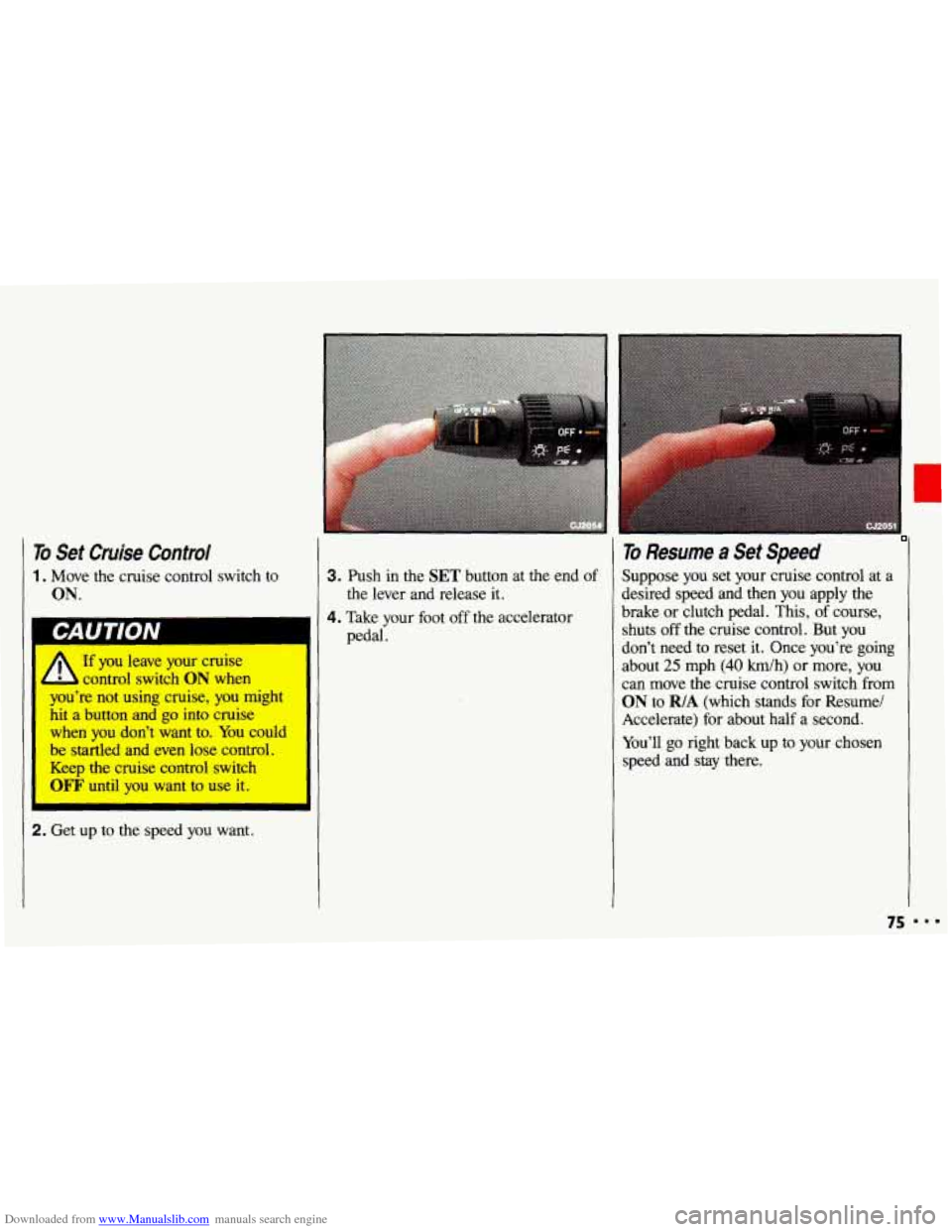
Downloaded from www.Manualslib.com manuals search engine To Set Cruise Control
1. Move the cruise control switch to
ON.
If you leave your cruise
control switch
ON when I
I you're not using cruise, you might
hit
a button and go into cruise I
I when you don't .want to. You could
be startled and even lose control.
I Keep the cruise control switch
WF' until you want to use it. I
2. Get up to the speed you want.
3. Push in the SET button at the end of
4. Take your foot off the accelerator the lever and release
it.
pedal.
To Resume a Set Speed
Suppose you set your cruise control at a
desired speed and then you apply the
brake or clutch pedal. This, of course,
shuts off the cruise control. But you
don't need to reset it. Once you're going
about
25 mph (40 h/h) or more, you
can move the cruise control switch from
ON to R/A (which stands for Resume/
Accelerate) for about half a second.
You'll
go right back up to your chosen
speed and stay there.
75 I..
Page 78 of 308
Downloaded from www.Manualslib.com manuals search engine Features & Controls
‘0 Resume a Set Speed (CONT.)
I
A
If you hold the switch at RIA
longer than half a second, the
vehicle will keep going faster until
you release the switch or apply the
brake or clutch pedal. You could
be startled and even lose control.
So unless you want to go faster,
don’t hold the switch at
RIA.
To Increase Speed While Using
Cruise Control
There are two ways to go to a higher
speed. Here’s
the first:
1. Use the accelerator pedal to get to the
2. Push the button at the end of the
higher
speed.
lever, then release
the button and the
accelerator pedal. You’ll now cruise
at the higher speed. Here’s
the second way to go to a higher
speed:
Move the cruise switch from ON to
R/A. Hold it there until you get up to
the speed
you want, and then release
the switch.
To increase your speed in very small
amounts, move
the switch to RIA for
less than half a second and then release
it. Each time you do this, your
vehicle will go about
1 mph
(1.6 km/h) faster.
Page 79 of 308
Downloaded from www.Manualslib.com manuals search engine To Reduce Speed While Using
Cruise Control
There are two ways to reduce your
speed while using cruise control:
Push in the button at the end of the
lever until you reach the lower speed
you want, then release it.
To slow down in very small amounts,
push the button for less than half a
second. Each time
you do this, you’ll
go
1 mph (1.6 km/h) slower.
Passing Another Vehicle While
Using Cruise Control
Use the accelerator pedal to increase
your speed. When
you take your foot off
the pedal, your vehicle will slow down
to the cruise control speed you set
earlier.
Using Cruise Control on Hills
How well your cruise control will work
on hills depends upon your speed, load,
and the steepness of the hills. When
going
up steep hills, you may have to
step on
the accelerator pedal to maintain
your speed. When going downhill, you
may have to brake or shift to a lower
gear to keep your speed down. Of
course, applying the brake
or clutch
pedal takes you out
of cruise control.
Many drivers find this to be too much
trouble and don’t use cruise control on
steep hills.
77
Page 80 of 308
Downloaded from www.Manualslib.com manuals search engine Features & Controls
To Get Out of Cruise Control
There are several ways to turn off the
cruise control:
Step lightly on the brake pedal, or
push the clutch pedal,
if you have a
manual transaxle; OR
Move the cruise switch to OFF.
To Erase Cruise Speed Memory
When you turn off the cruise control or
the ignition, your cruise control set
speed memory
is erased.
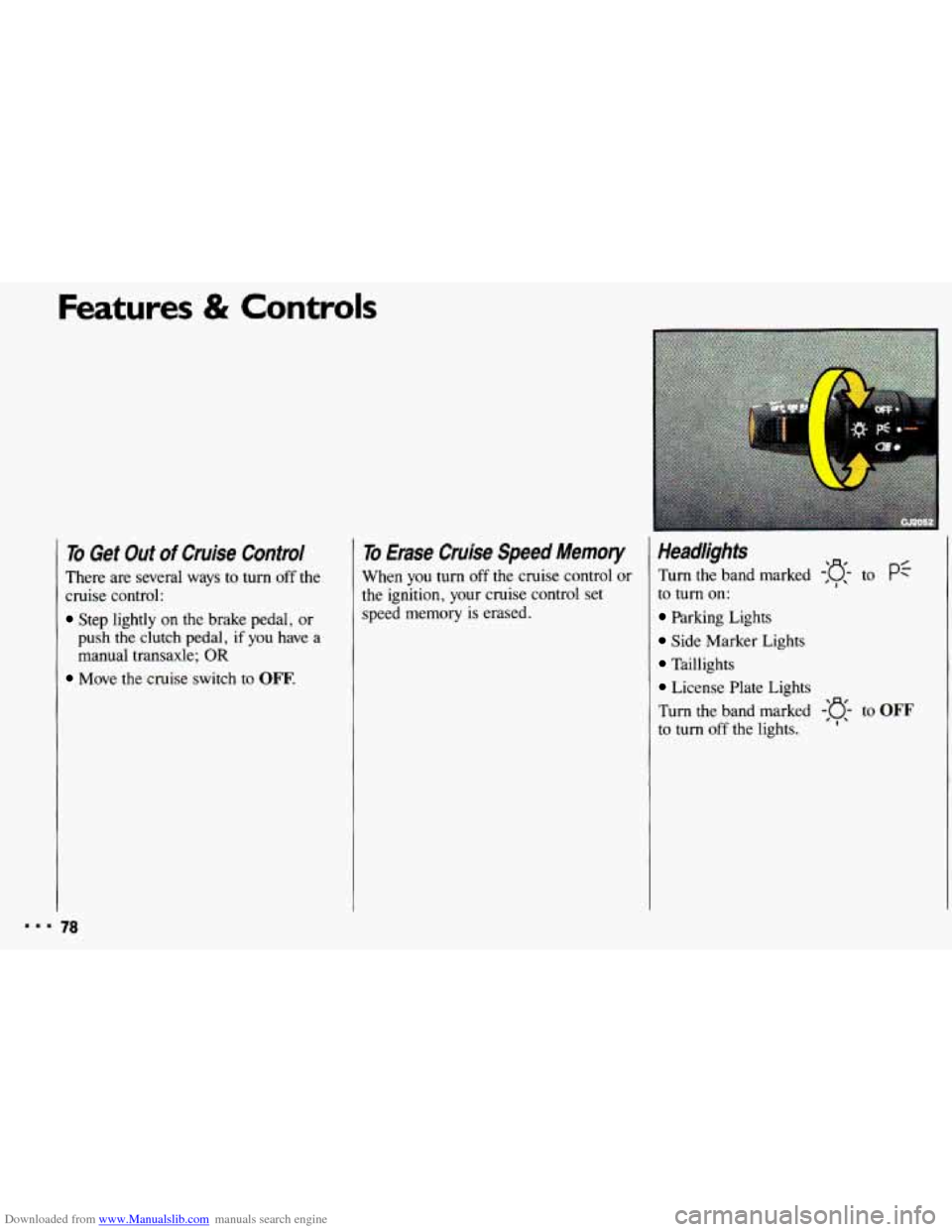
Headlights
Turn the band marked -:g- to pf
to turn on:
Parking Lights
Side Marker Lights
Taillights
License Plate Lights
Turn the band marked
-'o- to OFF
to turn off the lights. 'I'
Page 82 of 308
Downloaded from www.Manualslib.com manuals search engine Features & Controls
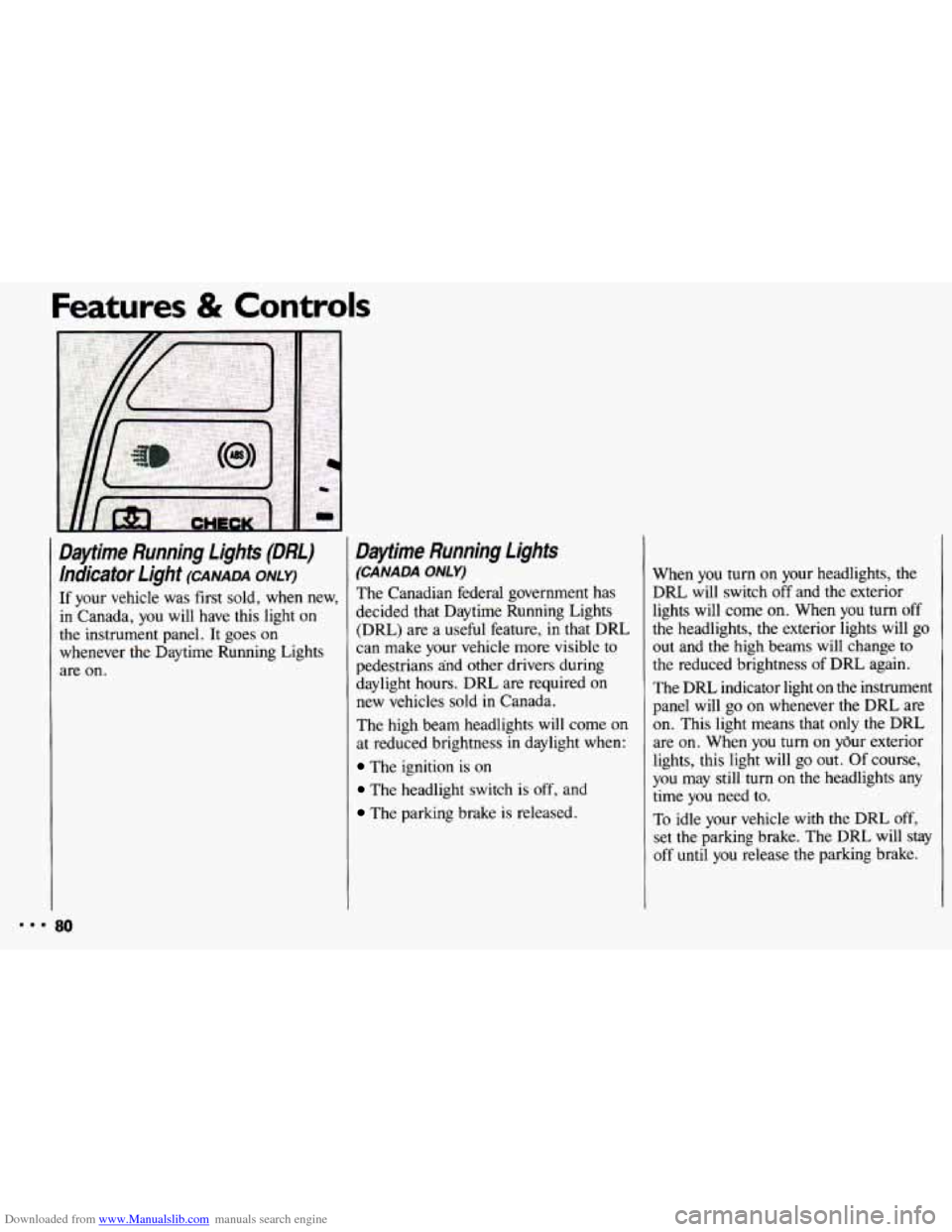
Daytime Running Lights (DRL) hdicator Light
(CANADA ONLY)
If your vehicle was first sold, when new,
in Canada, you will have this light on
the instrument panel. It goes on
whenever the Daytime Running Lights
are on.
Daflime Running Lights
(CANADA ONLY)
The Canadian federal government has
decided that Daytime Running Lights (DRL) are a useful feature,
in that DRL
can make your vehicle more visible to
pedestrians and other drivers during
daylight hours. DRL are required on
new vehicles sold
in Canada.
The high beam headlights
will come on
at reduced brightness
in daylight when:
The ignition is on
The headlight switch is off, and
The parking brake is released. When you
turn on your headlights,
the
DRL will switch off and the exterior
lights will come on. When you turn off
the headlights, the exterior lights will go out and the high beams will change to
the reduced brightness of DRL again.
The DRL indicator light on the instrument
panel will go
on whenever the DRL are
on. This light means that only the DRL
are on. When you turn
on your exterior
lights, this light will
go out. Of course,
you may still
turn on the headlights any
time
you need to.
To idle your vehicle with the DRL
off,
set the parking brake. The DRL will stay
off
until you release the parking brake.
80
Page 95 of 308
Downloaded from www.Manualslib.com manuals search engine The lnstrument Panel-
Your information System
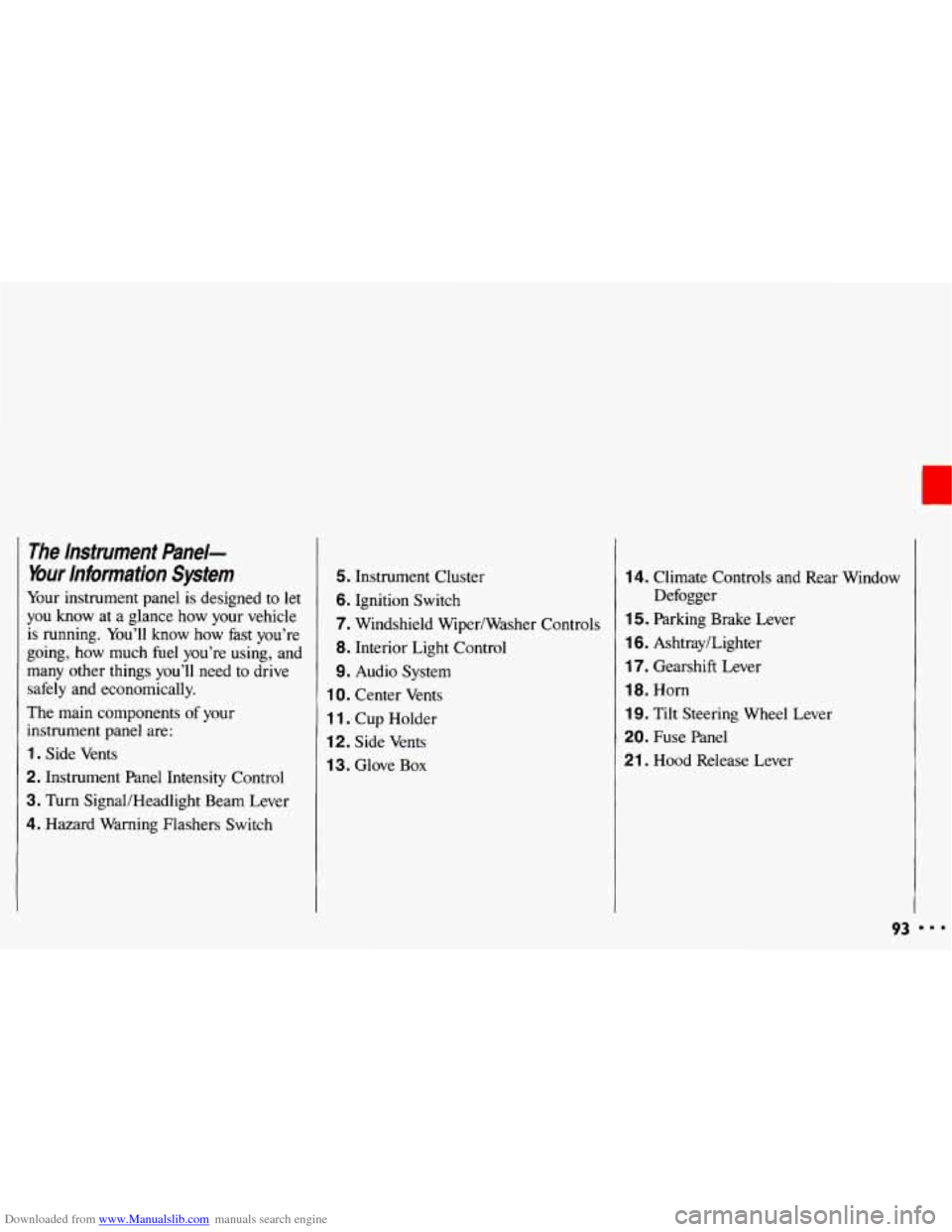
Your instrument panel is designed to let
you know at a glance how your vehicle
is running. You’ll know how fast you’re
going, how much fuel you’re using, and
many other things you’ll need to drive
safely and economically.
The main components
of your
instrument panel are:
1. Side Vents
2. Instrument Panel Intensity Control
3. Turn SignaVHeadlight Beam Lever
4. Hazard Warning Flashers Switch
5. Instrument Cluster
6. Ignition Switch
7. Windshield Wiper/Washer Controls
8. Interior Light Control
9. Audio System
1 0. Center Vents
1 1. Cup Holder
12. Side Vents
1 3. Glove Box
14. Climate Controls and Rear Window
1 5. Parking Brake Lever
16. Ashtray/Lighter
17. Gearshift Lever
18. Horn
19. Tilt Steering Wheel Lever
20. Fuse Panel
21 . Hood Release Lever Defogger
93 I..
Page 102 of 308
Downloaded from www.Manualslib.com manuals search engine Features & Controls
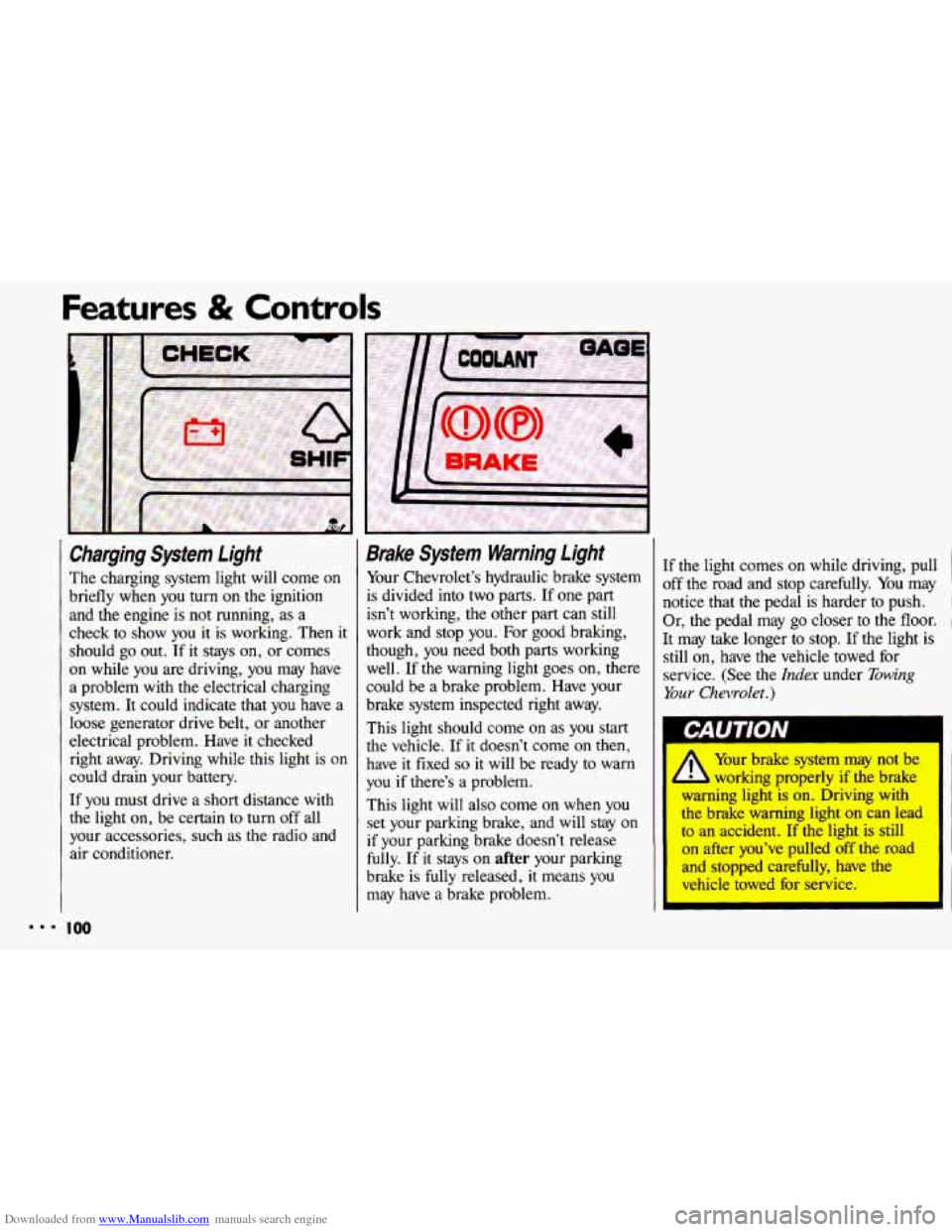
Charging System Light
The charging system light will come on
briefly when
you turn on the ignition
and the engine is not running, as a
check to show you it is working. Then it
should go out. If it stays on, or comes
on while you are driving, you may have
a problem with the electrical charging
system.
It could indicate that you have a
loose generator drive belt, or another
electrical problem. Have
it checked
right away. Driving while this light is on
could drain your battery.
If you must drive a short distance with
the light on, be certain to turn off all
your accessories, such as the radio and
air conditioner.
Brake Sysfem Warning Light
Your Chevrolet’s hydraulic brake system
is divided into two parts. If one part
isn’t working, the other part can still
work and stop you. For good braking,
though, you need both parts working
well. If the warning light goes on, there
could be a brake problem. Have your
brake system inspected right away.
This light should come on as you start
the vehicle. If it doesn’t come on then,
have
it fixed so it will be ready to warn
you if there’s
a problem.
This light will also come on when you
set your parking brake, and will stay
on
if your parking brake doesn’t release
fully. If it stays
on after your parking
brake is fully released,
it means you
may have
a brake problem. If
the light comes
on while driving, pull
off the road and stop carefully. You may
notice that the pedal is harder to push.
I
Or, the pedal may go closer to the floor. 1
It may take longer to stop. If the light is
still on, have the vehicle towed for
service. (See the
Index under Towing
Your Chevrolet.)
L-AU I IVN
I
/1 Your brake system may not be
L working properly if the brake
warning light is on. Driving with
the brake warning light
on can lead
to an accident. If the light is still
on after you’ve pulled off the road
and stopped carefully, have the
vehicle towed for service.
I