1993 CHEVROLET CAVALIER flat tire
[x] Cancel search: flat tirePage 193 of 308
Downloaded from www.Manualslib.com manuals search engine Don’t try to put a wheel cover on your
compact spare tire.
It won’t fit. Store the
wheel cover and plastic cap nuts in the
trunk or rear area until you have the flat
tire repaired or replaced.
16. Store the flat tire in the compact
spare tire compartment, and secure
with the wing bolt and extension.
Store the jack and wheel wrench in
their compartment, also.
MU I IVN 1
Storing a jack, a tire, or other
:quipment in the passenger
compartment
of the vehicle could
cause injury. In a sudden stop
or
collision, loose equipment could
strike someone. Store all these in
the proper place.
The compact spare is for temporary use
only. Replace the compact spare tire
with a full-size tire as soon as you can.
See
Compact Spare Tire next in this
section.
Compact Spare Tire
Although the compact spare was fully
inflated when your vehicle was new, it
can lose air after a time. Check the
inflation pressure regularly.
It should be
60 psi (420 Wa). The compact spare is
made to go up to
3,000 miles (5 000 km),
so you can finish your trip and have
your full-size tire repaired or replaced
where you want.
Of course, it’s best to
replace
your spare with a full-size tire as
soon as you can. Your spare will last
longer and be in good shape in case you
need it again.
Your anti-lock brake system warning
light may come on when you are driving
with a compact spare. See the
Index
under Anti-Lock Brake System Warning
Light.
191
Page 229 of 308
Downloaded from www.Manualslib.com manuals search engine 5. To remove the bulb, push the bulb in,
and rotate it counterclockwise.
6. Reverse all steps to reassemble the
taillight housing.
Windshield Wiper Blade
Replacement
Replacement blades come in different
types and are removed in different ways.
Here’s how
to remove the type with a
release clip:
1. Pull the windshield wiper arm away
2. Lift the release clip with a
from the windshield.
screwdriver and pull the blade
assembly
off the wiper arm.
the wiper arm.
3. Push the new wiper blade securely on
Loading %ur Vehicle
Two labels on your vehicle show how
much weight it may properly carry. The
Tire-Loading Information label found
on
the rear edge of the driver’s door tells
you the proper size, speed rating and
recommended inflation pressures for the
tires on your vehicle. It also gives
you
important information about the number
of people
that can be in your vehicle and
the total weight that you can carry. This
weight
is called the Vehicle Capacity
Weight and includes the weight
of all
occupants, cargo, and all nonfactory- installed options.
The other label
is the Certification
label, found on the rear edge of the
driver’s door. It tells you the gross
weight capacity
of your vehicle, called
I
227
Page 231 of 308
Downloaded from www.Manualslib.com manuals search engine 1--
-
Things you=
strike and injure
people in
a sudden stop or turn, or
in
a crash.
Put things in the trunk or rear
area
of your vehicle. In a trunk,
put them as hr forward as you
can.
Try to spread the weight
evenly.
If you have fold-down
rear seats, you’ll find four
anchors on the back wall
of your
trunk.
You can use these anchors
to tie down lighter loads. They’re
not strong enough for
heavy
things, however, so put them as
fbr forward
as you can in the
trunk or rear area.
Never stack heavier things, like
suitcases, inside the vehicle
so
that some of them are above the
tops
of the seats.
e When you carry something
inside the vehicle, secure it
whenever you can.
unless you need to.
0 Don’t leave a seat folded down
I
Tires
We don’t make tires. Your new vehicle comes with high quality tires made by a
leading tire manufacturer. These tires are warranted by the tire manufacturers and
their warranties are delivered with every
new Chevrolet. If your spare tire is a
different brand than your road tires,
you will have a tire warranty folder from each
of these manufacturers.
I I
CAUTION
Poorly maintained and improperly used tires are dangerous. 1
’ - Overloading your tires can cause overheating as a result of too much
friction. You could have
an air-out and a serious accident. See the Index
under hading Your Vehicle.
Underinflated tires pose the same danger as overloaded tires. The resulting
accident could cause serious injury. Check all tires frequently to maintain
the recommended pressure. Tire pressure should be checked
when your
tires
are cold.
sudden impact:
such as when you hit a pothole. Keep tires at the
recommended pressure.
I Overinflated tires are more likely to be cut, punctured, or broken by a
Worn, old tires can cause accidents. If your tread is badly worn, or if your
I tires have been damaged, replace them. I
229
I
I..
Page 232 of 308
Downloaded from www.Manualslib.com manuals search engine Service & Appearance Care
lnflation-lire Pressure
The Tire-Loading Information label
which is
on the rear edge of the driver’s
door shows the correct inflation
pressures for your tires, when they’re
cold. “Cold” means your vehicle has
been sitting for at least three hours or
driven no more than a mile. Don’t
let anyone tell you that
underinflation
or overinflation is
all right. It’s
not. If your tires don’t
have enough
you can get:
Too much flexing
Too much heat
Tire overloading
Bad weLA
Bad handling
Bad fuel economy. ition)
If your tires have too much air
(overinflation), you can get:
Unusual wear
Bad handling
Rough ride
Needless damage from road
hazards.
When to Check:
Check your tires once a month or more.
Don’t forget your compact spare tire. It
should be at
60 psi (420 kpa).
How to Check:
Use a good quality pocket-type gage to
check tire pressure. Simply looking at
the tires will not tell you the pressure,
especially if
you have radial tires-
which may look properly inflated even if
they’re underinflated.
If your tires have valve caps, be sure to
put them back on. They help prevent
leaks by keeping out dirt and moisture.
230
Page 233 of 308
Downloaded from www.Manualslib.com manuals search engine Tire hspection and Rotation I
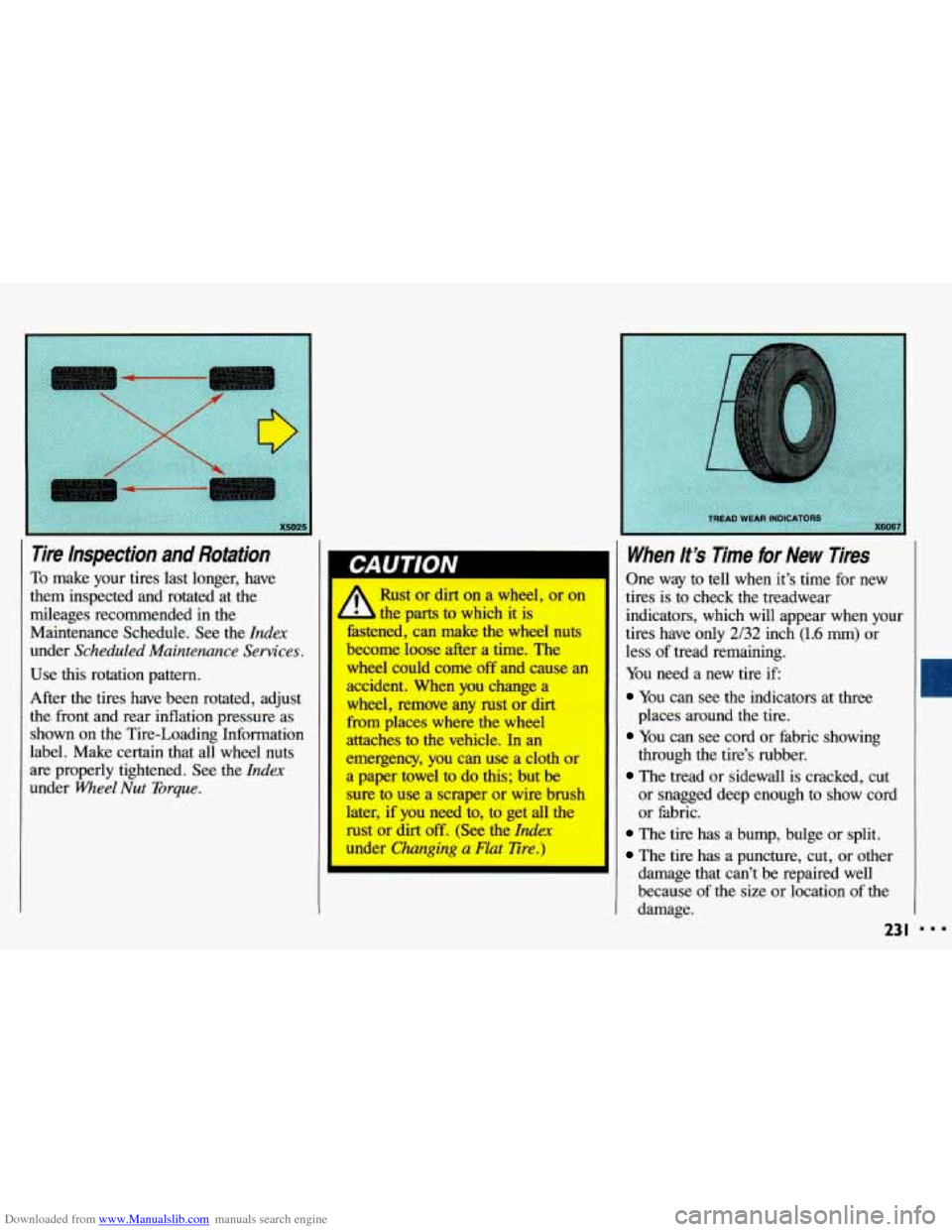
Use this rotation pattern.
After the tires have been rotated, adjust
the front and rear inflation pressure as
shown on the Tire-Loading Information
label. Make certain that all wheel nuts
are properly tightened. See the Index
under Wheel Nut Torque.
To make your tires last longer, have
them inspected and rotated at the
mileages recommended in the
Maintenance Schedule. See the
Index
under Scheduled Maintenance Services.
u I I’ -
Rust or dirt on a wheel, or on
; parts to which it is
fastened, can make the wheel nuts
become loose after a time. The
wheel could come off and cause an
accident. When you change a
wheel, remove any rust or dirt
from
places where the wheel
attaches to the vehicle. In an
emergency, you can use a cloth or
a paper towel to do this; but be
sure to use a scraper or wire brush
later, if you need to, to get all the
rust or dirt
off. (See the Index
under Changing a Flat Tire.)
When lt’s Time for New Tires
One way to tell when it’s time for new
tires
is to check the treadwear
indicators, which will appear when your
tires have
only 2/32 inch (1.6 mm) or
less of tread remaining.
You need a new tire if
You can see the indicators at three
You can see cord or fabric showing
The tread or sidewall is cracked, cut
places around the tire.
through the tire’s rubber.
or
snagged deep enough to show cord
or fabric.
The tire has a bump, bulge or split.
The tire has a puncture, cut, or other
damage that can’t be repaired well
because
of the size or location of the
damage.
23 I
Page 236 of 308
Downloaded from www.Manualslib.com manuals search engine Service & Appearance Care
Temperature-A, 8, C ~NTJ
Warning: The temperature grade for
this tire is established for a tire that is
properly inflated and not overloaded.
Excessive speed, underinflation,
or
excessive loading, either separately or in
combination, can cause heat buildup
and possible tire failure.
Those grades are molded on the
sidewalls of passenger car tires.
While
the tires available as standard or
optional equipment on General Motors
vehicles may vary
with respect to these
grades, all such tires meet General
Motors performance standards and have
been approved for use on General Motors vehicles.
All passenger type
(P Metric) tires must conform to Federal
safety requirements in addition to these
grades.
234
Wheel Alignment and
Tire Balance
The wheels on your vehicle were
aligned and balanced carefully at the
factory to give you the longest tire life
and best overall performance.
In most cases, you
will not need to have
your wheels aligned again. However,
if
you notice unusual tire wear or your
vehicle pulling one way or the other, the
alignment may need to be reset. If you
notice your vehicle vibrating when
driving on a smooth road, your wheels
may need to be rebalanced.
Wheel Replacement
Replace any wheel that is bent, cracked
or badly rusted. If wheel nuts keep
coming loose, the wheel, wheel bolts,
and wheel nuts should be replaced. If
the wheel leaks air out, replace
it
(except some aluminum wheels, which
can sometimes be repaired). See your
Chevrolet dealer if any of these
conditions exist.
Your dealer
will know the kind of wheel
you need. Each new wheel should have
the same load carrying capacity,
diameter, width, offset, and be mounted
the same way as the one
it replaces.
If you need to replace any of your
wheels, wheel bolts, or wheel nuts,
replace them only
with new GM
original equipment parts. This way, you
will be sure you have the right wheel,
wheel bolts, and wheel nuts for your
Chevrolet model.
Page 262 of 308
Downloaded from www.Manualslib.com manuals search engine Maintenance Schedule
Introduction
A Word About Maintenance
We at General Motors want to help you keep your vehicle in
good working condition. But
we don’t know exactly how
you’ll drive it. You may drive very
short distances only a
few times a week. Or
you may drive long distances all the
time in very hot, dusty weather.
You may use your vehicle in
making deliveries.
Or you may drive it to work, to do
errands or in many other ways.
Because of all the different ways people use their GM vehicles,
maintenance needs vary. You may even need more frequent
checks and replacements than you will find in the schedules
in this part.
So please read this part and note how you drive.
If you have
any questions on how to keep your vehicle in
good condition, see your Chevrolet dealer, the place many
GM owners choose to have their maintenance work done.
Your dealer can be relied upon to use proper parts and
practices.
260
Your Vehicle and the Environment
Proper vehicle maintenance not only helps to keep your
vehicle in good working condition, but also helps the
environment. All recommended maintenance procedures are
important. Improper vehicle maintenance or the removal
of
important components can significantly affect the quality of
the air we breathe. Improper fluid levels or even the wrong
tire inflation can increase the level
of emissions from your
vehicle.
To help protect our environment, and to help keep
your vehicle in
good condition, please maintain your vehicle
properly.
Page 273 of 308
Downloaded from www.Manualslib.com manuals search engine Section B: Owner Checks & Services
Listed below are owner checks and services which should
be performed at the intervals specified to help
ensure the
safety, dependability and emission control performance of
your vehicle. Be
sure any necessary repairs are completed at once.
Whenever any fluids or lubricants are added to your
vehicle, make sure they are the proper ones, as shown in
Section D.
At Each Fuel Fill (It is important for you or a service station attendant to perform these underhood checks at \
each fuel fill.)
CHECK
OR SERVICE I WHAT TO DO
Engine Oil Level
1
Check the engine oil level and add the proper oil if necessary. See the Index under Engine Oil for
further details.
Engine Coolant Level Check the engine coolant level
in the coolant recovery tank or surge tank and add the proper
coolant
mix if necessary. See the Index under Coolant for further details.
Windshield Washer Check the windshield washer fluid level
in the windshield washer tank and add the proper fluid
Fluid Level if necessary. See the
Index under Windshield Washer Fluid for further details. I
At Least Once a Month
CHECK
I OR SERVICE I WHAT TO DO
Tire Inflation
Check tire inflation. Make sure they are inflated to the pressures specified on the Tire-Loading
Information label located on the rear edge of
the driver’s door. See the Index under fires for
further details.
27 I I..