1993 CHEVROLET CAMARO warning light
[x] Cancel search: warning lightPage 105 of 358
I
This light will also come on when you set
your parking brake, and will stay on
if
your parking brake doesn’t release fully.
If it stays on after your parking brake is
fully released, it means you have a brake
problem.
If the light comes on while driving, pull
off the road and stop carefully. You may
notice that the pedal is harder to push. Or,
the pedal may
go closer to the floor. It
may take longer to stop.
If the light is still
on, have the vehicle towed for service.
(See “Towing Your Vehicle”
in the
Index.)
I
CAUTION: II ____~
Your brake system may not be
working properly if the brake
warning light is on. Driving
with the
brake warning light on can lead to
an accident. If the light is still
on
after you’ve pulled off the road and
stopped carefully, have the vehicle
towed for service.
I
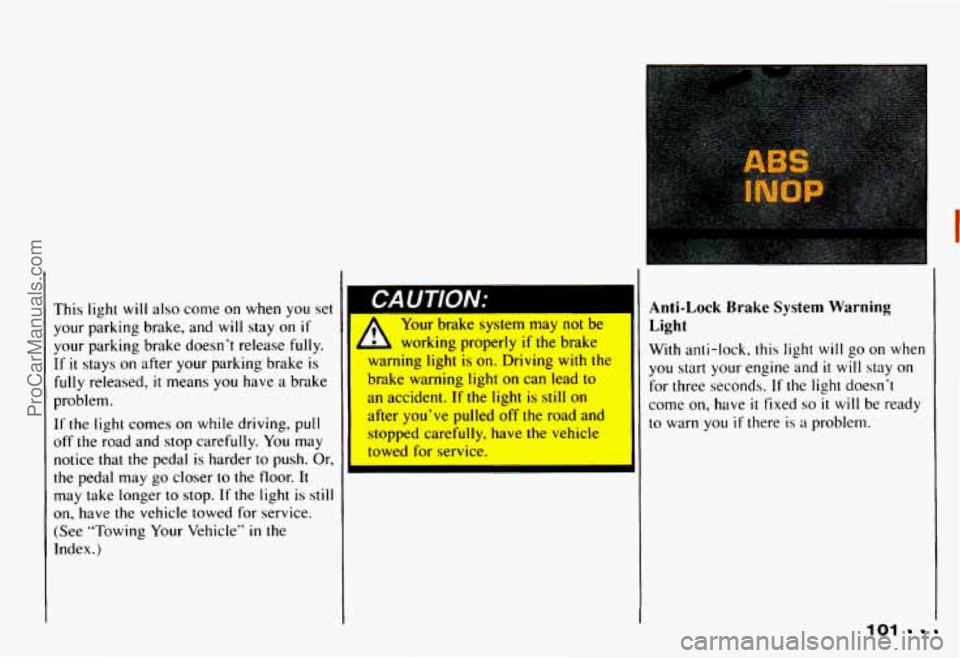
Anti-Lock Brake System Warning
Light
With anti-lock, this light will go on when
you start your engine and
it will stay on
for three seconds.
If the light doesn‘t
come
on, have it fixed so it will be ready
to warn
you if there is a problem.
101
ProCarManuals.com
Page 106 of 358

Features 8t Controls
f
I
I
. ’ 102
If the light stays on or comes on when
you’re driving, stop
as soon as possible
and turn the key off. Then start the engine
to reset the system. If the light still stays
on, or comes on again while you’re
driving, your Chevrolet needs service.
Unless the regular brake system warning
light is also on, you
will still have brakes,
but not anti-lock brakes. If the regular
brake system warning
light is also on, see
“Brake System Warning Light” earlier
in
this part. When your anti-lock system is working,
the message
LOW TRAC will appear on
your instrument cluster. This means that
slippery road conditions may exist. Adjust
your driving accordingly. The light
will
stay on for about four seconds after the
ABS stops working. The
LOW TRAC
light also comes on during engine starting
as
a bulb check.
Engine Coolant Temperature Gage
This gage shows the engine coolant
temperature.
If the gage pointer moves
into the red area, your engine is
too hot!
It means that your engine coolant has
overheated. If you have been operating
your vehicle under normal driving
conditions, you should
pull off the road,
stop your vehicle and
turn off the engine
as soon as possible.
HOT COOLANT CAN BURN YOU
BADLY!
In ”Problerns on the Road,” this manual
shows
what to do. See “Engine
Overheating”
in the Index.
ProCarManuals.com
Page 107 of 358

Voltmeter
You can read battery voltage on your
voltmeter. If
it reads less than 1 I volts or
more than
16 volts while your engine is
running, and
it stays there, you may have
a problem with the electrical charging
system. Have
it checked right away.
Driving with the voltmeter reading
in a
warning zone could drain your battery.
If you idle your engine for a while, the
voltmeter reading might move into the
yellow zone.
If the reading stays in the
yellow zone while you are driving, you
may have a problem with
the electrical
charging system. Have
it checked. While
the voltmeter reads
in the yellow zone,
your battery may
not be able to power
certain electrical accessories, like ABS.
(If this happens, your ABS INOP light
will come
on, See "Anti-Lock Brake
System Warning Light"
in this part.)
It' you must drive a short distance with the
voltmeter reading
in a warning zone. turn
off all your accessories, including your
comfort control and audio systems.
Malfunction Ind-kator Lamp
(Service Engine Soon Light)
A computer monitors operation of your
fuel, ignition and emission control
systems. This light should come on when
the ignition is
on, but the engine is not
running, as a check
to show you il is
working.
If it does not come on at all,
have
it fixed right away. If it stays on, or
it comes on while you are driving, the
computer is indicating that you have
a
problem. You should take your vehicle in
for service soon.
ProCarManuals.com
Page 109 of 358

Check Gages Light
This light will come on briefly when you
are starting the engine.
If the light comes
on and stays
on while you are driving.
check your gages
to see if they are in the
warning areas.
Low Oil Light
This light should come on while you are
starting your engine.
If the light doesn’t
come on. have
it repaired. If the light
comes on while starting your engine and
stays on. your engine
oil level may be too
low. You may need to add oil. See the
Index under “Engine
Oil.“
Low Coolant Light (V8 Engine)
This light should come on while you are
starting your engine.
If the light doesn’t
come on, have
it repaired. The light also
comes on when the coolant
in your
radiator is low.
You may need to add
coolant. See
the Index under “Engine
Coolant.“
.. Drtvlng wilt Lllr uw vv wwvuIIA I’
light on could cause your Chevrolet tc
overheat. See “Engine Overheating”
in the Index. Your Chevrolet could be
damaged, and
it wouldn’t be covered
by your warranty.
ProCarManuals.com
Page 140 of 358
Your Driving and the Road
136
Slowing down: If time allows, tap the
brake pedal once or twice
in advance of
slowing or stopping. This warns the driver
behind you.
Disabled: Your four-way flashers signal
that your vehicle
is disabled or is a
hazard. See “Hazard Warning Flashers”
in
the Index.
Traffic Officer
The traffic police officer is also a source
of important information. The officer’s
signals govern, no matter what the traffic
lights or other signs say.
The next section discusses some of the
road conditions you may encounter.
Defensive Driving
The best advice anyone can give about
driving
is: Drive defensively.
Please start
with a very important safety
device
in your Chevrolet: Buckle up. (See
“Safety Belts”
in the Index.)
Defensive driving really means “be ready for anything.“ On city streets,
rural roads,
or freeways, it means “always expect the
unexpected.”
Assume that pedestrians or other drivers
are going
to be careless and make
mistakes. Anticipate what they
might do.
Be ready for their mistakes.
Expect children
to dash out from behind
parked cars, often followed
by other
children. Expect occupants
in parked cars
to open doors into traffic. Watch for movement
in parked cars - someone
may be about
to open a door.
Expect other drivers
to run stop signs
when you are
on a through street. Be
ready
to brake if necessary as you go
:hrough intersections.
You may not have
:o use the brake, but if you do, you will be
-eady.
If you’re driving through a shopping
center parking
lot where there are
well-marked lanes, directional arrows,
and designated parking areas, expect
some drivers to ignore all these markings
and dash straight toward one part of the
lot.
ProCarManuals.com
Page 147 of 358
Anti-Lock Brakes (ABS)
Your Chevrolet has an advanced
electronic
braking system that will help
prevent skidding.
I
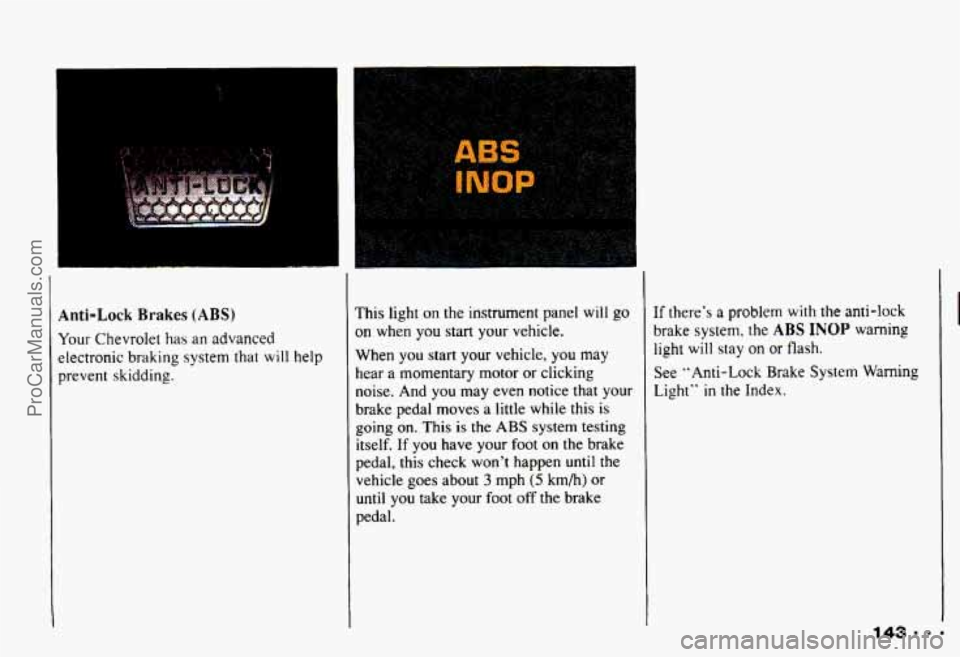
This light on the instrument panel will go
on when you start your vehicle.
When you start your vehicle,
you may
hear a momentary motor or clicking
noise. And you may even notice that your
brake pedal moves
a little while this is
going
on. This is the ABS system testing
itself. If you have your foot
on the brake
pedal, this check won't happen until the
vehicle goes about
3 mph (5 km/h) or
until you take your foot off the brake
pedal. If
there's
a problem with the anti-lock
brake system. the
ABS INOP warning
light will stay on
or flash.
See "Anti-Lock Brake
System Warning
Light" in the Index.
143.m-
ProCarManuals.com
Page 149 of 358

Disc Brake Wear Indicators
Unless you have the four-wheel disc
brake option, your Chevrolet has front
disc brakes and rear drum brakes.
Disc brake pads have built-in wear
indicators that make a high-pitched
warning sound when the brake pads are
worn and new pads are needed. The
sound may come and go or be heard all
the time your vehicle is moving (except
when you are pushing on the brake peda
firmly). 1 The brake wear warning sound
- means that sooner or later your
brakes won’t work well. That could
lead to an accident. When you hear
the brake wear warning sound, have
your vehicle serviced.
I
I
.1 LullllllullIg 1u UIIVt: Wllll WUIII-UU
brake pads could result in rnctl\~
brake repair. Some driving conditions
or climates may
cause a brake squeal when the brakes are
first applied or lightly applied. This does
not mean something
is wrong with your
brakes.
Rear Drum Brakes
If you have rear drum brakes, they don’t
have wear indicators,
but if you ever hear
a rear brake rubbing noise, have the rear
brake linings inspected.
Also, the rear
brake drums should be removed and
inspected each time the tires are removed
for rotation or changing. When you have
the front brakes replaced, have the rear
brakes inspected, too.
Brake linings should always be replaced
as complete axle sets.
ProCarManuals.com
Page 163 of 358
sometimes they can be waiting for you as
you come over a hill or dip into a shallow
valley. Start your windshield wipers and
washer, to help clear accumulated road
dirt. Slow down carefully.
Tips on Driving in Fog
If you get caught in fog, turn your
headlights on low beam, even
in daytime.
You’ll see
- and be seen - better. Use
your fog lights
if your vehicle has them.
Don’t use your high beams. The light will
bounce off the water droplets that make
up fog and reflect back at you. Use
your defogger. In high humidity, even
a light buildup of moisture on the inside
of the glass will cut down on your already
limited visibility. Run your windshield
wipers and washer occasionally. Moisture
can build up on the outside glass, and
what seems to be fog may actually be
moisture on the outside of your
windshield.
Treat dense fog as an emergency. Try to
find a place to pull off the road. Of course
you want to respect another’s property,
but you might need to put something
between you and moving vehicles
-
space, trees, telephone poles, a private
driveway, anything that removes you
from other traffic.
[f visibility is near zero and you must stop
but are unsure whether you are away from
the road,
turn your lights on, start your
hazard warning flashers, and sound your
horn at intervals or when you hear
approaching traffic.
Pass other vehicles in fog only if you can
see far enough ahead to pass safely. Even
then, be prepared to delay your pass if
you suspect the fog is worse up ahead. If
other vehicles try to pass you, make
it
easy for them.
ProCarManuals.com