Page 164 of 358
Your Driving and the Road
City Driving
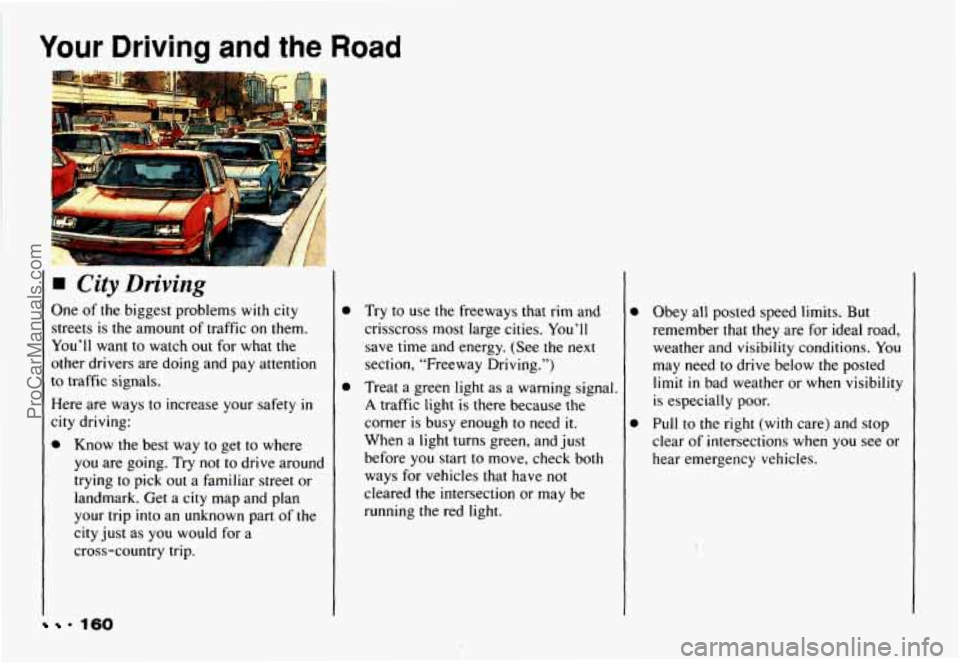
One of the biggest problems with city
streets is the amount of traffic on them.
You’ll want to watch out for what the
other drivers are doing
and pay attention
to traffic signals.
Here are ways to increase your safety
in
city driving:
9 160
0 Know the best way to get to where
you are going. Try not to drive around
trying to pick out a familiar street or
landmark. Get a city map and plan
your trip into an unknown part of the
city just as you would for a
cross-country trip.
0
0 Try to use the freeways that rim and crisscross most large cities. You’ll
save time and energy. (See the next
section, “Freeway Driving.”)
Treat a green light as a warning signal.
A traffic light is there because the
corner is busy enough to need
it.
When a light turns green, and just
before you start to move, check both
ways for vehicles that have not
cleared the intersection or may be
running the red light.
Obey all posted speed limits. But
remember that they are for ideal road,
weather and visibility conditions. You
may need
to drive below the posted
limit in bad weather or when visibility
is especially poor.
Pull to the right
(with care) and stop
clear of intersections when you see or
hear emergency vehicles.
ProCarManuals.com
Page 166 of 358
Your Driving and the Road
Just before you leave the lane,’ glance
quickly over your shoulder to make sure
there isn’t another vehicle
in your “blind”
spot.
If you are moving from an outside to a
center lane on a freeway having more
than two lanes, make sure another vehicle
isn’t about
to move into the same spot.
Look
at the vehicles two lanes over and
watch for telltale signs:
turn signals
flashing, an increase
in speed, or moving
toward the edge of the lane. Be prepared
to delay your move.
Once
you are moving on the freeway,
make certain you allow
a reasonable
following distance. Expect
to move
slightly slower at night.
162
Leaving the Freeway
When you want to leave the freeway,
move to
the proper lane well in advance.
Dashing across lanes at the last minute is
dangerous. If you miss your exit do not,
under any circumstances, stop and back
up. Drive on
to the next exit.
At each exit point is a deceleration lane.
Ideally
it should be long enough for you
to enter it at freeway speed (after
signaling,
of course) and then do your
braking before moving onto the exit
ramp. Unfortunately, not all deceleration
lanes are long enough
- some are too
short for
all the braking. Decide when to
start braking. If you must brake on the
through lane, and
if there is traffic close behind you, you can allow
a little extra
time and flash your brake lights
(in
addition to your turn signal) as extra
warning that you are about to slow down
and exit.
The exit ramp can be curved, sometimes
quite sharply.
The exit speed
is usually posted. Reduce
your speed according to your
speedometer, not
to your sense of motion.
After driving for any distance at higher
speeds, you
may tend to think you are
going slower than you actually are. For
example,
40 mph (65 km/h) might seem
like only
20 mph (30 km/h). Obviously,
this could lead
to serious trouble on a
ramp designed for
20 mph (30 km/h)!
ProCarManuals.com
Page 174 of 358
Your Driving and the Road
Winter Driving
Here are some tips for winter driving:
Have your Chevrolet in good shape
for winter. Be sure your engine
coolant mix is correct.
Snow tires can help in loose snow, but
they may give
you less traction on ice
than regular tires.
If you do not expect
to be driving in deep snow, but may
have to travel over ice, you may not
want to switch
to snow tires at all.
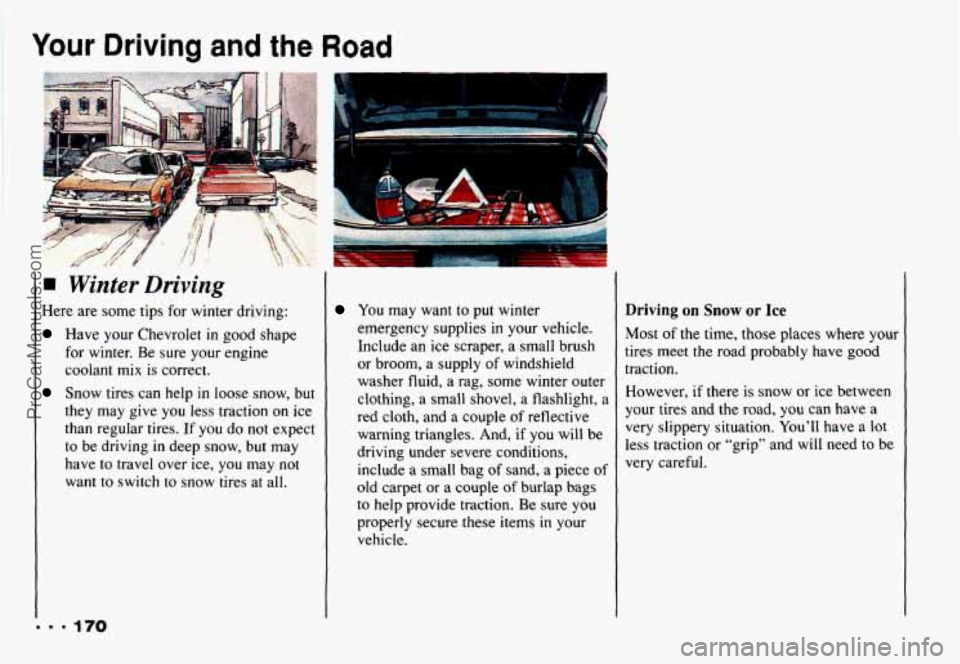
You may want to put winter
emergency supplies in your vehicle.
Include an ice scraper, a small brush
or broom, a supply
of windshield
washer fluid, a rag, some winter outer
clothing, a small shovel, a flashlight, a
red cloth, and a couple
of reflective
warning triangles. And, if you will be
driving under severe conditions,
include a small bag of sand, a piece of
old carpet or
a couple of burlap bags
to help provide traction. Be sure you
properly secure these items in your
vehicle.
Driving on Snow or Ice
Most of the time, those places where your
tires meet
the road probably have good
traction.
However, if
there is snow or ice between
your tires and the road, you can have a
very slippery situation. You’ll have a lot
less traction or “grip” and will need to
be
very careful.
ProCarManuals.com
Page 188 of 358
Problems on the Road
1
A
... 184
Hazard Warning
Flashers
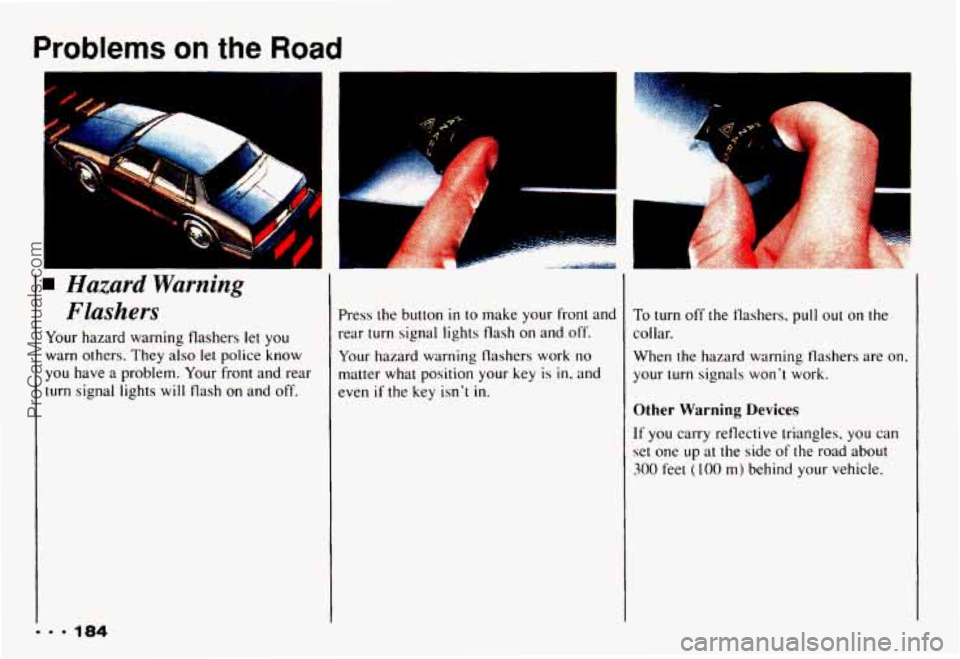
Your hazard warning flashers let you
warn others. They also let police know
you have a problem. Your front and rear
turn signal lights
will flash on and off.
Press the button in to make your fronl and
rear
turn signal lights flash on and off.
Your hazard warning flashers work no
matter what position your key
is in, and
even
if the key isn‘t in.
To turn off the flashers. pull out on the
collar.
When the hazard warning tlashers are on,
your turn signals won’t work.
Other Warning Devices
If you carry retlective triangles, you can
set one
up at the side of the road about
300 feet (100 m> behind your vehicle.
ProCarManuals.com
Page 197 of 358
I
c
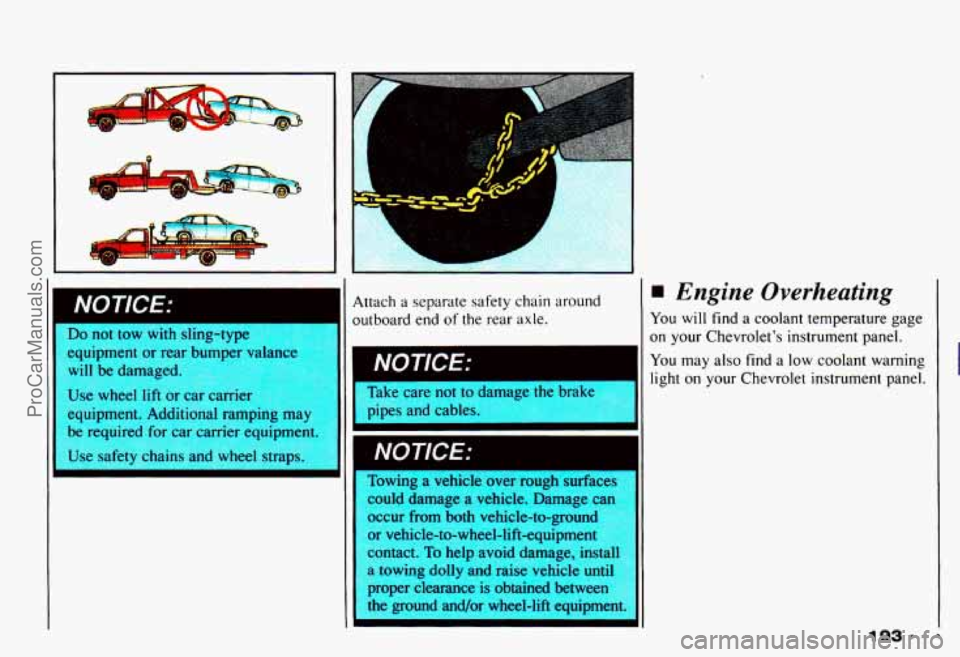
Do not tow with sling-type
eauipment or rear bumDer valance
equipment. Additional ramping may
be required for car carrier equipment.
Use safety chains and wheel straps. Attach
a separate
safety chain around
outboard end
of the rear axle.
NOTICE: I
could damage a vehicle. Damage can
occur from both vehicle-to-ground
or vehicle-to-wheel-lift-equipment
To help avoid damage, install
g dolly and raise vehicle until
er clearance is obtained between
the ground and/or wheel-lift equipment.
Engine Overheating
You will find a coolant temperature gage
on your Chevrolet's instrument panel.
You may also find a low coolant warning
light on your Chevrolet instrument panel.
193 9
ProCarManuals.com
Page 242 of 358
Service & Appearance Care
What to Use:
Standard and Limited-Slip Differential
Use Axle Lubricant (GM Part No.
1052271) or SAE 8OW-90 GL-5 gear
lubricant.
Engine Coolant
The following explains your cooling
system and how
to add coolant when it
is low. If
you have a problem with
engine overheating or if you need to add
coolant to your radiator, see “Engine
Overheating”
in the Index.
I
The proper coolant for your Chevrolet
will:
0
0
0
0
0
Give freezing protection down to
-34°F (-37°C).
Give boiling protection up to 262°F
(128°C).
Protect against rust and corrosion.
Help keep the proper engine
temperature.
Let
the warning lights work as they
should.
ProCarManuals.com
Page 308 of 358
Maintenance Schedule
Section C: Periodic Maintenance Inspections (Cont.)
INSPECTION
OR SERVICE
Rear Axle Service
Brake System Inspection
WHAT SHOULD BE DONE
Check the gear lubricant level in the rear axle and add if needed. See “Rear Axle” in the Index. A
fluid
loss in this system may indicate a problem. Check the system and repair it if needed. If your
vehicle
is used to pull a trailer, change the gear lubricant every 7,500 miles (12 500 km).
Inspect the complete system. Inspect brake lines and hoses for proper hookup, binding, leaks, cracks,
chafing, etc. Inspect disc brake pads for wear and rotors for surface condition. Also inspect drum
brake linings for wear and cracks. Inspect other brake parts, including drums, wheel cylinders,
calipers, parking brake, etc. The parking brake is self-adjusting and no manual adjustment is
required. You may need to have your brakes inspected more often if your driving habits or conditions
result in frequent braking.
NOTE: A low brake fluid level can indicate worn disc brake pads which may need to be serviced.
Also, if the brake system warning light stays on
or comes on, something may be wrong with the
brake system. See “Brake System Warning Light” in
the Index. If your anti-lock brake system
warning light stays on, comes on or flashes, something may be wrong with the anti-lock brake
system. See “Anti-Lock Brake System Warning Light” in
the Index.
~~
. * 304
ProCarManuals.com
Page 333 of 358
Index
Adding Coolant .............. 240
Add-on Electrical Equipment
.... 275
AirBags
...................... 25
How the System Works
........ 27
Servicing Your Chevrolet with
the System
................ 30
System Light
................ 26
Air Cleaner
................... 230
Air Conditioner Controls
......... 11 2
Air Control Knob
............... 110
Air Filter Replacement
.......... 231
Alignment and Tire Balance.
Wheel
..................... 262
Aluminum Wheels
............. 271
AM ......................... 127 AM/FM Stereo
With Cassette Tape Player
...... 1 17
With Compact Disc Player.
Delco-Base@ ............. 12 1
AM Stereo ................... 128
Antenna. Fixed Mast
........... 129
Anti-lock Brakes (ABS)
......... 143
System Warning Light
........ 101
To Use
.................... 144
Appearance Care
.............. 265
Appearance Care and Maintenance Materials
........ 274
Appearance Care. Service and
.... 217
Ashtray and Lighter
............. 94
Ashtray. Front
................. 94
Audio Systems
................. 11 5
Audio Systems. Comfort Controls and
................ 109 Automatic Transmission
......... 62
Automatic Transmission Fluid
.... 233
Axle. Limited-Slip Rear
.......... 70
Axle. Rear
................... 237
Backing Up (with a Trailer)
..... 178
Balance. Wheel Alignment
and Tire
................... 262
Battery
...................... 246
Beams. High
.................. 154
Before Leaving on a Long Trip
... 163
Belt. Lap-Shoulder
.............. 21
Better Business Bureau MediatiodArbitration Program
GM Participation
in ........ 316
Bi-Level Heating
............... 111
Blizzard. If You’re Caught in a ... 172
Box. Glove .................... 92
329 . .
ProCarManuals.com