1993 CHEVROLET BLAZER oil
[x] Cancel search: oilPage 324 of 386
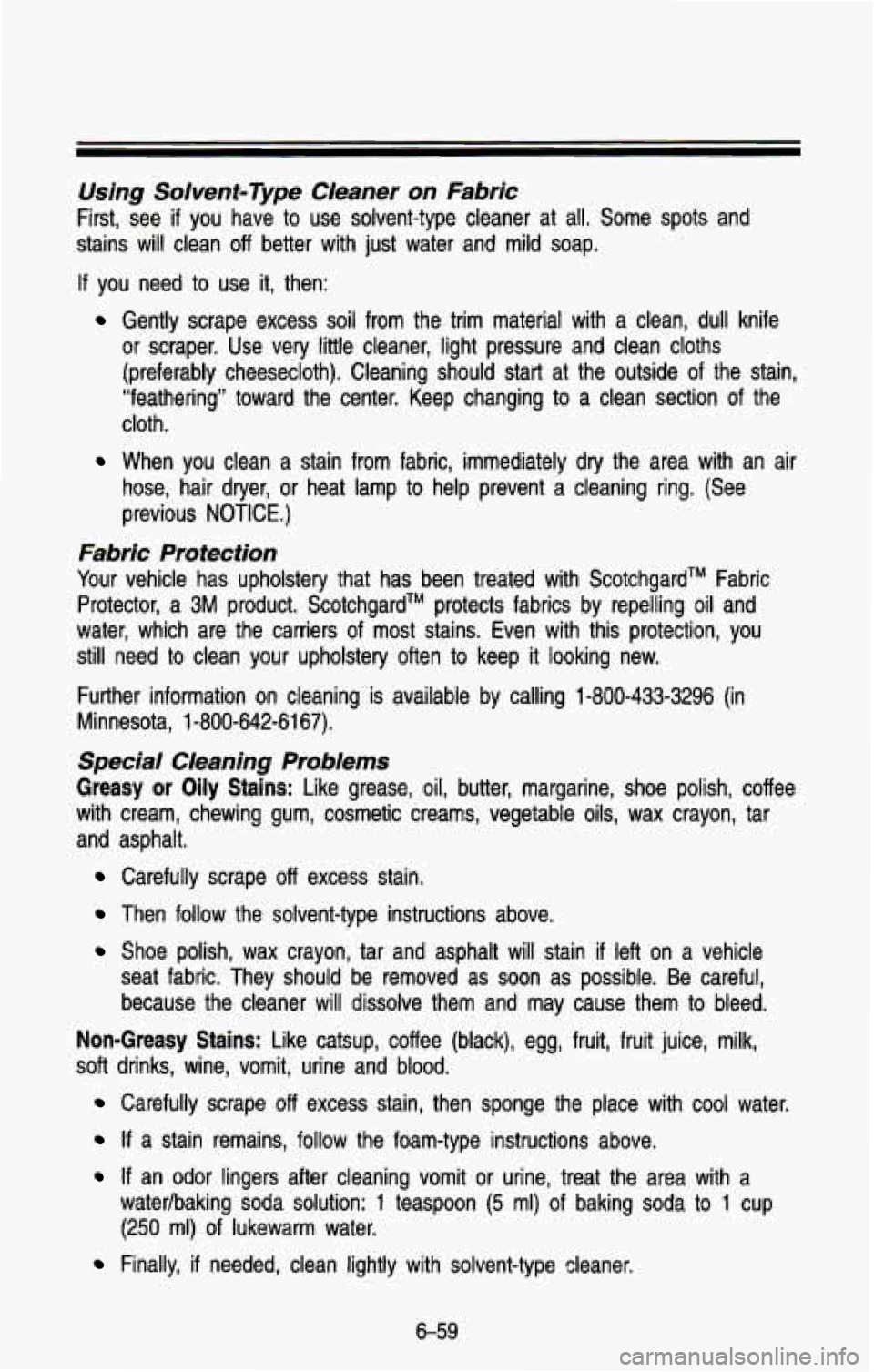
Using Solvent-Type CIeaner on Fabric
First, see if you have to use solvent-type cleaner at all. Some spots and
stains will clean
off better with just water and mild soap.
If you need to use it, then:
Gently scrape excess soil from the trim material with a clean, dull knife
or scraper. Use very little cleaner, light pressure and clean cloths
(preferably cheesecloth). Cleaning should start at the outside \
of the stain,
“feathering” toward the center. Keep changing
to a clean section of the
cloth
.
When you clean a stain from fabric, immediately dry the area with an air
hose, hair dryer, or heat lamp
to help prevent a cleaning ring. (See
previous NOTICE.)
Fabric Profection
Your vehicle has upholstery that has been treated with ScotchgardTM \
Fabric
Protector, a
3M product. ScotchgardTM protects fabrics by repelling oil and
water, which are the carriers
of most stains. Even with this protection, you
still need
to clean your upholstery often to keep it looking new.
Further information on cleaning is available by calling
1-800-433-3296 (in
Minnesota,
1-800-642-61 67).
Special Cleaning Problems
Greasy or Oily Stains: Like grease, oil, butter, margarine, shoe polish, coffee
with cream, chewing gum, cosmetic creams, vegetable oils, wax c\
rayon, tar
and asp ha1
t .
Carefully scrape off excess stain.
Then follow the solvent-type instructions above.
Shoe polish, wax crayon, tar and asphalt will stain if left on a vehicle
seat fabric. They should be removed as soon as possible. Be c\
areful, because the cleaner will dissolve them and may cause them
to bleed.
Non-Greasy Stains: Like catsup, coffee (black), egg, fruit, fruit juice, milk,
soft drinks, wine, vomit, urine and blood.
Carefully scrape off excess stain, then sponge the place with cool water.
If a stain remains, follow the foam-type instructions above.
If an odor lingers after cleaning vomit or urine, treat the area with a
watedbaking soda solution:
1 teaspoon (5 ml) of baking soda to 1 cup
(250 ml) of lukewarm water.
Finally, if needed, clean lightly with solvent-type cleaner.
6-59
Page 327 of 386

Protecting Exterior Bright Metal Parts
Bright metal parts should be cleaned regularly to keep their l\
uster. Washing
with water is all that is usually needed. However, you may use
GM Chrome
Polish on chrome or stainless steel trim,
if necessary.
Use special care with aluminum trim.
To avoid damaging protective trim, never
use auto or chrome polish, steam or caustic soap
to clean aluminum. A
coating of wax, rubbed to a high polish, is recommended for all bright metal
parts.
Aluminum Wheels (If So Equipped)
Your aluminum wheels have a protective coating similar to the painted surface
of your vehicle. Don’t use strong soaps, chemicals, chrome polis\
h, or other
abrasive cleaners on them because you could damage this coating\
. After
rinsing thoroughly, a wax may be apptied.
NOTICE 1
f you have aluminum wheels, don’t use an automatic vehicle wash that
?as hard silicon carbide cleaning brushes. These brushes can take
off the
xotective coating.
White Sidewall Tires
Your General Motors dealer has a GM White Sidewall Tire Cleaner. You can
use a stiff brush with
it.
Weatherstrips
These are places where glass or metal meets rubber. Silicone g\
rease there
will make them last longer, seal better, and not stick or squeak. Apply silic\
one
grease with a clean cloth at least eve@ six months.
Sheet Metal Damage
If your vehicle is damaged and requires sheet metal repair or replacement,
make sure the body repair shop applies anti-corrosion material
to the parts
repaired or replaced
to restore corrosion protection.
Foreign Material
Calcium chloride and other salts, ice melting agents, road oil \
and tar, tree
sap, bird droppings, chemicals from industrial chimneys, and 0the.r foreign\
matter can damage your vehicle’s finish
if they remain on painted surfaces.
Use cleaners that are marked safe for painted surfaces for the\
se stains.
Finish Damage
Any stone chips, fractures or deep scratches in the finish should be repaired
right away. Bare metal will corrode quickty and may develop into a major
repair expense.
6-62
Page 329 of 386
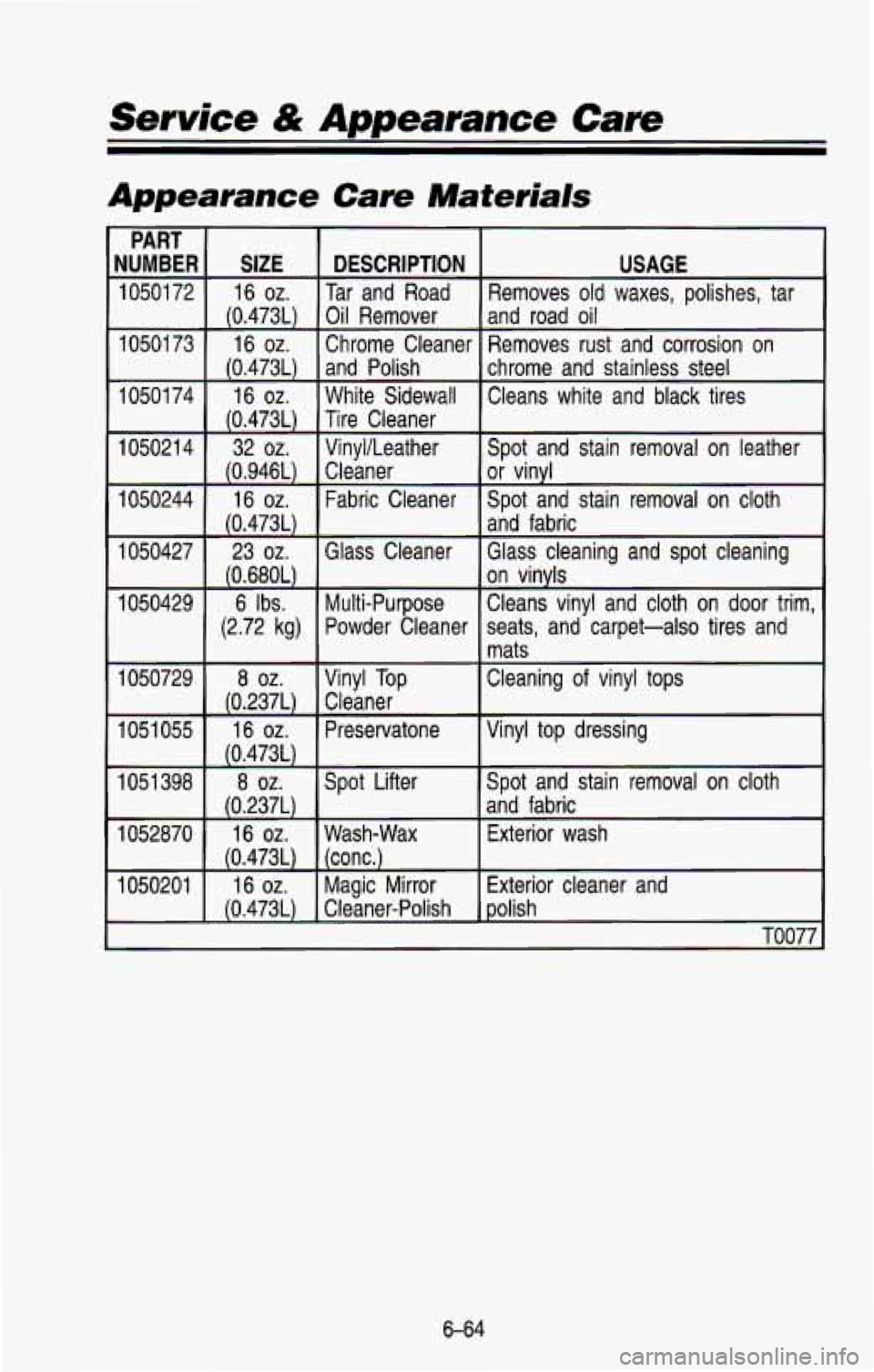
Service & Appearance Care
Appearance Care Materials
PART I I I
NUMBER SIZE DESCRIPTION USAGE
1050172 16 02. Tar and Road Removes old waxes, polishes, tar
1050173 16
oz. Chrome Cleaner Removes rust and corrosion on
I0501 74 16
02. White Sidewall Cleans white and black tires
(0.473L)
Oil Remover and road oil
(0.473L) and Polish chrome and stainless steel
(0.473L) Tire Cleaner
1050214 32
oz. VinvVLeather Spot and stain removal on leather
(0.946L) Cleaner or vinyl
(0.473L) and fabric
1050244 16 02. Fabric Cleaner Spot and stain removal on cloth
I050427 23
02. Glass Cleaner Glass cleanina and sDot cleaning I
(0.680L)
"
on vinyls
-
1050429 6 Ibs. Multi-PurDose Cleans vinvl and cloth on door tr\
im,
(2.72 kg) Powder cleaner seats, and'carpet-also tires and
mats
1050729 8
02. Vinyl Top
Cleaning of vinyl tops
1051
055 16 02. Preservatone Vinyl top dressing
IO51
398 8 02. Spot Lifter Spot and stain removal on cloth
1052870 16
02. Wash-Wax Exterior wash
(0.237L) Cleaner
(0.473L)
(0.237L)
and fabric
(0.473L) (conc.)
1050201 16
02. Magic Mirror Exterior cleaner and
I (0.473L) I Cleaner-Polish 1 polish
TO077
6-64
Page 334 of 386
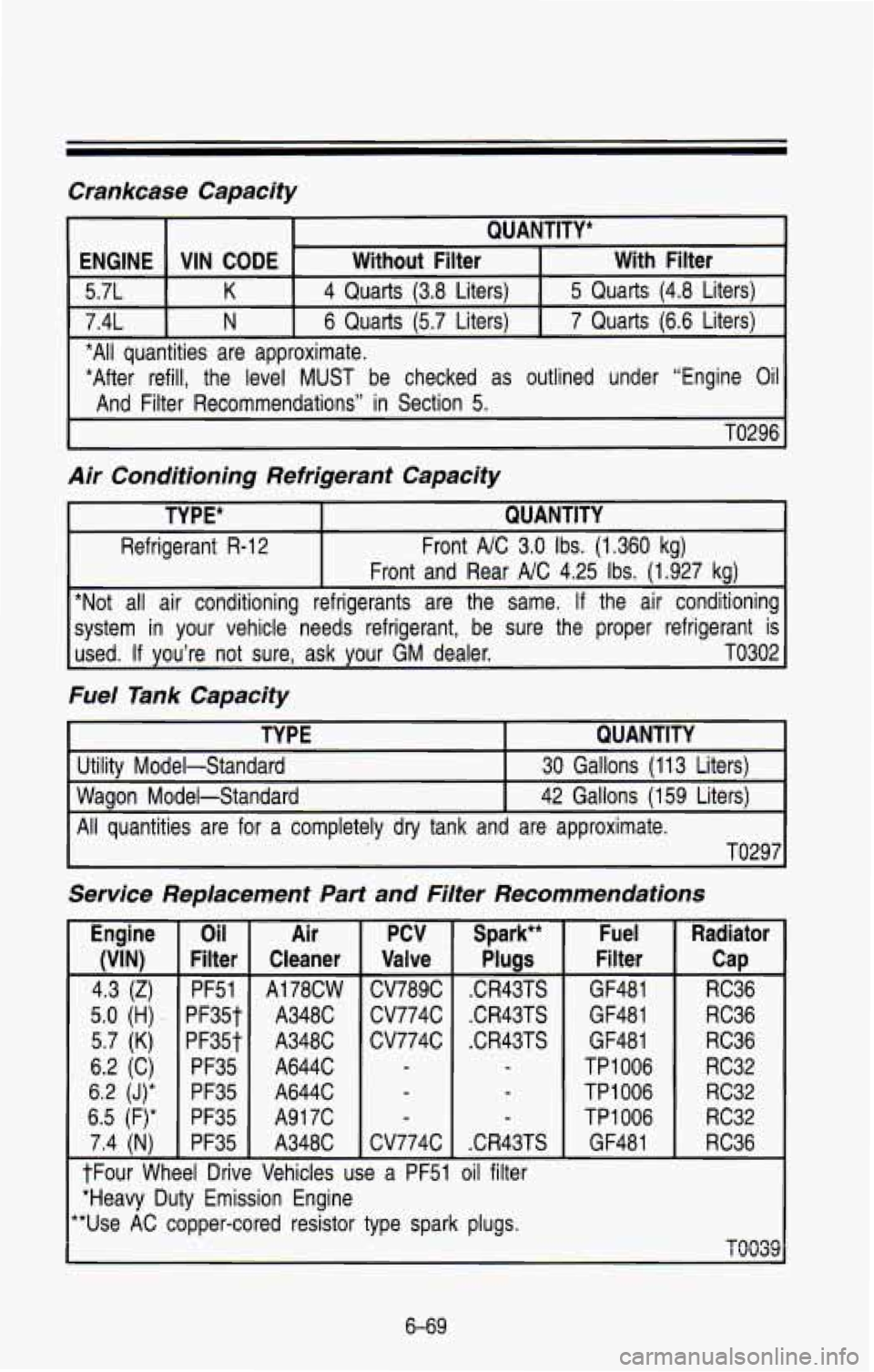
Crankcase Capacify
QUANTITY*
ENGINE VIN CODE Without Filter With Filter
5.7L K 4 Quarts (3.8 Liters) 5 Quarts (4.8 Liters)
7.4L N 6 Quarts (5.7 Liters) 7 Quarts (6.6 Liters)
*All quantities are approximate.
*After refill, the level MUST be checked as outlined under “\
Engine Oil
TO296
And Filter Recommendations” in Section
5.
Air Condifioning Refrigeranf Capacify
TYPE* QUANTITY
Refrigerant R-12 Front
AJC 3.0 Ibs. (1.360 kg)
Front and Rear AJC 4.25 Ibs. (1.927 kg)
*Not all air conditioning refrigerants are the same.
If the air conditioning
system in your vehicle needs refrigerant, be sure the proper r\
efrigerant is
used. If you’re not sure, ask your GM dealer. TO302
Fuel Tank Capacify
I -1
Utility Model-Standard 30 Gallons (113 Liters)
Wagon Model-Standard 42 Gallons (159 Liters)
All quantities are for a completely dry tank and are approxima\
te. TO2971
Service Replacemenf Part and Filfer Recommendations
5.7 (K)
6.2 (C)
6.2
(J)*
6.5 (F)*
-
Oil
Filter
PF5 1
PF35t PF35t
PF35
PF35
PF35
PF35
-
1
Air PCV
Cleaner Valve
A348C
cv774c
A348C cv774c
A644C
A644C
A91 7C
A348C cv774c
AI 7acw cv7agc
Spark**
Plugs
.CR43TS
.CR43TS
.CR43TS
-
.CR43TS i
use a PF51 oil filter
*Heavy Duty Emission Engine
**Use
AC copper-cored resistor type spark plugs.
Fuel
Filter
GF481
GF481
GF481
TP
1 006
TP 1 006
TP 1 006 G F48 1
Radiator
RC36
RC36
RC36
RC32
RC32
RC32
RC36
Cap
6-69
Page 345 of 386

Scheduled Maintenance Services
GASOLINE ENGINES WITH LIGHT DUTY EMISSIONS-
If your driving conditions meet those specified in “Scheduled Ma\
intenancc
Services” in this section, use Maintenance Schedule
I (t).
Item Miles (000) 3 6 7.5 9 12 15 18
No. Service Kilometers (000) 5 10 12.5 15 20 25 30
1 Engine Oil Change*-Every 12 Months, or e
Oil Filter Change*-Every 12 Months, or e
2 Chassis Lubrication-Every 12 Months, or e
3 Clutch Fork Ball Stud Lubrication
5 Cooling System Service*-Every 24
6 Air Cleaner Filter Replacement* Months
or
7 Front Wheel Bearing Repack
8 Transmission Service**
25 Drive Axle Service**
26 Brake Systems Inspection**
FOOTNOTES:
**See “Explanation
of Scheduled Maintenance Services” in this section.
*An Emission Control Service
tTo determine the emissions classification of your engine refer to “Selecting
the
Proper Maintenance Chart”
in this section.
TO332
Page 349 of 386

Scheduled Maintenance Services
GASOLINE ENGINES WITH HEAVY DUTY EMISSIONS-
If your driving conditions meet those specified in “Scheduled Ma\
intenancc Services”
in this section, use Maintenance Schedule I (t).
Miles (000) 3 6 9 12
Service Kilometers (000) 5 10 15 20
Item
No.
1-
2
3
5
6
7
8
10
11
12
13
14
15
16 17
18
19 I
20 !
21 1
22
’
.
24 *
25 I
26 I
FOOTNOTES:
* An Emission Control Service
**See “Explanation
of Scheduled Maintenance Services” in this section.
A Also a Noise Emission Control Service
I Applicable only to vehicles sold in the United States
t To determine the emissions classification of your engine refer to “Selecting the Proper
Maintenance Chart” in this section.
T033f
Oil Filter Change*-Every 12 Months, or
Drive Axle Service**
3rake Systems Inspection**
7-1 2
Page 355 of 386
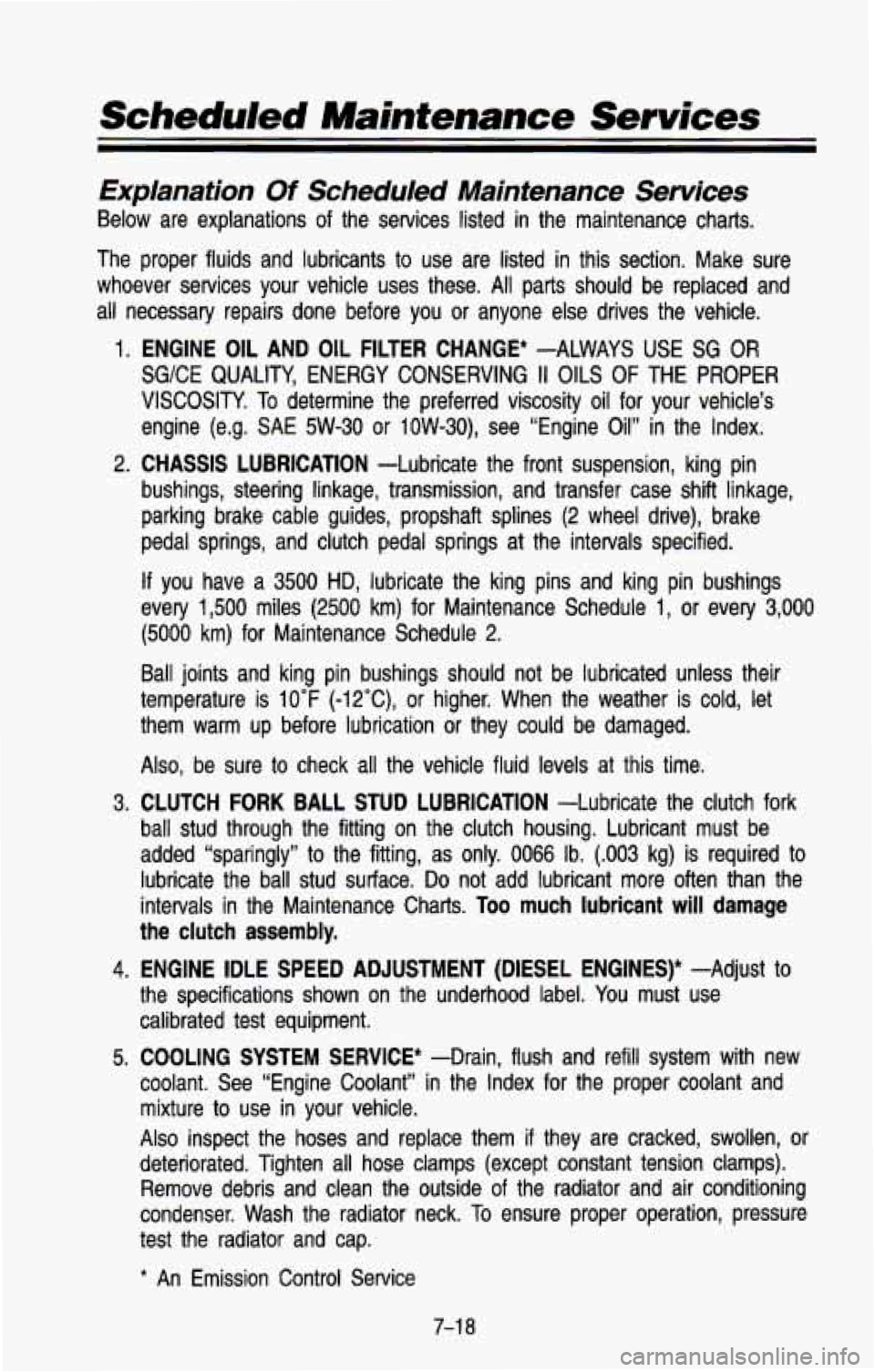
Scheduled Maintenance Services
Explanation Of Scheduled Maintenance Services
Below are explanations of the services listed in the maintenance charts.
The proper fluids and lubricants to use are listed in this section. Make sure
whoever services your vehicle uses these.
All parts should be replaced and
all necessary repairs done before you or anyone else drives the ve\
hicle.
1. ENGINE OIL AND OIL FILTER CHANGE* -ALWAYS USE SG OR
SG/CE QUALITY, ENERGY CONSERVING II OILS OF THE PROPER
VISCOSITY. To determine the preferred viscosity oil for your vehicle’s
engine (e.g. SAE 5W-30 or
10W-30), see “Engine Oil” in the Index.
2. CHASSIS LUBRICATION -Lubricate the front suspension, king pin
bushings, steering linkage, transmission, and transfer case shift\
linkage,
parking brake cable guides, propshaft splines
(2 wheel drive), brake
pedal springs, and clutch pedal springs at the intervals specif\
ied.
If you have a 3500 HD, lubricate the king pins and king pin bushings
every
1,500 miles (2500 km) for Maintenance Schedule 1, or every 3,000
(5000 km) for Maintenance Schedule 2.
Ball joints and king pin bushings should not be lubricated unl\
ess their
temperature is
10°F (-12”C), or higher. When the weather is cold, let
them warm up before lubrication
or they could be damaged.
Also, be sure to check all the vehicle fluid levels at this time.
3.
CLUTCH FORK BALL STUD LUBRICATION -Lubricate the clutch fork
ball stud through the fitting on the clutch housing. Lubricant \
must be
added “sparingly” to the fitting, as only.
0066 Ib. (.003 kg) is required to
lubricate the ball stud surface. Do not add lubricant more often than the
intervals in the Maintenance Charts.
Too much lubricant will damage
the clutch
assembly.
4. ENGINE IDLE SPEED ADJUSTMENT (DIESEL ENGINES)* -Adjust to
the specifications shown on the underhood label. You must use
calibrated test equipment.
5. COOLING SYSTEM SERVICE* -Drain, flush and refill system with new
coolant. See “Engine Coolant” in the Index for the proper\
coolant and
mixture
to use in your vehicle.
Also inspect the hoses and replace them if they i cracked, swollen, or
deteriorated. Tighten all hose clamps (except consrant tension clamps).
Remove debris and clean the outside of the radiator and air c\
onditioning
condenser. Wash the radiator neck.
To ensure proper operation, pressure
test the radiator and cap.
* An Emission Control Service
7-1 8
Page 358 of 386

23. EXHAUST PRESSURE EGULATOR VALVE INSPECTION* -Check that
the valve works properly. Correct any binding. Inspect hoses fo\
r cracks,
chafing or decay. Replace parts
as needed.
24. TIRE AND WHEEL ROTATION AND INSPECTION -For proper wear
and maximum tire life, rotate tires
at the first 6,000 miles (10 000
kilometers) for Schedule I (t) or 7,500 miles (12 500 kilometers) for
Schedule
II (.) and then every 15,000 miles (25 000 kilometers)
thereafter.
Follow the instructions and patterns shown in Section 6.
Check tires for uneven wear or damage. If irregular or premature wear is
apparent, check wheel alignment.
Also, check for damaged wheels. See
“Tires” in the Index for more information.
For dual wheels, whenever the vehicle, wheels, or fasteners are new\
,
have the wheel fastener torque set at the first 100,
1,000 and 6,000
miles
(160, 1600 and 10 000 km).
For
3500 H.D. Models, block the tires opposite those being removed to
keep the vehicle from rolling.
25.
DRIVE AXLE SERVICE -Check readfront axle fluid level and add as
needed. Check constant velocity joints and axle seals for leaki\
ng.
Locking differential-Drain fluid at first oil change and refill. Check
fluid level and add as needed at subsequent oil changes. In dusty
areas, or trailer towing applications drain fluid at every
15,000 miles
(24 135 kilometers) and refill$
every oil change. In dusty areas,
or trailer towing applications, drain
fluid every 15,000 miles
(24 135 kilometers) and refi1l.t
Standard differential -Check fluid level and add as needed at
More frequent lubrication may be required on heavy-duty or off-road
use.
26. BRAKE SYSTEM INSPECTION -When the engine oil is changed,
inspect the lines
and hoses for proper hookup, binding, leaks, cracks,
chafing, etc. Check the parking brake adjustment, and the fluid level in
the master cylinder.
A low fluid level can indicate worn disc brake pads
which may need to be serviced$
*An Emission Control Service
tA fluid loss in these systems may indicate a problem. Have them
inspected and repaired
at once.
7-2 1