Page 136 of 386
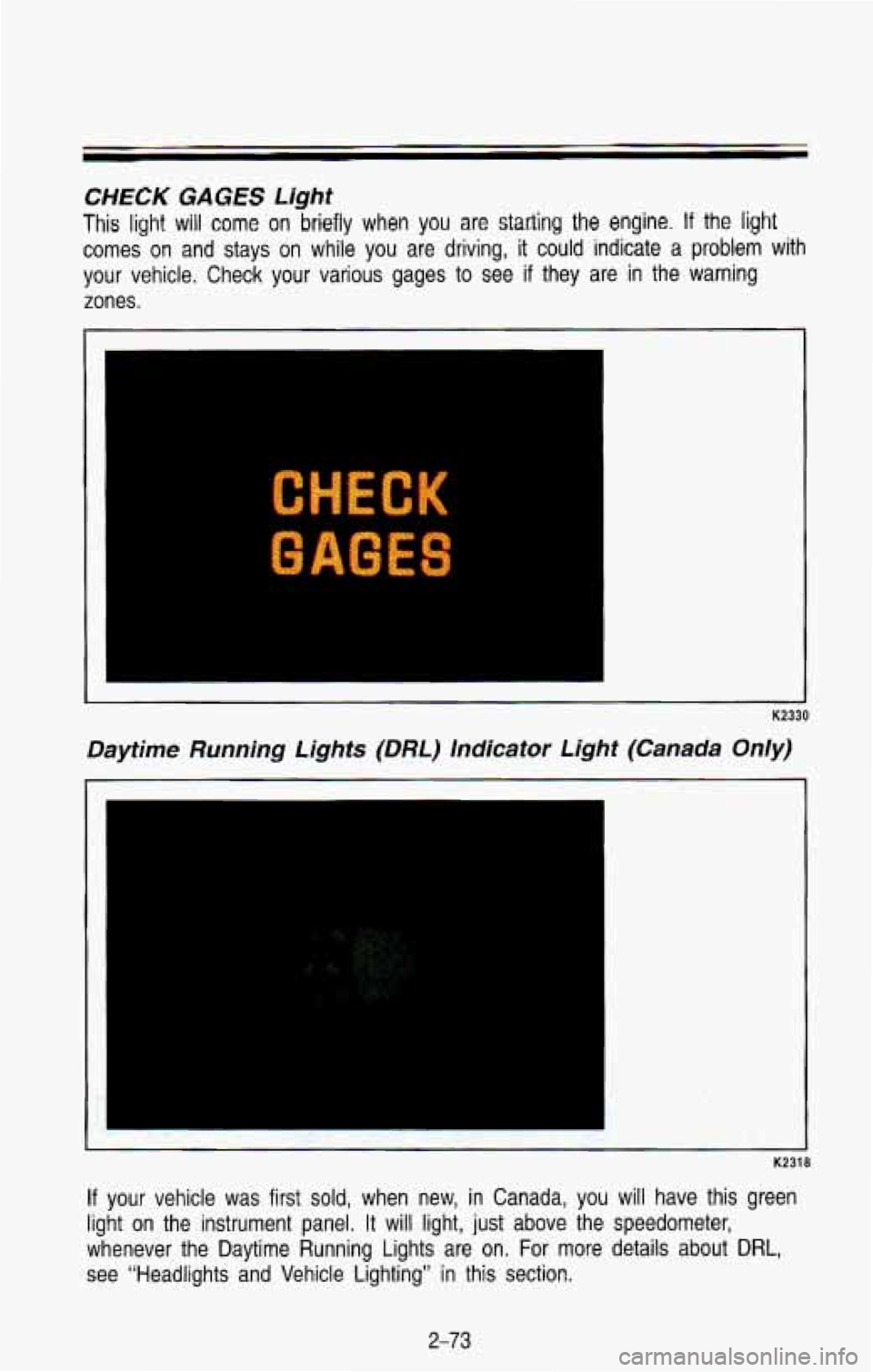
CHECK GAGES Light
This light will come on briefly when you are statling the engine. If the light
comes on and stays on while you are driving, it could indicate a problem with
your vehicle. Check your various gages to see if they are in the warning
zones.
C “5 XK
GAGES
K2330
Daytime Running Lights (DRL) Indicator tight (Canada Only)
K2318
If your vehicle was first sold, when new, in Canada, you will have this green
light on the instrument panel. It will light,
just above the speedometer,
whenever the Daytime Running Lights are on. For more details a\
bout
DRL,
see “Headlights and Vehicle Lighting’’ in this section.
2-73
Page 140 of 386

Listed are four situations you may experience with your fuel gage:
At the gas station, the fuel pump shuts off before the gage reads full.
It takes a little more or less fuel to fill up than the fuel gage indicated.
For example, the gage may have indicated the tank
was half full, but it
actually took a little more or less than half the tank’s capacity to
fill the
tank.
The gage moves a little when you turn a corner or speed up. \
The gage doesn’t go back to empty when you turn off the ignition.
None
of these indicate a ,problem with the fuel gage.
For information on how to
fill your fuel tank see “Fuel-Filling Your Tank” in
the Index.
For your fuel tank capacity, see “Fuel-Tank Capacity”
in the Index.
Engine Coolant Temperature Gage
260
This gage shows the engine coolant temperature. If the gage pointer moves
into the red area, about 260°F
(145°C) or more, your engine is too hot! It
means that your engine coolant has overheated.
If you have been operating
your vehicle under normal operating conditions, you should pull \
off the road,
stop your vehicle and turn
off the engine as soon as possible.
Hot Coolant Can Burn You Badly!
In “Problems on the Road”, this manual shows what to do. See “Engine
Overheating” in the Index.
2-77
Page 141 of 386
Featurns & Controls
30
Oil Pressure Gage
Standard Ciusier
Tachometer
Cluster
K2116
K2117
The oil pressure gage shows the engine oil pressure in psi (\
pounds per square inch) when the engine
is running. Canadian vehicles indicate pressure
in kPa (kilopascals). Oil pressure may vary with engine speed\
, outside
temperature and
oil viscosity, but readings above the low pressure zone
indicate the normal operating range.
2-78
Page 142 of 386
A reading in the low pressure zone may be caused by a dangerouslv low oil
level or other problem causing low oil pressure. Check your oi\
l as soon as
possible.
CAUTION
Don’t keep driving if the oil pressure is low. If you do, your engine
can become so hot that it catches on fire, You or others could be
burned. Check your oil as soon as possible and have your vehicle
serviced.
e NOTICE
I
Damage to your engine from neglected oil problems can rnstly at,,
not covered by your ‘Avanty.
I
Voltmeter
Standard Cluster
14
Tachometer Cluster
19
GL
K2336
When your engine is not running, but the ignition is on (in \
the Run position),
this gage
shows your battery’s state of charge in DC volts. When the engine
is running, the gage shows the condition
of the charging system. Readings
between the low and high warning zones indicate the normal ope\
rating range.
Readings in either warning zone indicate a possible problem in \
the electrical
system.
2-79
Page 150 of 386
Heater Output
Optional Engine Block Heater
If your engine is equipped with an optional engine block heater, you can use
it during initial start-up in cold weather (20"F,
-8OC, or lower) to help heat the
passenger compartment faster. Because an engine block heater war\
ms the
engine coolant, your vehicle's heating system can provide some \
heat as soon
as you start the engine.
The use of an engine block heater also reduces the time it takes for the
engine to reach normal operating temperature, and shortens the time it takes
the heater to reach full output. For more information, See "Engine Block
Heater" in the Index.
Electronic Heating/Air Conditioning System
Function Display
I ................... ...........I
K2:
If your vehicle has air conditioning, your heating/air conditioning \
system will
look like this.
When you first turn on your vehicle's air conditioning, open the windows
to
clear the vehicle of hot air.
3-5
Page 157 of 386
Comfort Controls & Audio Systems
Audio Systems
Your Delco@ audio system has been designed to operate easily a\
nd give
years of listening pleasure. But
you will get the most enjoyment out of it, if
you acquaint yourself with it first. Find out what your Delco@ system can do
and how to operate all its controls, to be sure you’re getting the most out
of
the advanced engineering that went into it.
~ CAUTION
* Hearing damage from loud noise is almost undetectable until it is too
- ,,,e. Your hearing can adapt to higher volumes of sound. Sound that
seems normal can be loud and harmful to your hearing. Take
precautions by adjusting the volume control on your radio
to a safe
sound level before hearing adapts to
it.
To help avoid hearing loss or damage:
Adjust the volume control to the lowest setting.
Increase volume slowly until you hear comfortably and clearly. I I
NOTICE
3-1 2
Page 182 of 386
If your engine ever stops while you’re driving, brake normally but don’t
pump your brakes. If you do, the pedal may get harder to push down. If
your engine stops, you will still have some power brake assist. But you
will use it when you brake. Once the power assist is used up, it may
take longer
to stop and the brake pedal will be harder to push.
Anti-lock Brakes (ABS)
Your vehicle has an advanced electronic braking system that can help\
keep it
under control.
When you start your vehicle and begin to drive away, you may hear
a
momentary motor or clicking noise. This is the ABS system testing itself.
AM41 5006
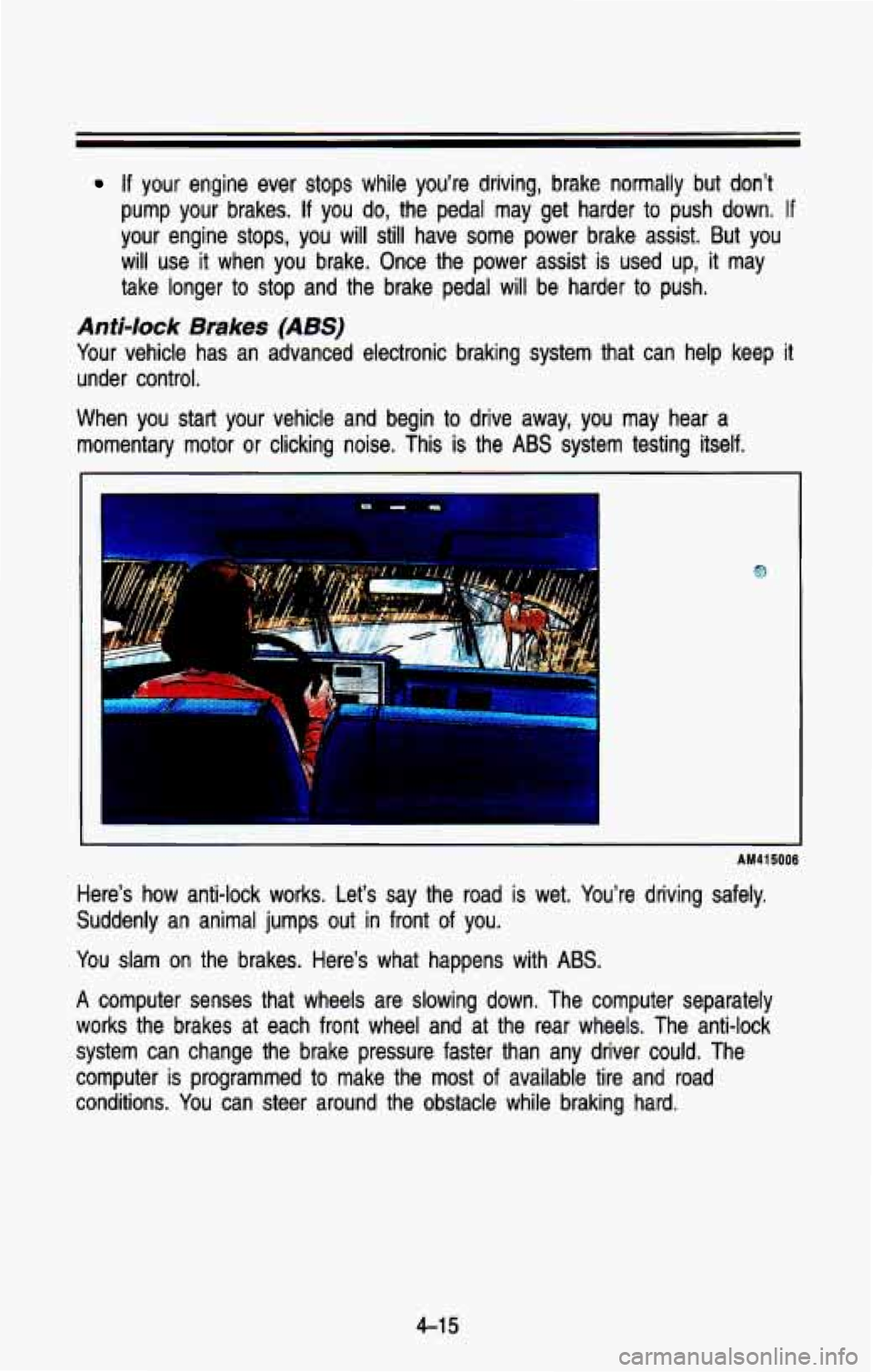
Here’s how anti-lock works. Let’s say the road is wet. Y\
ou’re driving safely.
Suddenly an animal jumps out in front of you.
You slam on the brakes. Here’s what happens with ABS.
A computer senses that wheels are slowing down. The computer sepa\
rately
works the brakes at each front wheel and at the rear wheels. \
The anti-lock
system can change the brake pressure faster than any driver co\
uld. The
computer is programmed to make the
most of available tire and road
conditions. You can steer around the obstacle while braking hard.
4-1 5
Page 185 of 386
Your Driving and the Road
Rear Drum Brakes
Your rear drum brakes don’t have the wear indicators, but if you ever hear a
rear brake rubbing noise, have the rear brake lining inspected.\
Also, the rear
brake drums should be removed and inspected each time the tire\
s are removed for rotation or changing. When you have the front brak\
es replaced,
have the rear brakes inspected, too.
Brake linings should always be replaced as complete axle sets. \
Brake Pedal Travel
See your dealer if the brake pedal does not return to normal height, or if
there is a rapid increase in pedal travel. This could be a sign of brake
trouble.
Brake Adjustment
Every time you make a brake stop, your disc brakes adjust for\
wear. If your
brake pedal goes down farther than normal, your rear drum brak\
es may need
adjustment. Adjust them by backing up and firmly applying the brakes a few
times.
Braking In Emergencies
Use your anti-lock braking system when you need to. With anti-lock, you \
can
steer and brake at the same time. In many emergencies, steerin\
g can help
you more than even the very best braking.
Steering
Power Steering
If you lose power steering assist because the engine stops or the\
system
fails to function, you can steer but it will take much more effort.
Steering Tips
Driving on Curves
It’s important to take curves at a reasonable speed.
A lot of the “driver lost control” accidents mentioned on the n\
ews happen on
curves. Here’s why:
Experienced driver
or beginner, each of us is subject to the same laws of
physics when driving on curves. The traction of the tires against the road
surface makes
it possible for the vehicle to change its path when you turn
the front wheels.
If there’s no traction, inertia will keep the vehicle going in
the same direction.
If you’ve ever tried to steer a vehicle on wet ice, you’ll \
understand this.
4-1 8
 wh")


