1993 CHEVROLET BLAZER engine
[x] Cancel search: enginePage 78 of 386
5. If your engine still won’t start (or starts but then stops), it could be
flooded with too much gasoline.
Try this:
Wait
15 seconds to let the starter motor cool down. Then push your
accelerator pedal all the way to the floor. Hold it there. Th\
en,
hold the
key in
Start for no more than ten seconds. This clears the extra
gasoline from the engine.
If the engine still doesn’t start, wait another
15 seconds and do Step 5 again.
Hot Engine Restart, 5.7L and 7.4L Engines (Vehicles Over 8500 GVWR): If
your engine is already hot and then stalls, turn your ignition\
key to Off. Then,
turn your key
to Run, and wait about 20 seconds before you restart your
engine.
When the engine starts, let go of the key and accelerator ped\
al.
rn rn I NOTICE 1
four engine is designed to work with the electronics in your vehicle. If you
1 electrical parts or accessories, you could change the way the fuel
tction system operates. Before adding electrical equipment, check\
with
hr dealer. If you don’t, your engine might not perform properly.
I you ever have to have your vehicle towed, see the part of this Man,,l
:hat tells how to do it without damaging your vehicle. See “Towing Your
Jehicle”
in the Index.
Driving Through Deep Standing Water
f you drive too quickly through deep puddles or standing water, water can I
:me in through your engine’s air intake and badly damage your engine. If
IOU can’t avoid deen ouddles or standino water, drive through very slowly.
-
2-1 5
Page 79 of 386
Features & Controls
Engine BIock Heater (Option)
i K221
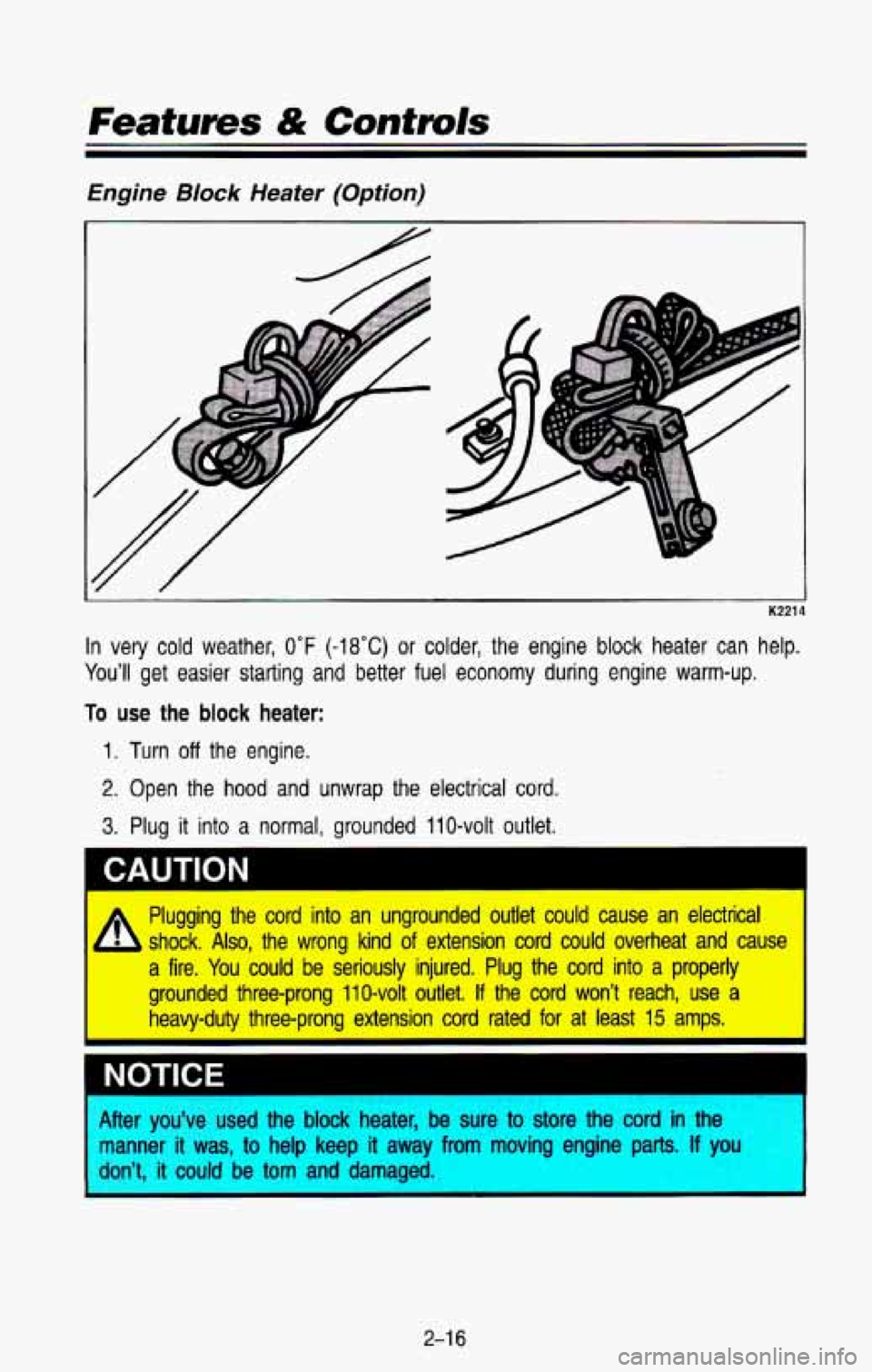
In very cold weather, 0°F (-18°C) or colder, the engine block heater can help.
You’ll get easier
starting and better fuel economy during engine warm-up.
To use the block heater:
1. Turn off the engine.
2. Open the hood and unwrap the electrical cord.
3. Plug it into a normal, grounded 110-volt outlet.
I 4
1
Plugging the cord into an ungrounded outlet muld cause an electrical
L shock, Also, the wrong kind of extension cord could overheat and cause
a fire. You could be seriously injured. Plug the cord into a properly
grounded threeprong 110-volt outlet. If the cord won’t reach, use a
heavy-duty threepmng extension cord rated for at least 15 amps.
I
I NOTICE
ter you’ve used the block heater, be sure to store the cord in the
nanner
it was, to help keep it away from moving engine parts. If you
lon’t, it could be tom and damaged.
2-1 6
Page 81 of 386
- It is dangerous to get out of your vehicle if the shift lever is not fully
4 in P (Park) with the parking brake firmly set. Your vehicle can roll.
Don’t leave your vehicle when the engine is running unless you have
to, If you have left the engine running, the vehicle can move
suddenly.
You or others could be injured. To be sure your vehicle
won’t
move, wh’en you’re on fairly level ground, always set your
parking brake and move the
shift lever to P (Park).
If you have four-wheel drive, your vehicle will be free to roll-even if
your shift lever is in P (Park)-if your transfer case is in N (Neutral).
So, be sure the transfer case is
in a drive gear-not N (Neutral).
See “Shifting Into Park” in the Index. If you are parking on a hill, or
if you’re pulling a trailer, also see “Parking on Hills’’ or ‘Towing a
Trailer”
in the Index.
R (Reverse)
Use this gear
to back up.
I NOTICE
I!
Shifting to R (Reverse) while your vehicle is moving forward could damage
jour transmission. Shift to R (Reverse) only after your vehicle is stopped.
To rock your vehicle back and forth
to get out of snow, ice or sand without
damaging your transmission, see “If You’re Stuck: In Sand, Mud, Ice or
Snow” in the Index.
N (Neutral)
In this setting, your engine doesn’t connect with the wheels.
To restart when
you’re already moving, use
N (Neutral) only. Also, use N when your vehicle is
being towed.
I CAUTION
Shifting out of P (Park) or N (Neutral) while your engine is “racing”
(run’ning at
high speed) is dangerous. Unless your foot is firmly on
the brake pedal, your vehicle could move very rapidly. You could lose
control and hit people or objects. Don’t shift out of P (Park) or N
(Neutral) while your engine is racing. I
2-1 8
Page 82 of 386
NOTICE
Damage to your transmission caused by shifting out of P (Park) or N
{Neutral) with the engine racing isn’t covered by your warranty.
OD (Automatic Overdrive)
This position is for normal driving.
If you need more power for passing, and
vou’re:
- Going less than about 35 mph (56 km/h), push your accelerator
pedal about halfway down
- Going about 35 mph (56 km/h) or more, push the accelerator all the
way down
You’ll shift down to the next gear and have more power.
OD should not be used when towing a trailer, carrying a heavy load, driving
on steep hills, or for off-road driving. Select
D (third gear) when operating the
vehicle under any of these conditions.
D (Third Gear)
This is like
OD, but you never go into Overdrive. You should use D when
towing a trailer, carrying a heavy load, driving on steep hills, or for off-road
driving.
2 (Second Gear)
This position gives you more power but lower fuel economy. You can use
2
on hills. It can help control your speed as you go down steep mountain
roads, but then you would also want
to use your brakes off and on.
If you manually select 2, the transmission will drive in second gear. You may
use this feature for reducing torque to the rear wheels when you are trying to
start your vehicle from a stop on slippery road surfaces.
1 (First Gear)
This position gives you even more power (but lower fuel economy) than
2.
You can use it on very steep hills, or in deep snow or mud. If the selector
lever is put
in 1, the transmission won’t shift into first gear until the vehicle is
going
‘slowly enough.
2-1 9
Page 84 of 386
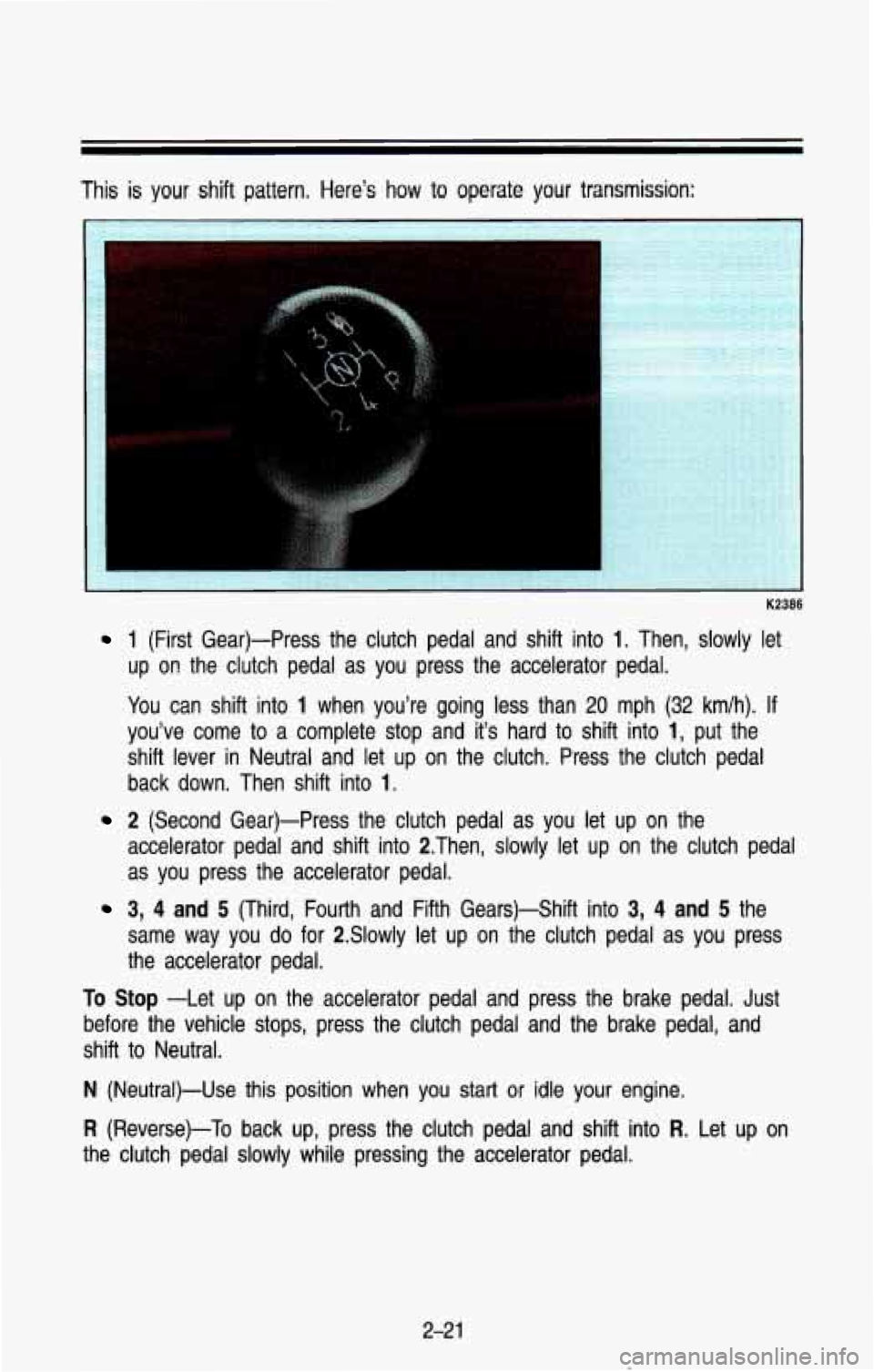
This is your shift pattern. Here’s how to operate your transmission:
-. ’ :- -. .. r
K2386
1 (First Gear)-Press the clutch pedal and shift into 1. Then, slowly let
up
on the clutch pedal as you press the accelerator pedal.
You can shift into
1 when you’re going less than 20 mph (32 km/h). If
you’ve come to a complete stop and it’s hard to shift i\
nto 1, put the
shift lever in Neutral and let up on the clutch. Press the c\
lutch pedal back down. Then shift into
1.
2 (Second Gear)-Press the clutch pedal as you let up on the
accelerator pedal and shift into 2.Then, slowly let up on the \
clutch pedal
as you press the accelerator pedal.
same way you
do for 2.Slowly let up on the clutch pedal as you press
the accelerator pedal.
3, 4 and 5 (Third, Fourth and Fifth Gears)-Shift into 3, 4 and 5 the
To Stop -Let up on the accelerator pedal and press the brake pedal. Just
before the vehicle stops, press the clutch pedal and the brake\
pedal, and
shift to Neutral.
N (Neutral)-Use this position when you start or idle your engine.
R (Reverse)-To back up, press the clutch pedal and shift into R. Let up on
the clutch pedal slowly while pressing the accelerator pedal.
2-21
Page 87 of 386

Features & Controls
Torque Lock
The parking brake should be set first whenever leaving the dri\
ver’s seat. If
you are parked on a hill and the transmission is placed in P (Park) before
the parking brake is set, the weight of the vehicle may put too much force
on the parking pawl in the transmission. It may be difficult to pull the selector
lever
out of P (Park). This is called “torque lock.” To prevent this, the parking
brake should be set
BEFORE moving the selector lever to P (Park).
When preparing to move the vehicle, the selector lever should be moved out
of P (Park) BEFORE releasing the parking brake. Set the parking brake first,
then release the transmission from
P (Park), even on level surfaces.
If “torque lock” does occur, you may have to have another vehicle nudge
your vehicle uphill
a little to take some of the pressure off the transmission
while you pull the selector lever out of
P (Park).
Shifting lnto P (Park) (Automatic Transmission Models Only)
It can be dangerous to get out of your vehicle if the shift lever is not I
A fully in P (Park) with the parking brake firmly set. Your vehicle can
roll.
If you have left the engine running, the vehicle can move suddenl\
y.
You or others could be injured.
To be sure your vehicle won’t move,
when you’re on fairly level ground, use the steps that foll\
ow.
If you have four-wheel drive, and your transfer case is in N (Neutral), I
your vehicle will be free to roll-even if your shift lever is in P
(Park). So, be sure the transfer case is in a drive gear-not in N
(Neutral).
If you are parking on a hill, or if you’re pulling a trailer, also see
I “Parking on Hills” or “Towing a Trailer” in the Index. I
2-24
Page 89 of 386
Features & Controls
Leaving Your Vehicle With the Engine Running (Automatic
Transmission Models Only)
A It can be dangerous to leave your vehicle with the engine running.
h Your vehicle could move suddenly if the shift lever is not fully in
P (Park) with the parking brake firmly set.
If you have four-wheel drive with a manual transfer case shift le\
ver
and your transfer case
is in N (Neutral), your vehicle will be free to
roll, even
if your shift lever is in P (Park). So be sure the transfer
case is in a drive gear-not in
N (Neutral).
And,
if you leave the vehicle with the engine running, it could
overheat and even catch fire. You or others could be injured. Don’t
I leave your vehicle with the engine running unless you have to.\
If you have to leave your vehicle with the englne runnmg, De sure your
vehicle is in
P (Park) and your parking brake is firmly set, before you leave
it.
If you have four-wheel drive with a manual transfer case shift le\
ver, be sure
that the transfer case is in a drive gear-not in
N (Neutral).
After you’ve moved the shift lever into the
P (Park) position, hold the regular
brake pedal down. Then,
see if you can move the shift lever away from
P (Park) without first pulling it toward you.
If you can, it means that the shift lever wasn’t fully locked \
into P (Park).
Parking Your Vehicle (Manual Transmission Models Only)
Before you get out of your vehicle, put your manual transmission in
R (Reverse) and firmly apply the parking brake.
If you have four-wheel drive, be sure your transfer case is in a drive gear.
Your vehicle could roll
if it isn’t.
If you are parking on a hill, or if your vehicle is equipped to tow a trailer,
see “Towing a Trailer” or “Parking on Hills” in the Index.
2-26
Page 91 of 386
Features & Controls
Engine Exhaust
I I
Engine exhaust can kill. It contains the gas carbon monoxide (CO),
which you can’t see or smell. It can cause unconsciousness and
death
.
You might have exhaust coming in if:
0 Your exhaust system sounds strange or different.
Your vehicle gets rusty underneath.
* Your vehicle was damaged in a collision.
Your vehicle was damaged when driving over high points on the
m Repairs weren’t done correctly.
e Your vehicle or exhaust system had been modified improperly.
road or over road debris.
If you ever suspect exhaust is coming into your vehicle:
0 Drive it only with all the windows down to blow out any CO;
and
I * Have
it fixed immediately.
2-28