Page 229 of 386
Your Driving and the Road
Turn Signals When Towing a Trailer
When you tow a trailer, your vehicle has to have a different turn signal
flasher and extra wiring. The green arrows on your instrument \
panel will flash
whenever you signal a turn
or lane change. Properly hooked up, the trailer
lights will also flash, telling other drivers you’re about
to turn, change lanes,
or stop.
When towing a trailer, the green arrows on your instrument pan\
el will flash for
turns even
if the bulbs on the trailer are burned out. Thus, you may think \
drivers behind you are seeing your signal when they are not.
It’s important to
check occasionally to be sure the trailer bulbs are still working.
Driving on Grades
Reduce speed and shift to a lower gear before you start down a long or
steep downgrade. If you don’t shift down, you might have to use your brakes
so much that they would get hot and no longer work well.
On
a long uphill grade, shift down and reduce your speed to 45 mph (70
kmlh) or less to reduce the possibility of engine and transmission overheating.
If you have an automatic transmission, you should use D (or, as you need to,
a lower gear) when towing a trailer. Operating your vehicle in D when towing
a trailer will minimize heat buildup and extend the
life of your transmission.
Or,
if you have a manual transmission with fifth gear and you are to\
wing a
trailer, it’s better not
to use fifth gear, just drive in fourth gear (or, as you
need to, a lower gear).
Parking on Hilk
You really should not park your rig on a hill. If something goes wrong, your
rig could start
to move. People can be injured and both your vehicle and the
trailer can be damaged.
But
if you ever have to park your rig on a hill, here’s how to do it:
1. Apply your regular brakes, but don’t shift into P (Park) yet, or into gear
for a manual transmission.
2. Have someone place chocks under the trailer wheels.
3, When the wheel chocks are in place, release the regular brakes\
until the
4. Reapply the regular brakes. Then apply your parking brake, and \
then
chocks absorb the load.
shift
to P (Park), or R (Reverse) for a manual transmission.
5. If you have a four-wheel-drive vehicle, be sure the transfer case \
is in
a
drive gear-not in
N (Neutral).
4-62
Page 233 of 386
Pm6/ems on the R~ad
Hazard Warning Flashers
AN505005
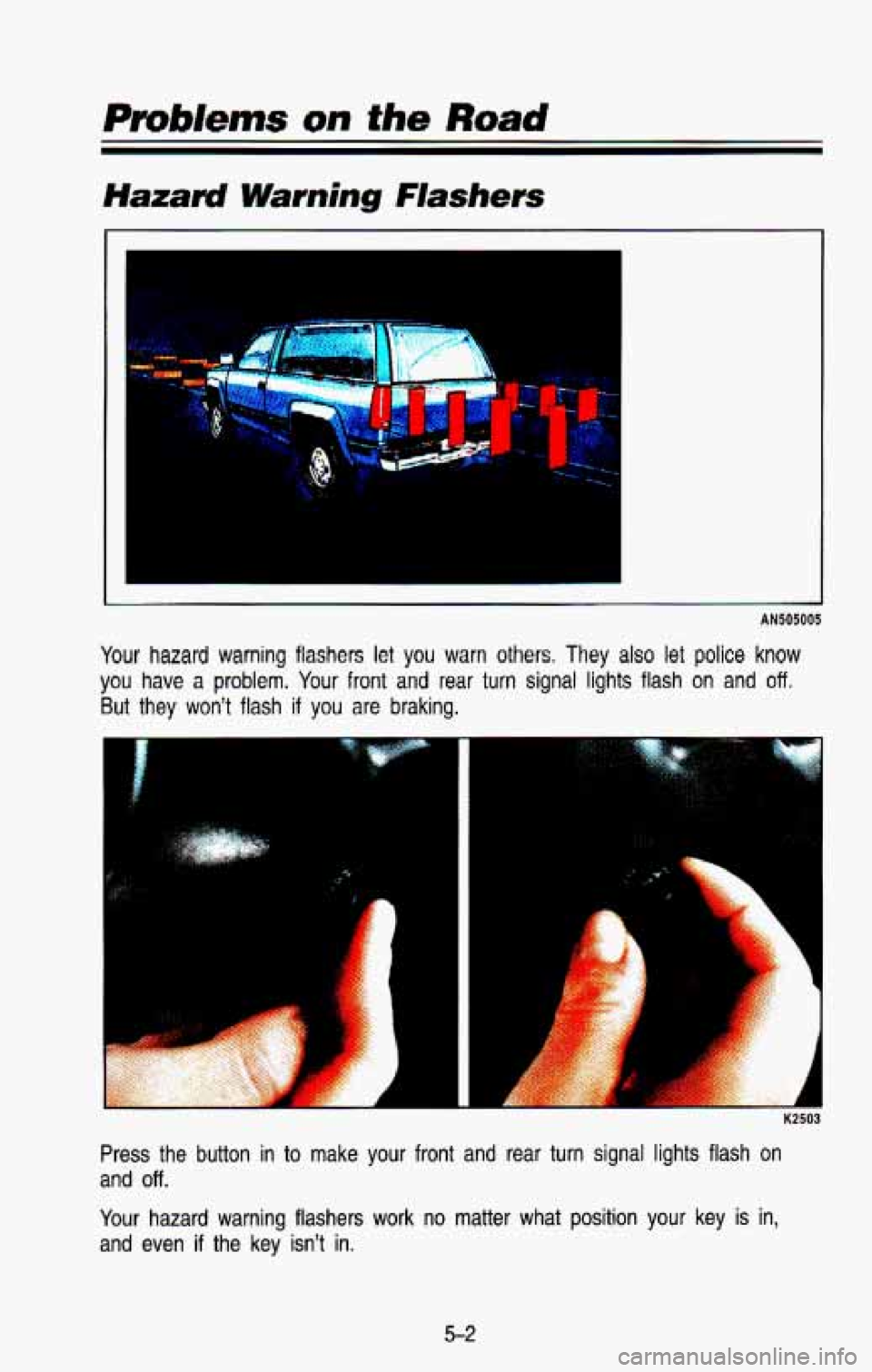
Your hazard warning flashers let you warn others. They also let police know
you have a problem. Your front and rear turn signal lights flash on and off.
But they won't flash if you are braking.
F
1
K2503
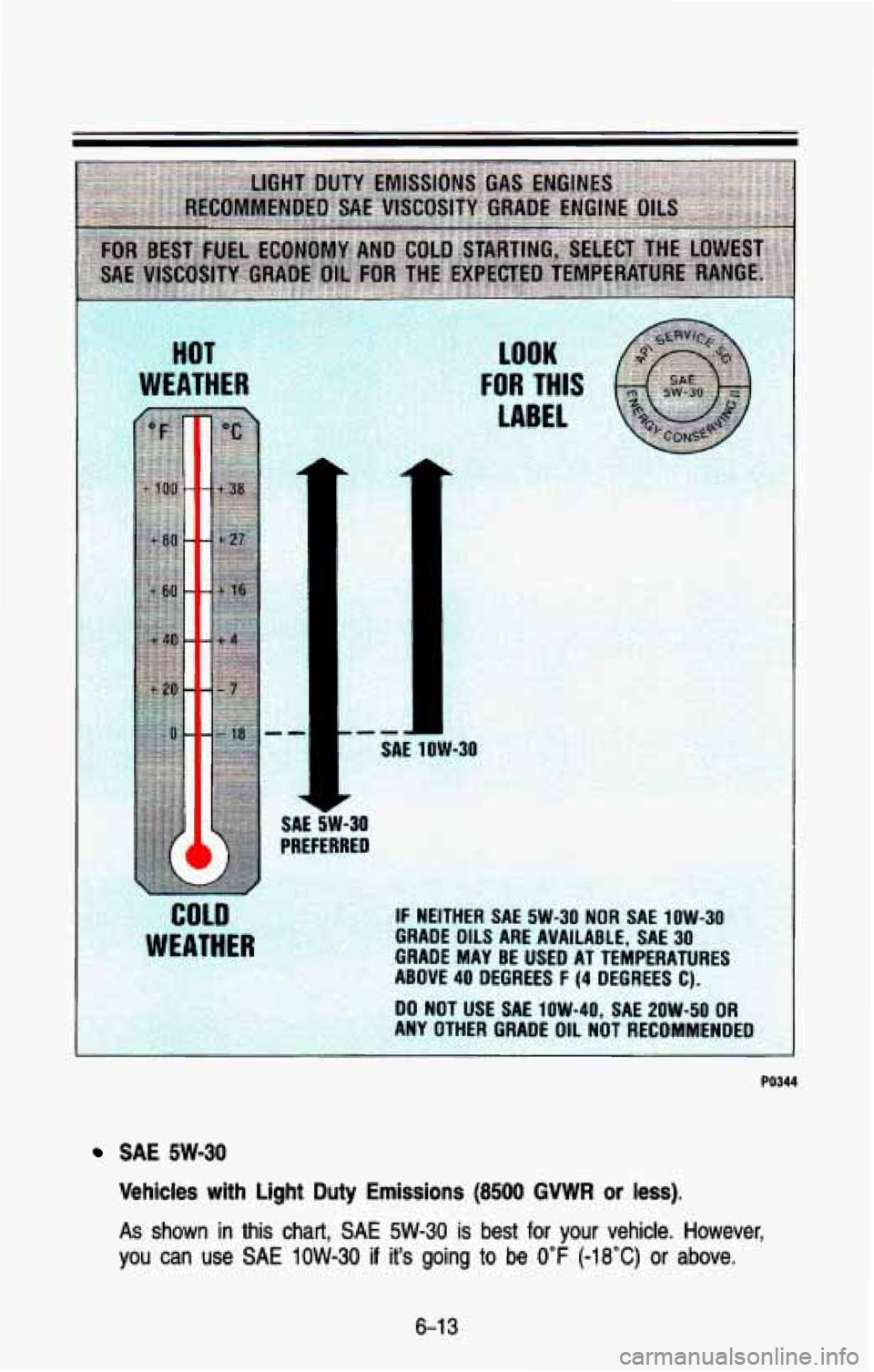
Press the button in to make your front and rear turn signal lights flash on
and off.
Your hazard warning flashers work no matter what position your key \
is in,
and even
if the key isn't in.
Page 235 of 386

ground connection you don’t want. You wouldn’t be able to start your
vehicle, and the bad grounding could damage the electrical systems.
CAUTION
A You could be injured if the vehicles roll. Set the parking brake firmly
on each vehicle. Put an automatic transmission in
P (Park) or a
manual transmission in
N (Neutral).
If you have a four-wheel-drive vehicle, be sure the transfer case is
not in N (Neutral).
3. Turn off the ignition on both vehicles. Turn off all lights that aren’t
needed, and radios. This will avoid sparks and help save both \
batteries.
And it could save your radio!
I
I jou leave a radio on, it could be badly damaged. The repairs woulc
be covered by your warranty.
4. Open the hoods and locate the batteries.
Find the positive
(t) and negative (-) terminals on each battery,
CAUTION
A Using a match near a battery can cause battery gas to explode.
b People have been hurt doing this, and some have been blinded. \
Use
a flashlight if you need more light.
Be sure the batteries have enough water.
You don’t need to add
water
to the Delco Freedom@ battery installed in every new GM
vehicle. But if a battery has filler caps, be sure the right amount of
fluid
is there. If it is low, add water to take care of that first. If you
don’t, explosive gas could be present.
Battery fluid contains acid that can bum you. Don’t get
it on you. If’
you accidentally get it in your eyes or on your skin, flush the place
with water and get medical help immediately. c
5. Check that the jumper cables don’t have loose or missing insulation. If
they do, you could get a shock. The vehicles could be damaged, too.
Before you connect the cables, here are some things you should\
know.
Positive (t) will go to positive (t) and negative (-) will go to negative
5-4
Page 263 of 386
Pmb/ems on the Road
Spinning your wheels can destroy parts of your vehicle as well as the
Rocking your vehicle to get it out:
First, turn your steering wheel left and right. That will clear the area around
your front wheels. Then shift back and forth between R and a forward gear
(or with a manual transmission, between First or Second gear and Reverse),
spinning the wheels as little as possible. Release the accelerator pedal while
you shift, and press lightly on the accelerator pedal when the transmission is
in gear. If that doesn’t get you out after a few tries, you may need to be
towed out. Or, you can use your recovery hooks, if your vehicle has them. If
you do need to be towed out, see “Towing Your Vehicle” in the Index.
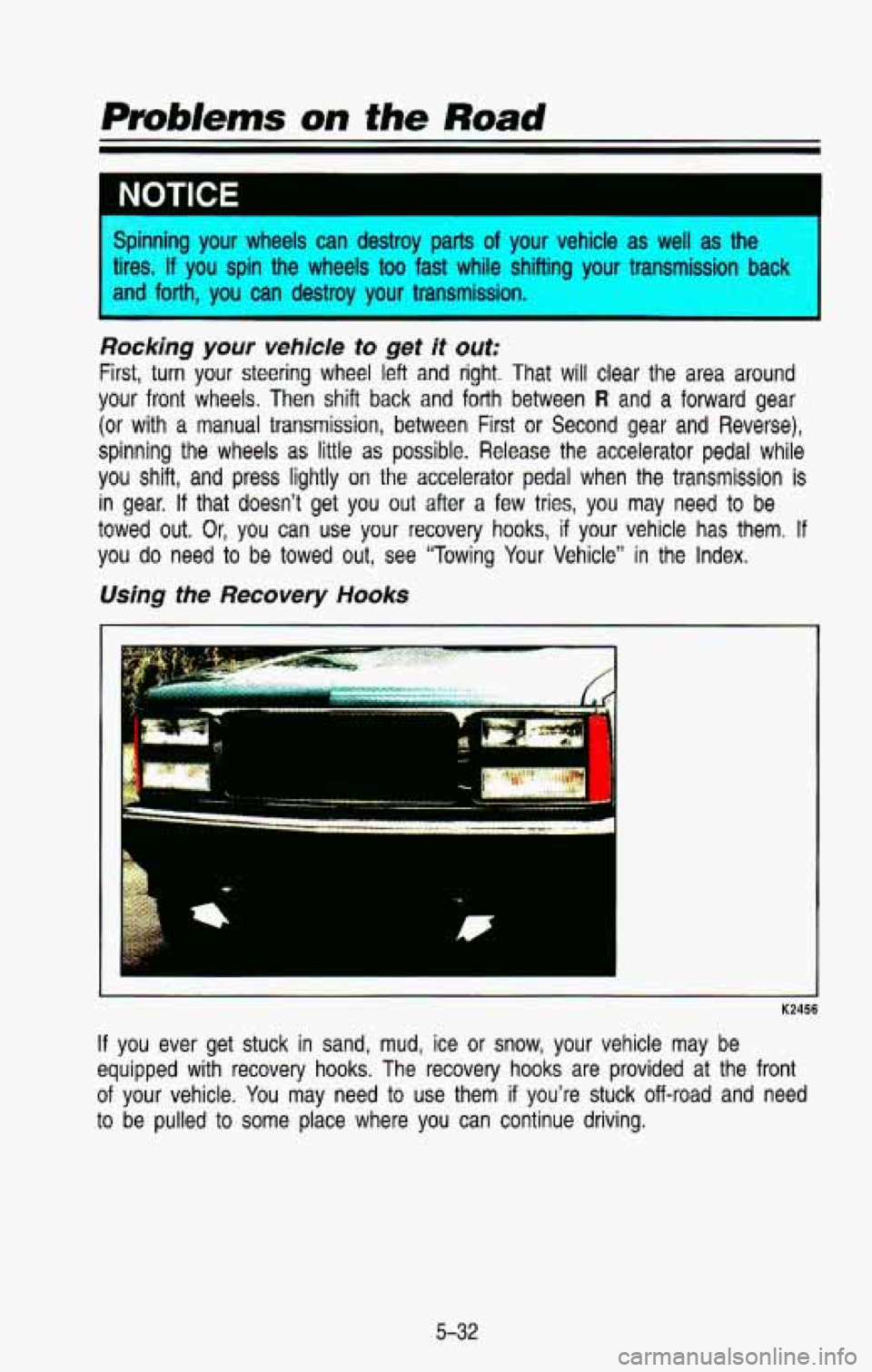
Using the Recovery Hooks
m
K2456
If you ever get stuck in sand, mud, ice or snow, your vehicle may be
equipped with recovery hooks. The recovery hooks are provided a\
t the front
of your vehicle. You may need to use them if you’re stuck off-road and need
to be pulled to some place where you can continue driving.
5-32
Page 278 of 386
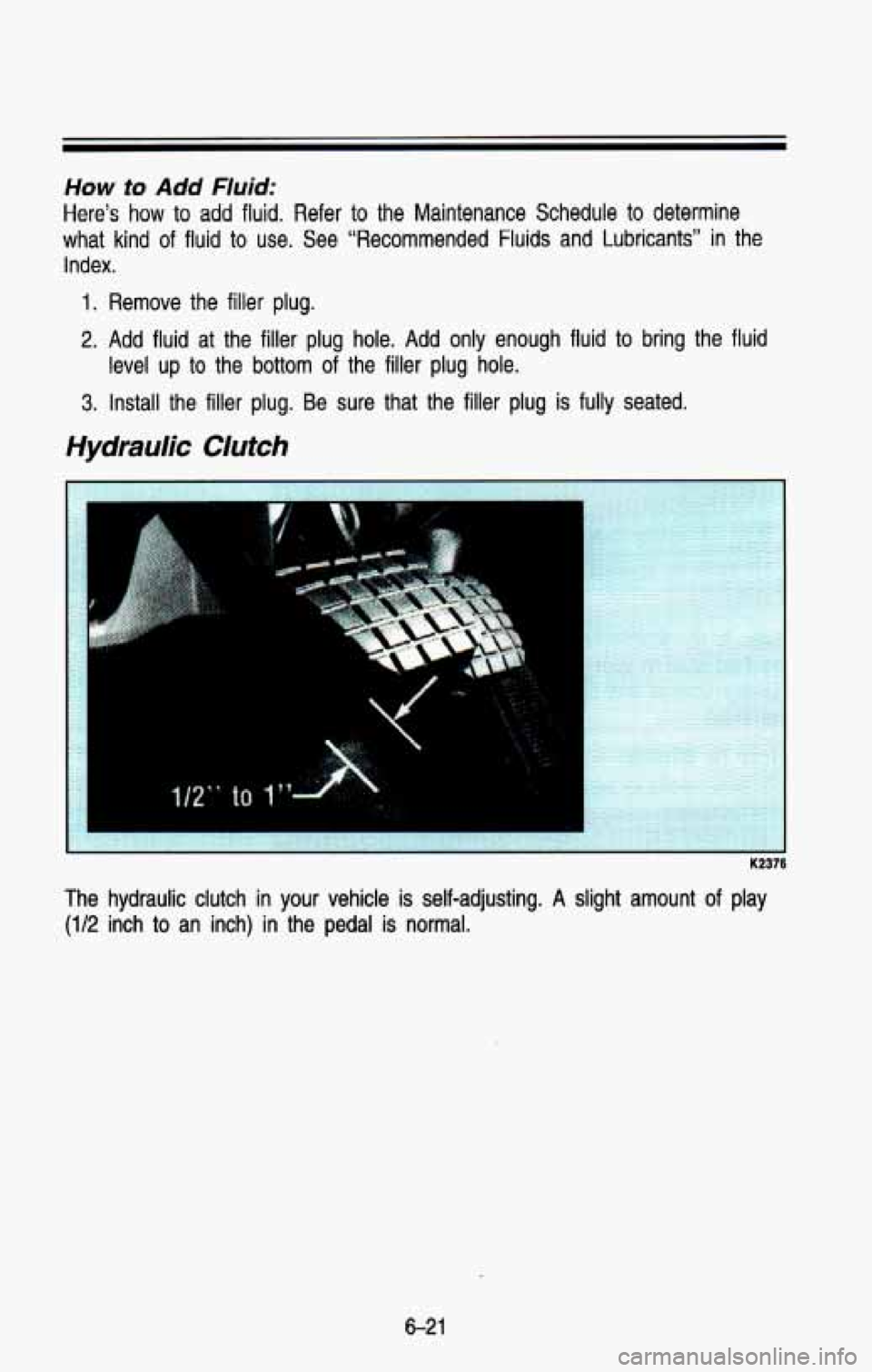
SAE 5W-30
Vehicles with Light Duty Emissions (8500 GVWR or less).
As shown in this chart, SA€ 5W-30 is best for your vehicle. However,
you can use SAE 1OW-30 if it's going to be 0°F (-18°C) or above.
6-1 3
Page 280 of 386
These numbers on an oil container show its viscosity, or thickness.
Do not use other viscosity oils such as SAE 1OW-40 or SAE 2OW-50.
Energy Conserving II
Oils with these words on the container will help you save fuel.
This doughnut-shaped logo (symbol) is used on most oil contai\
ners to help
you select the correct oil,
You should look for this on the
oil container, and use only those oils that
display the logo.
GM Goodwrench@ oil (in Canada, GM Engine Oil) meets all the requirements
for your vehicle.
Engine Oil Addifives:
Don't add anything to your oil. Your GM dealer is ready to advise if you think
something should be added.
When to Change Engine Oil:
See if any one of these is true for you;
Most trips are less than 4 miles (6 km).
It's below freezing outside and most trips are less than 10 miles (16 km).
The engine is at low speed most of the time (as in door to door
You tow a trailer often.
Most trips are through dusty places.
The vehicle is frequently operated off-road. delivery, or in stop-and-go
traffic),
If any one of these is true for your vehicle, then you need to change your oil
and filter every 3,000 miles (5000 km) or 3 months-whichever comes first.
Vehicles with Light Duty Emissions (8500 GVWR or less).
If none of them is true, change the oil every 7,500 miles (1 2 500 km) or 12
months-whichever comes first. Change the filter at the first oil change and at
every other oil change after that.
Vehicles with Heavy Duty Emissions (8501 GVWR or more).
If none of them is true, change the oil every 6,000 miles (1 0 000 km) or 12
months-whichever comes first. Change the filter at the first oil change and at
every other oil change after that if mileage determines when you change your
6-1 5
Page 286 of 386
How to Add Fluid:
Here’s how to add fluid. Refer to the Maintenance Schedule to determine
what kind
of fluid to use. See “Recommended Fluids and Lubricants” in the
Index.
1. Remove the filler plug.
2. Add fluid at the filler plug hole. Add only enough fluid to \
bring the fluid
3. Install the filler plug. Be sure that the filler plug is full\
y seated.
level up
to the bottom of the filler plug hole.
Hydraulic Clutch
I
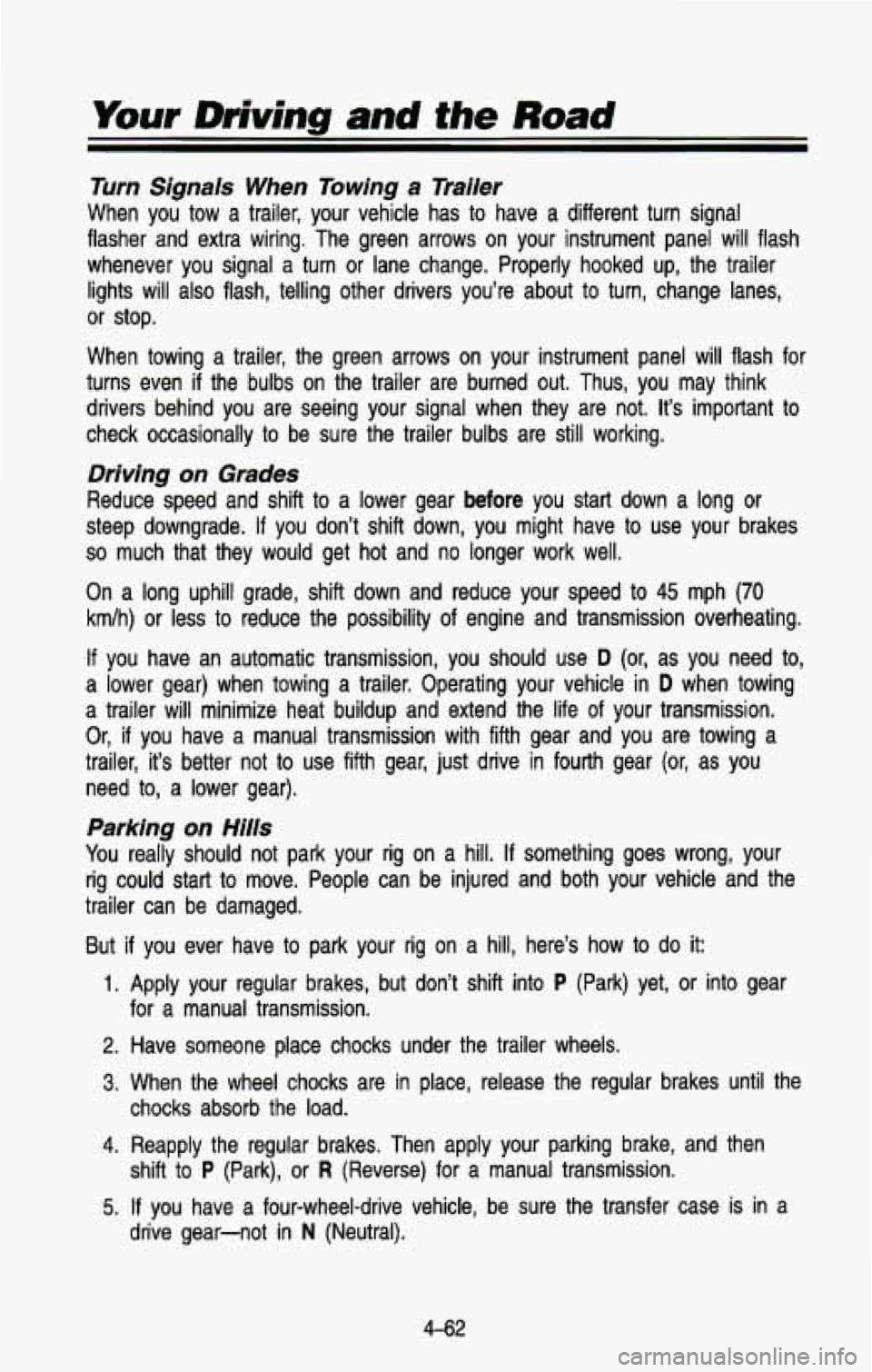
The hydraulic clutch in your vehicle is self-adjusting. A slight amount of play
(1/2 inch to an inch) in the pedal is normal.
6-21
Page 291 of 386

Service & Appearance Care
The following explains your cooling system and how to add cool\
ant when it is
low.
If you have a problem with engine overheating, see “Engine
Overheating” in the Index.
The proper coolant for your vehicle
will:
Give freezing protection down to -34°F (-37°C).
Give boiling protection up to 258°F (125°C).
Protect against rust and corrosion.
Help keep the proper engine temperature.
Let the warning lights and gages work as they should.
What to Use:
Use a mixture of clean water (preferably distilled), and antifreeze that meets
“GM Specification
6038-M,” which won’t damage aluminum parts. Also use
GM Engine Coolant Supplement (sealer) with a complete coolant change.
If
you use these, you don’t need to add anything else.
Adding only plain water to your cooling system can be dangerous.
I
Plain water, or some other liquid like alcohol, can boil before the \
proper coolant mix will. Your vehicle’s coolant warning system is set
for the proper coolant mix. With plain water or the wrong mix, your
engine could get too hot but you wouldn’t get the overheat \
warning. Your engine could catch fire and you or others could be burned. Us\
e
a 50/50 mix of clean water and a proper antifreeze.
jIi ,yo.w use an improper coolant mix, your engine .coutd overheat andi
badly damaged. The repair cost wouldn’t be covered by your warranty.’ TP~
much water in ;the mix can freeze and crack the engine, radiator, .heater
wre-ad -.other parts.
Some conditions, such as air trapped in the cooling system, can affect the
coolant level in the radiator. Check the coolant level when th\
e engine is cold
and follow the steps under “Adding Coolant” for the prope\
r way to
add
coolant.
.. .. ..
If you have to add coolant mdre than four times a year, have your dealer
check
your cooling system.
6-26