1993 CHEVROLET BLAZER light
[x] Cancel search: lightPage 308 of 386

2. Remove the two black plastic plugs in the rear light assembly access
holes.
3. Remove the two rear light assembly screws inside the fender an\
d pull
out the light assembly.
You may want to use a magnetic screwdriver
when removing the screws.
I
PO499
4. Remove the screws from the bulb retainer and take the bulb retainer off
of the light assembly.
5. Pull the old bulb straight out of the socket
6. Put in a new bulb and push it in until it is tight.
7. Replace the bulb retainer.
8. Replace the rear light assembly and tighten the screws. You may want
9. Close the tailgate or rear doors.
Fuses and Circuit Breakers
The wiring circuits in your vehicle are protected from short circuits by a
combination
of fuses, circuit breakers, and fusible thermal links in the wirin\
g
itself. This greatly reduces the chance
of fires caused by electrical problems.
See “Fuses and Circuit Breakers” in the Index for more information.
to use a magnetic screwdriver when installing the screws.
Headlights
The headlight wiring is protected by a circuit breaker
in the light switch. An
electrical overload will cause the lights
to go on and off, or in some cases to
remain
off. If this happens, have your headlight wiring checked right away.
6-43
Page 309 of 386
Service & Appearance Care
Windshield Wipers
The windshield wiper motor is protected by a circuit breaker and a fuse. If
the motor overheats due to heavy snow, etc., the wiper will stop until the
motor cools.
If the overload is caused by some electrical problem and not
snow, etc., be sure to get
it fixed,
Power Windows and Other Power Options
Circuit breakers in the fuse panel protect the power windows and other power
accessories. When the current load
is too heavy, the circuit breaker opens
and
closes, protecting the circuit until the problem is fixed or goes away.
Trailer Wiring Harness
The optional seven-wire trailer wiring harness is protected by an in-line fuse
in the battery feed wire. This fuse is near the junction
block. See “Trailer
Wiring Harness” in the Index for more information.
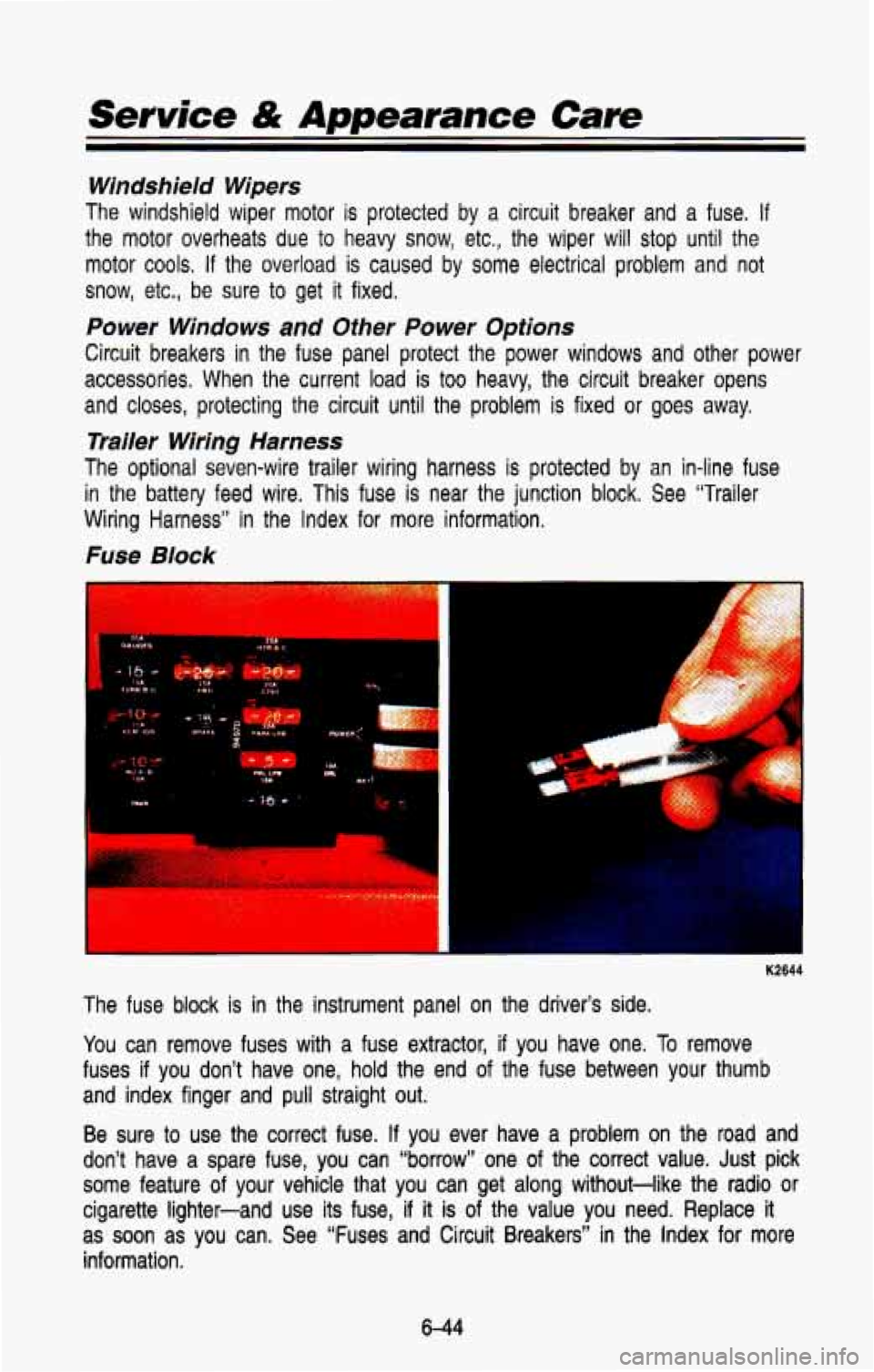
Fuse Block
m
, .. .
i
-+ lW -
-=
. . . . . . . . .
..
K2644
The fuse block is in
the instrument panel on the driver’s side.
You can remove fuses with a fuse extractor, if you have one. To remove
fuses
if you don’t have one, hold the end of the fuse between your thumb
and index finger and pull straight out.
Be sure to use the correct fuse.
If you ever have a problem on the road and
don’t have a spare fuse, you can “borrow” one of the correct value. Just pick
some feature of your vehicle that you can get along without-like the radio \
or
cigarette lighter-and use
its fuse, if it is of the value you need. Replace it
as
soon as you can. See “Fuses and Circuit Breakers” in the Index for more
information.
644
Page 310 of 386

Exhaust System
To help prevent damage to your exhaust system, do not continue to drive
your vehicle
if you notice:
Engine misfiring
Loss of performance
Other unusual operating conditions
Have your engine and exhaust system serviced regularly.
Three- Way Catalytic Converter
Your vehicle’s three-way catalytic converter is designed to reduce the
pollutants in your vehicle’s exhaust. Use only unleaded fuel in your vehic\
le. If
you use leaded fuel, you could damage your three-way catalytic \
converter,
and other engine components.
Computer Command Control System
This system has an oxygen (OS) sensor that helps keep your engine’s
air-fuel mixture at a proper level. Use only unleaded fuel in your vehicle.
If
you use leaded fuel, you could damage your oxygen (OS) sensor and
three-way catalytic converter.
The Malfunction Indicator Lamp
(SERVICE ENGINE SOON) on your
instrument panel lets you know when your emission control syste\
m needs
service. The light will come on briefly when you start your e\
ngine to let you know that the system
is working. If it does not come on when you start your
engine, or
if it comes on and stays on while you’re driving your system may \
need service. Your vehicle should still be driveable, but you should have your
system serviced right away.
Secondary Air Injection (AIR) System
You may have this system. It lets you know if your engine control module,
wiring harness or solenoid need service.
If the Malfunction Indicator Lamp
(Service Englne Soon) comes on, you need service.
645
Page 321 of 386
I CAUTION I
A Using the wrong replacement wheels, wheel bolts or wheel nuts on
your vehicle can be dangerous.
It could affect the braking and
handling
of your vehicle, make your tires lose air and make you lose
control. You could have an collision in which you or others could be
injured. Always use the correct wheel, wheel
bolts, and wheel nuts
for replacement.
I
I
I The wrong wheel can also cause problems with bearing life, brake cooling,
speedometerlodometer calibration, headlight aim, bumper height, vehicle
ground clearance, and tire
or tire chain clearance to the body and chassis.
A Putting a used wheel on your vehicle is dangerous. You can't know
how it's been used or how many miles it's been driven. It could fail
suddenly and cause an accident. If you have to replace a wheel, use
a new GM original equipment wheel,
I
Tire Chains
rNOTICE 'If put vehicle has LT265/75R16 size tires, don't use tire chams; they i can!
damage your vehicle.
6-56
Page 323 of 386

Service & Appearance Care
Cleaning the Inside of Your Vehjcle
Use a vacuum cleaner often to get rid of dust and loose dirt\
. Wipe vinyl with
a clean, damp cloth.
Your GM dealer has
two GM cleaners-a solvent-type spot lifter and a foam-type
powdered cleaner. They will clean normal spots and stains very \
well.
Here are some cleaning tips:
Always read the instructions on the cleaner label.
Clean up stains as soon as you can-before they set.
Use a clean cloth or sponge, and change to a clean area often. A soft
brush may be used
if stains are stubborn.
Use solvent-type cleaners in a well ventilated area only. If you use them,
don’t saturate the stained area.
If a ring forms after spot cleaning, clean the entire area immedi\
ately or it
will set.
Using Foam-Type CIeaner on Fabric
Vacuum and brush the area to remove any loose dirt.
Always clean a whole trim panel or section. Mask surrounding trim along
stitch or welt lines.
Mix Multi-Purpose Powdered Cleaner following the directions on t\
he
Use suds only and apply with a clean sponge.
container label.
Don’t saturate the material.
Don’t rub
it roughly.
As soon as you’ve cleaned the section, use a sponge to remove the
suds.
Rinse the section with a clean, wet sponge.
Wipe off what’s left with a slightly damp paper towel or cloth.
Then dry it immediately with an air hose, a hair dryer or a heat lamp.
NOTICE I
Be careful with a hair dryer or heat lamp. You could scorch the fabric
Wipe with a clean cloth.
6-58
Page 324 of 386
Using Solvent-Type CIeaner on Fabric
First, see if you have to use solvent-type cleaner at all. Some spots and
stains will clean
off better with just water and mild soap.
If you need to use it, then:
Gently scrape excess soil from the trim material with a clean, dull knife
or scraper. Use very little cleaner, light pressure and clean cloths
(preferably cheesecloth). Cleaning should start at the outside \
of the stain,
“feathering” toward the center. Keep changing
to a clean section of the
cloth
.
When you clean a stain from fabric, immediately dry the area with an air
hose, hair dryer, or heat lamp
to help prevent a cleaning ring. (See
previous NOTICE.)
Fabric Profection
Your vehicle has upholstery that has been treated with ScotchgardTM \
Fabric
Protector, a
3M product. ScotchgardTM protects fabrics by repelling oil and
water, which are the carriers
of most stains. Even with this protection, you
still need
to clean your upholstery often to keep it looking new.
Further information on cleaning is available by calling
1-800-433-3296 (in
Minnesota,
1-800-642-61 67).
Special Cleaning Problems
Greasy or Oily Stains: Like grease, oil, butter, margarine, shoe polish, coffee
with cream, chewing gum, cosmetic creams, vegetable oils, wax c\
rayon, tar
and asp ha1
t .
Carefully scrape off excess stain.
Then follow the solvent-type instructions above.
Shoe polish, wax crayon, tar and asphalt will stain if left on a vehicle
seat fabric. They should be removed as soon as possible. Be c\
areful, because the cleaner will dissolve them and may cause them
to bleed.
Non-Greasy Stains: Like catsup, coffee (black), egg, fruit, fruit juice, milk,
soft drinks, wine, vomit, urine and blood.
Carefully scrape off excess stain, then sponge the place with cool water.
If a stain remains, follow the foam-type instructions above.
If an odor lingers after cleaning vomit or urine, treat the area with a
watedbaking soda solution:
1 teaspoon (5 ml) of baking soda to 1 cup
(250 ml) of lukewarm water.
Finally, if needed, clean lightly with solvent-type cleaner.
6-59
Page 333 of 386
Service & Appearance Care
Specification Charts
Replacement Parts
Replacement part numbers listed in this section are based on the latest
information available at the time
of printing, and are subject to change. If a
part listed in this manual is not the same as the part used in your vehicle
when
it was built, or if you have any questions, please contact your GM truck
dealer.
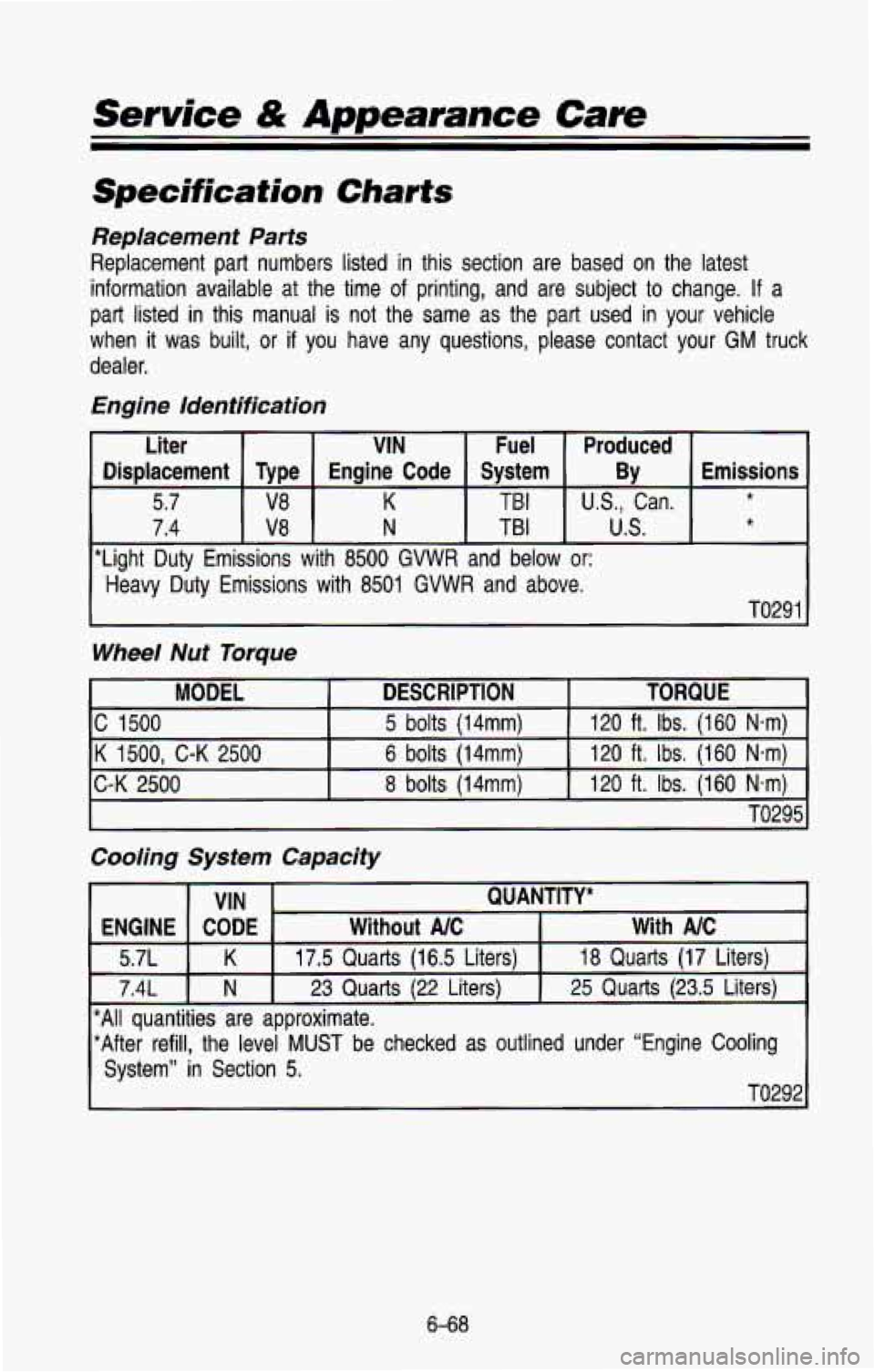
Engine identification
Liter VIN Fuel Produced
Displacement Type Engine Code System BY Emissions
5.7 V8 K TB I U.S., Can.
7.4 V8 N TB I us.
*
*
*Light Duty Emissions with 8500 GVWR and below or:
Heavy Duty Emissions with 8501 GVWR and
above.
TO291
Wheel Nut Torque
MODEL DESCRIPTION TORQUE
C 1500 5 bolts (14mm) 120 ft. Ibs. (1 60 Nmm)
K 1500, C-K 2500 6 bolts (1 4mm) 120 ft. Ibs. (160
N-m)
C-K 2500 8 bolts (14mm) 120 ft. Ibs. (160 Nem)
I TO2951
Cooling System Capacity
VIN QUANTITY*
ENGINE CODE Without NC With AIC
5.7L K 17.5 Quarts (16.5 Liters)
18 Quarts (1 7 Liters)
7.4- N 23 Quarts
(22 Liters) 25 Quarts (23.5 Liters)
*All quantities are approximate.
*After refill, the level
MUST be checked as outlined under “Engine Cooling
System” in Section
5.
TO292
6-68
Page 335 of 386
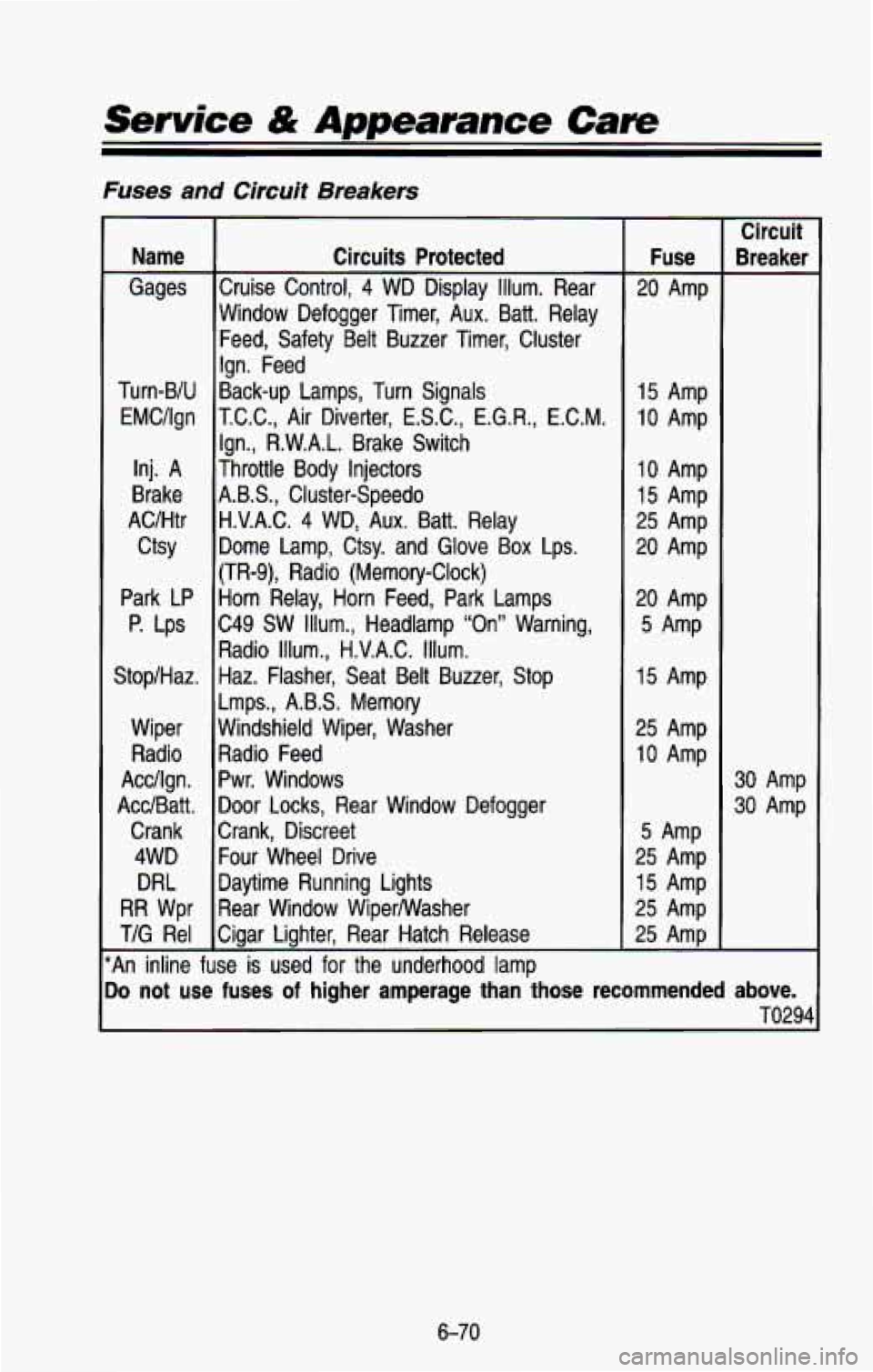
Fuses and Circuit Breakers
Name
Gages
Turn-BIU EMCIIgn
Inj.
A
Brake
AC/Htr
ctsy
Park LP
P. Lps
StopiHaz.
Wiper Radio
Acc/lgn.
AcdBatt. Crank 4WD
DRL
RR Wpr
TIG Re1
Circuits Protected
Cruise Control, 4 WD Display Illum. Rear
Window Defogger Timer, Aux. Batt. Relay Feed, Safety Belt Buzzer Timer, Cluster
Ign. Feed
Back-up Lamps, Turn Signals
T.C.C., Air Diverter, E.S.C.,
E.G.R., E.C.M.
Ign., R.W.A.L. Brake Switch
Throttle Body Injectors
A.B.S., Cluster-Speed0
H.V.A.C.
4 WD, Aux. Batt. Relay
Dome Lamp, Ctsy. and Glove Box Lps.
(TR-9), Radio (Memory-Clock)
Horn Relay, Horn Feed, Park Lamps C49 SW Illum., Headlamp
“On” Warning,
Radio Illum., H.V.A.C. Illum.
Haz. Flasher, Seat Belt Buzzer, Stop
Lmps., A.B.S. Memory
Windshield Wiper, Washer
Radio Feed
Pwr. Windows
Door Locks, Rear Window Defogger Crank, Discreet
Four Wheel Drive
Daytime Running Lights
Rear Window Wiperwasher
Cigar Lighter, Rear Hatch Release
Fuse
20 Amp
15 Amp
10 Amp
10 Amp
15 Amp
25
Amp
20 Amp
20 Amp
5 Amp
15 Amp
25 Amp
10 Amp
5 Amp
25 Amp
15 Amp
25 Amp
25 Amp
Circuit
Breaker
30 Amp
30 Amp
An inline fuse is used for the underhood lamp
Jo not use fuses of higher amperage than those recommended above.
TO291
6-70