1993 CHEVROLET BLAZER check engine
[x] Cancel search: check enginePage 78 of 386
5. If your engine still won’t start (or starts but then stops), it could be
flooded with too much gasoline.
Try this:
Wait
15 seconds to let the starter motor cool down. Then push your
accelerator pedal all the way to the floor. Hold it there. Th\
en,
hold the
key in
Start for no more than ten seconds. This clears the extra
gasoline from the engine.
If the engine still doesn’t start, wait another
15 seconds and do Step 5 again.
Hot Engine Restart, 5.7L and 7.4L Engines (Vehicles Over 8500 GVWR): If
your engine is already hot and then stalls, turn your ignition\
key to Off. Then,
turn your key
to Run, and wait about 20 seconds before you restart your
engine.
When the engine starts, let go of the key and accelerator ped\
al.
rn rn I NOTICE 1
four engine is designed to work with the electronics in your vehicle. If you
1 electrical parts or accessories, you could change the way the fuel
tction system operates. Before adding electrical equipment, check\
with
hr dealer. If you don’t, your engine might not perform properly.
I you ever have to have your vehicle towed, see the part of this Man,,l
:hat tells how to do it without damaging your vehicle. See “Towing Your
Jehicle”
in the Index.
Driving Through Deep Standing Water
f you drive too quickly through deep puddles or standing water, water can I
:me in through your engine’s air intake and badly damage your engine. If
IOU can’t avoid deen ouddles or standino water, drive through very slowly.
-
2-1 5
Page 131 of 386
Features & Controls
Do not operate the engine with the tachometer in the red area, or engine
damage may occur.
Damage
to your engine or vehicle caused by operating the engine in the
red area isn’t covered by your vehicle warranty.
Warning Lights, Gages and lndicafors
This part describes the warning lights and gages that are on \
your vehicle.
The pictures will help you locate them.
Warning lights and gages can signal that something is wrong be\
fore it
becomes serious enough
to cause an expensive repair or replacement. Paying
attention to your warning lights and gages could also save you or others from
injury.
Warning lights go on when there may be or is a problem with one of your
vehicle’s functions.
As you will see in the details on the next few pages,
some warning lights come on briefly when you turn the ignition\
key just
to let
you know they’re working.
If you are familiar with this part, you should not be
alarmed when this happens.
Gages can indicate when there may be
or is a problem with one of your
vehicle’s functions. Often gages and warning lights work together to let you
know when there’s
a problem with your vehicle.
When one of the warning lights comes on and stays on when you are
driving, or when one of the gages shows there may be a problem, check the
part that tells you what to
do about it. Please follow the manual’s advice.
Waiting
to do repairs can be costly-and even dangerous. So please get to
know your warning lights and gages. They’re a big help.
2-68
Page 134 of 386
Charging System Light
1
K2328
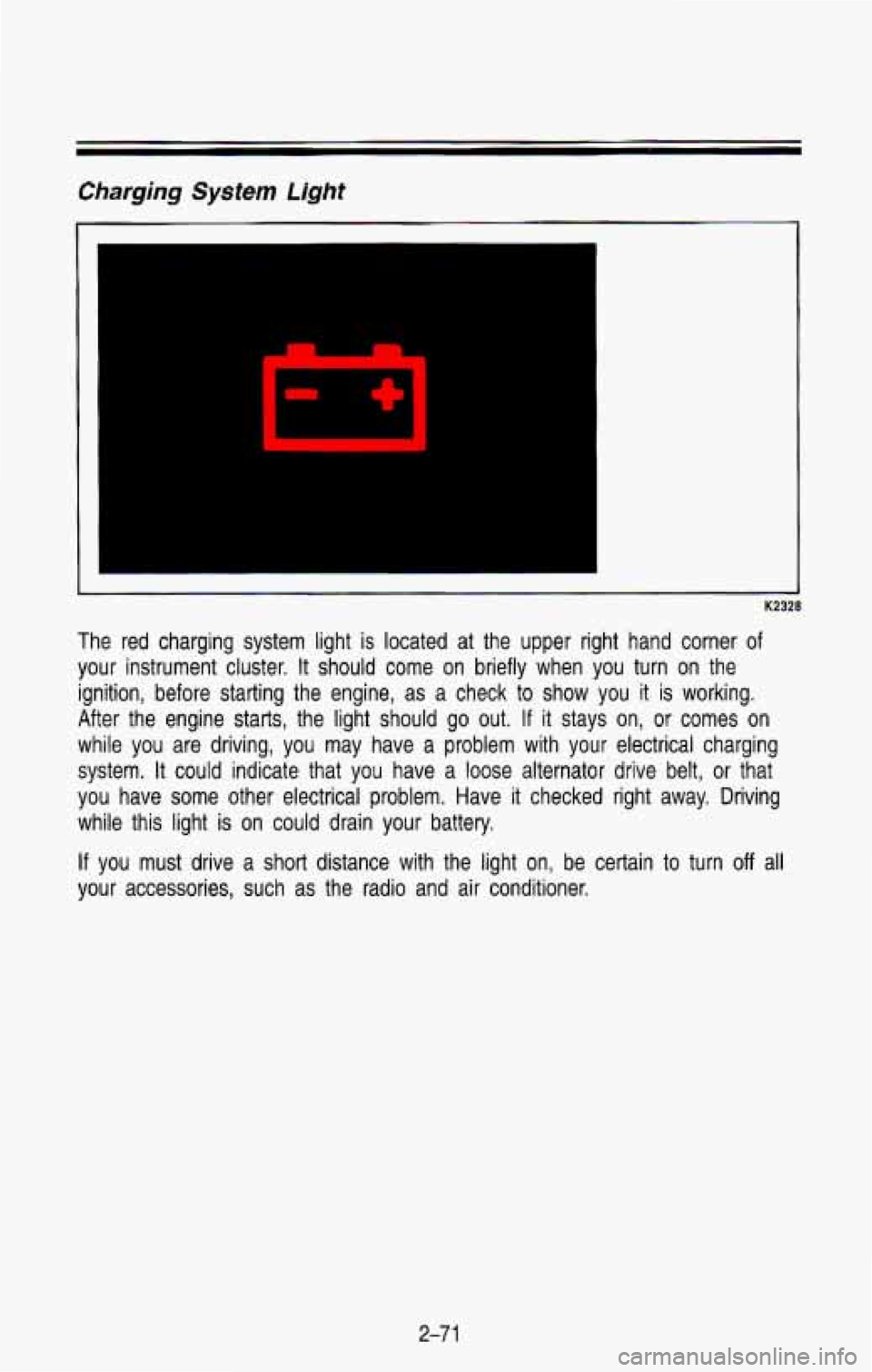
The red charging system light is located at the upper right hand corner of
your instrument cluster. It should come on briefly when you turn on the
ignition, before starting the engine, as a check
to show you it is working.
After the engine starts, the light should go out.
If it stays on, or comes on
while you are driving, you may have a problem with your elect\
rical charging
system. It could indicate that you have a loose alternator drive belt, or that
you have some other electrical problem. Have it checked right away. Driving
while this light is on could drain your battery.
If you must drive a short distance with the light on, be certain to turn off all
your accessories, such as the radio and air conditioner.
2-7 1
Page 135 of 386

Malfunction Indicator Lamp (Service Engine Soon Light)
RVI
llrll
I
K2329
A computer monitors operation of your fuel, ignition and emission control
systems. This light should come on when the ignition is on,
but the engine is
not running, as a check
to show you it is working. If it does not come on at
all, have it fixed right away. If it stays on, or comes on while you are driving,
the computer is indicating that you have a problem. You should take your
vehicle in
for service soon.
If you keep driving your vehicle with this light on, after awhile the emission
controls won’t work as well, your fuel economy won’t be as good, and
your engine may not
run as smoothly. This could lead to costly repairs not
covered
by your warranty. I
2-72
Page 136 of 386
CHECK GAGES Light
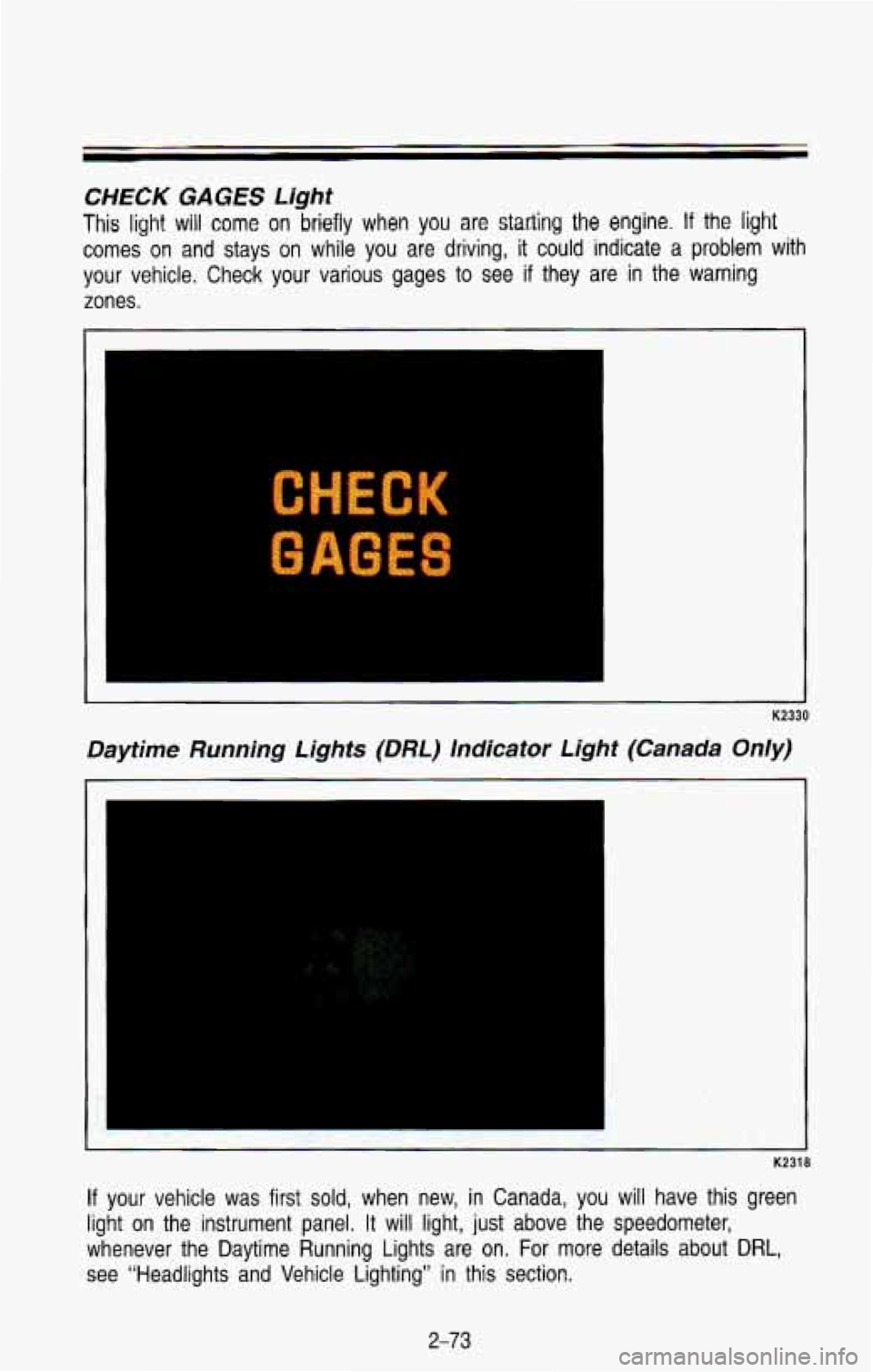
This light will come on briefly when you are statling the engine. If the light
comes on and stays on while you are driving, it could indicate a problem with
your vehicle. Check your various gages to see if they are in the warning
zones.
C “5 XK
GAGES
K2330
Daytime Running Lights (DRL) Indicator tight (Canada Only)
K2318
If your vehicle was first sold, when new, in Canada, you will have this green
light on the instrument panel. It will light,
just above the speedometer,
whenever the Daytime Running Lights are on. For more details a\
bout
DRL,
see “Headlights and Vehicle Lighting’’ in this section.
2-73
Page 142 of 386

A reading in the low pressure zone may be caused by a dangerouslv low oil
level or other problem causing low oil pressure. Check your oi\
l as soon as
possible.
CAUTION
Don’t keep driving if the oil pressure is low. If you do, your engine
can become so hot that it catches on fire, You or others could be
burned. Check your oil as soon as possible and have your vehicle
serviced.
e NOTICE
I
Damage to your engine from neglected oil problems can rnstly at,,
not covered by your ‘Avanty.
I
Voltmeter
Standard Cluster
14
Tachometer Cluster
19
GL
K2336
When your engine is not running, but the ignition is on (in \
the Run position),
this gage
shows your battery’s state of charge in DC volts. When the engine
is running, the gage shows the condition
of the charging system. Readings
between the low and high warning zones indicate the normal ope\
rating range.
Readings in either warning zone indicate a possible problem in \
the electrical
system.
2-79
Page 201 of 386
CAUTION I
If Driving on frozen lakes, ponds or rivers can be dangerous.
-L Underwater springs, currents under the ice, or sudden thaws can
weaken the ice. Your vehicle could fall through the ice and you and
your passengers could drown. Drive your vehicle on safe surfaces
only.
I
t
Driving In Water
Light rain causes no special off-road driving problems. But hea\
vy rain can
mean flash flooding, and flood waters demand extreme caution.
Find out how deep the water is before you drive through it. If it’s deep
enough to cover your wheel hubs, axles, or exhaust pipe, don’t try it\
-you
probably won’t get through. Also, water that deep can damage\
your axle and
other vehicle parts.
If the water isn’t too deep, then drive through it slowly. At fast speeds, water
splashes on your ignition system and your vehicle can stall. S\
talling can also
occur
if you get your tailpipe under water. And, as long as your tailpipe is
under water, you’ll never be able to start your engine. When you go through
water, remember that when your brakes get wet,
it may take you longer to
stop.
CAUTION
C
Driving through rushing water can be dangerous. Deep water can \
sweep your vehicle downstream and you and your passengers could\
drown. If it’s only inches deep, it can still wash away the ground
from under your tires, and you could lose traction and roll t\
he vehiclc
over. Don’t drive through rushing water.
I
After Off-Road Driving
Remove any brush or debris that has collected on the underbody\
, chassis, or
under the hood. These accumulations can be a fire hazard.
After operation in mud or sand, have the brake linings cleaned and checked.
These substances can cause glazing and uneven braking. Check th\
e body
structure, steering, suspension, wheels, tires, and exhaust syste\
m for damage.
Also, check the fuel lines and cooling system for any leakage.
Your vehicle will require more frequent service due
to off-road use, Refer to
Section
7 for additional information.
4-34
Page 212 of 386
Before Leaving on a Long Trip
Make sure you’re ready. Try to be well rested. If you must start when you’re
not fresh-such as after a day’s work-don’t plan to make too many miles
that first part of the journey. Wear comfortable clothing and shoes you can
easily drive in.
Is your vehicle ready for a long trip? If you keep it serviced and maintained,
it’s ready to go. If it needs service, have it done before starting out. Of
course, you’ll find experienced and able service experts
in your vehicle’s
dealerships all across North America. They’ll be ready and w\
illing to help
if
you need it.
Here are some things you can check before a trip:
e
e
On
Windshield Washer Fluid: Is the reservoir full? Are all windows clean
inside and outside?
Wiper Blades: Are they in good shape?
Fuel, Engine Oil, Other Fluids: Have you checked all levels?
Lights: Are they all working? Are the lenses clean?
Tires: They are vitally important to a safe, trouble-free trip. Is the tread
good enough for long distance driving? Are the tires all inflated to the
recommended pressure?
Weather Forecasts: What’s the weather outlook along your route?
Should you delay your trip a short time to avoid a major storm system?
Maps: Do you have up-to-date maps?
the Road
Unless you are the only driver, it is good to share the driving task with
others. Limit turns behind the wheel to about
100 miles (160 km) or two
hours at a sitting. Then, either change drivers or stop for s\
ome refreshment
like coffee, tea or soft drinks and some limbering up. But do stop and move
around. Eat lightly along the way. Heavier meals tend
to make some people
sleepy.
On two-lane highways or undivided multilane highways that do not have
controlled access, you’ll want to watch for some situations not usually found
on freeways. Examples are: stop signs and signals, shopping cen\
ters with
direct access to the highway, no passing zones and school zones, vehicles
turning left and right
off the road, pedestrians, cyclists, parked vehicles, and
even animals.
4-45