1993 CADILLAC SEVILLE problems on the road
[x] Cancel search: problems on the roadPage 13 of 407
Downloaded from www.Manualslib.com manuals search engine This Cadillac Manual is divided into major sections.
Introduction - How to use this Manual .....................
This section tells you how to use your Manual and includes
Safety and Vehicle Damage Warnings and Symbols
11
Section 1 - Seats and Safety Belts .........................
This section tells you how to use your seats and safety
belts properly.
61
Section 2 - Features and Controls ........................
This section explains how. to start and operate your Cadillac.
63 I
Section 3 - Comfort Controls and Audio Systems .......... 146 I
This section tells you how to adjust the ventilation and
comfort controls
and how to operate your Sound System.
Section 4 - Your Driving and the Road ................... 165 I
Here you’ll find helpful information and tips about the
road and how
to drive under different conditions.
Section 5 - Problems on the Road ....................... 220 I
This section tells you what to do if you have a problem
while driving, such as a flat tire,
or engine overheating.
Section 6 - Service and Appearance Care ................. 261 I
Here the manual tells you how to keep your Cadillac
running properly and looking good.
For more information on “Reporting Safety Defects”, see Owner
Assistance,
Page 7.
First Edition
Page 144 of 407
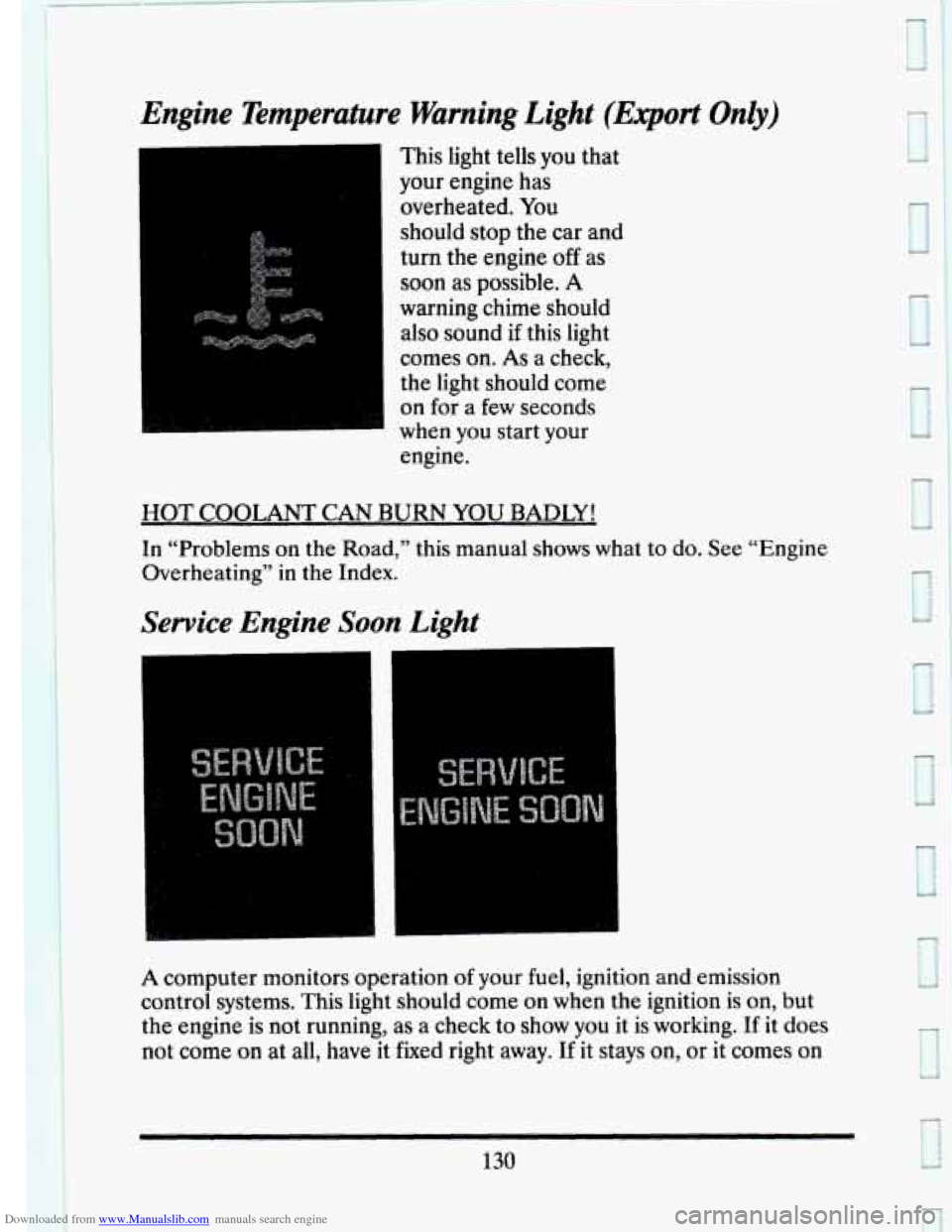
Downloaded from www.Manualslib.com manuals search engine Engine Temperature Warning Light (Export Only)
This light tells you that
your engine has
overheated. You
should stop the car and
turn the engine
off as
soon
as possible. A
warning chime should also sound if this light
comes on.
As a check,
the light should come
on for
a few seconds
when you start your
engine.
HOT COOLANT CAN BURN YOU BADLY!
In “Problems on the Road,” this manual shows what to do. See “Engine
Overheating”
in the Index.
Service Engine Soon Light
A computer monitors operation of your fuel, ignition and emission
control systems. This light should come on when the ignition is on, but
the engine is not running, as a check to show
you it is working. If it does
not come
on at all, have it fixed right away. If it stays on, or it comes on
130
e
Page 199 of 407
Downloaded from www.Manualslib.com manuals search engine A lot of the “driver lost control” accidents mentioned on the news
happen on curves. Here’s
why:
Experienced driver or beginner, each of us is subject to the same laws of
physics when driving on curves. The traction of the tires against the road
surface makes it possible for the vehicle to change its path
when you turn
the front wheels.
If there’s no traction, inertia will keep the vehicle going
in the same direction. If you’ve ever tried to steer a vehicle on wet ice,
you’ll understand this.
The traction
you can get in a curve depends on the condition of your tires
and the road surface, the angle at which the curve is banked, and your
speed. While you’re in a curve, speed is the one factor you can control.
Suppose you’re steering through a sharp curve. Then you suddenly
accelerate.
Those
two control systems -- steering and acceleration -- can overwhelm
those places where the tires meet the road and make you lose control.
What should you do
if this ever happens? Let up on the accelerator
pedal, steer the vehicle the
way you want it to go, and slow down.
Speed
limit signs near curves warn that you should adjust your speed. Of
course, the posted speeds are based on good weather and road
conditions. Under less favorable conditions you’ll want to
go slower.
If you need to reduce your speed as you approach a curve, do it before
you enter the curve, while your front wheels are straight ahead.
Try to adjust your speed so you can “drive” through the curve. Maintain a
reasonable, steady speed. Wait to accelerate
until you are out of the
curve, and then accelerate gently into the straightaway.
When you drive into a curve at night, it’s harder to see the road ahead of
you because
it bends away from the straight beams of your lights. This is
one good reason to drive slower.
Steering in Emergencies
There are times when steering can be more effective than braking. For
example, you come over a
hill and find a truck stopped in your lane, or a
car suddenly pulls out from nowhere,
or a child darts out from between
parked cars and stops right
in front of you. You can avoid these problems
185
Page 201 of 407

Downloaded from www.Manualslib.com manuals search engine If the level of the shoulder is only slightly below the pavement, recovery
should be fairly easy. Ease
off the accelerator and then, if there is nothing
in the way, steer
so that your vehicle straddles the edge of the pavement.
You can turn the steering wheel up to
1/4 turn until the right front tire
contacts
the pavement edge. Then turn your steering wheel to go straight
down the roadway.
If the shoulder appears to be about four inches (100 mm) or more below
the pavement, this difference can cause problems. If there is not enough
room to pull entirely onto the shoulder and stop,
then follow the same
procedures. But
if the right front tire scrubs against the side of the
pavement,
do NOT steer more sharply. With too much steering angle, the
vehicle may jump back onto the road with
so much steering input that it
crosses over into the oncoming traffic before you can bring it back under
control.
Instead, ease off again on the accelerator and steering input, straddle the
pavement once more, then try again.
PASSING
The driver of a vehicle about to pass another on a two-lane highway waits
for just the right moment, accelerates, moves around the vehicle ahead,
then goes back into the right lane again. A simple maneuver?
Not necessarily! Passing another vehicle on a two-lane highway is
a
potentially dangerous move, since the passing vehicle occupies the same
187
Page 204 of 407
Downloaded from www.Manualslib.com manuals search engine
Of course, traction is reduced when water, snow, ice, gravel, or other
material
is on the road. For safety, you’ll want to slow down and adjust
your driving to these conditions. It is important to slow down on slippery
surfaces because stopping distance
will be longer and vehicle control
more limited.
While driving on
a surface with reduced traction, try your best to avoid
sudden steering, acceleration, or braking (including engine braking by
shifting to a lower gear).
Any sudden changes could cause the tires to
slide. You
may not realize the surface is slippery until your vehicle is
skidding. Learn to recognize warning clues
-- such as enough water, ice 01
packed snow on the road to make a “mirrored surface” -- and slow down
when
you have any doubt.
Remember: Any anti-lock braking system
(ABS) helps avoid only the
braking skid. Steer the way
you want to go.
DRM.NG AT NIGHT
Night driving is more dangerous than day driving. One reason is that
some drivers are
likely to be impaired -- by alcohol or drugs, with night
vision problems, or
by fatigue.
Here
are some tips on night driving.
Drive defensively. Remember, this is the most dangerous time.
190
I
Page 208 of 407

Downloaded from www.Manualslib.com manuals search engine Driving too fast throl
car washes can cause
Try to avoid puddles.
them. Igh
large water puddles
or even going through some
problems, too. The water may affect your brakes.
But
if you can’t, try to slow down before you hit
r
A CAUTION:
Wet brakes can cause accidents. They won’t work well in a quick\
stop and may cause pulling to one side. You could lose control
of
the vehicle.
After driving through a large puddle
of water or a car wash,
apply your brake pedal lightly until your brakes work normally.
Hydroplaning
Hydroplaning is dangerous. So much water can build up under your tires
that they can actually ride on the water. This can happen
if the road is wet
enough and you’re going fast enough. When your vehicle
is hydroplaning,
it has little or no contact with the road.
You might not be aware
of hydroplaning. You could drive along for some
time without realizing your tires aren’t in constant contact with the road.
You could find out the hard way: when you have to slow, turn, move out
194
Page 219 of 407

Downloaded from www.Manualslib.com manuals search engine It takes longer to pass another vehicle when you're going uphill. You'll
want to leave extra room
to pass. If a vehicle is passing you and
doesn't have enough
room, slow down to make it easier for the other
vehicle to
get by.
0 As you go over the top of a hill, be alert. There could be something in
your lane,
like a stalled car or an accident.
You may see highway signs on mountains that warn of special
problems. Examples are long grades, passing or no-passing zones, a
falling
rocks area, or winding roads. Be alert to these and take
appropriate action.
Winter driving can present special problems. See "Winter Driving" in
the Index.
Parking on Hills
205
Page 234 of 407

Downloaded from www.Manualslib.com manuals search engine PROBLEMS ON THE ROAD
Here you'll find what to do about some problems that can occur on the
road.
220