1993 CADILLAC SEVILLE check engine light
[x] Cancel search: check engine lightPage 215 of 407
Downloaded from www.Manualslib.com manuals search engine time and flash your brake lights (in addition to your turn signal) as extra
warning that you are about to slow down and exit.
The exit ramp can be curved, sometimes quite sharply.
The exit speed is usually posted. Reduce your speed according
to your
speedometer, not to your sense
of motion. After driving for any distance
at higher speeds, you may tend to think you are going slower than you
actually are. For example,
40 mph (65 km/h) might seem like only 20 mph
(30 km/h). Obviously, this could lead to serious trouble on a ramp
designed for
20 mph (30 km/h)!
DMNG A LONG DISTANCE
Although most long trips today are made on freeways, there are still
many made
on regular highways.
Long-distance driving on freeways and regular highways is the same
in
some ways. The trip has to be planned and the vehicle prepared, you
drive at higher-than-city speeds, and there are longer turns behind
the
wheel. You’ll enjoy your trip more if you and your vehicle are in good
shape. Here are some tips for a successful long trip.
BEFORE LEAWNG ONA LONG THP
Make sure you’re ready. Try to be well rested. If you must start when
you’re not fresh
-- such as after a day’s work -- don’t plan to make too
many miles that first part of
the journey. Wear comfortable clothing and
shoes
you can easily drive in.
Is your vehicle ready for a long trip? If you keep it serviced and
maintained, it’s ready to
go. If it needs service, have it done before
starting out. Of course, you’ll find experienced and able service experts
in
Cadillac dealerships all across North America. They’ll be ready and
willing to help
if you need it.
Here are some things
you can check before a trip:
Windshield Washer Fluid: Is the reservoir full? Are all windows clean
inside and outside?
Wiper Blades: Are they in good shape?
0 Fuel. Enpine Oil. Other Fluids: Have you checked all levels?
201
Page 217 of 407
Downloaded from www.Manualslib.com manuals search engine Then here are some tips:
Make sure your vehicle is well ventilated, with a comfortably cool
Keep your eyes moving. Scan the road ahead and to the sides. Check
interior.
your rearview mirrors frequently and your instruments from time
to
time. This can help you avoid a fixed stare.
Wear good sunglasses in bright light. Glare can cause drowsiness. But
don't wear sunglasses at night. They will drastically reduce your
overall vision at the
very time you need all the seeing power you have.
If you get sleepy, pull off the road into a rest, service, or parking area
and take a nap, get some exercise,
or both. For safety, treat drowsiness
on the highway as an emergency.
As in any driving situation, keep pace with traffic and allow adequate
following distances.
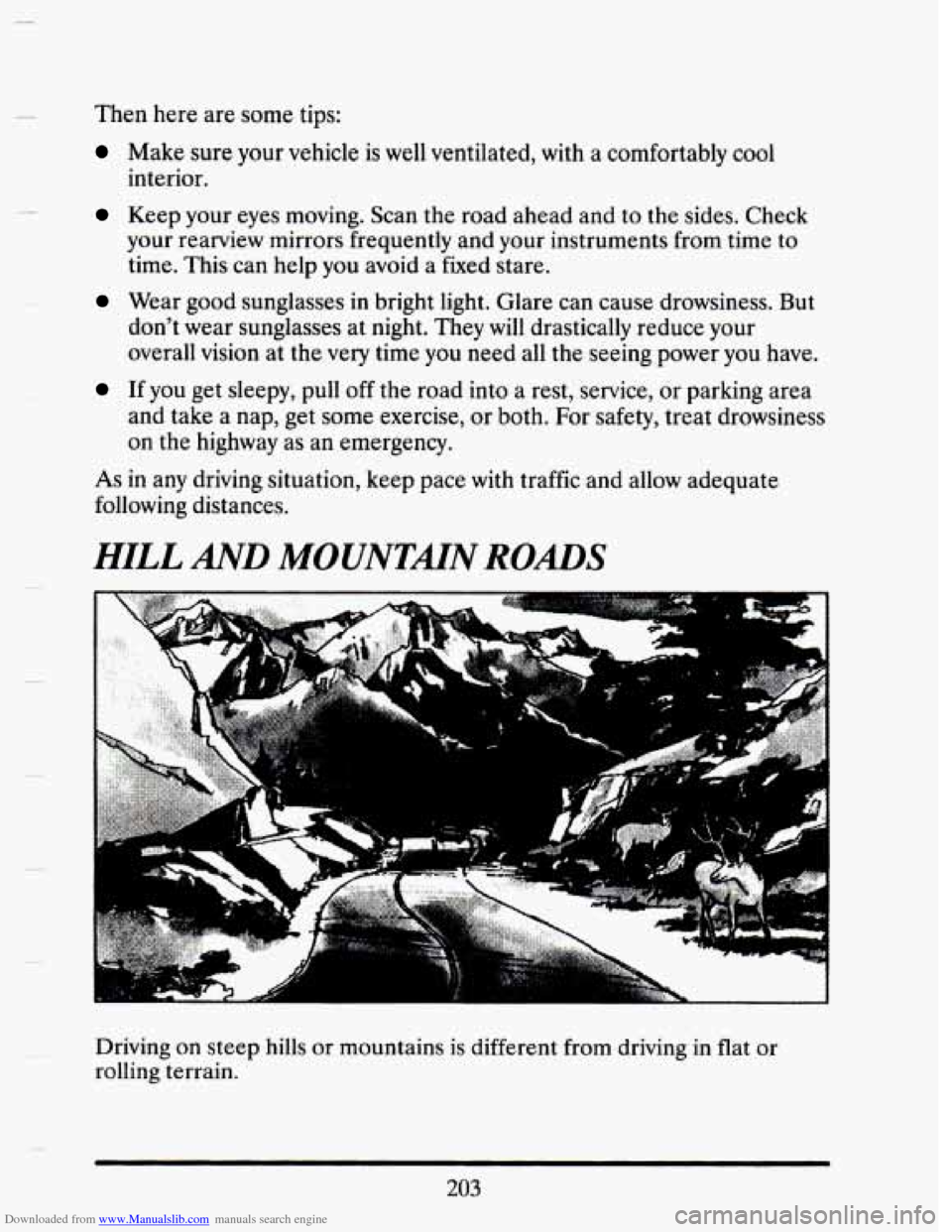
HILL AND MOUNTMN ROADS
Driving on steep hills or mountains is different from driving in flat or
rolling terrain.
203
Page 230 of 407
Downloaded from www.Manualslib.com manuals search engine Safety Chains
You should always attach chains between your vehicle and your trailer.
Cross the safety chains under the tongue
of the trailer so that the tongue
will not drop to the road if it becomes separated from the hitch. Follow
the manufacturer's recommendation for attaching safety chains. Always
leave just enough slack
so you can turn with your rig. And, never allow
safety chains to drag
on the ground.
Trailer Brakes
Does your trailer have its own brakcs'? He sure IO read and follow thc
instructions for the trailer brakes so you'll he ilblc to ir~ i~lI, ;rcliw an3
maintain them properly.
Driving with a Trailer
Towing a trailer requires a certain amount of experience. Before setting
out for the open road, you'll want to get to
know your rig. Acquaint
yourself with the feel of handling and braking with the added weight of
the trailer. And always keep
in mind that the vehicle you are driving is
now a good deal longer and not nearly so responsive as your vehicle is by
itself.
Before you start, check the trailer hitch and platform, safety chains,
electrical connector, lights, tires and mirror adjustment. If the trailer has
electric brakes, start your vehicle and trailer moving and then apply the
trailer brake controller by hand
to be sure the brakes are working. This
lets
you check your electrical connection at the same time.
During your trip, check occasionally to be sure that the load is secure,
and that the lights and any trailer brakes are still working.
216
L -4
c
L-
L-
C
Page 272 of 407
Downloaded from www.Manualslib.com manuals search engine A CAUTION:
Storing a jack, a tire or other equipment in the passenger
compartment
of the vehicle could cause injury. In a sudden stop
or collision, loose equipment could strike someone. Store all
these in the proper place.
COMPACT SPARE TIRE
Although the compact spare was fully inflated when your vehicle was
new, it can lose air after a time. Check the inflation pressure regularly. It
should be
60 psi (420 kPa). The compact spare is made to go up to 3,000
miles (5000 km), so you can finish your trip and have your full-size tire
repaired or replaced where you want. Of course, it’s best to replace your
spare with a full-size tire as
soon as you can. Your spare will last longer
and be
in good shape in case you need it again.
Your anti-lock brake system warning light may come on when you are
driving with a compact spare. See “Anti-Lock Brake System Warning
Light” in the Index.
258
I
Page 299 of 407
Downloaded from www.Manualslib.com manuals search engine I
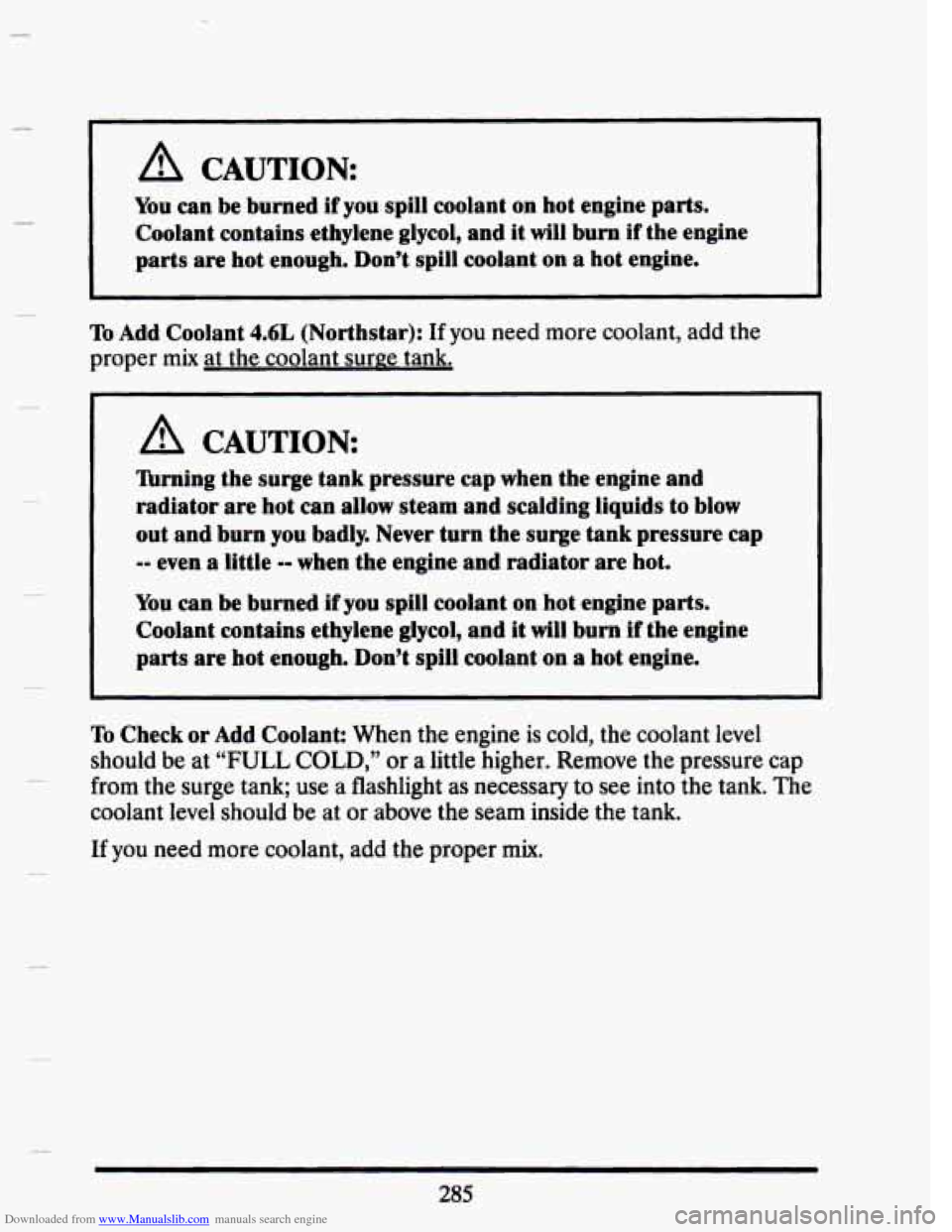
A CAUTION:
You can be burned if you spill coolant on hot engine parts.
Coolant contains ethylene glycol, and it
will burn if the engine
parts are hot enough. Don’t
spill coolant on a hot engine.
To Add Coolant 4.6L (Northstar): If you need more coolant, add the
proper
mix at the coolant surPe tank.
A CAUTION:
lbrning the surge tank pressure cap when the engine and
radiator are hot
can allow steam and scalding liquids to blow
out and burn you badly. Never turn the surge tank pressure cap
-- even a little -- when the engine and radiator are hot.
You can be burned if you spill coolant on hot engine parts.
Coolant contains ethylene glycol, and it
will burn if the engine
parts are hot enough. Don’t spill coolant
on a hot engine.
To Check or Add Coolant: When the engine is cold, the coolant level
should be at
“FULL COLD,” or a little higher. Remove the pressure cap
from the surge tank;
use a flashlight as necessary to see into the tank. The
coolant Ievel should be at or above the seam inside the tank.
If you need more coolant, add the proper mix.
Page 305 of 407
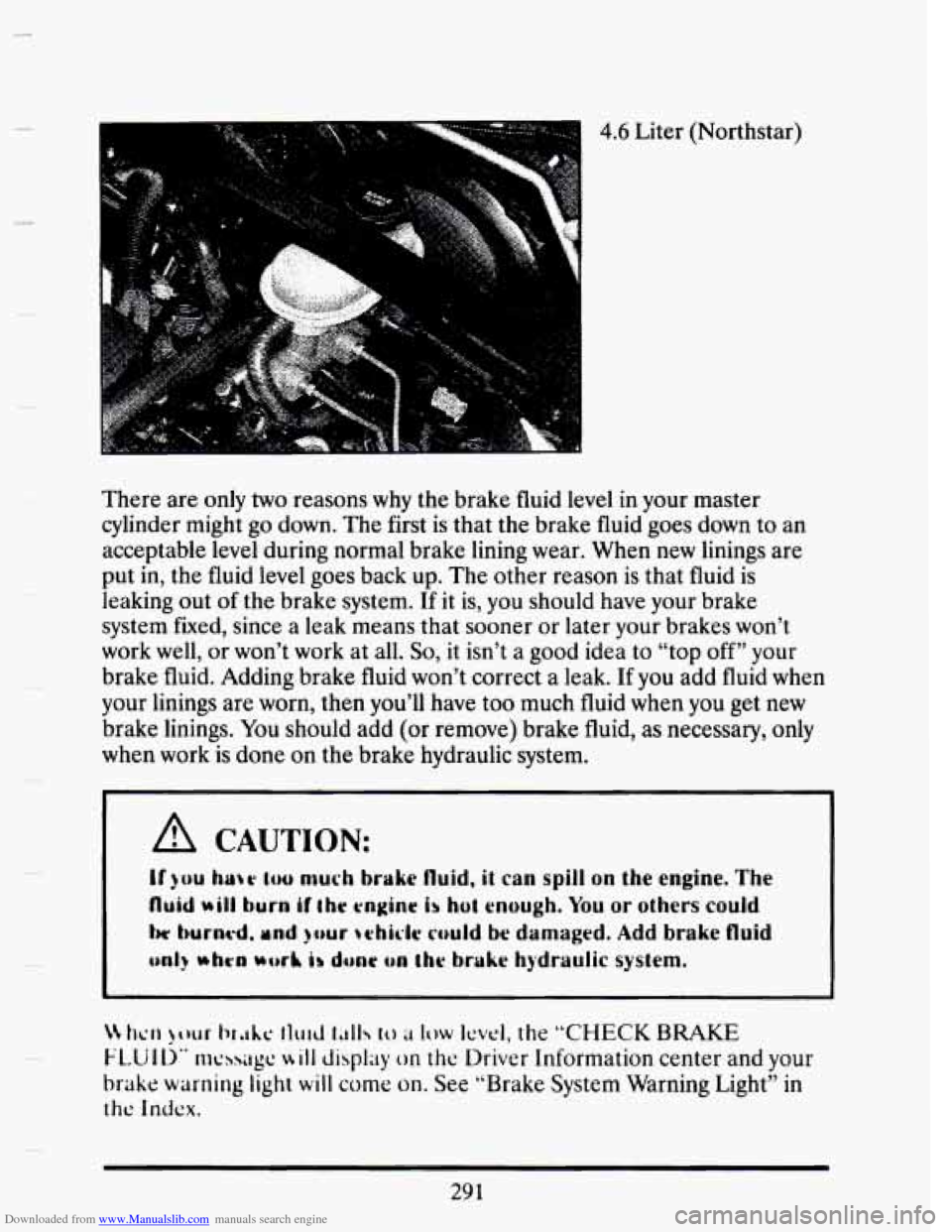
Downloaded from www.Manualslib.com manuals search engine There are only two reasons why the brake fluid level in your master
cylinder might go down. The first is that the brake fluid goes down to an
acceptable level during normal brake lining wear. When
new linings are
put in, the fluid level goes back up. The other reason is that fluid is
leaking out
of the brake system. If it is, you should have your brake
system
fixed, since a leak means that sooner or later your brakes won’t
work well, or won’t work at all.
So, it isn’t a good idea to “top off” your
brake fluid. Adding brake fluid won’t correct a leak. If you add fluid when
your linings are worn, then you’ll have too much fluid when you get new
brake linings.
You should add (or remove) brake fluid, as necessary, only
when work
is done on the brake hydraulic system.
A CAUTION:
If ),ou hate loo much brake fluid, it can spill on the engine. The
fluid will burn if the engine is hot enough. You or others could
tw borntd. and )our whicle could be damaged. Add brake fluid
onl) whco wcC h dune on the bruke hydraulic system.
\C hc‘n !our tmk tlu~cj 1,1115 10 ;I Iuw Icvel, the “CHECK BRAKE
FLU ID” ~nc~gc L+ ill display on the Driver Information center and your
brake warning light will come on. See “Brake System Warning Light” in
the Index.
291
Page 347 of 407
Downloaded from www.Manualslib.com manuals search engine Headlights
i
The headlight wiring is protected by a circuit breaker in the light switch.
An electrical overload will cause the lights to
go on and off, or in some
cases
to remain off. If this happens, have your headlight wiring checked
right away.
Windshield Wipers
The windshield wiper motor is protected by a circuit breaker and a fuse.
If the motor overheats due to heavy snow, etc., the wiper will stop until
the motor cools. If the overload is caused by some electrical problem and
not snow, etc.,
be sure to get it fixed.
rower Windows and Other Power Options
Circuit breakers in the fuse panel protect the power windows and other
power accessories. When the current load is too heavy, the circuit breaker
opens and closes, protecting the circuit until the problem is fixed or goes
away.
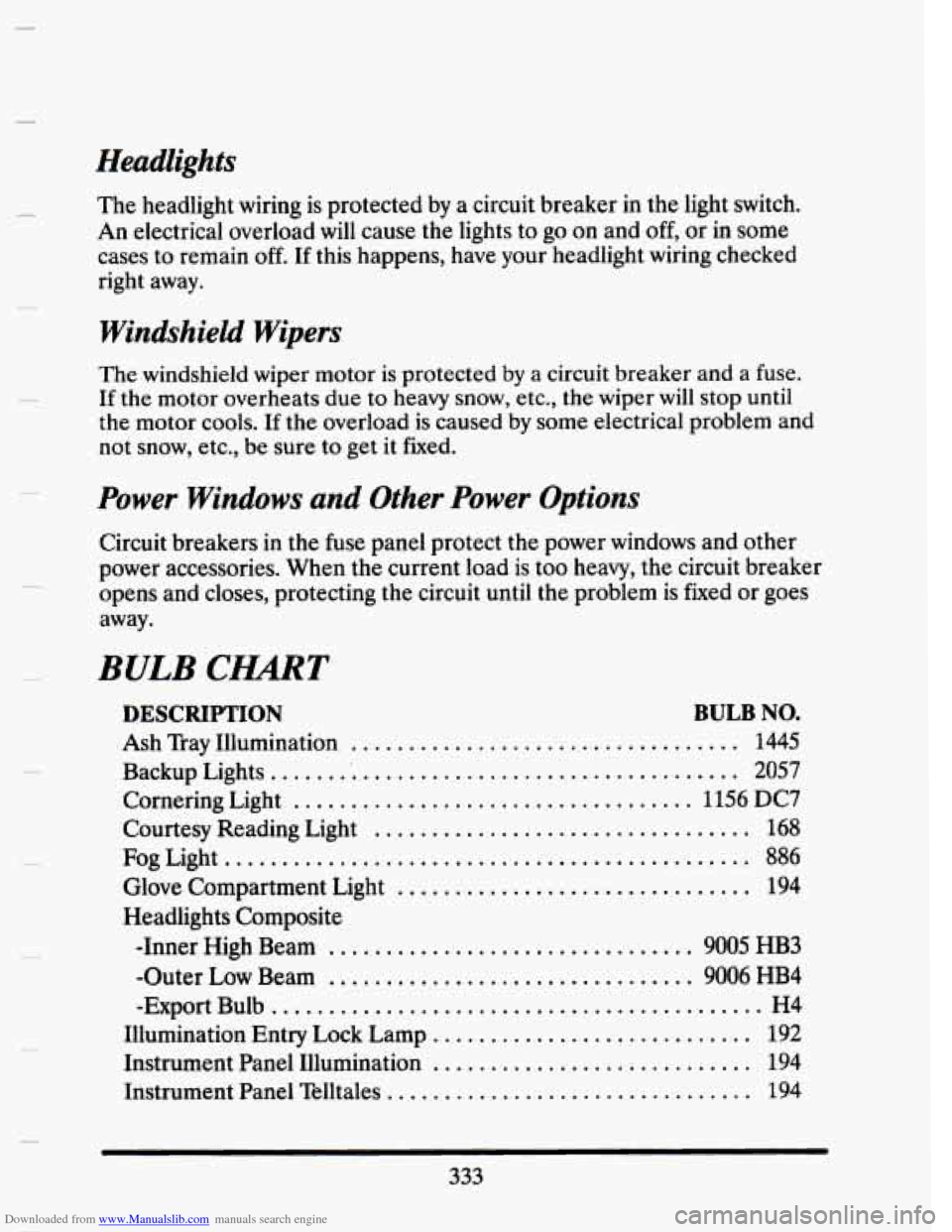
BULB CIT
DESCRIPTION BULB NO.
Ash Tray Illumination .................................. 1445
Backup Lights. ......................................... 2057
Cornering Light ................................... 1156 DC7
Courtesy Reading Light ................................. 168
Fog Light.. ............................................ 886
Glove Compartment Light ............................... 194
Headlights Composite
-Inner High Beam
................................ 9005 HB3
-Outer
Low Beam ................................ 9006 HB4
-Export Bulb ........................................... H4
Illumination Entry Lock Lamp ............................ 192
Instrument Panel Illumination ............................ 194
Instrument Panel Telltales ................................ 194
333
Page 383 of 407

Downloaded from www.Manualslib.com manuals search engine SERVICE PUBLICATIONS
Information on how to obtain Product Service Publications, subscriptions, Indexes and
summaries
as describedbelow is applicable only in the fifty U.S. states (and the District
fo Columbia) and only
for cars and light trucks with GVWR less than 10,OOO pounds
(4 536 kg).
In Canada, information pertaining to Product Service Bulletins and Indexes can be
obtained by writing to: General Motors of Canada Limited, Servi\
ce Pubiications
Department,
1908 Colonel Sam Drive Oshawa, Ontario LIH 8P7.
Cadillac regularly sends its dealers useful service bulletins ab\
out Cadillac products.
Cadillac
monitors product performance in the field. We then prepare bulletins for
servicing our products better, Now, you can get these bulletins
too.
Bulletins cover various subjects. Some pertain to the proper use and care of your
vehicle. Some describe costly repairs. Others describe inexpensiv\
e repairs which, if
done on time with the latest parts, may avoid future costly repairs. Some bulletins
tell a
technician how to repair a new or unexpected condition. Others describe a quicker way
to fix your vehicle. They can help a technician service your \
vehicle better.
Most bulletins apply
to conditions affecting a small number of vehicles Your Cadillac
dealership or a qualified technician may have
to determine if a specific bulletin applies
to
your vehicle.
You can subscribe to all Cadillac bulletins.
This way you’ll get them as they come out.
You can wait a while and get
an index to the bulletins. You can also get individual
bulletins. However, you’ll need the index
to identify them.
Subscriptions
You can subscribe to all Cadillac Product Service Publications (PSPs). This will include
bulletins for all cars sold by Cadillac and will not
be limited to PSPs applicable to any
particular model. When you buy a subscription, you will receive\
the PSPs in periodic
mailings shortly after they come out.
A subscription costs $100.00 U.S. ($110.00
including a special binder) and it entitles you to all PSPs published by Cadillac during
that model year. You can purchases a subscription by sending a\
check or money order
to
Cadillac Service Publications, Post Office Box 07130, Detroit, Michigan 48027, along
with the order form located on page
15. Your may get additions subscription ordering
forms by calling the toll-free number shown in this section or your
can find them at
participating dealerships.
Individual PSPs
If you don’t want to buy all the PSPs issued by Cadillac for all models in the model year,
you can buy individual
PSPs such as those which may pertain to a particular model. To
do this, you will first need to see our index of PSPs. It provides a variety of information.
Here’s what you’ll find in the index
and how you can get one.
7