Page 115 of 386
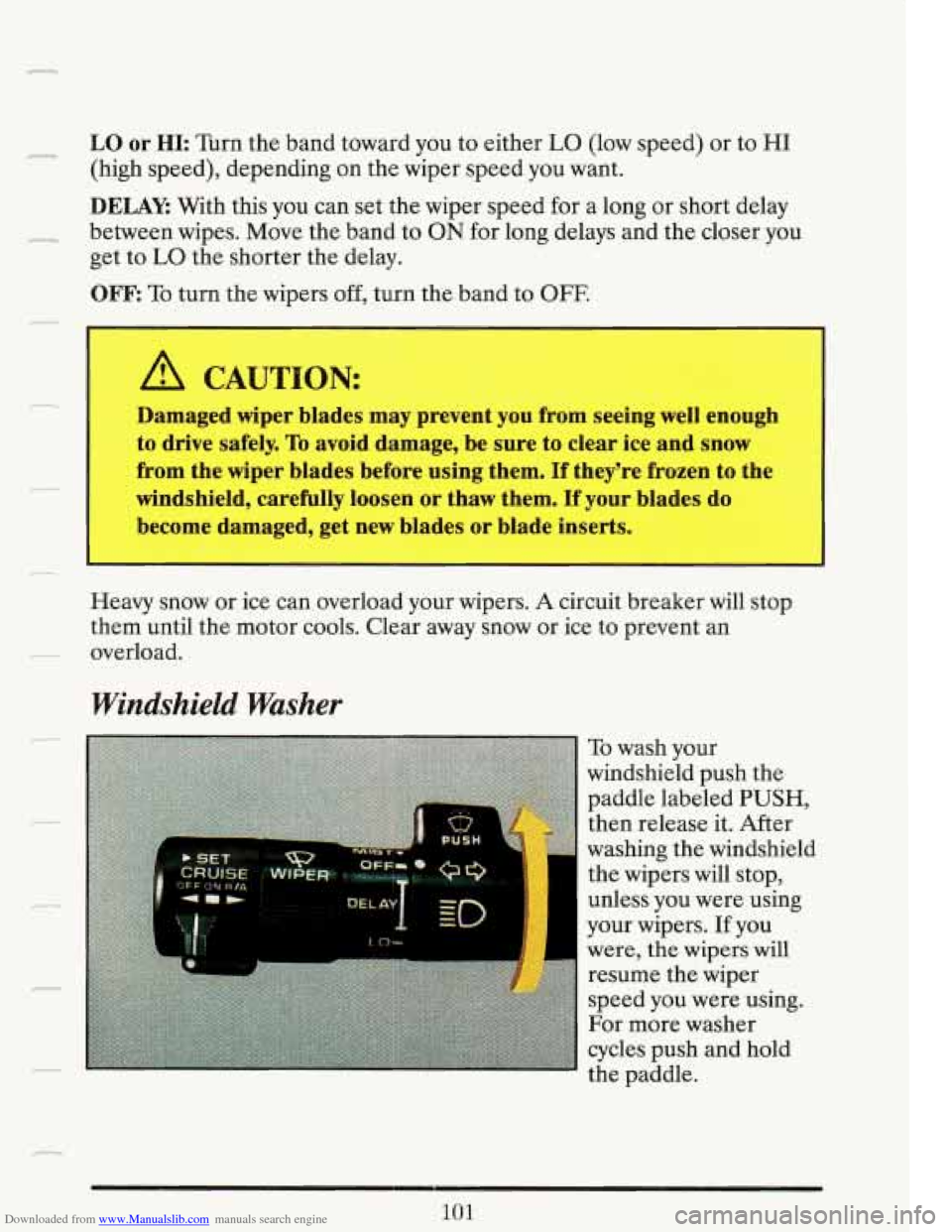
Downloaded from www.Manualslib.com manuals search engine - LO or HI: Turn the band toward you to either LO (low speed) or to HI
(high speed), depending on the wiper speed you want.
DELAY With this you can set the wiper speed for a long or short delay
get to
LO the shorter the delay.
7 between wipes. Move the band to ON for long delays and the closer you
OFI? To turn the wipers off, turn the band to OFF.
A CAUTION:
Damaged wiper blades may prevent you from seeing well enough
to drive safely.
To avoid damage, be sure to clear ice and snow
from the wiper blades before using them.
If they're frozen to the
windshield, carefully loosen or thaw them.
If your blades do
become damaged, get new blades or blade inserts.
Heavy snow or ice can overload your wipers.
A circuit breaker will stop
them until the motor cools. Clear away snow or ice to prevent an
-- overload.
Windshield Washer
- To wash your
windshield push the
paddle labeled PUSH,
then release it. After
washing the windshield
the wipers will stop,
your wipers.
If you
were,
the wipers will
- resume the wiper
speed you were using.
For more washer
cycles push and hold
the paddle.
-
L_ unless you were using
_I
1111
101
Page 202 of 386
Downloaded from www.Manualslib.com manuals search engine DMNG IN THE MN
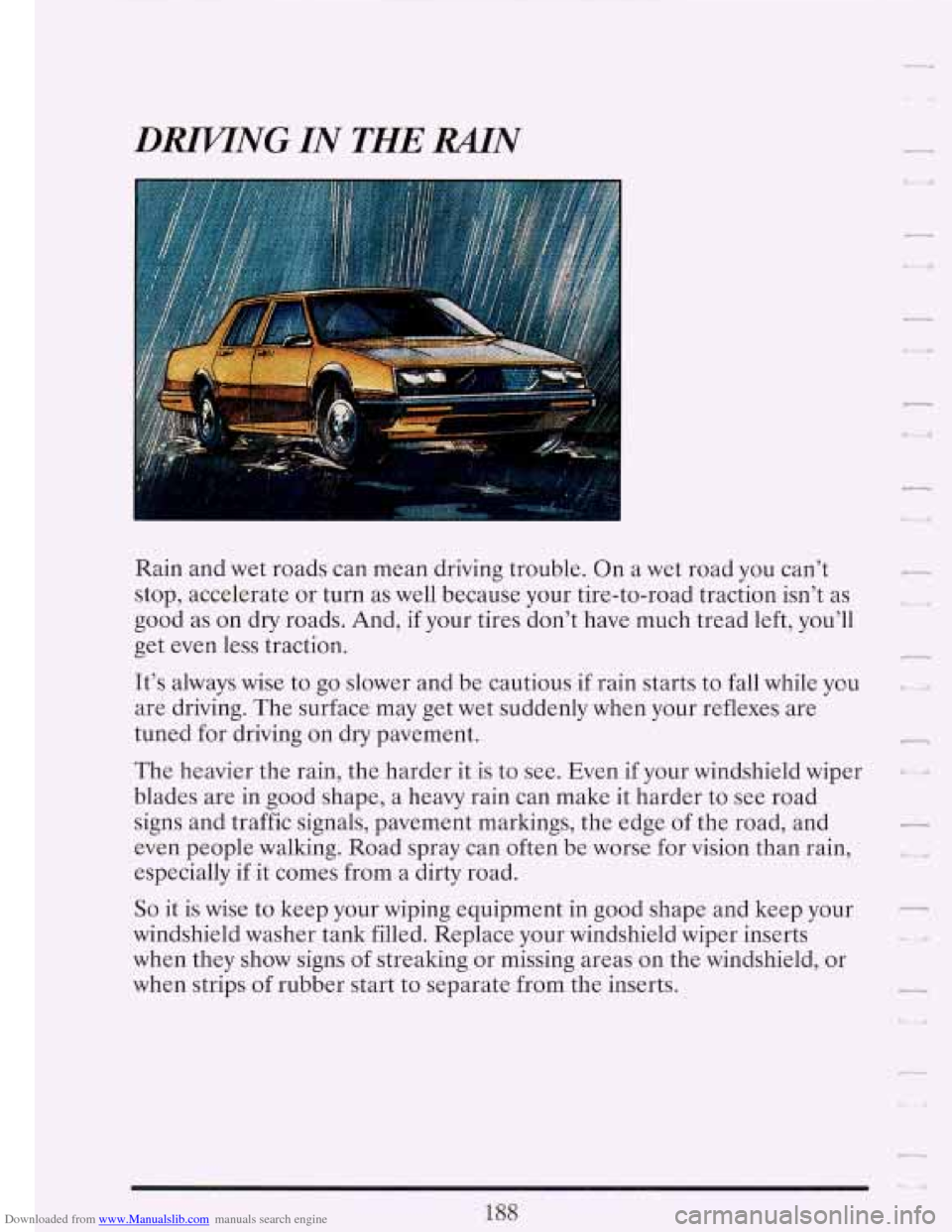
Rain and wet roads can mean driving trouble. On a wet road you can’t
stop, accelerate or turn as well because your tire-to-road traction isn’t as
good as on dry roads. And, if your tires don’t have much tread left, you’ll
get even less traction.
It’s always wise to
go slower and be cautious if rain starts to fall while yc.u II
are driving. The surface may get wet suddenly when your reflexes are
tuned for driving on dry pavement.
n
The heavier the rain, the harder it is to see. Even if your windshield wiper
blades are in good shape, a heavy rain can make it harder to see road
signs and traffic signals, pavement markings, the edge of the road, and
even people walking. Road spray can often be worse
for vision than rain,
especially if it comes from a dirty road.
So it is wise to keep your wiping equipment in good shape and keep your --
windshield washer tank filled. Replace your windshield wiper inserts
when they show signs of streaking or missing areas on the windshield, or
when strips
of rubber start to separate from the inserts.
188
Page 210 of 386
Downloaded from www.Manualslib.com manuals search engine time and flash your brake lights (in addition to your turn signal) as extra
warning that you are about to slow down and exit.
The exit ramp can be curved, sometimes quite sharply.
-.
U t I! The exit speed is usually posted. Reduce your speed according to your
speedometer, not to your sense
of motion. After driving for any distance
at higher speeds, you may tend to think you are going slower than you
actually are. For example,
40 mph (65 h/h) might seem like only 20 mph c_?
(30 km/h). Obviously, this could lead to serious trouble on a ramp
designed for
20 mph (30 kmih)!
I
L/
DRIVTNG A LONG DISTANCE
Although most long trips today are made on freeways, there are still
many made on regular highways.
Long-distance driving on freeways and regular highways is the same in
some ways. The trip has
to be planned and the vehicle prepared, you
drive at higher-than-city speeds, and there are longer turns behind the
wheel. You’ll enjoy your trip more if you and your vehicle are in good
shape. Here are some tips for a successful long trip.
BEFORE LEAWNG ONA LONG TRlP
Make sure you’re ready. Try to be well rested. If you must start when
you’re not fresh
-- such as after a day’s work -- don’t plan to make too
many miles that first part of the journey. Wear comfortable clothing and
shoes you can easily drive in.
.3
I
F i ! u
Is your vehicle ready for a long trip? If you keep it serviced and
maintained, it’s ready to
go. If it needs service, have it done before
starting out. Of course, you’ll find experienced and able service experts in
Cadillac dealerships all across North America. They’ll be ready and
7
willing to help if you need it. -1
Here are some things you can check before a trip:
Windshield Washer Fluid: Is the reservoir full? Are all windows clean
inside and outside?
Wiper Blades: Are they in good shape?
0 Fuel, Engine Oil, Other Fluids: Have you checked all levels?
Page 320 of 386
Downloaded from www.Manualslib.com manuals search engine CARE OF SAFETYBELTS
Keep belts clean and dry.
A CAUTION:
Do not bleach or dye safety belts. If you do, it may severely
weaken them. In a crash they might not be able to provide
adequate protection. Clean safety belts only with mild soap and
lukewarm water.
GLASS
Glass should be cleaned often. GM Glass Cleaner (GM Part No.
1050427) or a liquid household glass cleaner will remove normal tobacco
smoke and dust films.
Don’t use abrasive cleaners on glass, because they may cause scratches.
Avoid placing decals
on the inside rear window, since they may have to be
scraped
off later. If abrasive cleaners are used on the inside of the rear
window, an electric defogger element may be damaged.
Any temporary
license should not be attached across the defogger grid.
CLEANING THE OUTSIDE OF THE
WINDSHIELD
AND mPER BLADES
If the windshield is not clear after using the windshield washer, or if the
wiper blade chatters when running,
wax or other material may be on the
blade or windshield.
Clean the outside
of the windshield with GM Windshield Cleaner,
Bon-Ami Powder@ (GM Part
No. 1050011). The windshield is clean if
beads do not form when you rinse it with water.
Clean the blade by wiping vigorously with a cloth soaked in full strength
windshield washer solvent. Then rinse the blade with water.
Wiper blades should be checked on
a regular basis and replaced when
worn.
306