1993 CADILLAC FLEETWOOD oil change
[x] Cancel search: oil changePage 145 of 386
Downloaded from www.Manualslib.com manuals search engine If it doesn’t come on, have it repaired. If the light comes on and stays on,
your engine oil level is too low. Check your oil level and add enough oil
to bring the engine oil level up to the proper level. See “Engine Oil” in
the Index.
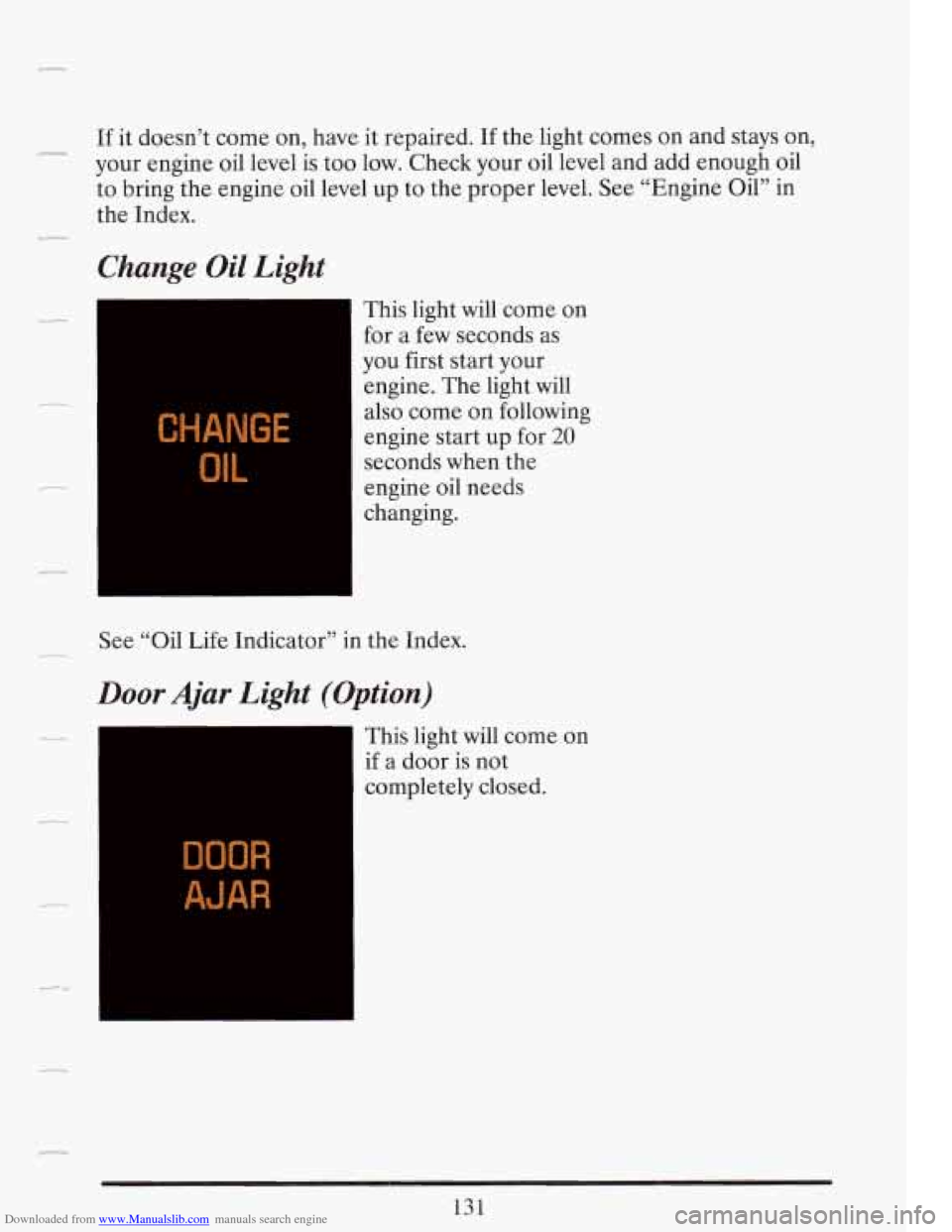
Change Oil Light
r
H E
This light will come on
for .a few seconds as
you first start your
engine. The light
will
also come on following
engine start up for
20
seconds when the
engine oil needs
changing.
See “Oil Life Indicator” in the Index.
Door Ajar Light (Option)
This light will come on
if
a door is not
completely closed.
r
Page 150 of 386

Downloaded from www.Manualslib.com manuals search engine i
FUEL GAGE
fI
I
Your fuel gage shows
about how much fuel is
in your tank.
It works only when the ignition is in the “RUN” position. The
17 bar
segments show the fuel remaining in your tank.
When only one bar segment still is lit, the
“LOW FUEC’ light will go on.
If the fuel supply gets critically low, none of the bar segments will be lit
and the
“LOW FUEC’ will flash. You should get fuel immediately.
Here are
a few concerns some owners have had about the fuel gage. All
these situations are normal and indicate nothing wrong with the fuel
gage.
The pump at the gas station shuts off before the fuel gage reads “F”.
I.
3, I
It takes more (or less) gas to fill up than the gage said. For example,
the gage said
“l/Y, but it took more or less than half the tank capacity -
to fill it. I
The gage changes when you turn (or stop,or speed up)
OIL LIFE INDICATOR
Your Cadillac has an Oil Life Indicator feature. This tells you when you
need to change your engine
oil. It’s based upon the engine oil
temperatures and your driving patterns.
-1
-1
The “CHANGE OIE’ light will come on for a few seconds as a bulb check
when
you start your engine. The system probably will say to change the oil
-.
n
- I
136
Page 151 of 386
Downloaded from www.Manualslib.com manuals search engine 1 between 3000 miles (5000 km) and 7500 miles (12500 km), but it may
even say to change it before
3000 miles under severe conditions. It all
depends on your driving patterns. (If it doesn’t, or
if it doesn’t even light
up, then something is wrong.
You will need to have it serviced.)
There are
two things the system won’t do: It can’t sense heavy dust in the
places where you drive.
If you drive in a dusty area, you should change
your oil every
3000 miles (5000 krn) or 3 months (whichever comes first),
unless the
“CHANGE OIL? light comes on sooner.
It doesn’t check how much oil you have
so you will still have to check for
that.
To check it, see the Index under “Engine Oil.”
When You’ve Changed the Oil
When new oil is put in, you’ll need to reset your system. To do that, turn
the ignition switch to the
“ON” position with the engine stopped. Fully
depress and release the accelerator pedal
3 times within 5 seconds.
If the “CHANGE OK’ light comes on and stays on for
5 seconds, it did
not reset. You’ll need to reset the system again.
137
Page 223 of 386
Downloaded from www.Manualslib.com manuals search engine *_
safety and that of your passengers. So please read this section carefully
before you pull a trailer.
Load-pulling components such as the engine, transmission, wheel
assemblies, and tires are forced to work harder against the drag
of the
added weight. The engine is required to operate at relatively higher speeds
and under greater loads, generating extra heat. What’s more, the trailer
adds considerably to wind resistance, increasing the pulling requirements.
All of that means changes in:
0 Handling
0 Durability
Fuel economy
If You Do Decide To Pull A Trailer
If you do, here are some important points.
0
0
0
0
0
0
There are many different laws having to do with trailering. Make sure
your rig will be legal, not only where you live but also where you’ll be
driving.
A good source for this information can be state or provincial
police.
Consider using a sway control if your trailer will weigh
2,000 pounds
(900 kg) or less. You should always use a sway control if your trailer
will
weigh more than 2,000 pounds (900 kg).
Don’t tow a trailer at all during the first 500 miles
(800 km) your new
vehicle is driven. Your engine, axle or other parts could be damaged.
Then, during the first
1,000 miles (1600 km) that you tow a trailer, don’t
drive over
50 mph (80 km/h) and don’t make starts at full throttle. This
helps your engine and other parts of your vehicle wear in at the heavier
loads. Avoid continuous operation
in mountainous areas that have
grades greater than
2% and are longer than 5 miles.
Change axle
oil annually or every 6,000 miles (9654 km) of trailer towing,
whichever comes first.
Three important considerations have to do with weight:
1. Weight of the nailer
How heavy can a trailer safely be? It should never weigh more than
2,000 pounds (907 kg). But, if you have the optional Trailer Towing
Page 277 of 386
Downloaded from www.Manualslib.com manuals search engine .-
Oils with these words on the container will help you save fuel.
This doughnut-shaped logo (symbol) is used on most oil containers to
help you select the correct oil.
You should look for this on the
oil container, and use only those oils that
display the logo.
GM Goodwrench@ oil (in Canada, GM Engine Oil) meets all the
requirements for your vehicle.
Engine Oil Additives: Don’t add anything to your oil. Your Cadillac
dealer
is ready to advise if you think something should be added.
When to Change Engine Oil: Your vehicle is equipped with an engine oil
life indicator (EOLI) feature. Oil change intervals are determined by the
EOLI and will usually fall at, or between, the two recommended
alternative intervals of
3,000 miles (5,000 kilometers) and 7,500 miles
(12,500 kilometers), but could be shorter than 3,000 miles (5,000
kilometers) under some very severe driving conditions shown in Schedule
I. The system will also indicate the need for an oil change
if 7,500 miles
(12,500 kilometers).
When the oil life index reaches
0, the “CHANGE OII? light come on.
This indicates that no oil life remains and the oil should be changed as
soon as possible, but certainly within the next
200 miles (320 km).
The EOLI will not detect excessively dusty conditions or engine
malfunctions which may effect the
oil. If you drive in dusty areas, change
the engine oil after every
3,000 miles (5,000 kilometers) or 3 months
(whichever comes first), unless instructed to do
so sooner by the
“CHANGE
OW light.
263
Page 278 of 386

Downloaded from www.Manualslib.com manuals search engine Engine Block Heater Option: An engine block heater can be a big help if
you have to park outside in
very cold weather, 0°F (-18OC) or colder. If
your vehicle has this option, see “Engine Block Heater”
in the Index.
How
To Reset the Oil Life Indicator: After the oil has been changed,
you’ll need to reset your system.
To do that, turn the ignition switch to the
“ON” position with the engine stopped fully depress and release the
accelerator pedal
3 times within 5 seconds.
If the “CHANGE OIC‘ light comes on and stays on for 5 seconds, it did
not reset. You’ll need to reset the system again.
What to
Do with Used Oil:
A CAUTION:
Used engine oil contains things that have caused skin cancer in
laboratory animals. Don’t let used oil stay on your skin for very
long. Clean your skin and nails with soap and water, or a good
hand cleaner. Wash or properly throw away clothing or rags
containing used engine oil.
Used oil can be a real threat to the environment. If you change your own
oil, be sure to drain all free-flowing oil from the filter before disposal.
-
Don’t ever dispose of oil by pouring it on the ground, into sewers, or into
streams or bodies of water. Instead, recycle it by taking
it to a place that
collects used oil. If you have a problem properly disposing of your used
oil, ask your dealer, a service station or
a local recycling center for help.
1:
n
264
I
Page 280 of 386
Downloaded from www.Manualslib.com manuals search engine AUTOMATIC TMSMISSION FLUID
When to Check and Change:
A good time to check your automatic transmission fluid level is when the
engine oil is changed. Refer to the Maintenance Schedule to determine
cpr
when to change your fluid. See “Scheduled Maintenance Services’’ in the
Index. -I
How to Check
BeC’%’uSe this operation can be a little difficult, you may choose to have
this done at a Cadillac dealership Service Department.
r IYI
”I If you do it yourself, be sure to follow all the instructions here, or you
could get a false reading on the dipstick.
p_
NOTICE:
I
Too much or too little fluid can damage your transmission.
much can mean that some of the fluid could come out and fall
on hot engine parts, starting
a fire. Be sure to get an accurate
reading if you check
your transmission fluid. I
l-
Wait at least 30 minutes before checking the transmission fluid level if
you have been driving:
0 When outside temperatures are above 90” F (32” C).
n !‘ b
0 At high speed for quite a while.
0 In heavy traffic -- especially in hot weather.
0 While pulling a trailer.
To get the right reading, the fluid should be at normal operating
temperature, which is
180°F to 200°F (82°C to 93OC).
To check transmission fluid hot: Get the vehicle warmed up by driving
about
15 miles (24 km) when outside temperatures are above 50°F
(10°C). If it’s colder than 50°F (lO°C), drive the vehicle in “D” (3rd
Gear) until the engine temperature gage moves and then remains steady
-
for ten minutes. Then follow the hot check procedures. t3
_L-
1 <- 1
266
Page 283 of 386
Downloaded from www.Manualslib.com manuals search engine r REARAXLE
1
When to Check and Change Lubricant:
Refer to the Maintenance Schedule to determine how often to check the
lubricant and when to change it. See “Periodic Maintenance Inspections”
in the Index.
How to Check Lubricant:
If the level is below the bottom of the filler plug hole, you’ll need to add
some lubricant. Add enough lubricant to raise the level to the bottom of
What to Use:
~ the filler plug hole.
Standard Differential
Use Axle Lubricant (GM Part
No. 1052271) or SAE 8OW-90 GL-5 gear
lubricant.
Limited-Slip Differential
To add lubricant when the level is low, use Axle Lubricant (GM Part No.
1052271) or SAE 8OW-90 GL-5 gear lubricant. To completely refill after
draining, add
4 ounces (1 18 ml) of Limited-Slip Differential Lubricant
Additive (GM Part
No. 1052358). Then fill to the bottom of the filler plug
hole with Axle Lubricant (GM Part
No. 1052271) or SAE 8OW-90 GL-5
~ gear lubricant.
ENGINE COOLANT
The proper coolant for your Cadillac will:
Give freezing protection down to -34°F (-37’ C) .
_- Give boiling protection up to 262°F (128°C) .
0 Protect against rust and corrosion.
__ 0 Help keep the proper engine temperature.
Let the warning lights work as they should.
What to Use:
Use a mixture of one-half clean water (preferably distilled) and one-half
antifreeze that meets
“GM Specification 1825-M,” which won’t damage
269