1993 CADILLAC ELDORADO light
[x] Cancel search: lightPage 170 of 398

Downloaded from www.Manualslib.com manuals search engine TREBLE
The slide control increases or decreases the treble response tone. Moving
the control to the right increases the treble
while moving it to the left
decreases it.
Your Cassette Tape Player
Your cassette tape player works best with tapes that are 30 to 45 minutes
long on each side. Tapes longer than that are
so thin that they may not
work well in this player.
If you look at the tape, or on its label or box, it should say whether its
bias, ("equalization" is 70 microseconds (70
U ) or 120 microseconds (120
U ). Chrome and metal tapes are 70 u scc and standard iron tapes are 120
U sec. Your tape player will adjust automatically for either type of
cassette tape.
To Play A Cassette Tape
0 Turn the radio on.
0 Insert the cassette through the tapc door. (The "TAPE" indicator in
the display will light.)
If you hear nothing or hear just a garbled sound, the cassette may not be
in squarely. Push the EJCT button to remove the tape and start over. The
tape equalization is automatically sensed and set. Inserting the cassette
also automatically disables
DNR""'" and activates DOLBY"' noise
reduction.
DNR" is the Dynamic Noise Reduction. It helps remove background hiss
noise from the radio.
@ Once the tape is playing, use the upper and lower knobs to adjust the
volume and balance, just as you do
for the radio. Push the upper knob
to change tape direction. The arrow in the display show which
direction the tape is being played.
'"DNR" is a registered trademark of National Semiconductor
Corporation.
156
Page 171 of 398

Downloaded from www.Manualslib.com manuals search engine FWD (Forward)
Push the FWD button to move forward rapidly to another part of the
tape. The radio will play during fast forward. To stop the tape push the
same button and the tape will start to play again.
REV (Reverse)
Push the REV button to move the tape rapidly backward. To stop the
tape, push the same button lightly or any of the other buttons. The radio
will play during this reve.rse function.
To go from one side of the tape to the other, push in the upper knob on
your radio.
To remove the tape, push EJCT. The tape can be ejected when
the ignition is turned
off.
NEXT
Push the NEXT button up to jump quickly to the next selection. If the
selection is at the end
of the tape, the tapc will reverse directions and
begin playing at
a normal speed.
PREV
Push the PREV button up to quickly go to the beginning of the last
selcction.
If the player has played less than 10 seconds into the current selection:
depressing the PREV button
will cause the player to find the beginning of
the previous selection and resume play from that point. If the player is
more than
10 seconds into the current selection, pressing PREV button
will cause the player to find the beginning of the current selection and
resume play from that point.
If PREV is issued while the first selection on
the tape is being played, the player will return to the beginning of that
side of the tape.
S TIPL (Stop-Play)
Press ST/PL to switch back to the radio without ejecting the tape. Press it
a second time to start playing it again.
157
Page 174 of 398

Downloaded from www.Manualslib.com manuals search engine Comp (Compression)
Pressing COMP makes soft and loud passages more nearly equal in
volume. For example, playing classical or jazz music with very quiet and
very loud passages
in the same tune. The COMP display will light as long
as COMP is on.
Setting The Clock
Turn the ignition on. Then:
To Set the Hour:
0 Press SET, and within 5 seconds,
0 Press and hold SEEK. When the clock gets to the correct hour, let go.
To Set the Minutes:
Press SET, and within 5 seconds,
Press and hold SCAN. When the clock gets to the correct minute, let
Your clock
is set.
go*
Care of Your Cassette Tape Player
A tape player that is not cleaned regularly can cause reduced sound
quality, ruined cassettes, or a damaged mechanism. Cassette tapes should
be stored
in their cases away from contaminants, direct sunlight, and
extreme heat. If they aren’t, they may not operate properly or cause
failure of the tape player.
Your tape player should be cleaned regularly each month or after every
15 hours of use. If you notice a reduction in sound quality, try a known
good cassette to see
if the tape or the tape player is at fault. If this other
cassette has
no improvement in sound quality, clean the tape player.
Clean your tape player with a wiping-action, non-abrasive cleaning
cassette, and follow the directions provided with it.
Cassettes are subject to wear and the sound quality may degrade over
time. Always make sure that the cassette tape is
in good condition before
you have your tape player serviced.
160
Page 175 of 398

Downloaded from www.Manualslib.com manuals search engine Care of Your Compact Discs
Handle discs carefully. Store them in their original cases or other
protective
cases and away from direct sunlight and dust. If the surface of
a disc is soiled, dampen a clean, soft cloth in a mild, neutral detergent
solution and clean it, wiping from the center to the edge.
L
.
Be sure never to touch the signal surface when handling discs. Pick up
discs by grasping the outer edges or the edge of the hole and the outer
edge.
Power Antenna Mast Care
Your power antenna will look its best and work well if it's cleaned from
time to time.
To Clean the Antenna Mast:
1. Turn on the ignition and radio to raise the antenna to full mast
2. Dampen a clean cloth with mineral spirits or equivalent solvent.
3. Wipe cloth over the mast sections, removing any dirt.
4. Wipe dry with clean cloth before retracting.
5. Make the antenna go up and down by turning the radio or ignition on
6. Then repeat if necessary.
extension.
and
off.
161
Page 184 of 398

Downloaded from www.Manualslib.com manuals search engine TRAFFIC LIGHTS
I
7
I
We're all familiar with traffic lights or stop lights. Often green arrows are
being used in the lights for improved traffic control. On some multilane
roads, green arrows light up, indicating that traffic in one or more lanes
can move or make a turn. Green arrows don't mean "go no matter what."
You'll still need to proceed with caution, yielding the right of way to
pedestrians and sometimes to other vehicles.
Some traffic lights also use red arrows to signify that you must
stop before
turning on red.
1
REVERSIBLE LANE
ON
LANE
ROADWAY
MULTI-
€3
€3
0
f3
n
Page 185 of 398

Downloaded from www.Manualslib.com manuals search engine Many city roads and expressways, and even bridges, use reversible-lane
traffic control during rush hours. A red
X light above a lane means no
driving in that lane at that time.
A green arrow means you may drive in
that lane.
Look for the signs posted to warn drivers what hours and days
these systems are in effect.
PAWMENT MmNGS
I NU
PASSING
ZONE
Pavement markings add to traffic signs and signals. They give information
to drivers without taking attention from the roadway. A solid yellow line
on your side of the road or lane means “don’t cross.’’
YOUR OW SIGNALS
Drivers signal to others, too. It’s not only more polite, it’s safer to let
other drivers know what you are doing. And in some places the law
requires driver signals.
Turn and lane change signals. Always signal when
you plan to turn or
change lanes.
If necessary, you can use hand signals out the window: Left arm straight
out for a left turn, down for slow
or about-to-stop, and up for a right turn.
Slowing down.
If time allows, tap the brake pedal once or twice in
advance
of slowing or stopping. This warns the driver behind you.
Disabled. Your four-way flashers signal that your vehicle is disabled or is
a hazard.
See “Hazard Warning Flasher” in the Index.
171
Page 186 of 398

Downloaded from www.Manualslib.com manuals search engine TRAFFIC OFFICER
The traffic police officer is also a source of important information. The
officer’s signals govern, no matter what the traffic lights
or other signs
say.
The next section discusses some
of the road conditions you may
encounter.
DEFENSIVE DMNG
The best advice anyone can give about driving is: Drive defensively.
Please start with a
very important safety device in your Cadillac: Buckle
up. (See “Safety Belts” in the Index.)
Defensive driving really means “be ready for anything.” On city streets,
rural roads, or freeways, it means “always expect the unexpected.”
Assume that pedestrians or other drivers are going to be careless and
make mistakes. Anticipate what they might do. Be ready for their
mistakes.
Expect children to dash out from behind parked cars, often followed by
other children. Expect occupants in parked cars to open doors into traffic.
Watch for movement in parked cars
-- someone may be about to open a
door.
Expect other drivers to run stop signs when you are
on a through street.
Be ready to brake if necessary as
you go through intersections. You may
not have to use the brake, but if
you do, you will be ready.
If you’re driving through a shopping center parking lot where there are
well-marked lanes, directional arrows, and designated parking are\
as,
expect some drivers to ignore all these markings and dash straight toward
one part
of the lot.
Pedestrians can be careless. Watch for them. In general, you must give
way
to pedestrians even if you know you have the right of way.
Rear-end collisions are about the most preventable of accidents. Yet they
are common. Allow enough following distance. It’s the best defensive
driving maneuver,
in both city and rural driving. You never know wh.en
the vehicle in front
of you is going to brake or turn suddenly.
172
Page 188 of 398
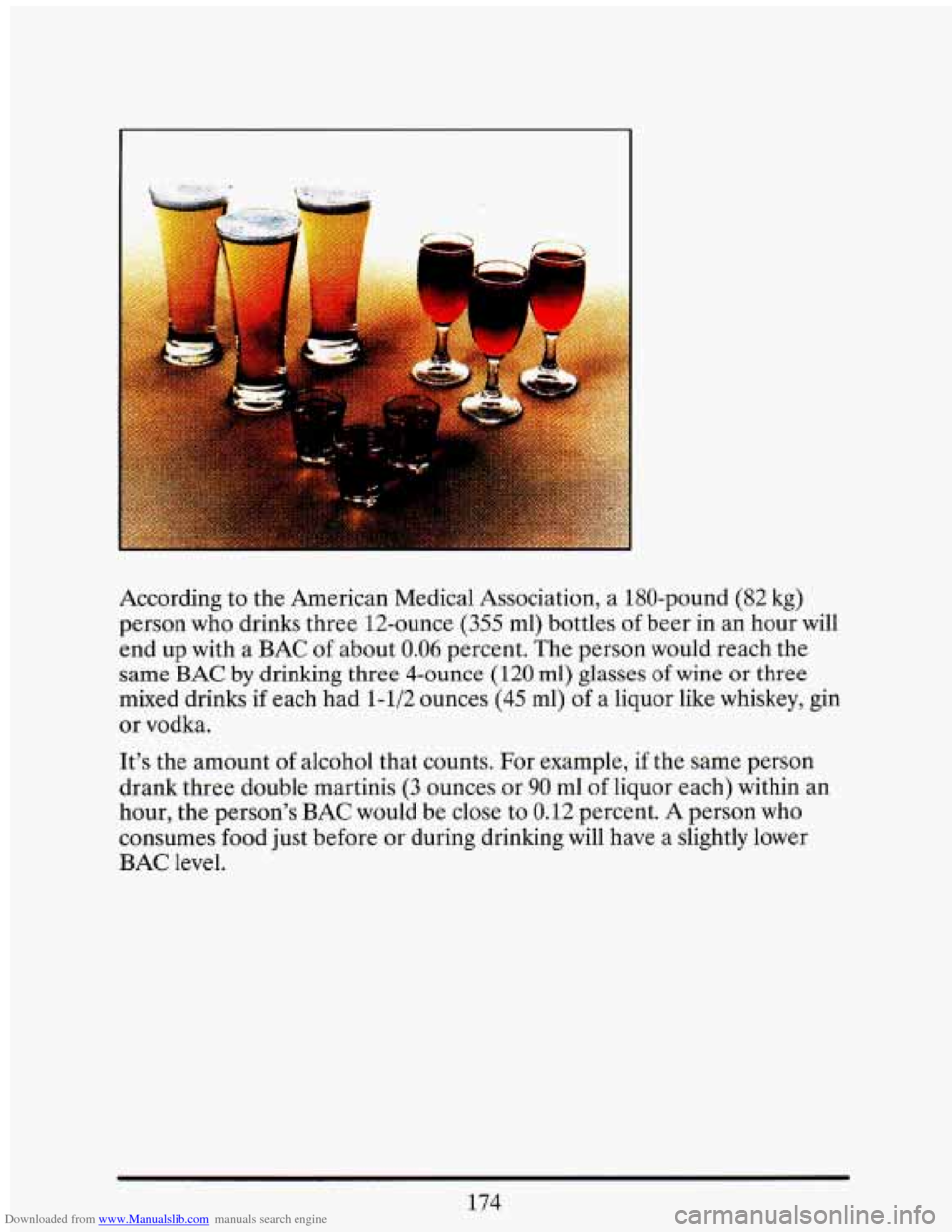
Downloaded from www.Manualslib.com manuals search engine According to the American Medical Association, a 180-pound (82 kg)
person who drinks three 12-ounce (355 ml) bottles of beer in an hour will
end up with
a BAC of about 0.06 percent. The person would reach the
same
BAC by drinking three 4-ounce (120 ml) glasses of wine or three
mixed drinks if each had
1-1/2 ounces (45 ml) of a liquor like whiskey, gin
or vodka.
It’s the amount
of alcohol that counts. For example, if the same person
drank three double martinis
(3 ounces or 90 ml of liquor each) within an
hour, the person’s
BAC would be close to 0.12 percent. A person who
consumes food just before or during drinking will have a slightly lower
BAC level.
174