1993 CADILLAC ELDORADO fuel
[x] Cancel search: fuelPage 159 of 398

Downloaded from www.Manualslib.com manuals search engine Temperature
To select the
temperature
you want,
push
the blue button
for a cooler setting and
the red button for a
warmer setting.
The
temperature setting
will be displayed
on
the digital screen.
I
You can select temperatures from 65 F ( 18 " C) to 85 F (69 " C). And, at
each end,
you may choose 60°F (16" C), for maximum cooling, and 903F
(33"C), for maximum heating.We recommend when first getting familiar
with your vehicle, select
75°F (24°C). You may find that your own
personal comfort requires a slightly higher or lower setting. Once you set
the temperature, the system will automatically maintain the set
temperature.
ECON
With this setting it's all automatic, but the air conditioningcorupressor
does not operate and
it won't remove humidity from the alr. However,
the system will try
to keep the air at the selected temperature. Use this
setting
in cold or cool weather to save fuel.
If it's warm outside and you need to cool the air, use the next choice.
AUTO
With this setting, the air conditioning compressor runs and it's all
automatic. In cold weather when the system senses the need for heat, the
air
flow will be directed out the floor ducts. As the interior temperature
approaches
the desired setting, the blower speed will decrease and the air
flow could be directed through the defroster and floor ducts. To maintain
interior comfort, the air
flow may move to the air outlets and floor ducts
145
Page 213 of 398
Downloaded from www.Manualslib.com manuals search engine time and flash your brake lights (in addition to your turn signal) as extra
warning that you are about
to slow down and exit.
The exit ramp can be curved, sometimes quite sharply.
The exit speed
is usually posted. Reduce your speed according to your
speedometer, not to your sense of motion. After driving for any distance
at higher speeds, you may tend to think you are going slower than you
actually are. For example,
40 mph (65 km/h) might seem like only 20 mph
(30 kmih). Obviously, this could lead to serious trouble on a ramp
designed for
20 mph (30 kmih)!
DMNG A LONG DISTANCE
Although most long trips today are made on freeways, there are still
many made on regular highways.
Long-distance driving on freeways and regular highways is the same in
some ways.
The trip has to be planned and the vehicle prepared, you
drive at higher-than-city speeds, and there are longer turns behind the
wheel. You’ll enjoy your trip more
if you and your vehicle are in good
shape. Here are some tips for a successful long trip.
BEFORE LEAVTNG ONA LONG TRIP
Make sure you’re ready. Try to be well rested. If you must start when
you’re not fresh
-- such as after a day’s work -- don’t plan to make too
many miles that first part
of the journey. Wear comfortable clothing and
shoes
you can easily drive in.
Is your vehicle ready for a long trip? If you keep it serviced and
maintained, it’s ready
to go. If it needs service, have it done before
starting out.
Of course, you’ll find experienced and able service experts in
Cadillac dealerships all across North America. They’ll be ready and
willing
to help if you need it.
Here are some things you can check before a trip:
Windshield Washer Fluid: Is the reservoir full? Are all windows clean
inside and outside?
Wiper Blades: Are they in good shape?
Fuel. Engine Oil, Other Fluids: Have you checked all levels‘?
199
Page 224 of 398
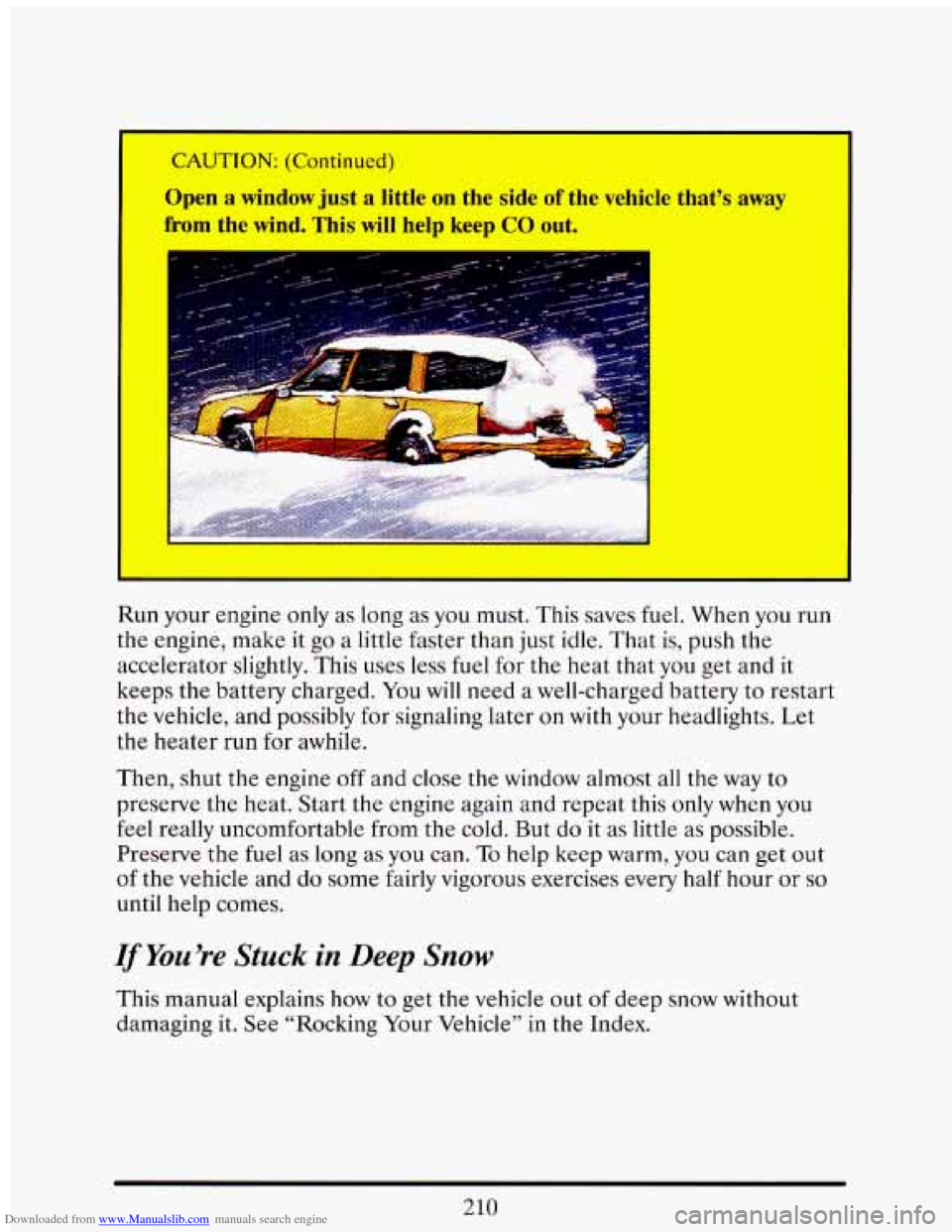
Downloaded from www.Manualslib.com manuals search engine Open a window just a little on the side of the vehicle that’s away
from the wind. This will help keep GO out.
Run your engine only as long as you must. This saves fuel. When you run
the engine, make it go a little faster than just idle. That is, push the
accelerator slightly. This uses less
fuel for the heat that you get and it
keeps the battery charged. You will need a well-charged battery to restart
the vehicle,
and possibly for signaling later on with your headlights. Let
the heater run for awhile.
Then, shut the engine off and close the window almost all the way to
preserve the heat. Start the engine again and repeat this only when you
feel really uncomfortable from the cold. But do
it as little as possible.
Preserve the fuel as long
as you can. To help keep warm, you can get out
of the vehicle and do some fairly vigorous exercises every half hour or so
until help comes.
VYou’re Stuck in Deep Snow
This manual explains how to get the vehicle out of deep snow without
damaging
it. See “Rocking Your Vehicle’’ in the Index.
210
Page 225 of 398

Downloaded from www.Manualslib.com manuals search engine TOWING A TMLER
’ A CAUTION:
If you don’t use the correct equipment and drive properly, you
can lose control when you pull
a trailer. For example, if the
trailer is too heavy, the brakes may not work well
-- or even at
all. You and your passengers could be seriously injured. Pull a
trailer onp7 ;€you have followed all the step? in this section.
NOTJCE
Fulling
I
in costly repairs not covered by your wan lty. To pull a trailer
correctly, follow the advice
in this secti I.
Load-pulling components such as the engine, transaxle, wheel assemblies,
and tires are forced to
work harder against the drag of the added weight.
The engine is required
to operate at relatively higher speeds and under
greater loads, generating extra heat. What’s more, the traile\
r adds
considerably to wind resistance, increasing the pulling requirements.
All of that means changes in:
0 Handling
0 Durability
Fuel economy
If You Do Decide To Pull A Trailer
If you do, here are some important points.
There are many different laws having to do with trailering. Make sure
your rig will be legal,
not only where you live but also where you’ll be
driving.
A good source for this information can be state or provincial
police.
21 1
Page 272 of 398

Downloaded from www.Manualslib.com manuals search engine rd
SERVICE AND APPEARANCE CARE
Here you will find information about the care of your Cadillac. This
section begins
with service and fuel information, and then it shows how to
check important fluid and lubricant levels. There is also technical
information about your vehicle, and a section devoted to its appearance
care.
SERWCE
Your Cadillac dealer knows your vehicle best and wants you to be happy
with it.
Wc hopc you’ll go to your dealer for all your service needs. You’ll
get genuine GM parts and GM-trained and supported service people.
We hope you’ll want to keep your GM vehicle all GM. Genuine GM parts
have one
of these marks:
Doing Your Own Service Work
If you want to do some of your own service work, you’ll want to get the
proper Cadillac Service Manual. It tells you much more about
how to
service your Cadillac than this manual can.
To order the proper service
manual, see “Service Publications’’ in the Index.
You should keep a record
with all parts receipts and list the mileage and
the date of any service work you perform. See “Maintenance Record” in
the Index.
258
Page 273 of 398
Downloaded from www.Manualslib.com manuals search engine r
P
A CAUTION
You can be iqjnred if you try to do service work on a vehicle
without knowing enough about it.
Be sure you have sdlicient knowledge, experience, and the
proper replacement parts and tools before you attempt any
vehicle maintenance task,
@ Be sure to use the proper nuts, bolts and other fasteners.
“k@sh” and ccmetricm fasteners can be easily eonffrsed. If
you use the mng fasteners, parts can later break or fall off.
You could be hurt.
1_ FUEL
!-
Use premium unleaded gasoline rated at 91 octane or higher. It should
meet specifications
ASTM D4814 in the US. and CGSB 3.5-92 in
Canada. These fuels should have the proper additives,
so you should not
have to add anything to the fuel.
In the U.S. and Canada, it’s easy to be sure you get the right kind of
only unleaded nozzles will fit into your vehicle’s filler neck.
T- gasoline (unleaded). You’ll see “UNLEADED” right on the pump. And
Be sure the posted octane is at least 91.
If the octane is less than 91, you
may get a heavy knocking noise when you drive. (In an emergency, you
may be able to use lower octane
-- as low as 87 -- if heavy knocking does
not occur.)
If you’re using 91 or higher octane unleaded gas and you still
get heavy knocking, your engine needs service.
I
259
Page 274 of 398

Downloaded from www.Manualslib.com manuals search engine What about gasoline with blending materials that contain oxygen, such as
MTBE or alcohol?
MTBE is “methyl tertiary-butyl ether.” Fuel that is no more than
15%
MTBE is fine for your car.
Ethanol is ethyl or grain alcohol. Properly-blended fuel that is no more
than
10% ethanol is fine for your car.
Methanol
is methyl or wood alcohol.
r 1
NOTICE:
Fuel that is more than 5% methanol is bad for your vehicle.
Don’t use it. It can corrode metal parts in your fuel system and
also damage plastic and rubber parts. That damage wouldn’t be
covered under your warranty. And even at
5% or less, there must
be 6Ccosolvents” and corrosion preventers in this fuel to help
avoid these Droblems.
Gasolines for Cleaner Air
Your use
of gasoline with detergent additives will help prevent deposits
from forming in your engine and fuel system. That helps keep your
engine
in tune and your emission control system working properly. It’s
good for your vehicle, and you’ll be doing your part for cleaner air.
Many gasolines are now blended with materials called oxygenates.
General Motors recommends that you use gasolines
with these blending
materials, such as
MTBE and ethanol. By doing so, you can help clean
the air, especially in those parts
of the country that have high carbon
monoxide levels.
In addition, some gasoline suppliers are now producing reformulated
gasolines. These gasolines are specially designed to reduce vehicle
emissions. General Motors recommends that you use reformulated
gasoline. By doing
so, you can help clean the air, especially in those parts
of the country that have high ozone levels.
You should ask your service station operators if their gasolines contain
detergents and oxygenates, and
if they have been reformulated to reduce
vehicle emissions.
260
Page 275 of 398

Downloaded from www.Manualslib.com manuals search engine FUELS IN FOREIGN COUNTNES
If you plan on driving in another country outside the U.S. or Canada,
unleaded fuel may be hard to find.
Do not use leaded gasoline. If you use
even one tankful, your emission controls won't work well or at all. With
continuous use, spark plugs can get fouled, the exhaust system can
corrode, and your engine
oil can deteriorate quickly. Your vehicle's
oxygen sensor will be damaged. All of that means costly repairs that
wouldn't be covered by your warranty.
To check on fuel availability, ask an auto club, or contact a major oil
company that does business in the country where you'll be driving.
You can also write us at the following address
for advice. Just tell us
where you're going and give your Vehicle Identification Number (VIN).
General Motors of Canada Ltd.
International Export Sales
EO. Box 828
Oshawa, Ontario L1H 7N1, Canada
FILLING YOUR TANK
261