1993 CADILLAC ELDORADO mirror
[x] Cancel search: mirrorPage 202 of 398
Downloaded from www.Manualslib.com manuals search engine A cornering skid and an acceleration skid are best handled by easing your
foot
off the accelerator pedal.
If your vehicle starts to slide (as when you turn a corner on a wet, snow-
or ice-covered road), ease your foot off the accelerator pedal as soon as
you
feel the vehicle start to slide. Quickly steer the way you want the
vehicle to go.
If you start steering quickly enough, your vehicle will
straighten out. As it does, straighten the front wheels.
Of course, traction is reduced when water, snow, ice, gravel, or other
material is on the road. For safety, you’ll want to slow down and adjust
your driving to these conditions. It is important to slow down on slippery
surfaces because stopping distance will be longer and vehicle control
more limited.
While driving on a surface with reduced traction, try your best to avoid
sudden steering, acceleration,
or braking (including engine braking by
shifting to
a lower gear). Any sudden changes could cause the tires to
slide. You may not realize the surface is slippery until your vehicle is
skidding. Learn to recognize warning clues
-- such as enough water, ice or
packed snow
on the road to make a “mirrored surface” -- and slow down
when you have any doubt.
Remember: Any anti-lock braking system
(ABS) helps avoid only the
braking skid. Steer the way you want to go.
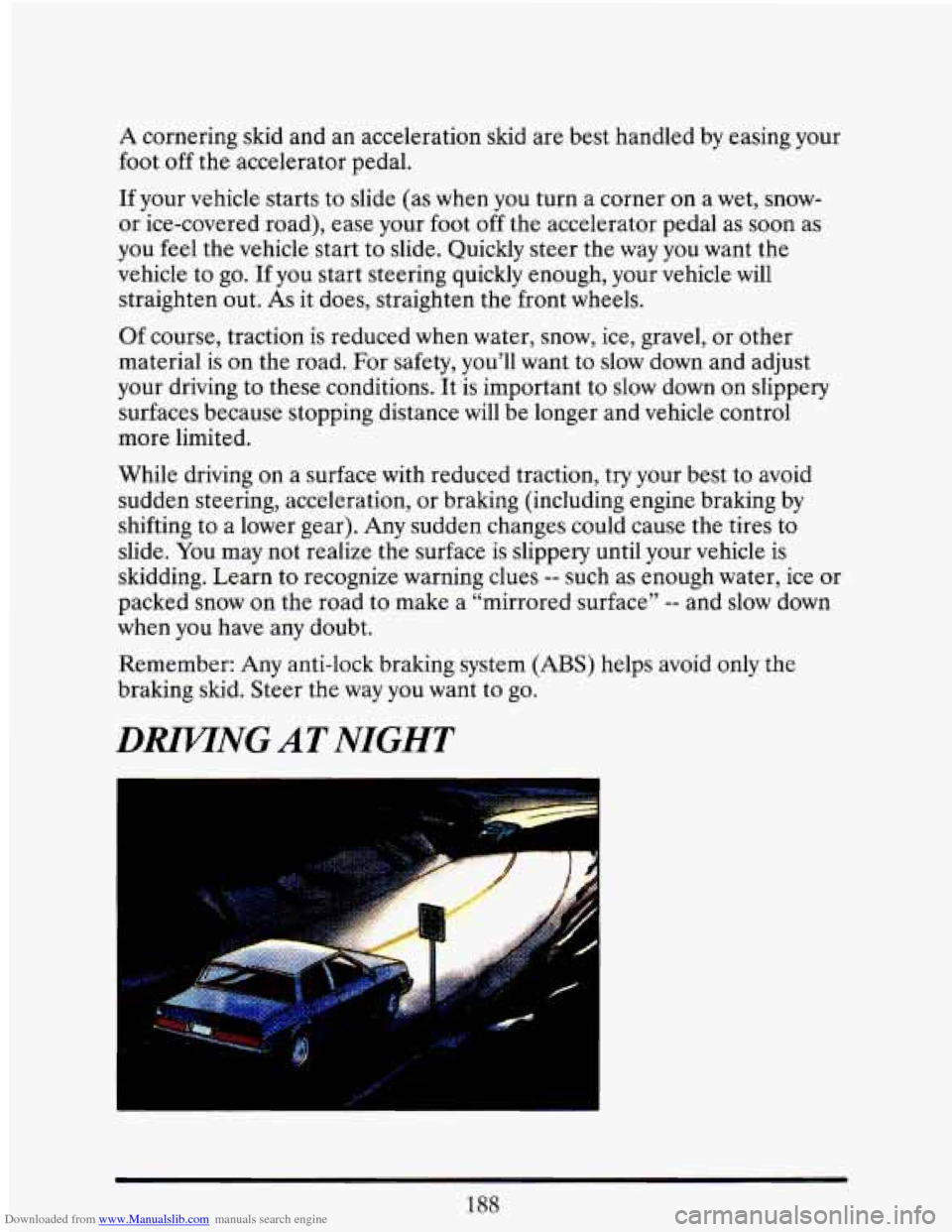
DIWTNG AT NIGHT
188
Page 203 of 398
Downloaded from www.Manualslib.com manuals search engine Night driving is more dangerous than day driving. One reason is that
some drivers are likely to be impaired
-- by alcohol or drugs, with night
vision problems, or by fatigue.
Here are some tips on night driving.
0
0
0
0
0
0
0
Drive defensively. Remember, this is the most dangerous time.
Don’t drink and drive. (See “Drunken Driving” in the Index for more
on this problem.)
Adjust your inside rearview mirror to reduce the glare from headlights
behind you.
Since you can’t see as well, you may need to slow down and keep more
space between you and other vehicles. It’s hard to tell how fast the
vehicle ahead is going just by looking at its taillights.
Slow down, especially on higher speed roads. Your headlights can light
up only
so much road ahead.
In remote areas, watch
for animals.
If you’re tired, pull off the road in a safe place and rest.
Night Vision
No one can see as well at night as in the daytime. But as we get older
these differences increase.
A 50-year-old driver may require at least twice
as much light to see the same thing
at night as a 20-year-old.
What you do in the daytime can
also affect your night vision. For
example, if you spend the day
in bright sunshine you are wise to wear
sunglasses. Your eyes will have
less trouble adjusting to night.
But if you’re driving, don’t wear sunglasses at night. They may cut down
on glare from headlights, but they also make a lot
of things invisible that
should remain visible
- such as parked cars, obstacles, pedestrians, or
even trains blocking railway crossings. You may want to put on your
sunglasses after you have pulled into a brightly-lighted service or
refreshment area. Eyes shielded from that glare may adjust more quickly
to darkness back on the road. But be sure to remove your sunglasses
before you leave the service area.
You can be temporarily blinded by approaching lights. It can take a
second or
two, or even several seconds, for your eyes to readjust to the
189
Page 204 of 398

Downloaded from www.Manualslib.com manuals search engine dark. When you are faced with severe glare (as from a driver who doesn’t
lower the high beams, or a vehicle with misaimed headlights), slow down
a little. Avoid staring directly into the approaching lights. If there
is a line
of opposing traffic, make occasional glances over the line
of headlights to
make certain that one
of the vehicles isn’t starting to move into your lane.
Once
you are past the bright lights, give your eyes time to readjust before
resuming speed.
High Beams
If the vehicle approaching you has its high beams on, signal by flicking
yours to high and then back to low beam. This is the usual signal
to lower
the headlight beams. If the other driver still doesn’t lower the beams,
resist the temptation to put your high beams on. This only makes two
half-blinded drivers.
On a freeway, use your high beams only in remote areas where you won’t
impair approaching drivers. In some places, like cities, using high beams
is illegal.
When you
follow another vehicle on a freeway or highway, use low
beams. True, most vehicles now have day-night mirrors that enable the
driver
to reduce glare. But outside mirrors are not of this type and high
beams from behind can bother the driver ahead.
A Few More Night Driving Suggestions
Keep your windshield and all the glass on your vehicle clean -- inside and
out. Glare at night
is made much worse by dirt on the glass. Even the
inside
of the glass can build up a film caused by dust. Tobacco smoke also
makes inside glass surfaces
very filmy and can be a vision hazard if it’s left
there.
Dirty glass makes lights dazzle and flash more than clean glass would,
making the pupils
of your eyes contract repeatedly. You might even want
to keep a cloth and some glass cleaner in your vehicle if you need to clean
your glass frequently.
Remember that your headlights light up far less of a roadway when you
are
in a turn or curve.
Keep your eyes moving; that way, it’s easier to pick out dimly lighted
objects.
190
Page 212 of 398
Downloaded from www.Manualslib.com manuals search engine Switch on your turn signal, check your rearview mirrors as you move
along, and glance over your shoulder as often as necessary.
Try to blend
smoothly with the traffic flow.
Driving on the Freeway
Once you are on the freeway, adjust your speed to the posted limit or to
the prevailing rate
if it’s slower. Stay in the right lane unless you want to
pass.
If you are on a two-lane freeway, treat the right lane as the slow lane
and the left lane as the passing lane.
If you are on
a three-lane freeway, treat the right lane as the slower-speed
through lane, the middle lane as the higher-speed through lane,\
and the left lane as the passing lane.
Before changing lanes, check your rearview mirrors. Then use your turn
signal.
Just before you leave the lane, glance quicklyover your shoulder to make
sure there isn’t another vehicle in your “blind” spot.
If you are moving from an outside to a center lane on a freeway having
more than two lanes, make sure another vehicle isn’t about to move into
the same spot. Look at the vehicles two lanes over and watch for telltale
signs: turn signals flashing, an increase
in speed, or moving toward the
edge
of the lane. Be prepared to delay your move.
Once you are moving on the freeway, make certain you allow
a
reasonable following distance. Expect to move slightly slower at night.
Leaving the Freeway
When you want to leave the freeway, move to the proper lane well in
advance. Dashing across lanes at the last minute
is dangerous. If you miss
your exit do not, under any circumstances, stop and back up. Drive on to
the next
exit.
At each exit point is a deceleration lane. Ideally it should be long enough
for you to enter it at freeway speed (after signaling,
of course) and then
do your braking before moving onto the exit ramp. Unfortunately, not all
deceleration lanes
are long enough -- some are too short for all the
braking. Decide when to start braking.
If you must brake on the through
lane, and if there is traffic close behind you, you can allow a little extra
Page 215 of 398
Downloaded from www.Manualslib.com manuals search engine Then here are some tips:
0
0
0
0
Make sure your vehicle is well ventilated, with a comfortably cool
interior.
Keep your eyes moving. Scan
the road ahead and to the sides. Check
your rearview mirrors frequently and your instruments from time
to
time. This can help you avoid a fixed stare.
Wear good sunglasses in bright light. Glare can cause drowsiness. But
don’t wear sunglasses at night.
They will drastically reduce your
overall vision at the very time you need all the seeing power
you have.
If you get sleepy, pull
off the road into a rest, service, or parking area
and take a nap, get some exercise, or both. For safety, treat drowsiness
on the highway as an emergency.
As in any driving situation, keep pace with traffic and allow adequate
following distances.
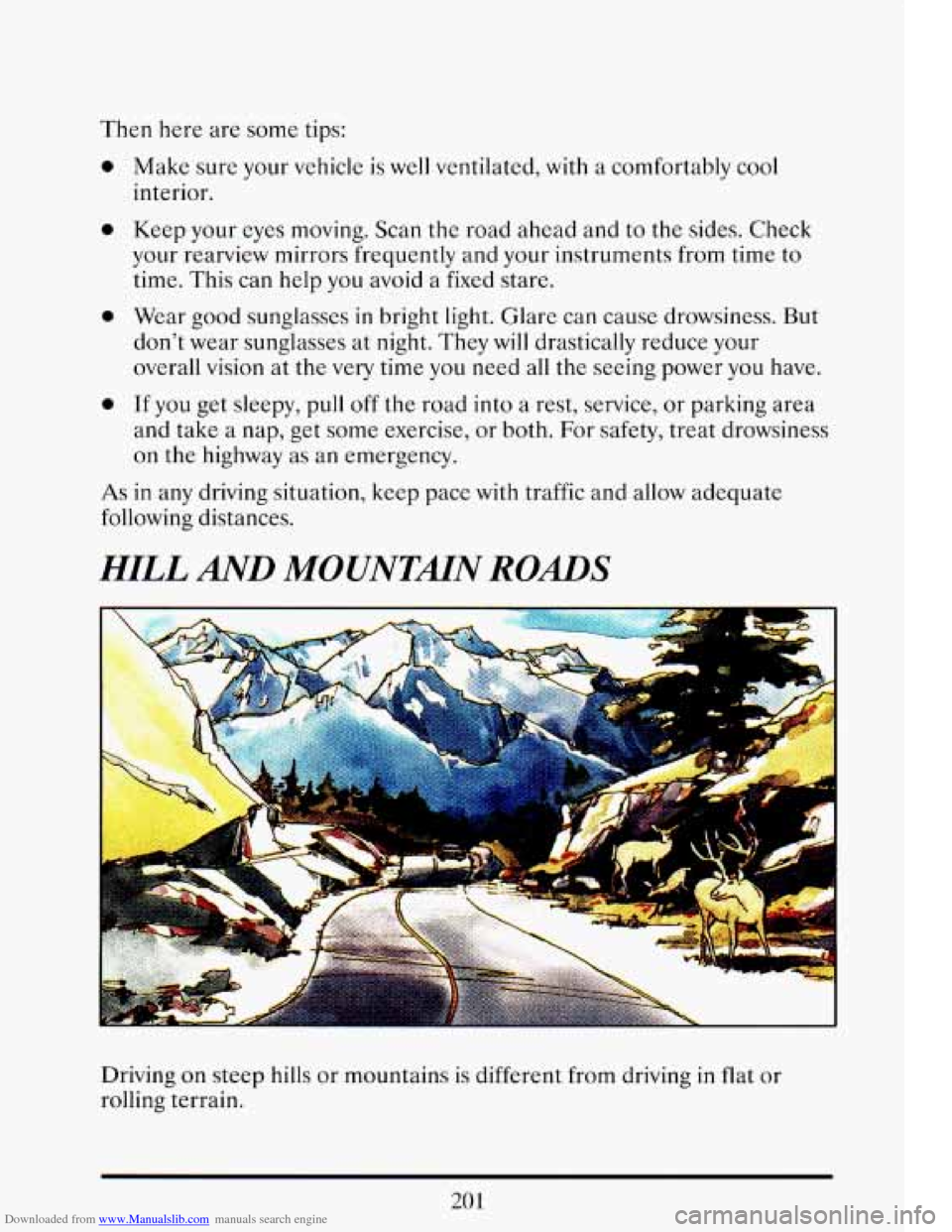
HILL AND MOUNTMN ROADS
J
Driving on steep hills or mountains is different from driving in flat or
rolling terrain.
201
Page 228 of 398

Downloaded from www.Manualslib.com manuals search engine Safety Chains
You should always attach chains between your vehicle and your trailer.
Cross the safety chains under the tongue of the trailer
so that the tongue
will not drop to the road
if it becomes separated from the hitch. Follow
the manufacturer’s recommendation for attaching safety chains. \
Always
leave just enough slack
so you can turn with your rig. And, never allow
safety chains
to drag on the ground.
Trailer Brakes
Does your trailer have its own brakes? Be sure to read and follow the
instructions for the trailer brakes
so you’ll be able to install, adjust and
maintain them properly.
Because you have anti-lock brakes, do not try to tap into your vehicle’s
brake system. If you do, both brake systems won’t work well, or at all.
Driving with a Trailer
Towing a trailer requires a certain amount of experience. Before setting
out for the open road, you’ll want
to get to know your rig. Acquaint
yourself with the feel of handling and braking with the added weight
of
the trailer. And always keep in mind that the vehicle you are driving is
now a good deal longer and not nearly so responsive as your vehicle is by
itself.
Before you start, check the trailer hitch and platform, safety chains,
electrical connector, lights, tires and mirror adjustment.
If the trailer has
electric brakes, start your vehicle and trailer moving and then apply the
trailer brake controller
by hand to be sure the brakes are working. This
lets you check your electrical connection at the same time.
During your trip, check occasionally to be sure that the load is secure,
and that the lights and any trailer brakes are
still working.
Following Distance
Stay at least twice as far behind the vehicle ahead as you would when
driving your vehicle without a trailer. This can help
you avoid situations
that require heavy braking and sudden turns.
214
Page 338 of 398
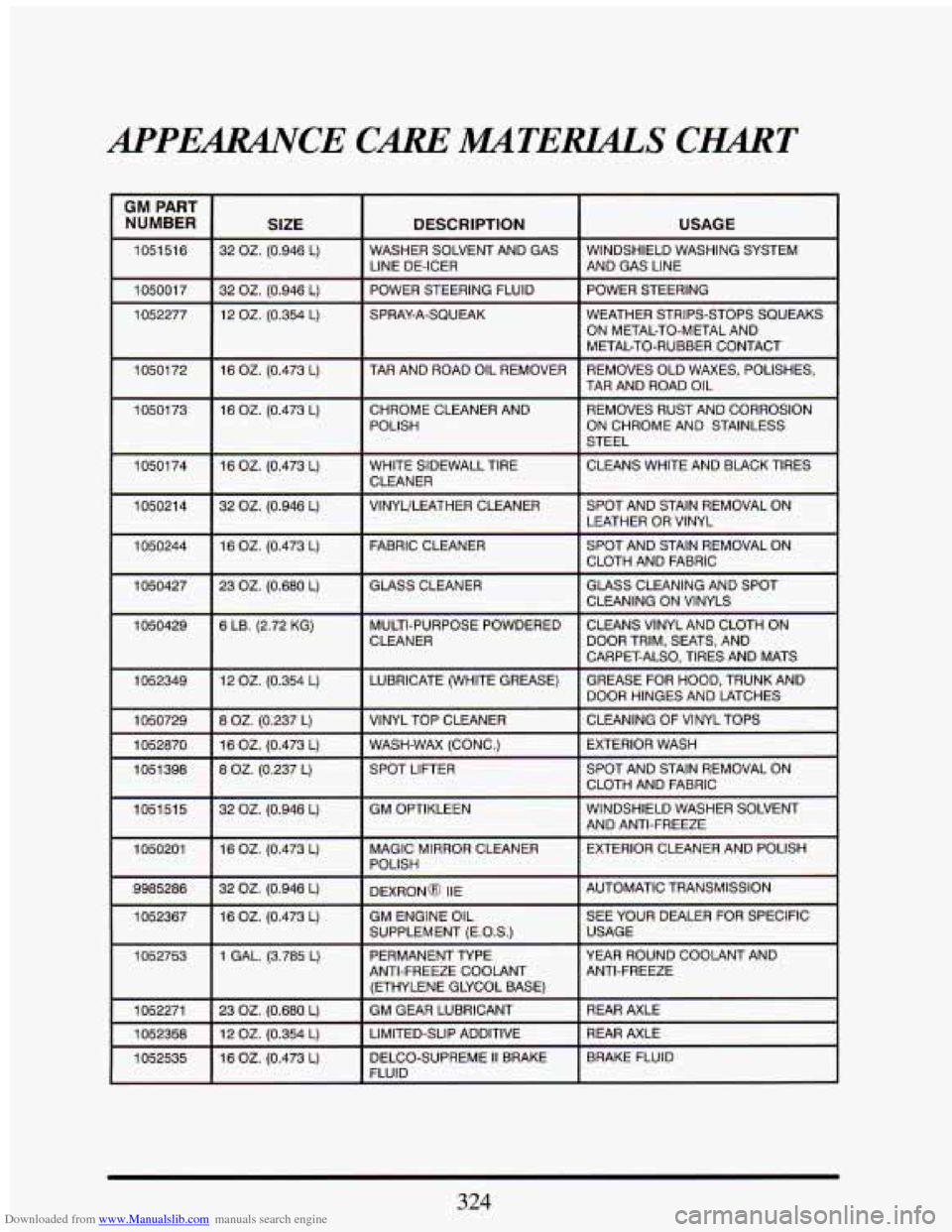
Downloaded from www.Manualslib.com manuals search engine GM PART
NUMBER
SIZE I DESCRIPTION USAGE
1051516 WINDSHIELD WASHING SYSTEM
AND GAS LINE 32 OZ. (0.946 L) WASHER SOLVENT AND GAS
105001 7 POWER STEERING
WEATHER STRIPS-STOPS SQUEAKS ON METAL-TO-METAL AND
METAL-TO-RUBBER CONTACT
1052277
I 1050172 I
16 OZ. (0.473 L) I TAR AND ROAD OIL REMOVER
I
REMOVES OLD WAXES, POLISHES,
TAR AND ROAD OIL
I
CHROME CLEANER AND
POLISH ' REMOVES RUST AND CORROSION
ON CHROME AND STAINLESS
STEEL
CLEANS WHITE AND BLACK TIRES
WHITE SIDEWALL TIRE
SPOT AND STAIN REMOVAL ON
LEATHER
OR VINYL
SPOT AND STAIN REMOVAL ON
CLOTH AND FABRIC
I 1050427 I I GLASS CLEANER I 23 OZ. (0.680 L) GLASS CLEANING AND SPOT
CLEANING ON VINYLS
I
1050429 6 LB. (2.72 KG)
I
MULTI-PURPOSE POWDERED
CLEANER CLEANS VINYL AND CLOTH
ON
DOOR TRIM, SEATS, AND
CARPET-ALSO. TIRES AND MATS
1052349 12 Of. (0.354 L) LUBRICATE (WHITE GREASE)
1050729 8 OZ. (0.237 L) VINYL TOP CLEANER
1052870
16 OZ. (0.473 L)
WASH-WAX (CONC.) GREASE FOR HOOD, TRUNK
AND
DOOR HINGES AND LATCHES
CLEANING
OF VINYL TOPS
EXTERIOR WASH
SPOT AND STAIN REMOVAL ON
CLOTH AND FABRIC
WINDSHIELD WASHER SOLVENT AND ANTI-FREEZE
1051 398 8 OZ. (0.237 L) SPOT LIFTER
1051515 32 OZ. (0.946 L) GM OPTIKLEEN
EXTERIOR CLEANER AND POLISH
16 OZ. (0.473 L) MAGIC MIRROR CLEANER
POLISH
32 OZ. (0.946 L) DEXRONQ IIE I 9985286 AUTOMATIC TRANSMISSION
SEE YOUR DEALER
FOR SPECIFIC
USAGE 1 1052367 I SUPPLEMENT (E.0.S.I I 16 OZ. (0.473 L) GM
ENGINE OIL I
YEAR ROUND COOLANT AND
ANTI-FREEZE 1 GAL. (3.785 L) PERMANENT TYPE
ANTI-FREEZE COOLANT
16 OZ. (0.473 L) DELCO-SUPREME II BRAKE
1052753
REAR AXLE
REAR AXLE
BRAKE FLUID
I I I FLUID 1
324
Page 343 of 398

Downloaded from www.Manualslib.com manuals search engine 1nrVc-I
SENSE
I I
BIII mc 1 m DRL
SUSPENSION RTD (BAT)
L HDLP LO
R HDLP LO L HDLP HI R HDLP HI
-1
COOL FAN TRANS/ECS
FUSE CENTER IDENTIFICATION I
ENGINE COMPARTMENT FUSE BLOCK
COIL 20A - 4.9L DISTRIBUTOR - 4.6L IGNITION CONTROL MODULE SIR 20A - DIAGNOSTIC ENERGY RESERVE MODULE
- ARMING SENSOR
- POWERTRAIN CONTROL MODULE (PCM) (DERM) SIR (AIR BAG)
PCM (IGN) 10A - PASSKeyB DECODER MODULE
INJ 10A
INJ 10A
IGN 10A
- FUEL INJECTORS 1,4,6,7
- FUEL INJECTORS 2,3,5,8
- A/C COMPRESSOR - ELECTROCHROMIC MIRROR - INSTRUMENT PANEL CLUSTER - DIAGNOSTIC ENERGY RESERVE MODULE
- KEYLESS ENTRY MODULE - CORNERING LIGHTS - CHIME MODULE - TWILIGHT SENTINEVDRL MODULE - BACKUP LIGHTS - BRAKE TRANSMISSION SHIFT INTERLOCK (DERM)
SIR (AIR BAG)
FUEL 20A
- FUELPUMP - POWERTRAIN CONTROL MODULE
PCM (BAT) 10A
A/C 1OA
HTD
W/S 10A
STOP LP 20A
TURN/HAZ 20A
- POWERTRAIN CONTROL MODULE (PCM)
- A/C COMPRESSOR
- HEATED WINDSHIELD
- STOP LIGHTS
- HAZARD LIGHTS - TURN SIGNAL LIGHTS DRL
1OA (CANADA)
DRL 1OA (CANADA)
SUSPENSION 10A
- DAYTIME RUNNING LIGHTS
- DAYTIME RUNNING LIGHTS
- ROAD SENSING SUSPENSION
- SPEED SENSITIVE SUSPENSION (4.9L)
- ROAD SENSING SUSPENSION (NORTHSTAR)
RTD (BAT) 20A
L HDLP LO 1 OA (EXPORT)
R HDLP LO 1OA (EXPORT)
L HDLP HI 10A (EXPORT)
R HDLP HI (EXPORT)
IGN
3 10A
- LEFT HEADLAMP LOW BEAM
- RT HEADLAMP LOW BEAM
- LEFT HEADLAMP HIGH BEAM
- RIGHT HEADLAMP HIGH BEAM
- HEATED WINDSHIELD - HEATER AND A/C PROGRAMMER - ELECT. LEVEL CONTROL (ELC) - DEFOGGER RELAY “D”
- CRUISE CONTROL - POWERTRAIN CONTROL MODULE
- COOLING FANS - POWERTRAIN CONTROL MODULE (4.6L) - FRONT AND REAR HEATED OXYGEN
COOLING
FAN 10A
SENSOR (4.6L)
TRANS/ECS
1 OA
SOLENOID - EXHAUST GAS RECIRCULATION (EGR)
- POWERTRAIN CONTROL MODULE (PCM) - AUTOMATIC TRANSAXLE - EVAPORATIVE EMISSION CONTROL
SOLENOID
- OVERSPEED ALERT MODULE (EXPORT) - POWER STEERING PRESSURE SWITCH
329