Page 123 of 340
iI
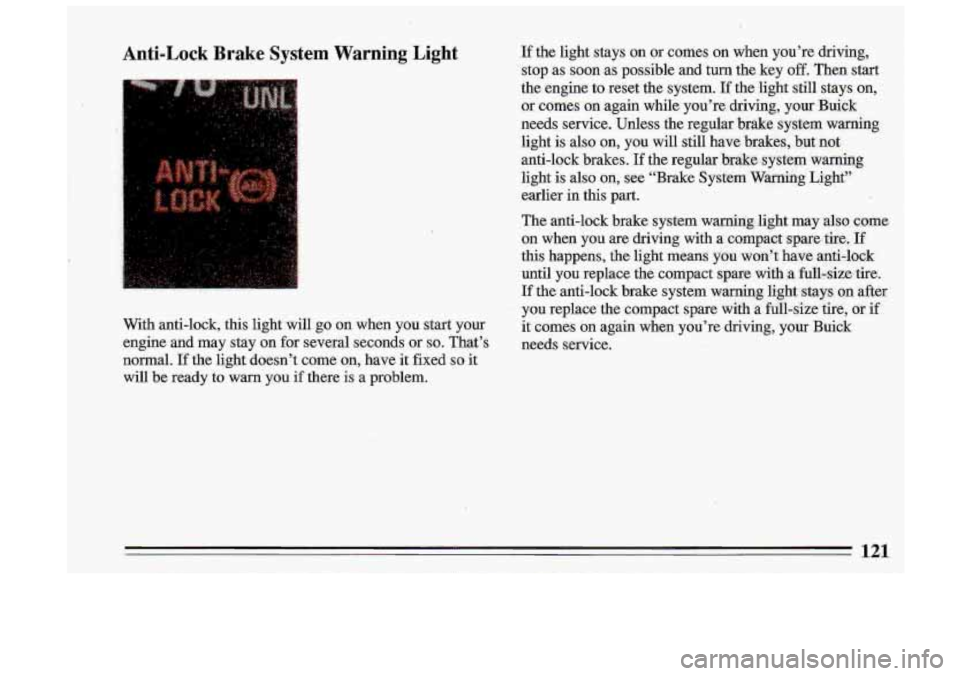
Anti-Lock Brake System Warning Light
. -, i’
.. I. ,:,:
With anti-lock, this light will go on when you start your
engine and may stay on for several seconds or
so. That’s
normal.
If the light doesn’t come on, have it fixed so it
will be ready to warn you if there is a problem.
If the light stays on or comes on when you’re driving,
stop as soon as possible and turn the key
off. Then start
the engine to reset the system.
If the light still stays on,
or comes on again while you’re driving, your Buiek
needs service. Unless the regular ‘brake system warning
light is also
on, you will still have brakes, but not
anti-lock brakes.
If the regular brake system warning
light is also
on, see “Brake System Warning Light”
earlier
in this part.
The anti-lock brake system warning .light may also come
on when you are driving with
a compact spare. tire, If
this happens, the light means you won’t have anti-lo,ck
until you replace the compact spare ,with
.a fuU-simtire.
If the anti-lock brake system warning light stays
on after
you replace the compact spare with a full-size tire, or if
it comes
on again when you’re driving, your Buick
needs service.
121
Page 124 of 340
Engine Coolant Temperature Warning: ’ J
Light
1
I
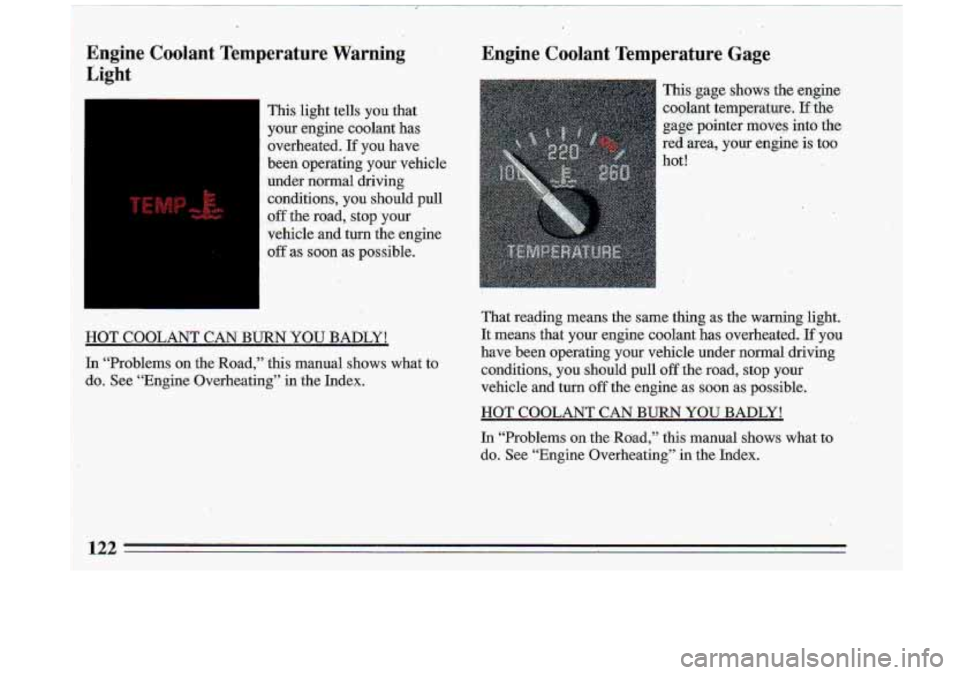
This light tells you that ‘
your engine coolant has
ovetheated.
If you have
been operating your vehicle
under normal driving
.conditions, you should pull
off the road, stop your
vehicle and
turn the engine
-off as soon as possible.
:I
HOT COOLANT CAN BURN YOU-BADLY!
In “Problems on the Road,” this manual shows what to
do. See “Engine Overheating” in the Index.
Engine Coolant Temperature Gage
This gage shows the engine
coolant temperature,
If the
gaie: pointer moves into the
red area, your engine is too
hot!
: y’,
That reading means the same thing as the warning light.
It means that your engine coolant has overheated.
If you
have been operating your vehicle under normal driving.
conditions, you should pull off-the road, stop your
vehicle and
turn off the engine as soon as possible.
HOT COOLANT CAN BURN YOU BADLY!
In “Problems on the Road,” this manual shows what to
do. See “Engine Overheating” in the Index.
133
Page 155 of 340
.
RAILROAD ADVANCE
CROSSING
NARROW
BRIDGE
x h
h
h
Y
I
LOW W WOBKE
SHOULDER FLAGGER AHEAD
AHEAD
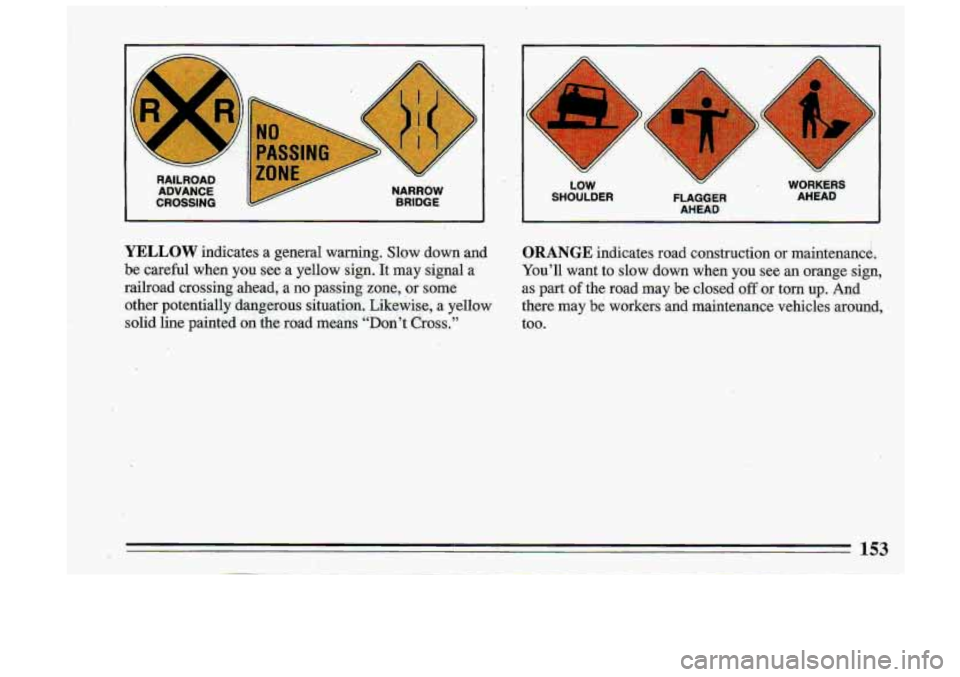
YELLOW indicates a general warning. Slow down and
be careful when you see
a yellow sign. It may signal a
railroad crossing ahead, a no passing. zone, or somi
other potentially dangefous situation. Likewise, a yellow
.solid line painted on the road means “Don’t Cross.”
I
ORANGE indicates road construction or maintenance. I
You’ll want to slow down when you see an .orange sign,
as part of the road may be closed off .or torn up. And
there may be workers and maintenance vehicles -around,
too.
153
Page 157 of 340
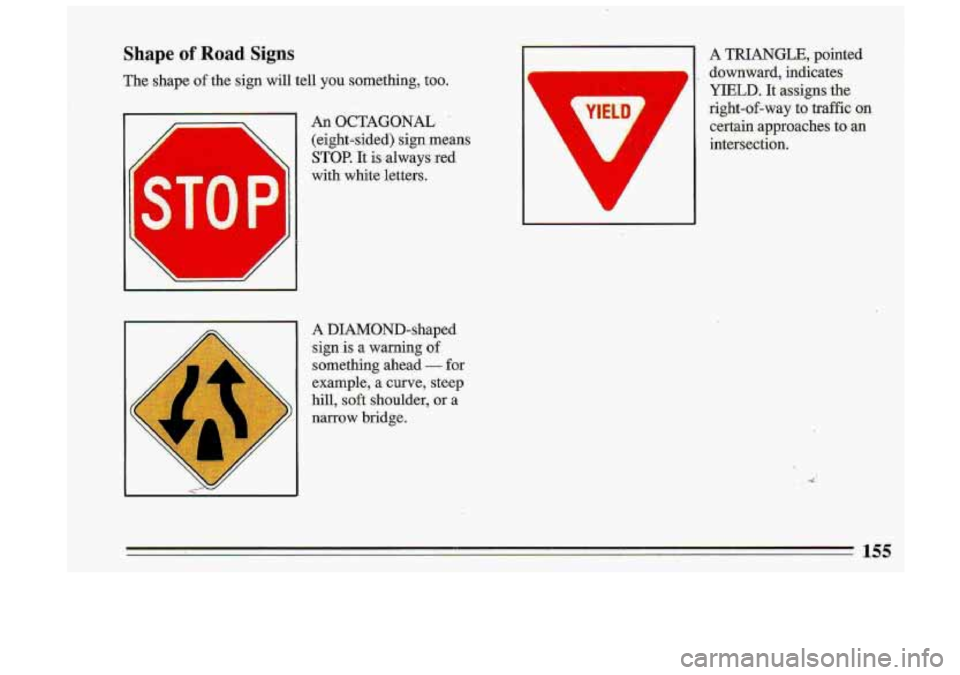
Shape of Road Signs
The shape of the sign will tell you something, too.
Is
An OCTAGONAL
(eight-sided) sign-means
STOP. It is always red
with white letters.
A TRIANGLE, pointed
YIELD. It assigns the
right-of-way to traffic on
certain approaches to
an
intersection.
., downward, indicates
..
A DIAMOND-shaped
sign is a warning of
something ahead - for
example, a curve, steep
hill, soft shoulder, or a
narrow bridge.
Page 161 of 340
Your Own Signals Defensive Driving
Drivers signal
to others, too. It’s not only more polite,
it’s safer ‘to let other drivers know what you are doing.
And in some places the law requires driver signals.
Turn and lane change signals. Always signal when you
plan to turn or change lanes.
If necessary, you can
use hand signals out the window:
Left arm straight out for
a left turn, down- for slow or
about-to-stop, and up for a right turn.
Slowing. down. If time allows, tap the brake pedal once
or twice
in advance of slowing or stopping. This warns
the driver behind you.
Disabled. Your -four-way flashers signal that your
vehicle is disabled or is a hazard. See “Hazard Warning
Flasher” in the Index.
Traffic Officer
The traffic police officer is also a source of important
information.
The officer’s signals govern, no matter
what the traffic lights or other signs say.
The next section discusses some of the road conditions
you
may encounter. The
best advice anyone can give about driving is: Drive
i
defensively. !
Please start with a very important safety device in your
Buick: Buckle up. (See “Safety Belts” in the Index.) i
Defensive driving really means “be ready for anything.”
On city streets, rural roads, or freeways, it means
“always expect the unexpected.”
Assume that pedestrians or other drivers are going to be
careless and make mistakes. Anticipate what they might
do. Be ready for their mistakes.
Expect children to dash out from behind parked cas,
often-followed by other children. Expect occupants
in
parked cars to open doors into traffic., Watch for
movement
in parked cars - someone may be about to
open a door.
Expect other drivers to run stop signs when. you are on a
through street. Be ready to brake if necessary
as you go
through intersections. You may not have
to use the
brake, but if you do, you will be ready.
If you’re driving through a shopping center parking lot
where there are well-marked lanes, directional arrows,
and designated parking areas, expect.some drivers to
159
__
Page 170 of 340
I
1 /! CAUTION: A CAUTION:
The brake wear warn g s
sooner or later your brakes won’t work well
That could lead
to an accident. When you hear
the brake wear warning
-- -3 your
vehicle serviced. -. --I - ,~
I
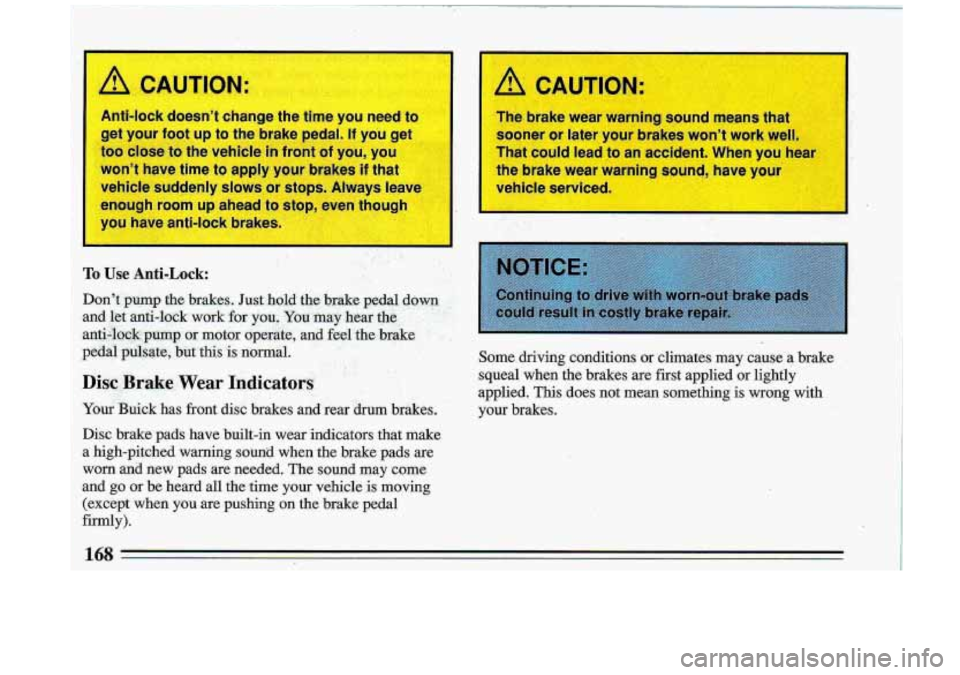
Some driving conditions or climates may cause a brake
squeal when the brakes are first applied or lightly
applied. This
does not mean something is wrong with
your brakes.
Page 177 of 340

vehicle is skidding. Learn to recognize warning clues -
such as enough water, ice or packed snow on the road to
make a “mirrored surface’’
- and slow .down when you
.have any doubt.
Remember: Any anti-lock braking system (ABS) helps
avoid only the braking skid. Steer the way you want
to
go-
Driving at Night
Night driving is more dangerous than day driving. One
reason is that some drivers are likely to be impaired
-
by alcohol or drugs, with night vision prob1ems;or by
fatigue.
Here are some tips on night driving.
0
0
0
0
a
0
0
Drive defensively. Remember, this is the most
dangerous time.
Don’t drink and drive. (See “Drunken Driving.” in
the Index for more on this problem.)
Adjust your inside rearview mirror to reduce the
glare from headlights behind you.
Since’ you can’t see as well,
you may need to slow
down and
keep more space between you and other
vehicles. It’s hard to tell how fast the vehicle ahead
is going just
by looking at its taillights,
Slow down, especially on higher speed roads. Your
headlights can light up only
so much road ahead.
In remote areas, watch for animals.
If you’re tired, pull
off the road in a safe place and
rest.
175
I
.!
I
Page 183 of 340
Tips on Driving in Fog
If you get caught in fog, turn your headlights on low
beam, even in daytime. You’ll see
- and be seen -
better.
Pass other vehicles in fog only if you can see far enough
ahead to pass safely. Even then, be prepared to delay
your pass if you suspect the
fog.is worse up ahead. If
other vehicles try to pass you, make it easy for them.
*
If visibility is near zero and you must stop but are
unsuTe whether you are away
from the road, turn your
lights on, start
your hazard warning flasher, and sound
your
Born at intervals or when you hear approaching
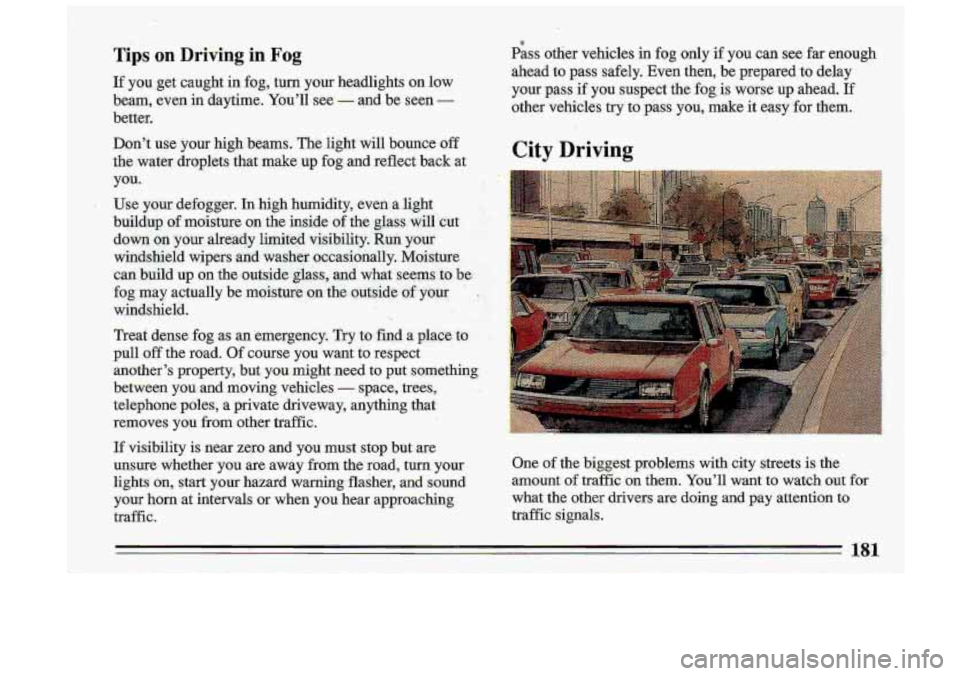
traffic. One
of the
biggest problems with city streets is the
amount of traffic
on them. You’ll want to watch out for
what the other drivers are doing and pay attention
to
traffic signals.
181