Page 193 of 340
Winter Driving
Here are some tips for winter driving:
Have your Buick in good shape for winter. Be sure
your engine coolant mix is co-rrect.
Snow tires. can help in loose snow, but they may give
you less traction on ice than regular tires. If you do
not expect to be driving
in deep snow, but may have
to travel over ice,
you may not want to switch to
snow tires at all.
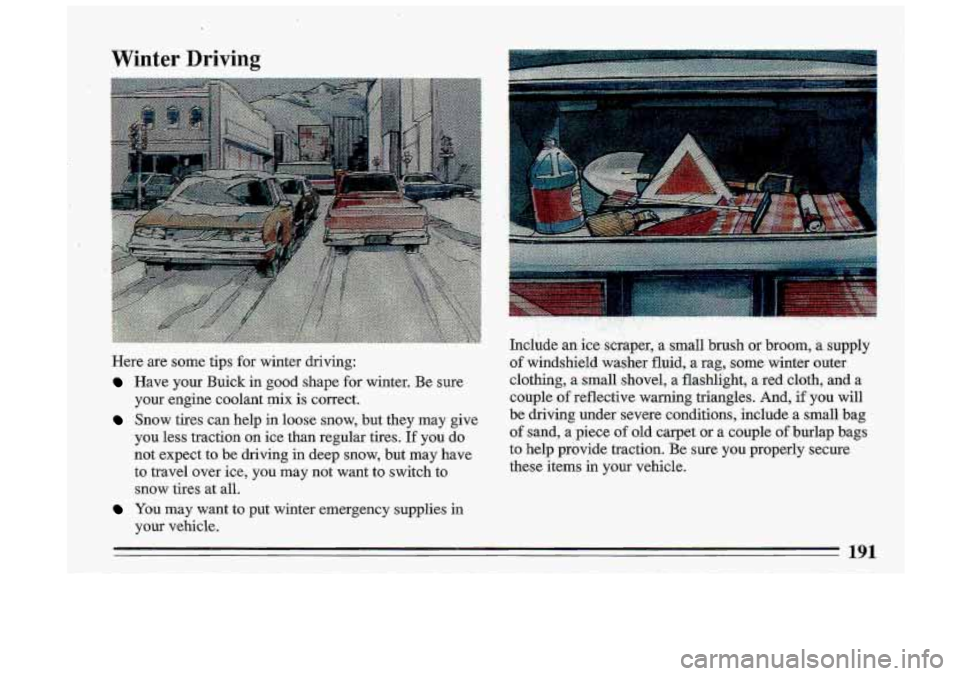
You may want to put winter emergency supplies in
your vehicle.
I
I
.. . ..
Include an.ice:scrapGq a small brush .or broom, a supply
of'windshield washer fluid,
a rag, some winter outer
clothing,
a small shovel, a flashlight, a, red. cloth,. and a
couple
.of reflective warning triangles. And, if you will
be driving under:severe conditions, include a small bag
of sand, a piece of ,old carpel .or a couple of burlap. bags
to help provide traction. Be sure y.ou properly secure
these items in your vehicle.
Page 205 of 340
Part 5 Problems on the Road
I- .. . 1. ’ . ’ ‘I
.. .....
Here you’ll find what to do about some problems that can occur on the road .
Part 5 includes:
Hazard Warning Flashers
............................................................
“Jump”Starting ...................................................................
OtherWarningDevices .............................................................
TowingYourBuick ................................................................
Engineoverheating ................................................................
IfaTireGoesFlat .................................................................
ChangingaFlatTire ................................................................
CompactSpareTire ................................................................
If You’re Stuck in Sand, Mud, Ice or Snow ..............................................
204
205
206
212
216
224
224
238
239
Page 207 of 340
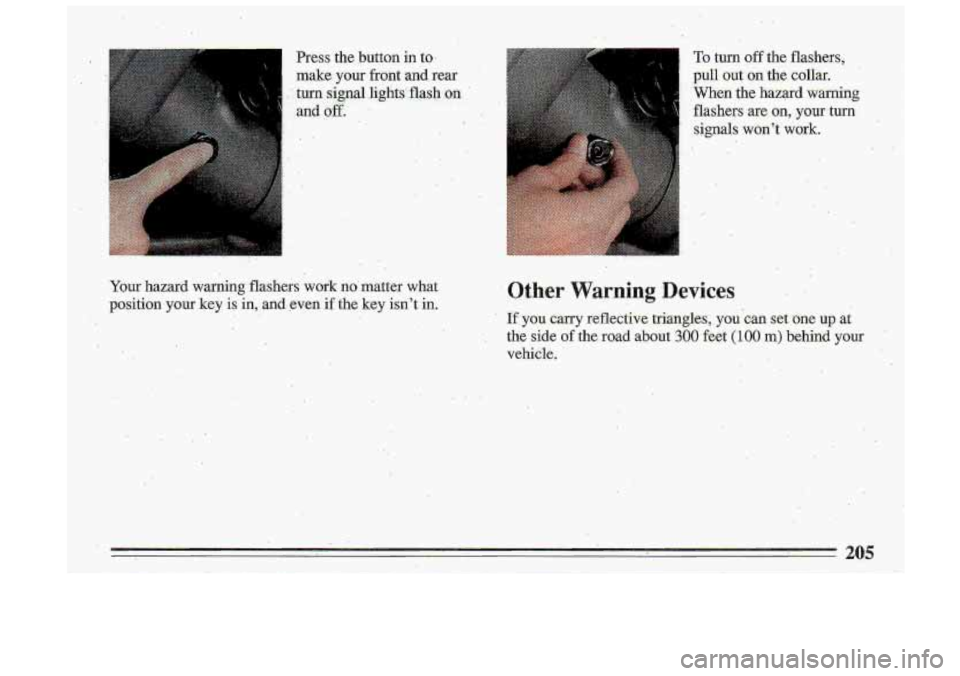
7 Press the button in to. ~ make your front and, rear
i : turn s$gnal .lights' flash on
and
off. .. . ,.
,.
I .'
Your hazard warning -flashers work no' matter wnat
position your key is in, and even if the key isn't in.
To turn off the flashers,
pull out on the collar.
When the hazard
warning
flashers are on, your turn
signals won't work.
Other Warning Devices
If you carry reflective triangles; you can set one up at
the side
of the road about 300 feet (100 m) behind your
vehicle.
205
Page 214 of 340
Towing Your Car
Try to have a GM dealer or a professional towing
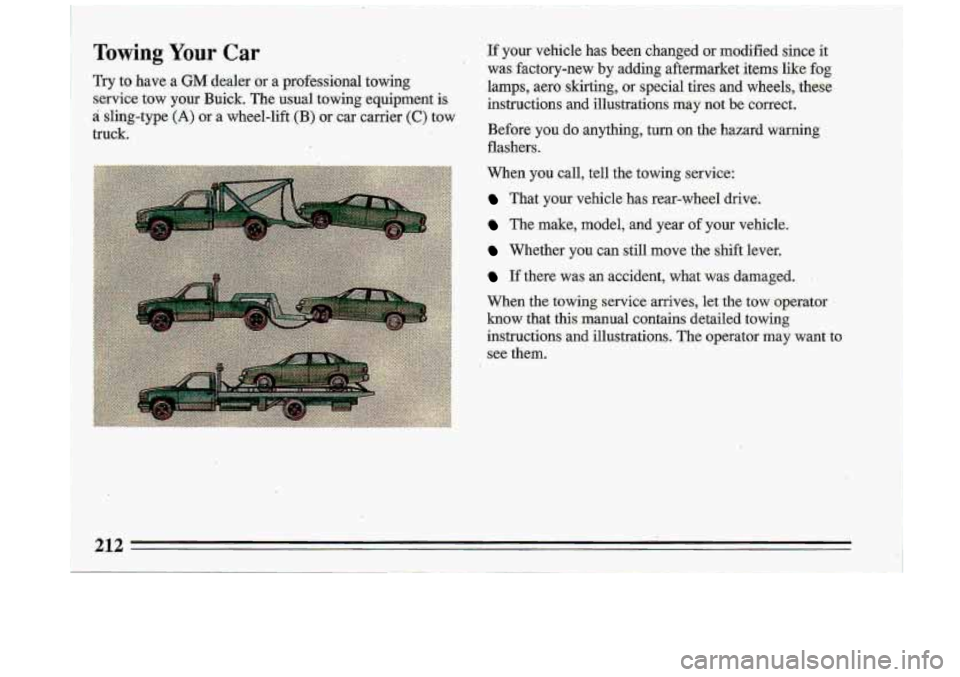
service tow your Buick. The usual towing equipment is
a sling-type (A) or a wheel-lift (B) or car carrier (C) tow
truck.
If your vehicle has been changed or modified since it
was factory-new
by adding aftermarket items like fog
lamps, aero skirting, or special
tires and wheels, these
instructions and illustrations may not
be correct.
Before you do anything, turn on the hazard warning
flashers.
When you call, tell.the towing service:
That your vehicle has rear-wheel drive.
The make, model, and year of- your vehicle.
Whether you can still move the shift lever.
If there was an accident, what was damaged.
When the towing service arrives, let the
tow operator
know that this manual contains detailed towing
instructions and illustrations. The operator may want to
see them.
Page 219 of 340
1. Turn off yom air conditioner.
If :No .Steam Is Coming From Your Engine:
If you get the overheat warning but see or hear no
steam, the problem may not be
too serious. Sometimes
the engine can get a little
too hot when you:
Climb a long hill on a.hot day.
Stop :after high speed driving.
Idle for long periods in traffic.
Tow a trailer.
If you get the overheat warning with no sign of steam,
try this
for a minute or so:
If there's still no. sign of steam, push the accelerator until
the .engine speed is about twice
as fast as normal idle-
speed. Bring the engine speed back
to normal idle speed
after two or three minutes.
Now see if the warning stops.
But then,
if you still have the-warning, TURN OF'F THE
ENGINE AND GET EVERYONE OUT OF THE
VEHICLE until it cools down.
You may decide not to 1ift.the hood but to get service
help right away.
217
Page 221 of 340
1
I
11 parts, can be very hot. Don’t 1 Ich them. I
do, you can be burned.
Don’t
run the engine if ther I leak. If yo
the engine,
it could lose all coolant. That could
cause an engine Pire, and you could be burned.
Get any leak fixed before you drive the vehicle.
If there seems to be no leaK, start tne engine again to see
if the fan runs when the engine does. If it doesn’t,, your
vehicle needs service. Turn
off the engine.
How to Add Coolant to the Coolant
Recovery Tank
If you,haven’t found a problem yet, but the coolant level
isn’t at or above
“FULL COLD,” add-a 50/50 mixture of
clean water (preferably distilled) and a proper antifreeze
at the coolant recovery tank. (See “Engine Coolant’’ i\
n
the Index for more information about the proper coolant
mix.)
can be dangerous. Plain water, or some other I
liquid like alcohol, can boil before the, proper
coolant mix will. Your vehicle’s coolant warning
system
is set for the proper coolant mix. With
plain water
or the wrong mix, your engine could
get too hot but you wouldn’t get the overheat
warning. Your engine could catch fire.and you
or others could be burned. Use a 50/50 mix of
clean
---- s-- -1 a proper antifr ze.
5
219 1 i
Page 222 of 340
m
m
II
L, CAUTIOP
You can be bu 3d if you spill coolant on hot
engine parts. Coolant contains ethylene
glycc
and it will burn if the engine parts are hot
enough. Don’t
spill coolant on a hot engine.
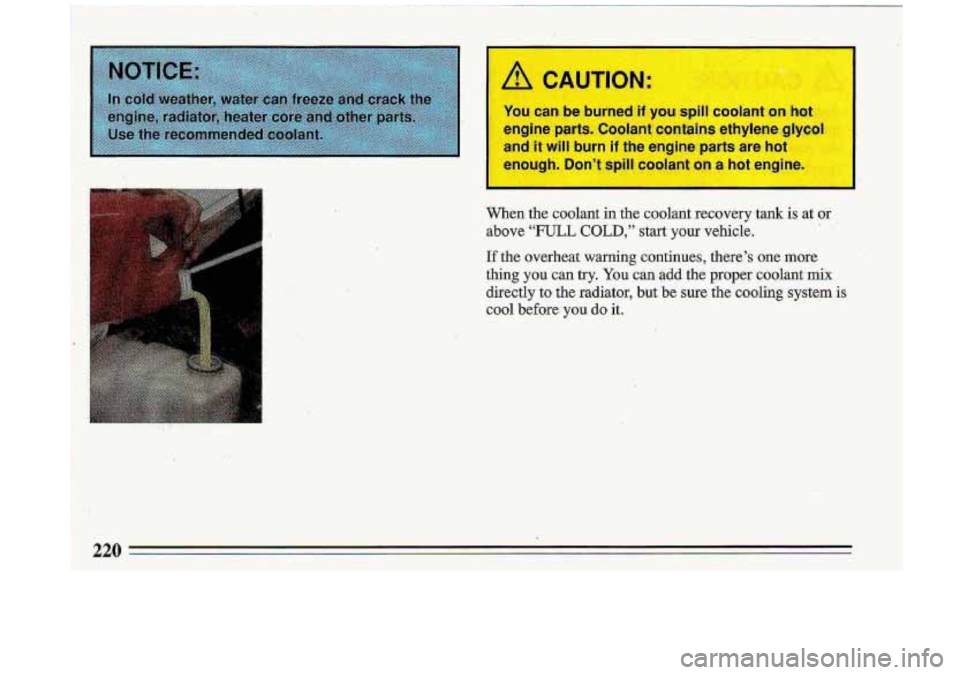
When the Luolant in the coolant recovery ~~IMC is “1 or
above
“FULL COLD,” start your vehicle.
If the overheat warning continues, there’s one more
thing
you can try. You can add the proper coolantmix
directly to the radiator, but be sure the cooling system is
cool before
you do it.
220
Page 240 of 340
Compact Spare T,ire
Although the compact spare was fully inflated when
your vehicle -was new, it can lose air after a time. Check
the inflation pressure regularly. It should be
60 psi (420
Pa). The compact spare is made to g6 up to 3,000 miles
(50,OO km), so you can finish your trip and have. your
full-size tire repaired
or replaced where you want. Of
course, it’s best to replace your spare with a full-size ti\
re
as soon as you can. Your spare will last longer and be in
good shape in case you need it again.
Your anti-1ock.brake system warning light -may come on
when you are driving with a compact spare. See
“Anti-Lock Brake System Waming Light”
in the Index.
Don’t-use
your compact spare on some other vehicle. And don’t mix your compact spare or wheel
with other
wheels or tires. They. won’t
fit.. Keep your spare and its
wheel together.
., ,. .. .. , ...
L CAUTIOF
s J a Jal , a we, or orner equlpmenr in rn
passenger compartment of the vehicle could
cause injury. In
a sudden stop or collision,
loose equipment could strike someone. Store al
these
in the proper place
3s