Page 156 of 340
449
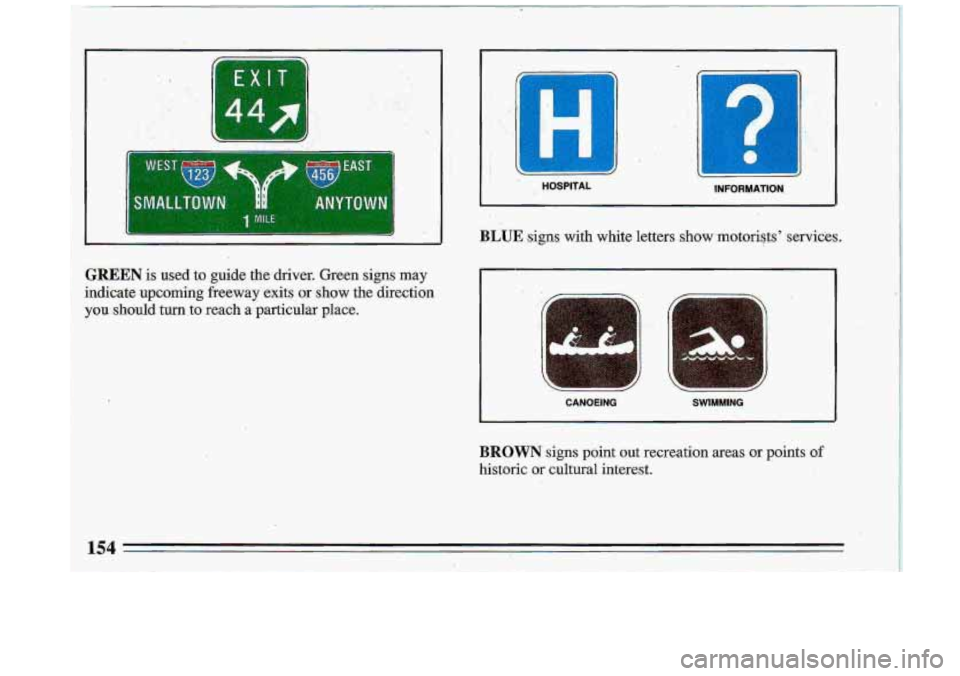
GREEN is used to guide the driver. Green signs may
indicate ,upcoming freeway exits or show the direction
you should turn to reach a particular place.
3 H
HOSPITAL INFORMATION,
BLUE signs with white letters show motorists' services.
r
...... .
CANOEING SWIMMING
BROWN signs point out recreation areas or points of
historic or cultural interest.
154
Page 170 of 340
I
1 /! CAUTION: A CAUTION:
The brake wear warn g s
sooner or later your brakes won’t work well
That could lead
to an accident. When you hear
the brake wear warning
-- -3 your
vehicle serviced. -. --I - ,~
I
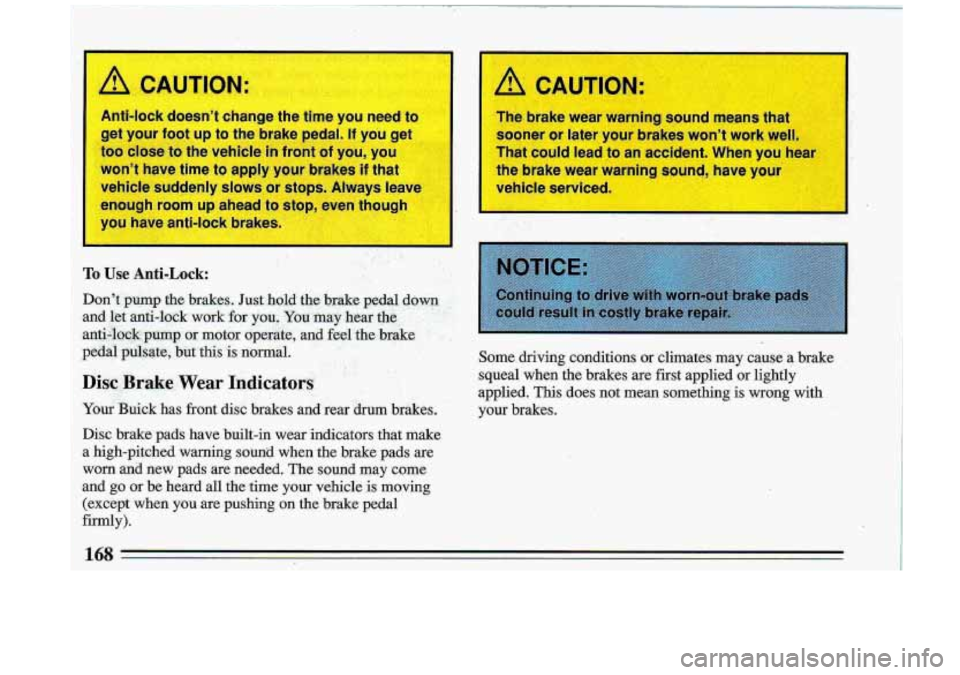
Some driving conditions or climates may cause a brake
squeal when the brakes are first applied or lightly
applied. This
does not mean something is wrong with
your brakes.
Page 178 of 340
Night Vision
'No one can see as we11 at night as in the daytime. But as
we get older these differences increase.
A 50-year-old
driver may require .at least twice as much light
to see the
same thing at night as a 20-year-old.
What you do in the daytime can also affect your night
vision.
For example, if you spend the day in bright
sunshine you are wise to wear sunglasses.
Your eyes will
have less trouble adjusting to night.
But'if you're driving, don't wear sunglasses at night.
They.may cut down on glare from headlights, but they
also make a lot
of things invisible that should remain
yisible
- such as parked cars, obstacles, pedestrians, or
even train5 blocking railway crossings. You mzy want to
put on
your sunglasses -after ,you have pulled into a
brightly-lighted service or refreshment area. Eyes shie1ded.from that glare
may adjust.more quickly to
darkne,ss back on the road. But be sure to remove your
sunglasses before
you leave the service area.
When you .follow another vehicle
on a freeway or
highday, use low beams. True, most vehic1e.s now.have,
day-night mirrors that enable the driver to reduce glare.
But outside mirrors are not
of this type and.high beams
from behind can bother the driver ahead.
176
Page 187 of 340
I
!i 1 I
I
0
0
Wear good sunglasses in bright light. Glare can.
cause drowsiness.
But don’t wear sunglasses at I
night. They will drastically reduce your overall
vision at the very time you need all the seeing power
you have.
If you get sleepy, pull
off the road into a’rest, service,
or parking area and take a nap, get some exercise,
or
both. For safety, treat drowsiness on the highway as.
1
an emergency.
As in any driving situation, keep pace with traffic and
allow adequate following distances.
185
Page 213 of 340
11. Try to start the vehicle with the dead battery.
If it won’t start after a few tries, it probably needs
service.
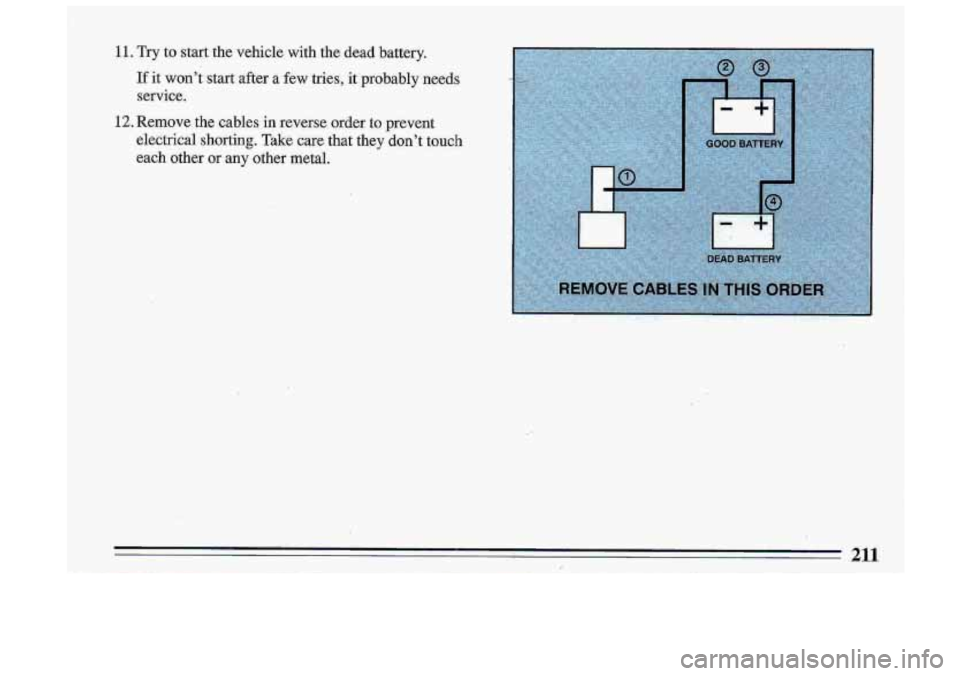
12. Remove the cables in reverse order to prevent
electrical shorting. Take care that they don’t touch
each other or any other metal.
!
I
Page 214 of 340
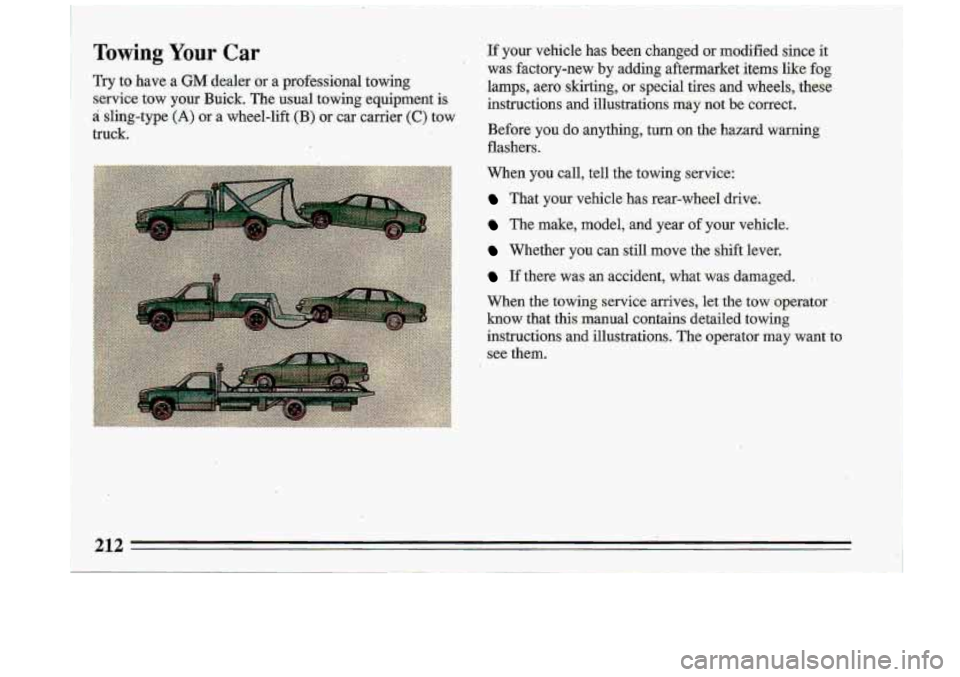
Towing Your Car
Try to have a GM dealer or a professional towing
service tow your Buick. The usual towing equipment is
a sling-type (A) or a wheel-lift (B) or car carrier (C) tow
truck.
If your vehicle has been changed or modified since it
was factory-new
by adding aftermarket items like fog
lamps, aero skirting, or special
tires and wheels, these
instructions and illustrations may not
be correct.
Before you do anything, turn on the hazard warning
flashers.
When you call, tell.the towing service:
That your vehicle has rear-wheel drive.
The make, model, and year of- your vehicle.
Whether you can still move the shift lever.
If there was an accident, what was damaged.
When the towing service arrives, let the
tow operator
know that this manual contains detailed towing
instructions and illustrations. The operator may want to
see them.
Page 219 of 340
1. Turn off yom air conditioner.
If :No .Steam Is Coming From Your Engine:
If you get the overheat warning but see or hear no
steam, the problem may not be
too serious. Sometimes
the engine can get a little
too hot when you:
Climb a long hill on a.hot day.
Stop :after high speed driving.
Idle for long periods in traffic.
Tow a trailer.
If you get the overheat warning with no sign of steam,
try this
for a minute or so:
If there's still no. sign of steam, push the accelerator until
the .engine speed is about twice
as fast as normal idle-
speed. Bring the engine speed back
to normal idle speed
after two or three minutes.
Now see if the warning stops.
But then,
if you still have the-warning, TURN OF'F THE
ENGINE AND GET EVERYONE OUT OF THE
VEHICLE until it cools down.
You may decide not to 1ift.the hood but to get service
help right away.
217
Page 221 of 340
1
I
11 parts, can be very hot. Don’t 1 Ich them. I
do, you can be burned.
Don’t
run the engine if ther I leak. If yo
the engine,
it could lose all coolant. That could
cause an engine Pire, and you could be burned.
Get any leak fixed before you drive the vehicle.
If there seems to be no leaK, start tne engine again to see
if the fan runs when the engine does. If it doesn’t,, your
vehicle needs service. Turn
off the engine.
How to Add Coolant to the Coolant
Recovery Tank
If you,haven’t found a problem yet, but the coolant level
isn’t at or above
“FULL COLD,” add-a 50/50 mixture of
clean water (preferably distilled) and a proper antifreeze
at the coolant recovery tank. (See “Engine Coolant’’ i\
n
the Index for more information about the proper coolant
mix.)
can be dangerous. Plain water, or some other I
liquid like alcohol, can boil before the, proper
coolant mix will. Your vehicle’s coolant warning
system
is set for the proper coolant mix. With
plain water
or the wrong mix, your engine could
get too hot but you wouldn’t get the overheat
warning. Your engine could catch fire.and you
or others could be burned. Use a 50/50 mix of
clean
---- s-- -1 a proper antifr ze.
5
219 1 i