Page 244 of 340
Service Doing Your Own Service. Work
perform. see “Maintenance Record” in the Index.
Page 246 of 340
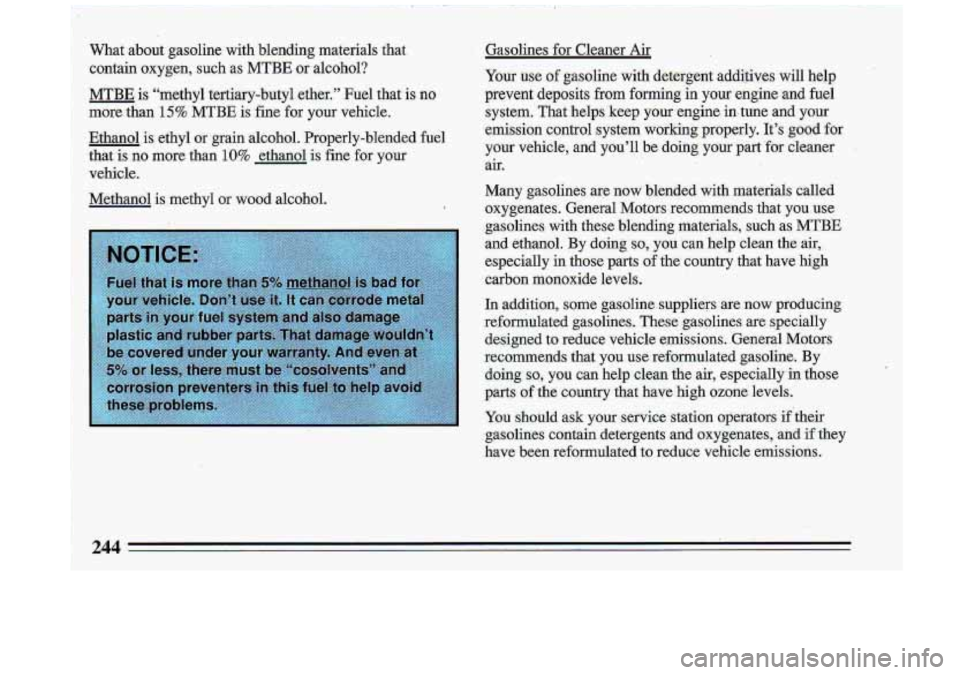
What about gasoline with blending materials that contain oxygen, such as MTBE or alcohol?
MTBE is “methyl tertiary-butyl ether.” Fuel that is, no
more than 15% MTBE is fine for your vehicle.
Ethanol is ethyl or .grain alcohol. Properly-blended fuel
that
is no more than 10% ethanol is fine for your
vehicle.
Methanol is methyl or
wood alcohol. Gasolines
for Cleaner Air
Your use
of gasoline with detergent additives will help
prevent deposits from forming in your engine:and
fuel
system. That helps keep your ,engine in. tune and your
emission control system working properly. It’s good
for
your vehicle, and you’ll be doing your part for cleaner
air.
Many gasolines are now blended with materials called
oxygenates. General Motors .recommends that you use
gasolines with these blending materials, such as MTBE
and-ethanol. By doing so, you can help clean the
ak,
especially in those parts of the country that have high
carbon monoxide levels.
In addition, som-e gasoline suppliers are now .producing
reforniulated gasolines. These gasolines are specially
designed to reduce vehicle emissions. General Motors
recommends that you use reformulated gasoline. By
doing
so, you can help clean the air, especially in those
parts
of the country that have high ozone levels.
You should ask your service station operators if their
gasolines contain detergents and oxygenates, and
if they
have been reformulated to reduce vehicle emissions.
.
Page 254 of 340
It’s below freezing outside and most trips are less:
than
10 miles (16 km).
. The engine is -at low .speed most of the time (as in
door
tp door delivery, or in stop-and-go traffic).
You tow a trailer often.
Most trips are through dusty places.
If -any one of these is true for your vehicle, then you
need-to change
your oil.and filter every 3,000 miles
(5 000 km) or, 3 months - whichever comes first.
If none of them is true, change the oil every 7,500 miles
(12 -500 km) or 12 months - whichever comes first.
Change the filter at the first oil change and
at every
other oil change after that.
Engine Block Heater: An engine block heater can be a
big help if-you have
to park outside in very cold
weather,
-20 * F (-29 C] or .colder. If your vehicle has
this option, see
“Engine Block Heater” in the Index.
What to Do with Used Oil:
Used engine oil contains things that have
caused skin cancer in laboratory animals.
Da
let used oil stay on your skin for very long
Clean your skin and nails with soap and water,
away clothing or rags containing used engine
0
lr a good hand cleaner. Wash or properly throw
I
..
Used oil can be a real threat to the environment. If you
change your
own oil, be sure to drain all free-flowing oil
Erom the filter before disposal. Don’t ever dispose of oil
by pouring
it on the ground, into sewers, or into streams
or bodies of water. Instead, recycle it by taking it.to a
place that collects used oil. If you have a problem
properly disposing of your used oil, ask your dealer, a
service station or
a local recycling center for help.
252
Page 255 of 340
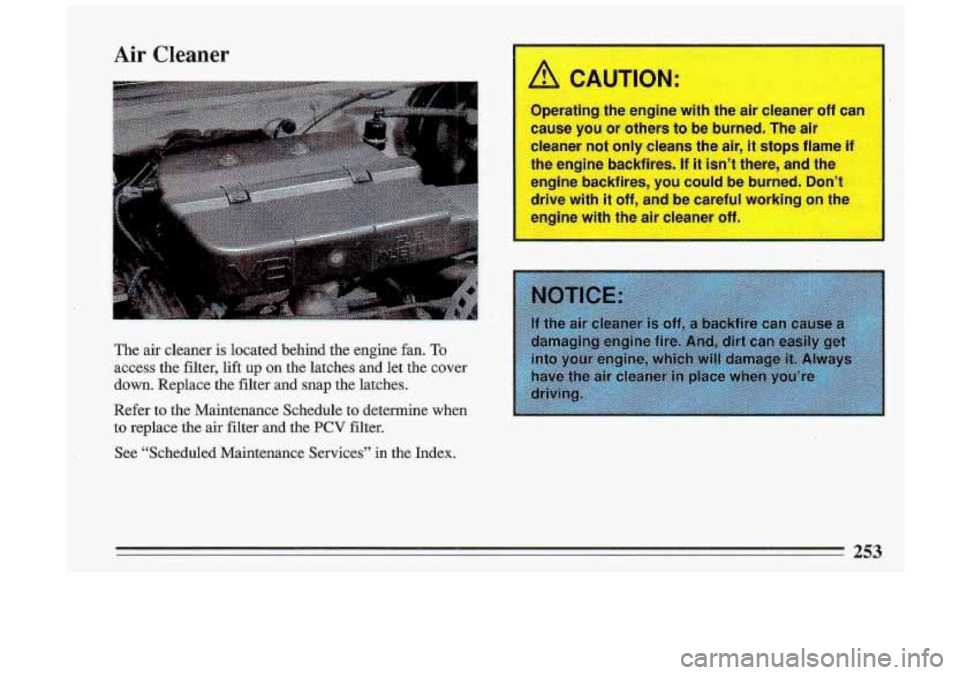
Air Cleaner
The air cleaner is located behind the engine fan. To
access the filter, lift up on the latches and let the cover
down. Replace the filter and snap the latches.
Refer
to the Maintenance Schedule to determine when
to replace-the air filter and the
PCV filter.
See “Scheduled .Maintenance Services”
in the Index.
Operath e engine wltn tne air cleaner off can
cause you or others to be burned. The air
cleaner not only cleans the air,
it stops flame i
the engine backfires. If it isn’t there, and the
engine backfires, you could be burned. Don’t
drive
with it off, and be careful working on tT
engine with t‘ air cf - - -- -8r om-
_.
I
253
Page 256 of 340
Automatic Transmission Fluid
When to Check and Change:
A good time to check your auiomatic transmission fluid
level is when the engine oil is changed. Refer to the
Maintenance Schedule to determine when to change
your fluid. See “Scheduled Maintenance Services” in
the Index.
How to Check:
Because this operation can be a little difficult, you may
choose to have this done at
a Buick,dealership Service
Department.
If
you do it yourself, be sure to follow all the
instructions here, or you could get a false reading on the
.
dipstick. Wait
at least
30 minutes before checking the
transmission fluid level
if you have been driving:
0 When outside temperatures are above. 90 F ‘(32 C);
0 At high speed for quite a while. I
In heavy traffic - &specially in hot weathEr.: . .
While pulling a trailer.
To get the right reading, the fluid should be at normal
operating temperature, which is
180 F to 200 *F (82 C
To check transmission fluid hot: Get the vehicle ‘warmed
up
by driving about 15 miles (24 krn) when outside
temperatures are above
50 F (1 0 C). If it’s colder than
50 F ( 10 C), drive the vehicle in “D” (3rd Gear) until
the engine temperature gage moves and then remains
steady for ten minutes. Then follow the hot check
procedures.
To check transmission fluid cold: A cold check is made
after the vehicle has been sitting for
8 hours or more
with the engine
off and is used only as a reference. Let
the engine run at idle for
5 minutes if outside
temperatures are
50 F (10 C) or more. If ‘it’s colder
than
50 OF (10 * C), you may have to idle the engine
longer.
A hot check must €0110~ when fluid is added
during
a cold check.
..
to 93 C).
254
Page 275 of 340
When to Check: Check your tires once .a month or
more.
Don’t forget
your compact spare-tire (if SO equipped). It
should be at 60 psi (420 Pa).
How to Check: Use a good quality pocket-type gage to
check tire pressure. Simply looking at the tires will not
tell you the pressure, especially if
you have radial tires
- which may look properly inflated even if they’re
underinflated.
If your tires have valve caps, be sure to put them back
.on. They help prevent leaks by keeping
out dirt and
moisture.
Tire Inspection and Rotation
To make your tires last longer, have them inspected and
rotated at the mileages recommended in the, Maintenance Schedule. See “Scheduled Maintenance Services”
in the Index.
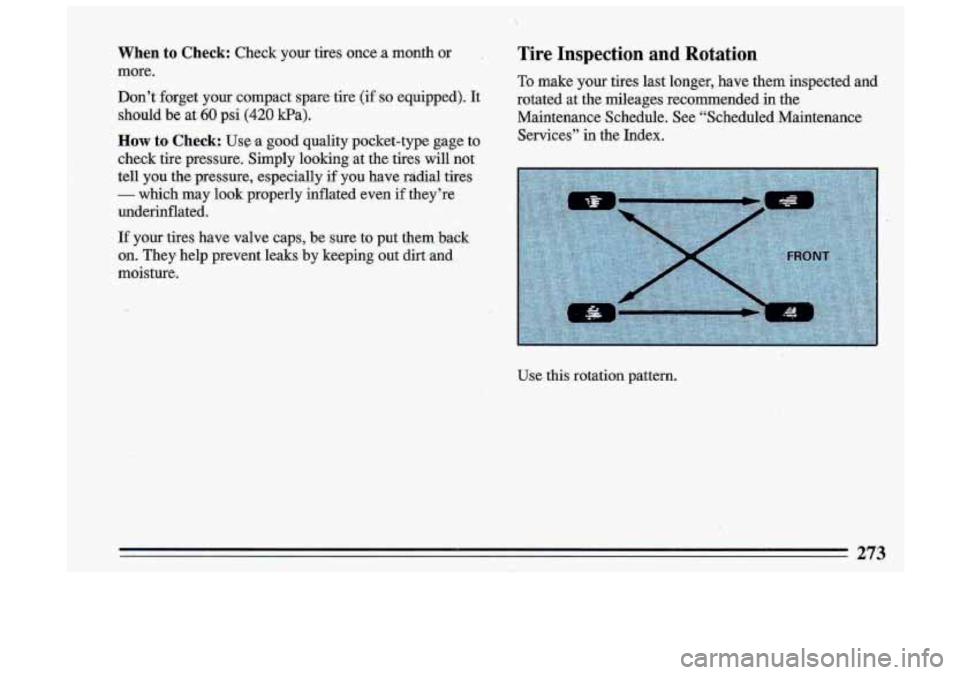
Use this rotation pattern.
t
273
Page 277 of 340
The tire has a puncture, cut, or other damage that
can’t be repaired well because of the size or location
of the damage.
Buying New Tires
.To find out what kind and size of tires you need; look at
the Tire-Loading Information label.
The tires installed on your vehicle when it was new had
a Tire Performance Criteria Specification
(TPC Spec)
-number on each tire’s sidewall. When you get new tires, get ones with that same TPC Spec number.
That way,
your vehicle will continue
to have tires that are designed
to give proper endurance, handling, speed rating,
traction, ride and other things during normal service on
your vehicle.
If your tires have an all-season tread
design, the
TPC nu-mber will be followed. by a “MS”
(for mad and snow).
If you ever replace your tires with those not having a
TPC Spec number, make sure .they are the same size,
load range, speed rating and construction type (bias,
bias-belted or radial) as your original tires.
‘t
A CAUTION:
Mixing tires could cause you to lose control
while driving. If you mix tires of different siz
or types (radial and bias-belted tires), the
vehicle may not handle properly, and you
cows
have a crash. Be sure to use the same size and
type tires
on all four wheels.
It’s all right to drive with your compact spare (if
you have one). It
was developed for use on your
I
I
‘ :le.
Uniform Tire Quality Grading
The following information relates to the system
developed by the United States National Highway
Traffic Safety Administration which grades tires
by
treadwear, traction and temperature performance. (This
applies only to vehicles sold
in the United States.)
Treadwear
The treadwear grade is a comparative rating based on
the wear rate of the tire when tested under controlled
conditions
on a specified govement test course. For
I
Page 287 of 340
Finis,h Damage
Any stone chips, fractures or deep scratches in the fini.sh
should be repaired right away. Bare metal will corrode
quickly and may develop into a major repair expense.
Minor chips and scratches can be repaired with touch-up
materials available from your dealer .or other service outlets. Larger areas'of finish damage can be corrected
,
in your dealer's body and paint shop.
Un,derbody Maintenance
Chemicais used €or ice, and snow removal and-dust
control can collect
on the underbody. If these are not
removed, accelerated corrosion (rust) can occur .on. the
underbody.parts such as fuel lines, frame, floor pan, and
exhaust system even though they have corrosion
protection.
At least every spring, flush these materials from the
underbody with plain water. Clean any areas where mud
and other debris can collect. Dirt packed in closed areas
of the frame should be loosened before being flushed.
Your dealer or an underbody vehicle washing system
can do this for you.
Chemical Paint Spotting
Some weather and atmosphexic conditions can create a
chemical fallout. Airborne pollutants can fall upon and
attack painted surfaces
on your vehicle. This damage
can take
two forms: blotchy, ringlet-shaped
discolorations, and small irregular dark
spots etched into
the paint surface.
Although no defect in the paint job causes this, Buick
will repair, at no chaKge to the owner, the surfaces
of
new vehicles damaged by this fallout condition within
12 months or 12,000 miles.(20 000 km) of purchase,
whichever comes first.
9
t
285