Page 220 of 324
I
Gasolines for Cleaner Air
Your use of gasoline with detergent additives will help
prevent deposits from forming in your engine and fuel
system. That helps keep your engine in tune and your
emission control system working properly. It’s good €or
your vehicle, and you’ll be doing your part for cleaner
air.
Many gasolines are now blended with materials called oxygenates. General Motors recommends that you use
gasolines with these blending materials, such as MTBE
and ethanol. By doing
so, you can help clean the air,
especially in those parts
of the country that have high
carbon monoxide levels.
In addition, some gasoline suppliers are now producing
reformulated gasolines. These gasolines are specially
designed to reduce vehicle emissions. General Motors
recommends that you use reformulated gasoline. By
doing
so, you can help clean the air, especially in those
parts of the country that have high Ozone levels.
You should ask your service station operators if their
gasolines contain detergents and oxygenates, and if they
have been reformulated
to reduce vehicle emissions.
Fuels in Foreign Countries
If you plan on driving in another country outside the
U.S. or Canada, unleaded fuel may be hard to find. Do
not use leaded gasoline. If you use even one tankful,
your emission controls won’t work well or at all. With
continuous use, spark plugs can get fouled, the exhaust system can corrode, and your engine oil can deteriorate
quickly. Your vehicle’s oxygen sensor will be damaged.
All of that means costly repairs that wouldn’t be covered
by your warranty.
To check on fuel availability, ask an auto club, or
contact a major oil company that does business in the
country where you’ll be driving.
You can also write us at the following address for
advice. Just tell us where you’re going and give your
Vehicle Identification Number
(VIN).
General Motors of Canada Ltd.
International Export Sales
P.O. Box 828
Oshawa, Ontario L1H 7N1, Canada
218
Page 225 of 324
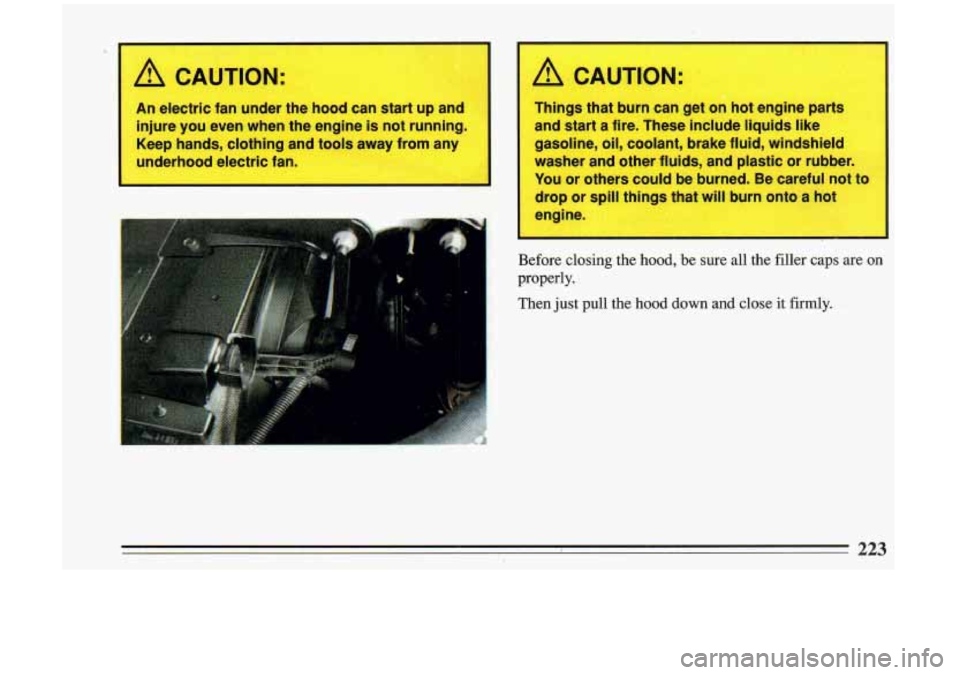
A CAUTION:
An electric fan under the hood can start up and
injure you even when the engine is not running.
Keep hands, clothing and tools away from a---
underhood electric fan.
-
A CAUTION:
Things that burn can get on hot engine parts
and start a fire. These include liquids like
gasoline,
oil, coolant, brake fluid, windshield
washer and other fluids, and plastic or rubber.
You or others could be burned. Be careful not to
drop or spill things that will burn onto a hot
engine.
Before closing the hood, be sure all the filler caps are on
properly.
Then just pull the hood down and close
it firmly.
Page 226 of 324
Engine Oil
It’s a good idea to check your engine oil every time you
get fuel.
In order to get an accurate reading, the oil must
be warm and the vehicle must be on level ground.
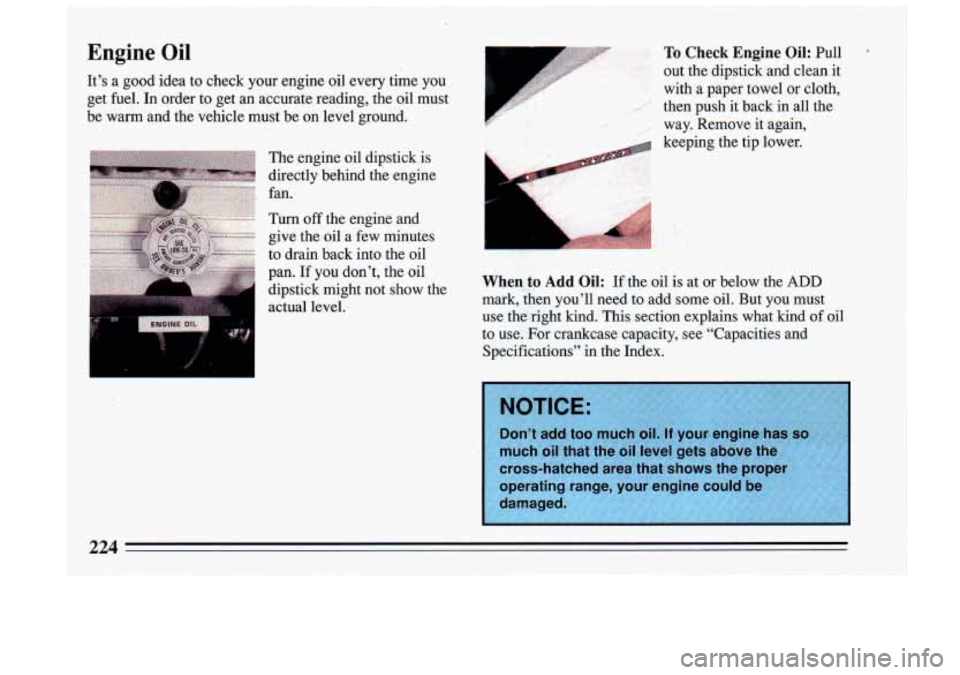
The engine
oil dipstick.is
directly behind the engine
fan..
Turn off the engine and
give the oil a
few minutes
to drain back into the oil
pan.
If you don’t, the oil
dipstick might not show the
actual level.
To Check Engine Oil: Pull ’
1 out the dipstick and clean it
with a paper towel or cloth,
I.ii’ ” then push it back in all the
.. , way. Remove it again,
When to Add Oil: If the oil is at or below the ADD
mark, then you’ll need to add some oil. But you must
use tlwright kind. This section explains what kind
of oil
to use. For crankcase capacity, see “Capacities and
Specifications”
in the Index.
Page 227 of 324
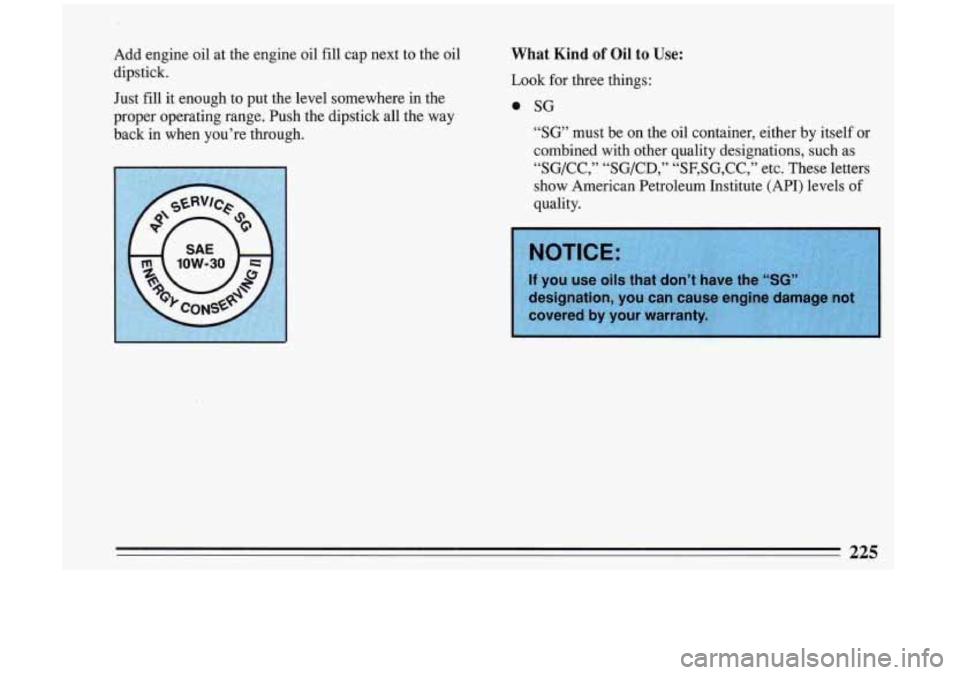
Add engine oil at the engine oil fill cap next to the oil
dipstick.
Just fill it enough to put the level somewhere in the
proper operating range. Push the dipstick all the way
back in when you’re through. What Kind of Oil to Use:
Look for three things:
. sc
“SG’ must be on the oil container, either by itself or
combined with other quality designations, such as
“SG/CC,” “SG/CD,” “SF,SG,CC,” etc. These letters \
show American Petroleum Institute (API) levels of
quality.
225
Page 228 of 324
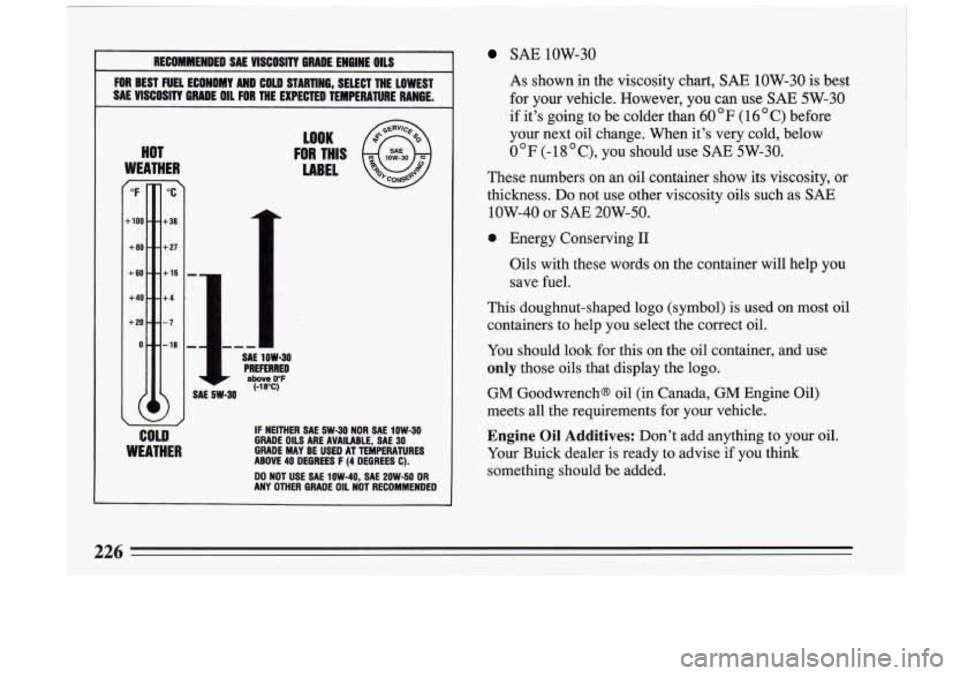
RECOMMENDED SAE VISCOSITY BRADE ENGINE: OILS
FOR BEST FUEL ECONOMY AND COW STARTlW6, SELECT THE LOWEST
SAE VISCOSITY GRADE OIL FOR THE EXPECTED TEMPERATURE RANGE.
HOT
WEATHER r
"F
-100 '
+a0 '
+60
+40
+20 '
7
"C
I +3a
. +27
,+16
+4
-7
- 18
WEATHER
LOOK
@
FOR THIS
LABEL $+';J
-- SAE T. 10W.30
PREFERRED above 0°F (-18°C)
IF NEITHER SAE 5W-30 NOR SAE 1OW-30
GRADE OILS ARE AVAILABLE, SAE 30
GRADE MAY BE USED AT TEMPERATURES
ABOVE
40 DEGREES F (4 DEGREES C).
DO NOT USE SAE
1OW-40, SAE 2OW-50 OR ANY OTHER GRADE OIL NOT RECOMMENDED
SAE 1OW-30
As shown in the viscosity chart, SAE 1OW-30 is best
for
your vehicle. However, you can use SAE 5W-30
' if it's going to be colder than 60 OF (16 C) before
your next oil change. When it's very cold, below
O*F (-18*C), you should use SAE 5W-30.
These numbers on an oil container show its viscosity, or
thickness.
Do not use other viscosity oils such as SAE
1OW-40 or SAE 20W-50.
0 Energy Conserving I1
Oils with these words on the container will help you
save fuel.
This doughnut-shaped logo (symbol) is used on most oil containers to help you select the correct oil.
You should look for this on the oil container, and use
only those oils that display the logo.
GM Goodwrench@ oil (in Canada, GM Engine Oil)
meets all the requirements for your vehicle.
Engine Oil Additives: Don't add anything to your oil.
Your Buick dealer is ready to advise
if you think
something should be added.
226
Page 229 of 324
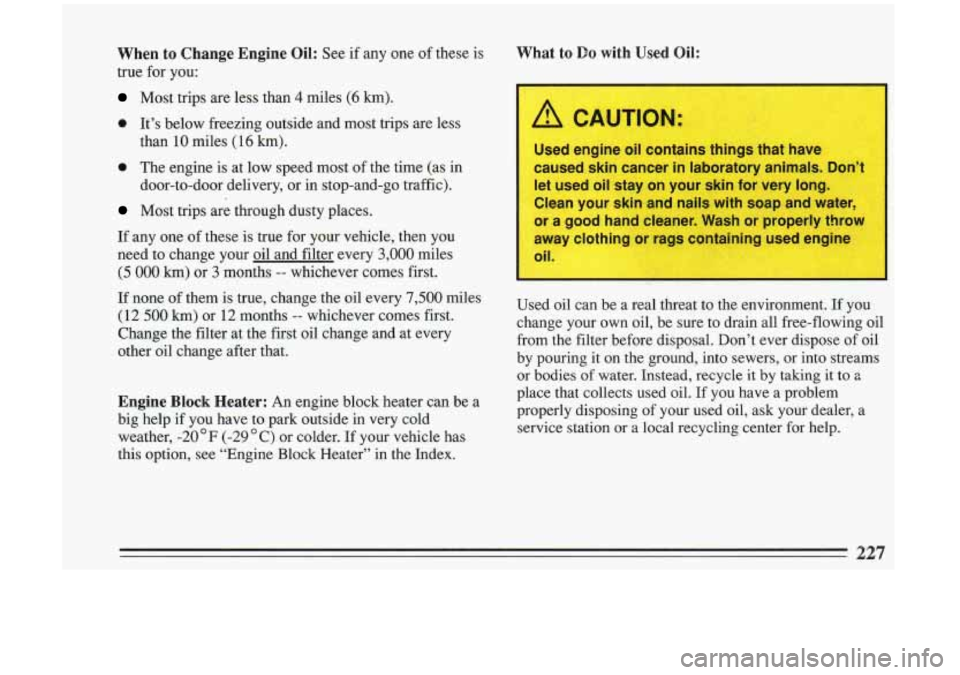
When to Change Engine Oil: See if any one of these is
true for you:
Most trips are less than 4 miles (6 km).
a It’s below freezing outside and most trips are less
than
10 miles (16 km).
0 The engine is at low speed most of the time (as in
door-to-door delivery, or in stop-and-go traffic).
Most trips are through dusty places.
If any one of these is true for your vehicle, then you
need to change your oil and filter every
3,000 miles
(5 000 km) or 3 months -- whichever comes first.
If none of them is true, change the oil every 7,500 miles
(12
500 km) or 12 months -- whichever comes first.
Change the filter at the first oil change and at every
other oil change after that.
Engine Block Heater: An engine block heater can be a
big help if you have to park outside in very cold
weather, -20
OF (-29 C) or colder. If your vehicle has
this option, see ?Engine Block Heater”
in the Index.
What to Do with Used Oil:
1
Used oil can be a real threat to the environment. If you
change your own oil, be
sure to drain all free-flowing oil
from the filter before disposal. Don’t ever dispose of oil
by pouring it on the ground, into sewers, or into streams
or bodies
of water. Instead, recycle it by taking it to 2
place that collects used oil. If you have a problem
properly disposing
of your used oil, ask your dealer, a
service station or a local recycling center for help.
227
Page 231 of 324
Automatic Transaxle Fluid
When to Check and Change:
A good time to check your automatic transaxle fluid
level is when the engine oil is changed. Refer to the
Maintenance Schedule to determine when
to change
your fluid. See “Scheduled Maintenance Services” in
the Index.
How to Check:
Because this operation can be a little difficult, you may
choose to have this done at a Buick dealership Service
Department.
If you do it yourself, be sure to follow all the
instructions here, or you could get a false reading on the
dipstick.
Page 233 of 324
are made especially for your automatic transaxle.
Damage caused by fluid other than
DEXRONs-IIE is
not covered by your new vehicle warranty.
After adding fluid, recheck the fluid level as
described under
“How to Check.”
When the correct fluid level is obtained, push the
dipstick back in all the way.
Engine Coolant
The following explains your cooling system and how to
add coolant when it is low. If you have a problem with
engine overheating, see “Engine Overheating” in the
Index.
The proper coolant for your Buick
will:
Give freezing protection down to -34’F (-37 ’ C) .
0 Give boiling protection up to 262 ’ F ( 128 ’ C) .
Protect against rust and corrosion.
Help keep the proper engine temperature.
0 Let the warning lights work as they should.
What to Use:
Use a mixture of one-half clean water (preferably
distilled) and one-half antifreeze that meets “GM Specification 1825-M,” which won’t damage aluminum
parts. Use GM Engine Coolant Supplement (sealer) with
any complete coolant change. You can also use a
recycled coolant conforming to “GM Specifications
1825-M” with a complete coolant flush and-refill.
If you
use these, you don’t need to add anything else.
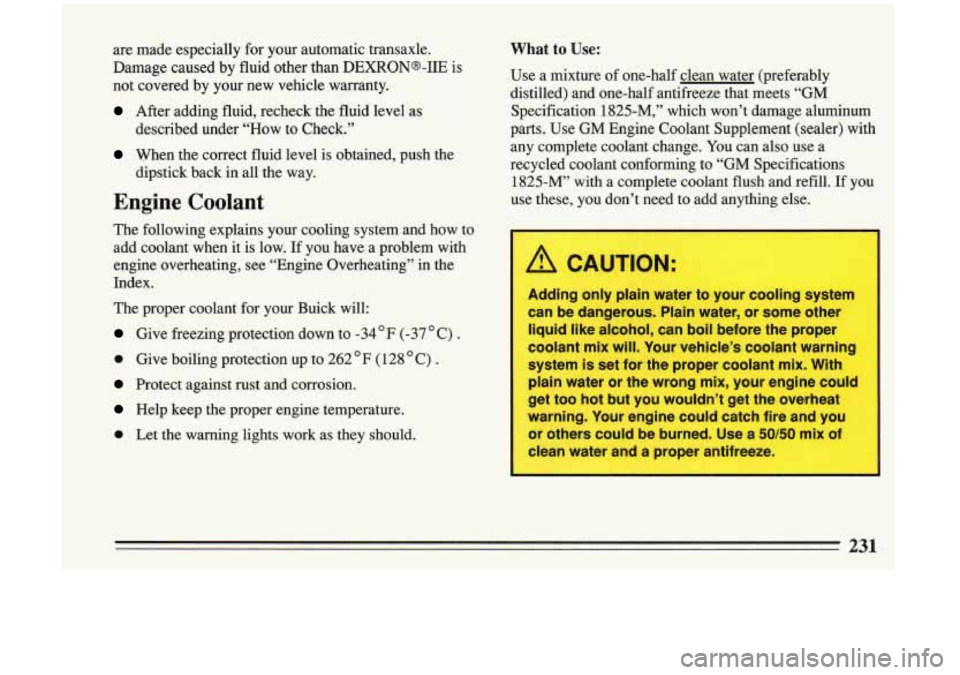
Adding only plain water to your cooling system
can be dangerous. Plain water, or some other
liquid like alcohol, can boil before the proper
coolant mix will. Your vehicle’s coolant warnin!
system
is set for the proper coolant mix. With
plain water or the wrong mix, your engine coul
get
too hot but you wouldn’t get the overheat
warning. Your engine could catch fire and you
or others could be burned. Use a
50150 mix of
clean water and
a proper antifreeze.
231