1993 BUICK RIVIERA tire type
[x] Cancel search: tire typePage 163 of 324
0
0
0 0
0
Don’t overtake a slowly moving vehicle too rapidly.
Even though the brake lights are not flashing, it may
be slowing down
or starting to turn.
If you’re being passed, make it easy for the
following driver to get ahead
of you. Perhaps you
can ease a little to the right.
Loss of Control
Let’s review what driving experts say about what
happens when the thee control systems (brakes, steering
and acceleration) don’t have enough friction where the
tires meet the road to do what the driver has asked.
In any emergency, don’t give up. Keep trying to steer
and constantly seek an escape route or area
of less
danger.
Skidding
In a skid, a driver can lose control of the vehicle.
Defensive drivers avoid most skids by taking reasonable
care suited to existing conditions, and by not
“overdriving” those conditions. But skids are always
possible.
The three types of skids correspond to your Buick’s
three control systems. In the braking skid your wheels aren’t rolling. In the steering or cornering skid, too
Page 193 of 324
Towing Your Vehicle Before you do anything, turn on the hazard warning
flashers.
Try to have a
GM dealer or a professional towing
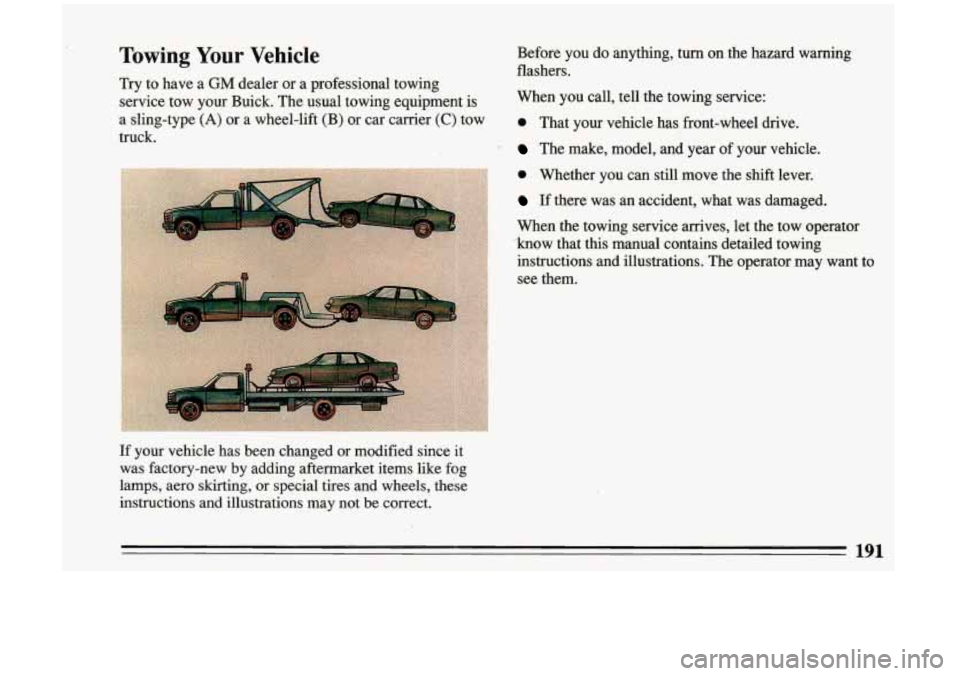
service tow your Buick. The usual towing equipment is When you call, tell the towing service:
a sling-type
(A) Or a wheel-lift (B) Or Car carrier (c) tow 0 That your vehicle has front-wheel drive.
truck.
. The make, model, and year of your vehicle.
If your ‘vehicle has been changed or modified since it
was factory-new by adding aftermarket items like fog
lamps, aero skirting,
or special tires and wheels, these
instructions and illustrations may not be correct.
0 Whether you can still move the shift lever.
If there was an accident, what was damaged.
When the towing service arrives, let the tow operator
-know that this manual contains detailed towing instructions and illustrations. The operator may want to
see them.
191
Page 248 of 324
When to Check: Check your tires once a month or
more.
Don’t forget your compact spare tire. It should be at
60
psi (420 kPa).
I
How to Check: Use a good quality pocket-type gage to
check tire pressure. Simply looking at the tires will not
tell you the pressure, especially
if you have radial tires --
which may look properly inflated even if they’re
underinflated.
If your tires have valve caps, be sure to put them back on. They help prevent leaks .by keeping out dirt and
moisture.
Tire Inspection and Rotation
To make your tires last longer, have them inspected and
rotated at the mileages recommended
in the
Maintenance, Schedule. See “Scheduled Maintenance
Services”
in the Index.
r-
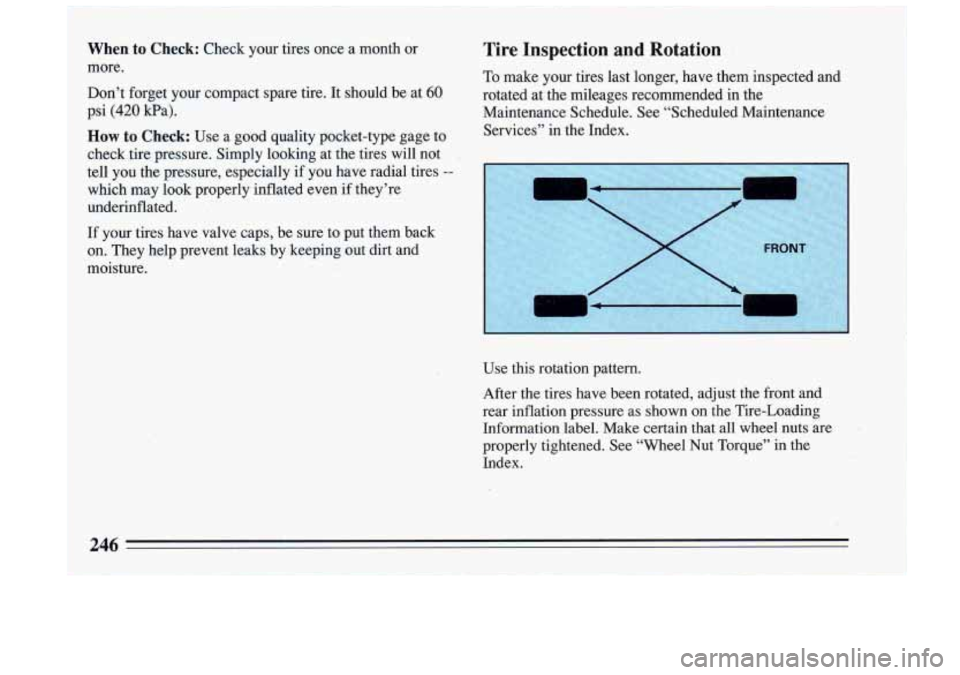
Use this rotation pattern.
After the tires have been rotated, adjust the front and
rear inflation pressure
as shown on the Tire-Loading
Information label. Make certain that all wheel nuts are
properly tightened. See “Wheel Nut Torque”
in the
Index.
Page 250 of 324
Buying New .Tires
To find out what kind and size of tires you need, look at
:the Tire-Loading Information label.
The tires installed on your vehicle when it was new had
a Tire Performance Criteria Specification (TPC Spec)
number on each tire’s sidewall. When you get new tires,
:get ones with that same TPC Spec number. That way,
*your vehicle will continue to have tires that are designed
to give proper endurance, handling, speed rating,
traction, ride and other things during normal service on
your vehicle. If your tires have an all-season tread
design, the TPC number will be followed by a
“MS’,
(for mud and snow).
;If you ever replace your tires with those not having a
!.TPC Spec number, make sure they are the same size,
load rdnge, speed rating and construction type (bias,
bias-belted or radial) as your original tires.
, A CAUTION:
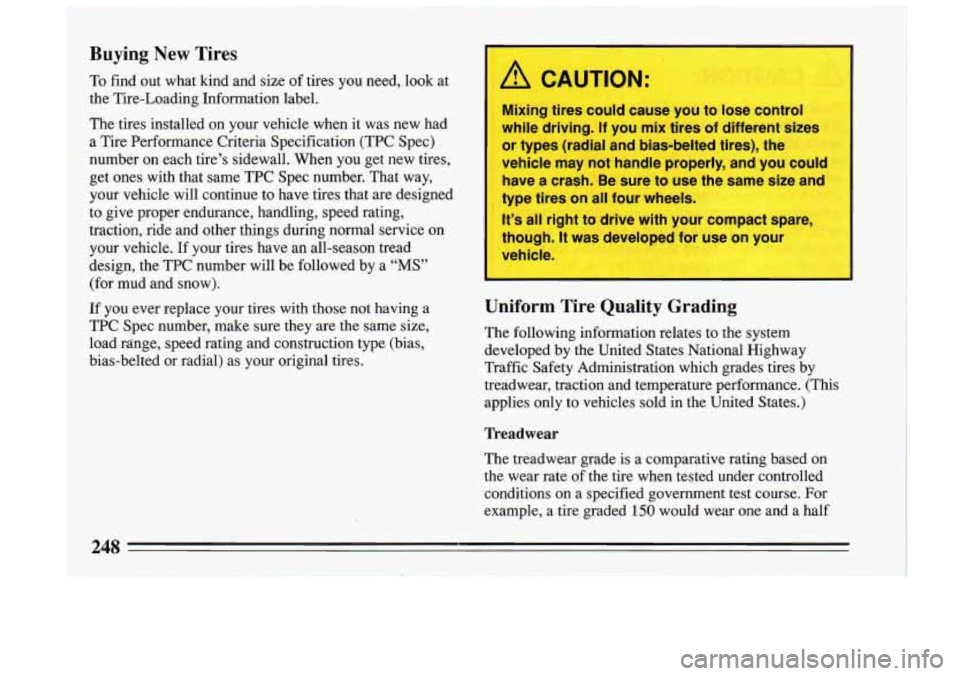
Mixing tires could cause you to lose control
while driving.
If you mix tires of different sizes
or types (radial and ‘bias-belted tires), the
1 vehicle may not handle properly, and you cou’ ’
have a crash. Be sure to use the same size ana
type tires on all four wheels.
It’s
all right to drive with your compact spa
though. It was developed for use
on your
vehicle.
~1
Uniform Tire Quality Grading
The following information relates to the system
developed by the United States National Highway
Traffic Safety Administration which grades tires by
treadwear, traction and temperature performance. (This
applies only to vehicles~ sold.in the United States.)
Treadwear
The treadwear grade is a comparative rating based on
the wear rate of the tire when tested under controlled
conditions on a specified government test course. For
example, a tire graded
150 would wear one and a half
248
Page 251 of 324
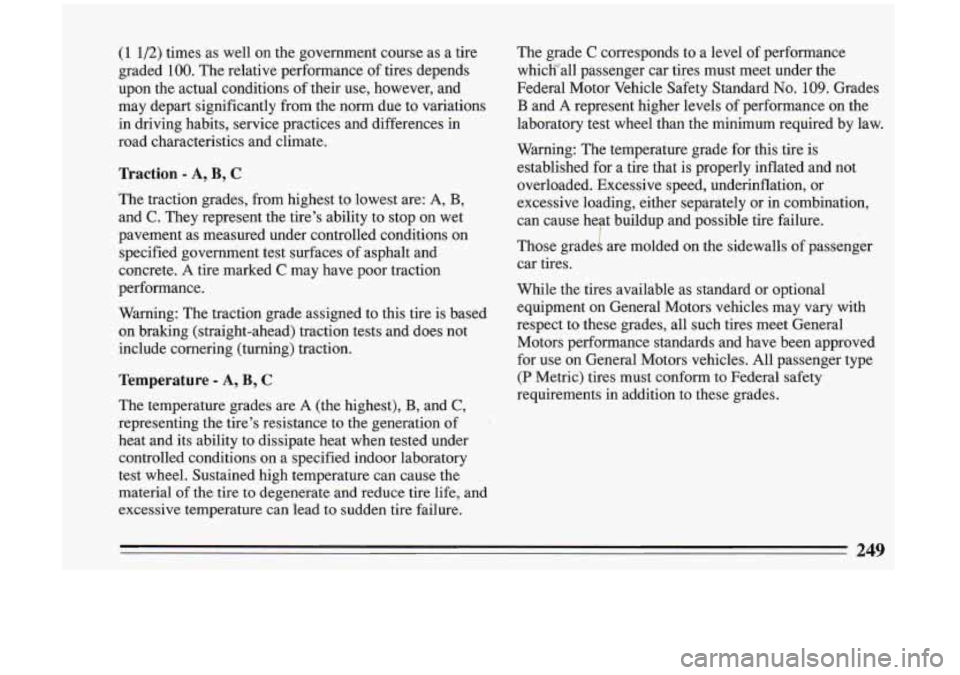
(1 1/2) times as well on the government course as a tire
graded
100. The relative performance of tires depends
upon the actual conditions of their use, however, and
may depart significantly from the norm due to variations
in driving habits, service practices and differences in
road characteristics and climate.
Traction - A, B, C
The traction grades, from highest to lowest are: A, B,
and C. They represent the tire’s ability to stop on wet
pavement as measured under controlled conditions on
specified government test surfaces of asphalt and
concrete. A tire marked
C may have poor traction
performance.
Warning: The traction grade assigned to this tire is based
on braking (straight-ahead) traction tests and does not
include cornering (turning) traction.
Temperature - A, B, C
The temperature grades are A (the highest), B, and C,
representing the tire’s resistance to the generation of
heat and its ability to dissipate heat when tested under
controlled conditions on a specified indoor laboratory
test wheel. Sustained high temperature can cause the
material of the tire
to degenerate and reduce tire life, and
excessive temperature can lead to sudden tire failure. The
grade
C corresponds to a level of performance
whicrall passenger car tires must meet under the
Federal Motor Vehicle Safety Standard
No. 109. Grades
B and A represent higher levels of performance on the
laboratory test wheel than the minimum required by law.
Warning: The temperature grade for this tire is
established for a tire that is properly inflated and not
overloaded. Excessive speed, underinflation, or
I
excessive loading, either separately or in combination, !
can cause heat buildup and possible tire failure.
Those grade
b are molded on the sidewalls of passenger
car tires.
While the tires available as standard or optional
equipment on General Motors vehicles may vary with
respect to these grades, all such tires meet General
Motors performance standards and have been approved
for use
on General Motors vehicles. All passenger type
(P Metric) tires must conform to Federal safety
requirements in addition to these grades.
249
Page 255 of 324
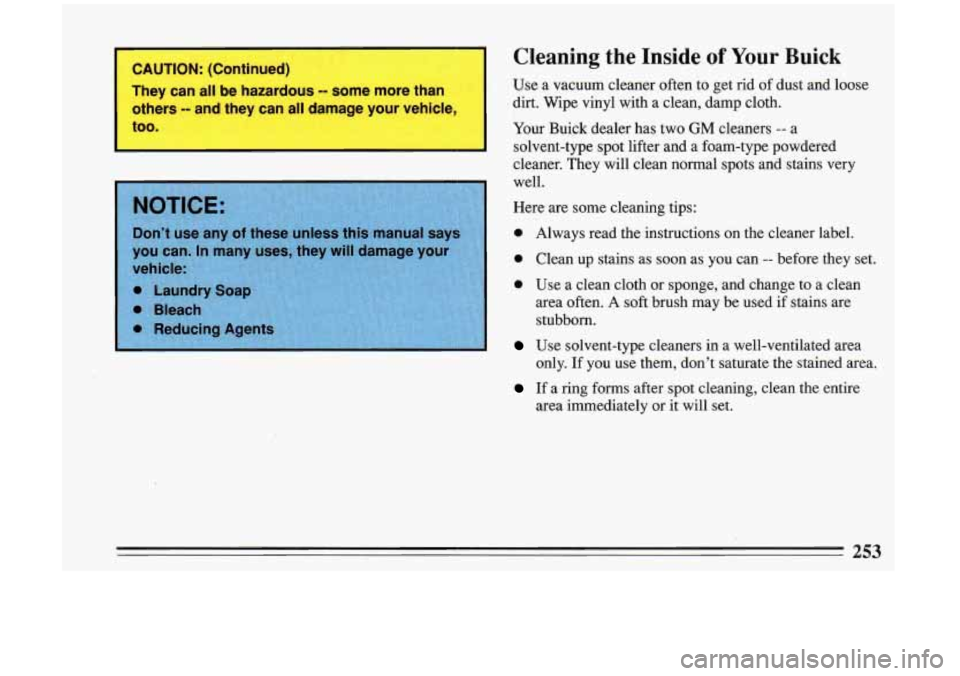
Cleaning the Inside of Your Buick
Use a vacuum cleaner often to get rid of dust and loose
dirt. Wipe vinyl with a clean, damp cloth.
Your Buick dealer has two
GM cleaners -- a
solvent-type spot lifter and a foam-type powdered
cleaner. They will clean normal spots and stains very
well.
Here are some cleaning tips:
0 Always read the instructions on the cleaner label.
0 Clean up stains as soon as you can -- before they set.
0 Use a clean cloth or sponge, and change to a clean
area often. A soft brush may be used if
stains are
stubborn.
Use solvent-type cleaners in a well-ventilated area
only. If you use them, don’t saturate the stained area.
If a ring forms after spot cleaning, clean the entire
area immediately or it will set.
Page 307 of 324
Run (Ignition Key Position) ......................... 72
Running Lights. Daytime
........................... 98
Running Your Engine While You’re Parked
............ 82
Safety Belt Care
................................ 256
Safety Belt Extender
.............................. 56
Safety Belt Reminder Light
......................... 25
Safety Belt Replacement
........................... 57
Safety Belt. Center Adult Passenger
.................. 42
Safety Belt. Lap
.................................. 42
Safety Belt. Lap-Shoulder
.......................... 27
Safety Belts
..................................... 13
Safety Belts. Buckled Wrong
........................ 29
Safety Belts. Questions About
....................... 24
Safety Belts. Rear Seat Passengers
................... 38
Safety Belt.
Too Loose ............................. 28
Safety Belt.
Torn ................................. 57
Safety Belts. Twisted
.............................. 31
Safety Belts. Right Front. Adult Passenger
............. 38
Safety Belts. Usage by Adults
....................... 26
Safety Belts. Usage by Children
..................... 43
Safety Belts. Usage During Pregnancy
................. 37
Safety Belts. Why They Work
....................... 20
Safety Belts. Worn Under
Arm ...................... 30
Safety Defects. Reporting .......................... 291
Scheduled Maintenance Services
.................... 273
Safety Warnings
.................................. 10 Seats and Safety Belts
............................. 13
Seat Controls
.................................... 14
Second Gear. When to Use
......................... 77
Securing A Child Restraint
......................... 45
Security Light
................................. 67. 69
Service Tips
.................................... 216
Service A/C Light
............................... 115
Service and Appearance . Care ...................... 215
“Service Engine Soon” Warning Light
............... 113
Service Parts Identification Label
................... 261
Service Publications
.............................. 292
Setting the Clock
......................... 127.130. 132
Setting the Trip Odometer
......................... 107
ShapeofRoadSigns
............................. 143
Sheet Metal Damage
............................. 258
Shift. Brake-Transaxle Interlock
.................. 75. 81
Shift Lever Positions
.............................. 75
Shifting Into Park
................................. 79
Shifting Out of Park
............................... 81
Signaling Turns
................................... 85
Signs. Road .................................... 140
Skidding ....................................... 161
Slippery Surfaces. Driving on
...................... 179
Snow or Ice. Driving on
........................... 179
Solvent-Type Cleaner on Fabric
.................... 254
Sound Equipment. Adding
......................... 125
Sound Systems
.................................. 124
Snowstorm. If You’re Caught in a Bad
............... 180
SpareTire
...................................... 212
305’ I