Page 161 of 308
Driving a Long Distance
Although most long trips today are made on freeways,
there are still many made on regular highways.
Long-distance driving on freeways and regular
highways is the same in some ways. The trip has to be
planned and the vehicle prepared,
you drive at
higher-than-city speeds, and there are longer turns
behind the wheel. You’ll enjoy your trip more if you and
your vehicle are in good shape. Here are some tips for a
successful long trip.
Before Leaving on a Long Trip
0
0
0
0
0
0
Make sure you’re ready. Try to be well rested. If you
must start when you’re not fresh -- such as after a day’s
work
-- don’t plan to make too many miles that first part
of the journey. Wear comfortable clothing and shoes you
can easily drive
in.
Is your vehicle ready for a long trip? If you keep it
serviced and maintained, it’s ready to go.
If it needs
service, have it done before starting out. Of course,
you’ll find experienced and able service experts in
Buick dealerships all across North America. They’ll be
ready and willing to help
if you need it.
Here are some things you can check before a trip:
0
Windshield Washer Fluid: Is the reservoir full? Are
all windows clean inside and outside?
Wiper Blades: Are they in good shape?
Fuel, Eng;ine Oil, Other Fluids: Have you checked
all levels?
Lights: Are they all working? Are the lenses clean?
- Tires: They are vitally important to a safe,
trouble-free trip.
Is the tread good enough for
long-distance driving? Are the tires all inflated to the
recommended pressure?
Weather Forecasts: What’s the weather outlook
along your route? Should you delay your trip a short
time to avoid a major storm system?
Maps:
Do you have up-to-date maps?
On the Road
Unless you are the only driver, it is good to share the
driving task with others. Limit turns behind
the wheel to
about
100 miles (160 km) or two hours at a sitting.
Then, either change drivers or stop for some refreshment
like coffee, tea or soft drinks and some limbering up.
But do stop and move around. Eat lightly along the way.
Heavier meals tend
to make some people sleepy.
159
ProCarManuals.com
Page 171 of 308
stopped by the snow. Put on extra clothing or wrap a
blanket around you. If you have no blankets or extra
clothing, make body insulators from newspapers, burlap
bags, rags, floor mats
-- anything you can wrap around
yourself or
tuck under your clothing to keep warm.
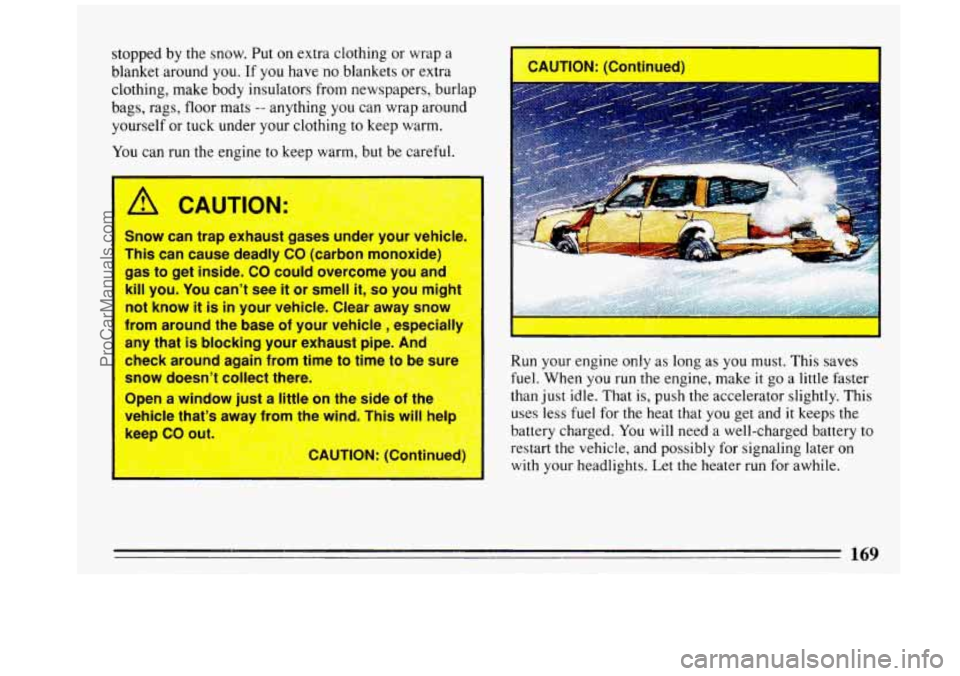
You can run the engine to keep warm, but be careful.
naust ases under your veh'ick
Snow can
trap 1
This can cause deadly CO (carbon monoxide)
gas to get inside.
CO could overcome you and
II you. You can't see it or smell it, so you mighl
not know
it is in your vehicle. Clear away snow
from around the base of your vehicle
, especial11
any that is blocking your exhaust pipe. And
r':.:%--l check around again from time to time to be surel ..,;I
. . ,;-< 4
Snow doesn't collect there. k, ..;:-- :,: -;-'-- , " ~ ' -. :< . . . ..',.;.L ,:--; .: ., ; ,&': - .. 1 .' . . . ,'--I -..
, , CA,UTION: (Continued)
I
Run your engine only as long as you must. This saves
fuel. When you run the engine, make
it go a little faster
than just idle. That
is, push the accelerator slightly. This
uses less fuel for the heat that you get and it keeps
the
battery charged. You will need a well-charged battery to
restart the vehicle, and possibly for signaling later on
with your headlights. Let the heater run for awhile.
169
ProCarManuals.com
Page 176 of 308
Following Distance
Stay at least twice as far behind the vehicle ahead as you
would when driving your vehicle without a trailer. This
can help you avoid situations that require heavy braking
and sudden turns.
Passing
You’ll need more passing distance up ahead when
you’re towing a trailer. And, because you’re a good deal
longer,
you’ll need to go much farther beyond the
passed vehicle before
you can return to your lane.
Backing Up
Hold the bottom of the steering wheel with one hand.
Then, to move the trailer to the left, just move that hand
to the left. To move the trailer to the right, move your
hand to the right. Always back up slowly and, if
possible, have someone guide you.
Making Turns
When you’re turning with a trailer, make wider turns
than normal.
Do this so your trailer won’t strike soft
shoulders, curbs, road signs, trees, or other objects.
Avoid jerky or sudden maneuvers. Signal well in
advance.
firn Signals When Towing a Trailer
When you tow a trailer, your vehicle has to have a
different turn signal flasher and extra wiring. The green
arrows on your instrument panel will flash whenever
you signal a turn or lane change. Properly hooked up,
the trailer lights will also flash, telling other drivers
you’re about to turn, change lanes or stop.
When towing a trailer, the green arrows
on your
instrument panel will flash for turns even if the bulbs on
the trailer are burned out.
Thus, you may think drivers
behind you are seeing your signal when they are not.
It’s
important to check occasionally to be sure the trailer
bulbs are still working.
Driving On Grades
Reduce speed and shift to a lower gear before you start
down a long or steep downgrade. If
you don’t shift
down, you might have to use your brakes
so much that
they would get hot and no longer work well.
On a long uphill grade, shift down and reduce your
speed to around
45 mph (70 km/h) to reduce the
possibility of engine and transaxle overheating.
If you are towing a trailer that weighs more than
1,000
pounds ( 450 kg), and you have an automatic transaxle
with Overdrive, you may prefer to drive in
“D” instead
of Overdrive
(or, as you need to, a lower gear).
174
ProCarManuals.com
Page 177 of 308
Parking on Hills
You really should not park your vehicle, with a trailer
attached, on a hill. If something goes wrong, your rig
could start to move. People can be injured, and both
your vehicle and the trailer can be damaged.
But if
you ever have to park your rig on a hill, here’s
how to do it:
1.
2.
3.
4.
5.
Apply your regular brakes, but don’t shift into “P’
(Park) yet.
Have someone place chocks under the trailer wheels.
When the wheel chocks are in place, release the
regular brakes until the chocks absorb the load.
Reapply the regular brakes. Then apply your parking
brake, and then shift to “P” (Park).
Release the regular brakes.
When You Are Ready to Leave After
Parking on
a Hill
1. Apply your regular brakes and hold the pedal down
while you:
Start your engine;
Shift into a gear; and
0 Release the parking brake.
2. Let up on the brake pedal.
3. Drive slowly until the trailer is clear of the chocks.
4. Stop and have someone pick up and store the chocks.
Maintenance When Trailer Towing
Your vehicle will need service more often when you’re
pulling a trailer. See the Maintenance Schedule for more
on this. Things that are especially important in trailer
operation are automatic transaxle fluid (don’t overfill),
engine oil, belt, cooling system, and brake adjustment.
Each
of these is covered in this manual, and the Index
will help you find them quickly. If you’re trailering, it’s
a good idea to review these sections before
you start
your trip.
Check periodically to see that all hitch nuts and bolts are
tight.
175
ProCarManuals.com
Page:
< prev 1-8 9-16 17-24