Page 272 of 308
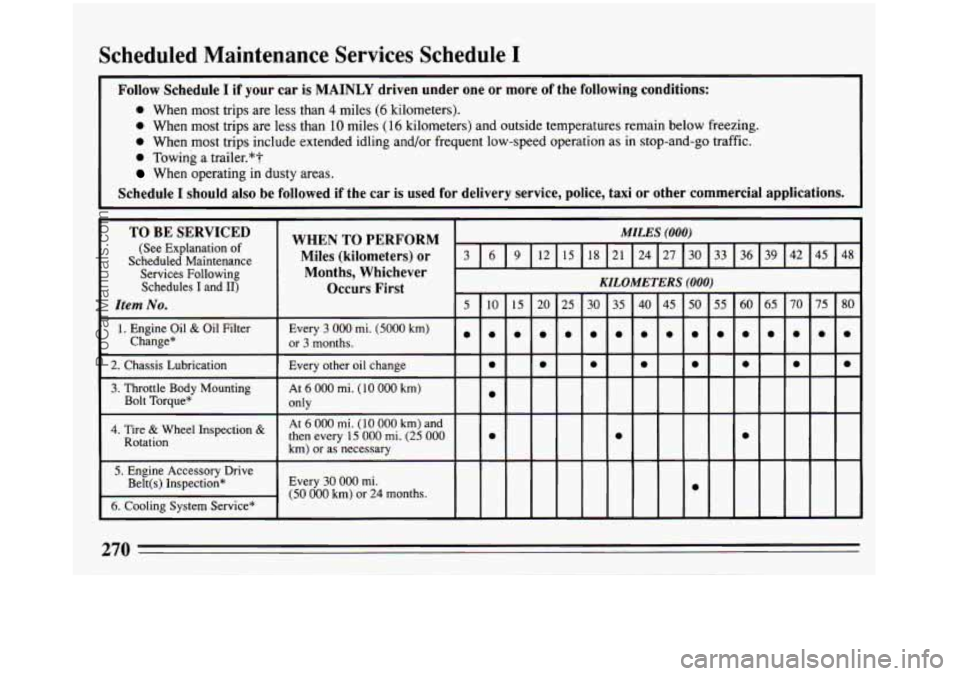
Scheduled Maintenance Services Schedule I
Follow Schedule I if your car is MAINLY driven under one or more of the following conditions: I
0 When most trips are less than 4 miles (6 kilometers).
0 When most trips are less than 10 miles (16 kilometers) and outside temperatures remain below freezing.
0 When most trips include extended idling and/or frequent low-speed operation as in stop-and-go traffic.
0 Towing a trailer.*?
When operating in dusty areas.
Schedule I should also be followed if the car is used for delivery service, police, taxi or other commercial applications.
TO BE SERVICED
(See Explanation of
Scheduled Maintenance
Services Following Schedules
I and 11)
Item No.
1. Engine Oil & Oil Filter
Change*
2. Chassis Lubrication
3. Throttle Body Mounting Bolt Torque*
4. Tire & Wheel Inspection &
Rotation
5. Engine Accessory Drive
' Belt(s) Inspection*
6. Cooling System Service*
65 70 75 80
0.00
0 0
270
ProCarManuals.com
Page 273 of 308
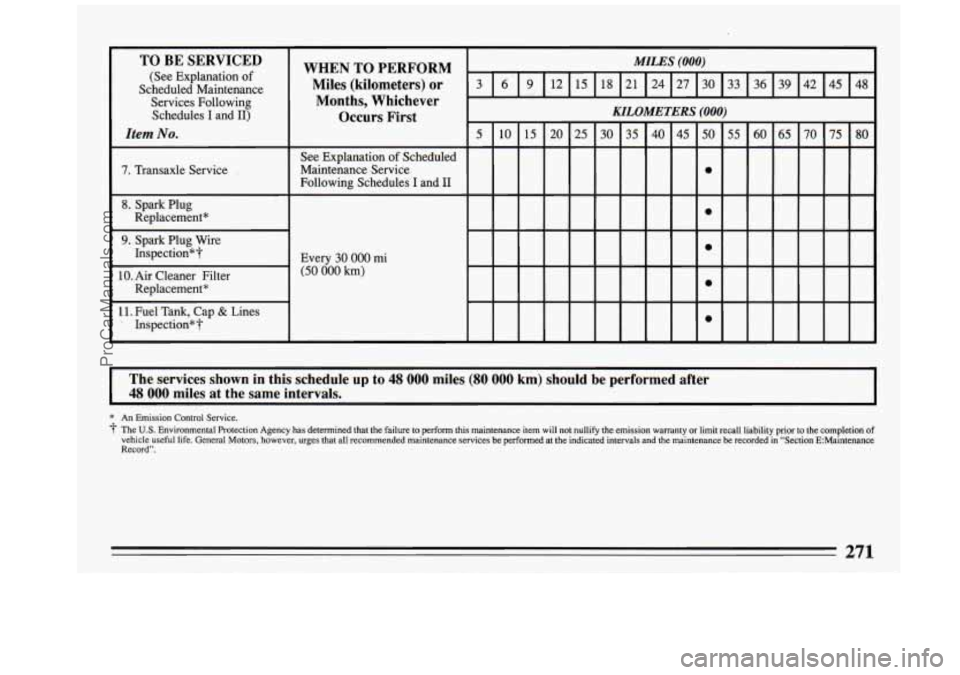
The services shown in this schedule up to 48 000 miles (80 000 km) should be performed after
48 000 miles at the same intervals.
* An Emission Control Service.
3- The U.S. Environmental Protection Agency has determined that the failure to perform this maintenance item will not nullify the emission warranty or limit recall liability prior to the compktion of vehicle useful life. General Motors, however, urges that all recommended maintenance services be performed at the indicated intervals and the maintenance be recorded in "Section EMaintenance
Record".
271
ProCarManuals.com
Page 274 of 308
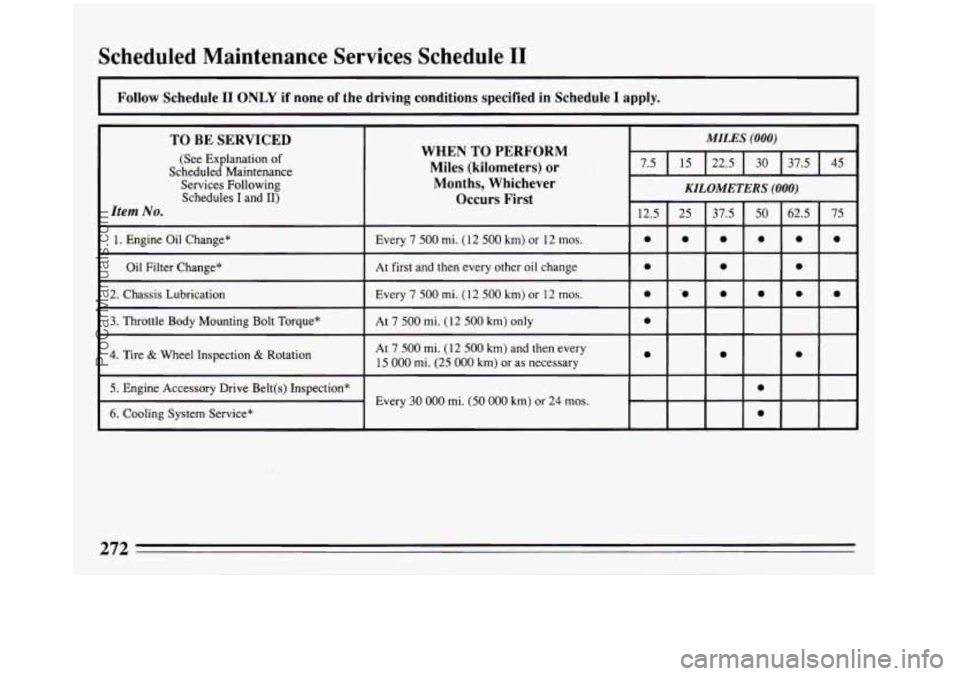
Scheduled Maintenance Services Schedule I1
IIONLY if none of the driving conditions specified in Schedule I apply.
TO BE SERVICED
(See Explanation of
Scheduled Maintenance
Services Following Schedules
I and 11)
Item No.
1. Engine Oil Change*
Oil Filter Change*
2. Chassis Lubrication
3. Throttle Body Mounting Bolt Torque*
4. Tire & Wheel Inspection & Rotation
5. Engine Accessory Drive Belt(s) Inspection*
6. Cooling System Service*
WHEN TO PERFORM
Miles (kilometers)
or
Months, Whichever
Occurs First
I MILES (000)
lm
KILOMETERS (
Every 7 500 mi. (12 500 km) or 12 mos. 1~101010 ~~
At first and then every other oil change
Every
7 500 mi. (12 500 km) or 12 mos.
At 7 500 mi. (12 SO0 km) only
At
7 500 mi. (12 SO0 km) and then every
15 000 mi. (25 000 km) or as necessary 1.1 1.1
I I I 0 Every 30 000 mi. (SO 000 km) or 24 mos. I I I
I I I 0
+
272
ProCarManuals.com
Page 275 of 308
WHEN TO PERFORM (See Explanation of
Scheduled Maintenance Miles (kilometers) or
Services Following Months, Whichever
Schedules I and 11) Occurs First
Item No.
Every 30 000 mi. (SO 000 km)
r
~~ ~~
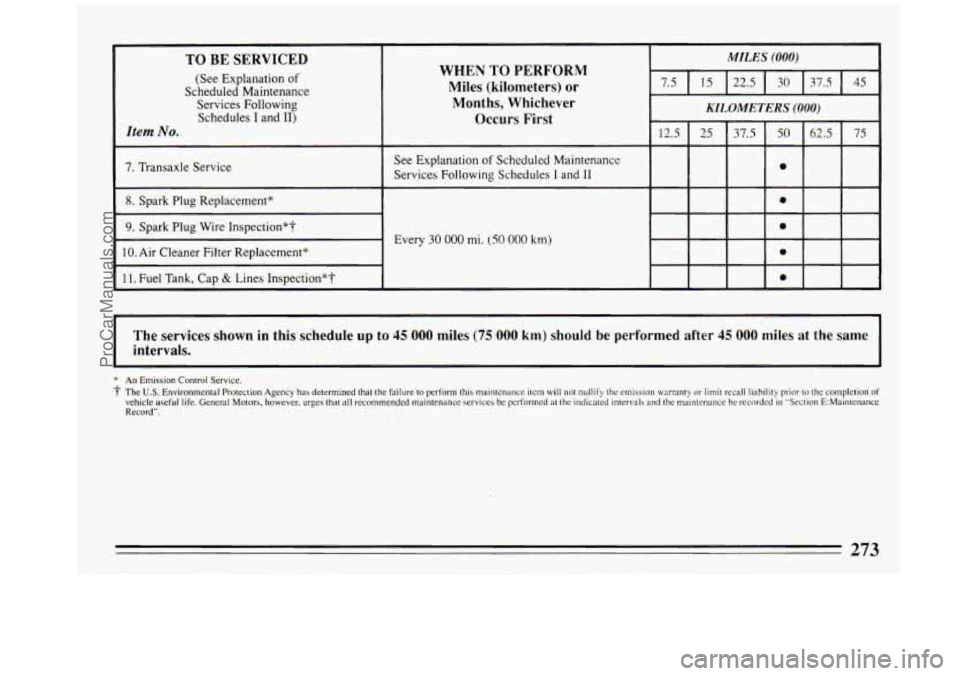
The services
shown in this schedule up to 45 000 miles (75 000 km) should be performed after 45 000 miles at the Same
intervals.
273
ProCarManuals.com
Page 276 of 308
Explanation of Scheduled Maintenance
Services
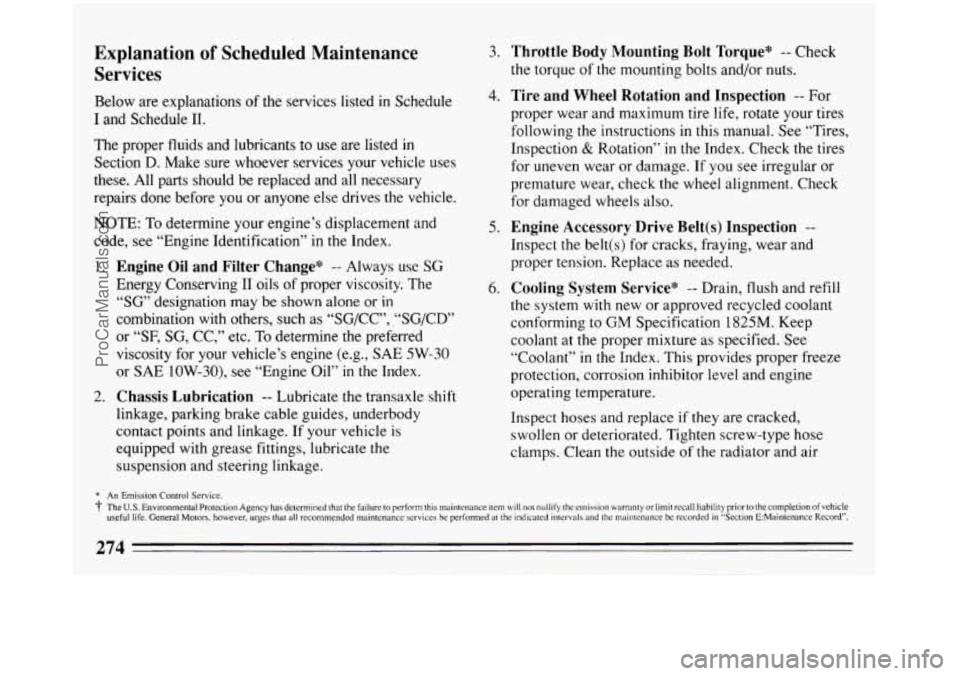
Below are explanations of the services listed in Schedule
I and Schedule 11.
The proper fluids and lubricants to use are listed in
Section D. Make sure whoever services your vehicle uses
these. All parts should be replaced and all necessary
repairs done before
you or anyone else drives the vehicle.
NOTE: To determine your engine’s displacement and
code, see “Engine Identification” in the Index.
1. Engine Oil and Filter Change* -- Always use SG
Energy Conserving I1 oils of proper viscosity. The
“SG” designation may be shown alone or in
combination with others, such as “SG/CC”, ,“SG/CD”
or
“SF, SG, CC,” etc. To determine the preferred
viscosity for your vehicle’s engine (e.g., SAE 5W-30
or SAE 10W-30), see “Engine Oil”
in the Index.
2. Chassis Lubrication -- Lubricate the transaxle shift
linkage, parking brake cable guides, underbody
contact points and linkage. If your vehicle is
equipped with grease fittings, lubricate
the
suspension and steering linkage. 3.
Throttle Body Mounting
Bolt Torque* -- Check
the torque
of the mounting bolts and/or nuts.
4. Tire and Wheel Rotation and Inspection -- For
proper wear and maximum tire life, rotate your tires
following the instructions
in this manual. See “Tires,
Inspection
& Rotation” in the Index. Check the tires
for uneven wear or damage. If you see irregular or
premature wear, check the wheel alignment. Check
for damaged wheels also.
5. Engine Accessory Drive Belt(s) Inspection --
Inspect the belt(s) for cracks, fraying, wear and
proper tension. Replace as needed.
6. Cooling System Service* -- Drain, flush and refill
the system
with new or approved recycled coolant
conforming to GM Specification 1825M. Keep
coolant at the proper mixture as specified. See
“Coolant”
in the Index. This provides proper freeze
protection, corrosion inhibitor level and engine
operating temperature.
Inspect hoses and replace
if they are cracked,
swollen or deteriorated. Tighten screw-type hose
clamps. Clean the outside
of the radiator and air
* An Emission Control Service.
The
U.S. Environmental Protection Agency has determined that the failure to perform this maintenance item will not nullify the emission warranty or limit recall liability prior tothe completion of vehicle useful life. General Motors, however, urges that all recommended maintenance \
services he performed at the indicatcd intervals and the maintenance be recorded in ”Section E:Maintenance Record”.
274
ProCarManuals.com
Page 281 of 308

CHECK OR
I SERVICE WHAT TO DO
Underbody
Flushing At
least every spring, use plain water
to flush any corrosive materials from
the underbody. Take care to clean
thoroughly any areas where mud and
other debris can collect.
Section C: Periodic Maintenance
Inspections
Listed below are inspections and services which s ,hou !Id
be performed at least twice a year (for instance, each
spring and fall).
You should let your GM dealer’s
service department or other qualified service center do
these jobs. Make sure any necessary repairs are
completed at once.
INSPECTION
OR SERVICE
Steering,
Suspension and
Front-Wheel- Drive Axle
Boot and Seal
Inspection
Exhaust System
Inspection
Throttle Linkage
Inspection
WHAT SHOULD BE DONE
Inspect the front and rear suspension
and steering system for damaged, loose or missing parts, signs of wear,
or lack of lubrication. Inspect
the
power steering lines and hoses for
proper hookup, binding, leaks,
cracks, chafing, etc. Clean and then
inspect the drive axle boot seals for
damage, tears or leakage. Replace
seals
if necessary.
Inspect the complete exhaust
system. Inspect the body near
the
exhaust system. Look for broken,
damaged, missing or out-of-position
parts as well as open seams, holes,
loose connections, or other conditions which could cause
a heat
build-up
in the floor pan or could let
exhaust fumes into the vehicle. See
“Engine Exhaust”
in the Index.
Inspect the throttle linkage for
interference or binding, and for
damaged or missing parts. Replace
parts
as needed.
279
ProCarManuals.com
Page 284 of 308
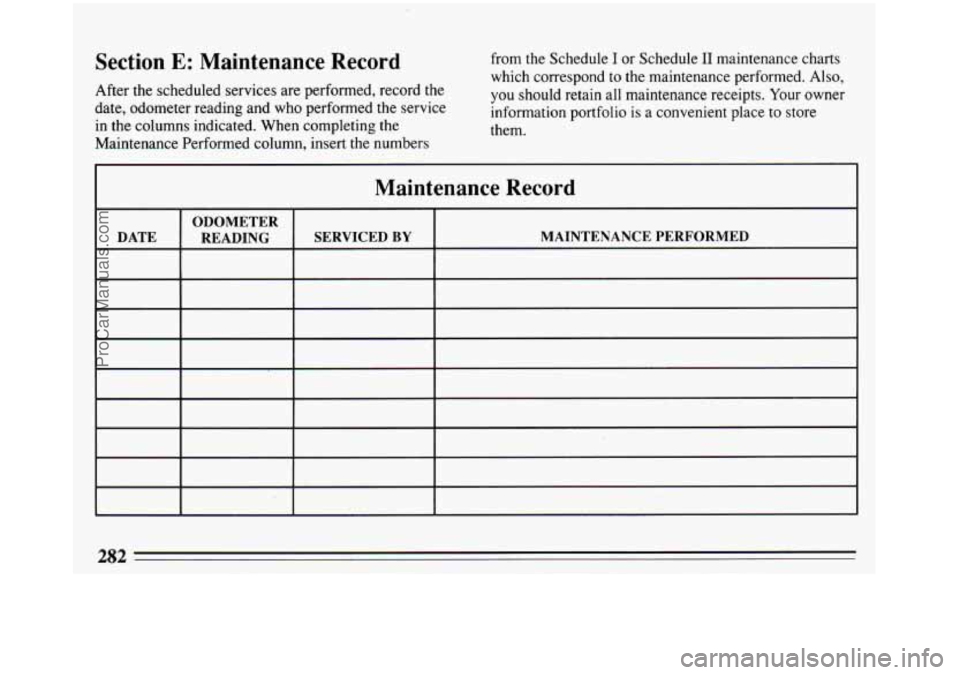
Section E: Maintenance Record
After the scheduled services are performed, record the
date, odometer reading and who performed the service
in the columns indicated. When completing the
Maintenance Performed column, insert the numbers from
the Schedule I or Schedule I1 maintenance charts
which correspond
to the maintenance performed. Also,
you should retain all maintenance receipts. Your owner
information portfolio is a convenient place to store
them.
Maintenance Record
282
ProCarManuals.com
Page 285 of 308
Maintenance Record
ODOMETER
DATE MAINTENANCE PERFORMED SERVICED
BY READING
- ~~ ~ ~
283
ProCarManuals.com